Extension of Städel Museum

The new extension to the Städel Museum complements the garden wing (designed by the architects von Hoven and Heberer) and the west wing annex (Peichl) to form a configuration of buildings enclosing the garden area. This area of green is, however, still accessible and can be enjoyed from both the Festival Hall and from the street.
The front garden zone along the road with its wealth of mature trees is punctuated by an opening which establishes a visual correlation both to the extension building as well as into the courtyard garden itself. Green ‘carpets of plants’ with birch and robinia alternate with the light-coloured gravel, and sculptures – as well as seating – ‘furnish’ the space.
The extension building is attached ‘head on’ to the main exhibition floor in the historical garden wing and forms a bridge-like, single-storeyed connecting volume. The principal corpus of the extension is a narrow, three-storeyed block lying parallel to the Academy of Fine Arts and the garden wing, docking onto the west wing at right angles. The volume of the new building largely maps out the route to be followed through the interior space.

Visitors access the new extension via the wide, existing main staircase and the garden wing. The ‘head’ of the new building is formed by the entrance area to the east, starting with a ‘distribution and orientation’ space which latches onto the garden wing. One of the possible tour routes leads from here up into the exhibition rooms on the second floor, via the west stairs to the art sections on the first floor and back to the ‘head’ again, to the Garden Room and the exhibition spaces on the ground floor. The Garden Room has been conceived as an art café; it is here that internal and external spaces, urban and garden areas interact, and it is here that the delights of art and coffee can be enjoyed.
The exhibition rooms are reserved in design: smoked oak parquet floors, smooth plastered and painted walls and ceilings with fluorescent lighting create a restrained background for the works of art. Crystaline, glazed oriel-style windows of varying depths serve as points of orientation for visitors moving from room to room, as well as relaxation zones. The exhibition rooms on the three floors in the main building corpus have been designed to be used in a variety of ways, especially with regard to the juxtaposition of individual pieces in the museum’s collection with groups of works loaned from private collections. This is facilitated by spanning the interior spaces of the building without columns and integrating ventilation ducts in the exterior walls. In addition, a lofty ceiling height creates generously proportioned spatial combinations.
The load-bearing structure of the extension building is of concrete. The façade cladding of rhythmically folded stainless steel sheeting protects the layers of insulation and mirrors the sky, the historic buildings and the trees countless times. The building corpus captures and plays with light, and establishes a presence through the multifaceted reflection of its surroundings while at the same time creating a sense of space and distance to existing museum buildings.

Location Frankfurt am Main, Germany

Programme Extension and integration into the spatial programme: exhibition space, lobby, library, bookshop, storage, technology, administration, workshops

Competition 2008, 2nd Prize ex aequo

Gross Floor Area 6‘662 m2

Competition Organzier Städelsches Kunstinstitut, Frankfurt am Main, Germany

Team GG Ivana Vukoja, Nicolai Rünzi, Karsten Buchholz

Landscape Architecture Vogt Landschaftsarchitekten, Zurich

Structural Engineer Dr. Lüchinger + Meyer Bauingenieure AG, Zurich

Building Services Engineer Waldhauser Haustechnik AG, Münchenstein

Lighting Consultant Lichtdesign Ingenieurgesellschaft mbH, Cologne, Germany

Congress House Davos

Location Davos, Switzerland

Programme New cogress hall, 6 small halls, lobby, offices, press, preparation rooms, technology, storage, outdoor facilities, parking spaces

Competition 2008, 2nd Prize

Gross Floor Area 5'500 m2

Competition Organzier Landschaft Davos Gemeinde

Team GG Nicolai Rünzi, Ivana Vukoja, Karsten Buchholz, Markus Seiler

Landscape Architecture Schweingruber Zulauf Landschaftsarchitekten, Zurich

Structural Engineer DIAG Davoser Ingenieure AG, Davos Platz
Aerni + Aerni Bauingenieure, Zurich

Building Services Engineer Waldhauser Haustechnik AG, Münchenstein

Building Physics Engineer BAKUS Bauphysik & Akustik GmbH, Zurich

Residential District Blaricummermeent, Area B

Location Blaricum, The Netherlands

Programme 9 single-family houses, 4 single-family houses as live/work combination, 6 semi-detached houses, 6 residential studios, 3 multi-family houses

Competition 2008, 2nd Prize

Competition Organzier Town of Blaricum

Team GG Kim Sneyders, Daniela Bergmann, Daniela Schadegg, Andréanne Pochon

Contact architects Onix bv, Groningen, The Netherlands
ANA architecten, Amsterdam, The Netherlands
DAAD architecten bv, Beilen, The Netherlands

Landscape Architecture Karres en Brands landschapsarchitecten bv, Hilversum, The Netherlands

Extension of Kunsthaus Zürich

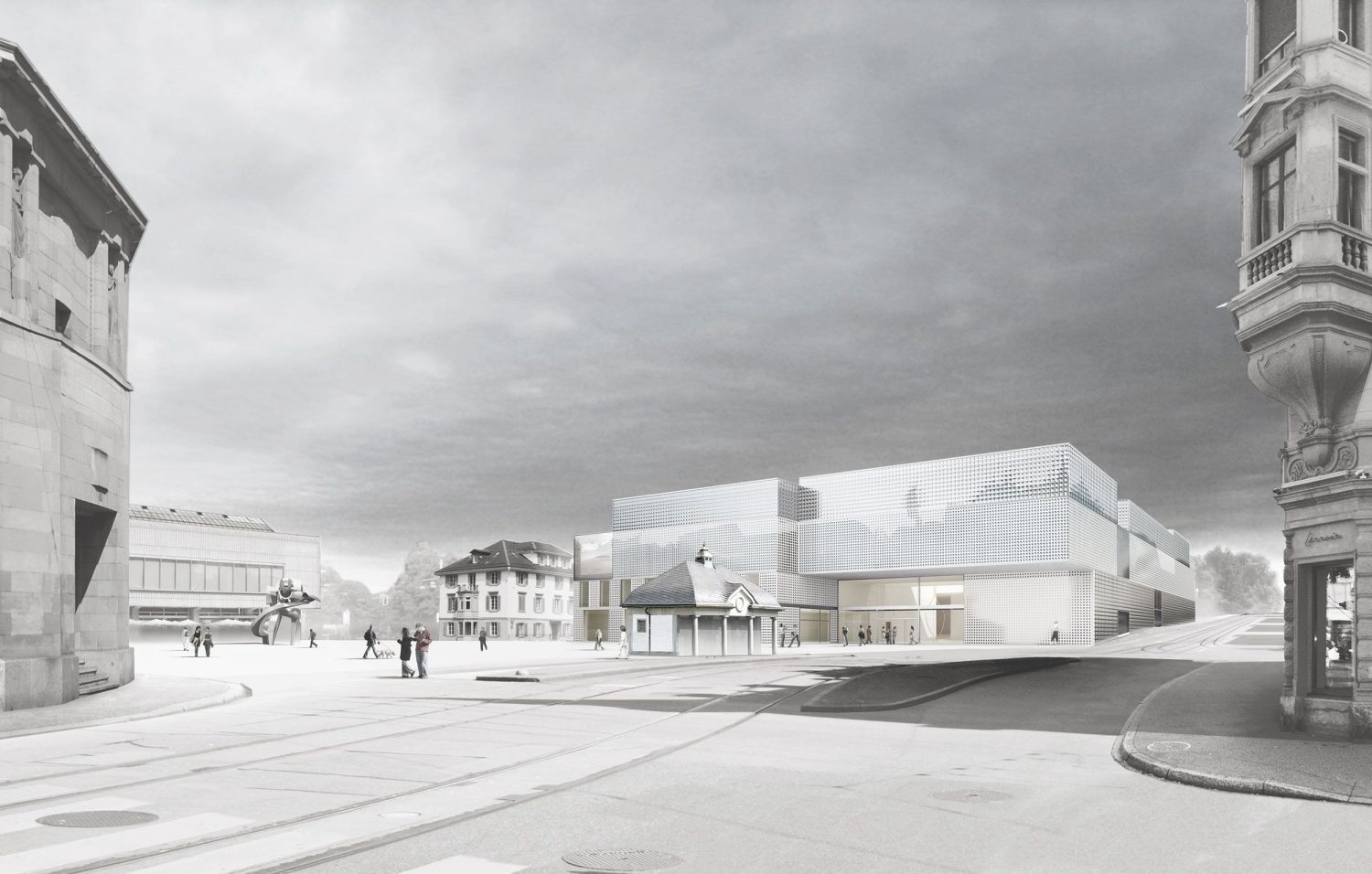
The competition design for the extension to Kunsthaus Zürich envisages, in a sense, a mirroring of the existing building. The new extension constitutes a companion piece to the older building, both spatially and in terms of its utilization. Taking this premise as the point of departure, Heimplatz square is transformed by means of continuous paving into an urban ‘stone carpet’ linking the two museum buildings across the street that separates them. The new building opens up to Heimplatz with a projecting volume and a cutout portion facing the square, as a generous, welcoming gesture.

Like the institutional architecture along Rämistrasse, the new museum building boasts a substantial footprint, yet it also references the small scale of the buildings immediately adjacent to it through the configuration of the roof structures.

Inside the extension, a system of ‘squares and pathways’ leads visitors to the open-access facilities and through to the garden at the back, as well as into the exhibition spaces. these ‘passageway spaces’ form generously proportioned, light-filled circulation areas that provide orientation and offer vistas to the exterior, while also displaying artworks. They offer information, set the mood, and give visitors an opportunity to linger and relax.

In contrast, the main exhibition spaces are restrained, concentrated, rectangular rooms with light-diffusing glass ceilings. A range of different light solutions allows carefully controlled levels of daylight to enter the exhibition spaces, creating a lively atmosphere with natural light. To achieve this, daylight is focused into the building laterally through skylight superstructures set atop the building. Conversely, this has the striking effect of making the building glow with its own luminosity when the interior is brightly lit during evening events and residual light filters through to the exterior. The height of these skylight structures varies as a function of the depth of the exhibition spaces and the number of glazed faces on each skylight unit. This rule generates a roof landscape with an engaging relief effect.

The load-bearing structure is primarily in concrete, with steel deployed in the skylight areas. The façade is conceived as a translucent and ‘light-bearing’ wall. It is composed of windows and concrete elements with glass bricks in a range of sizes. Some are more transparent or translucent, others less so, to reflect the distinct requirements of the particular parts of the building. Rear-ventilated elements made up of large-format etched glass bricks protect the lateral glazing in the roof-light units and their louvers. Where the glass bricks are set in front of the insulated load-bearing walls, they form ‘peepholes’ affording occasional blurred glimpses of the wall construction. Glass as a construction material thus appears in a wide range of different manifestations: as matt or reflecting glass, as panes, ‘bricks,’ or solar elements; it may appear pixelated, ‘pointillist,’ or as a smooth expanse of glazing. Glass gives the building its characteristic appearance and conveys a sense that this is a museum building, an architectural genre whose primary function lies in harnessing light to enable the visual perception of artworks.

Location Zurich, Switzerland

Programme Gallery extension

Competition 2008, 2nd Prize

Gross Floor Area 12'750 m2

Competition Organzier Zürcher Kunstgesellschaft, Stiftung Zürcher Kunsthaus, City of Zurich

Team GG Ivana Vukoja, Nicolai Rünzi, Christian Maggioni, Damien Andenmatten, Karsten Buchholz

Landscape Architecture Schweingruber Zulauf Landschaftsarchitekten, Zurich

Structural Engineer Dr. Schwartz Consulting AG, Zug

Building Services Engineer Waldhauser Haustechnik AG, Münchenstein

Building Physics Engineer BAKUS Bauphysik & Akustik GmbH, Zurich

Daylighting Consultant Arup Lighting, London, United Kingdom

Lighting Consultant Lichtdesign Ingenieurgesellschaft mbH, Cologne, Germany

Traffic Engineer Enz & Partner GmbH, Zurich


Areal Letzibach, Area C

Location Zurich, Switzerland

Programme Residential, office, university and public uses

Competition 2008

Gross Floor Area 40'757 m2

Competition Organzier Schweizerische Bundesbahnen SBB

Team GG Nicolai Rünzi, Kim Snyders, Karsten Buchholz, Martin Schiess, Luisa Wittgen

Site Management Ghisleni Partner AG, Rapperswil

Landscape Architecture Balliana Schubert Landschaftsarchitekten, Zurich

Structural Engineer Dr. Lüchinger + Meyer Bauingenieure AG, Zurich

Electrical Engineer IBG Graf AG, St. Gallen

Building Services Engineer Waldhauser Haustechnik AG, Münchenstein

Plumbing GRP Ingenieure Fachplaner für Sanitär- und Sprinkleranlagen, Lucerne

Traffic Engineer Enz & Partner GmbH, Zurich

Colours Adrian Schiess, Mouans-Sartoux, France

Munch Museum and Stenersen Museum Collections

The construction of a new Munch/Stenersen Museum in Oslo is part of the urban development plan for the former Paulsenkaia harbor site, which is to be given a boost by the appeal of the museum and the nearby Opera. On the reclaimed land of the harbor area adjacent to the new opera, a boulevard is envisioned, lined with buildings housing shops, cafes, and restaurants on the ground floor with offices and apartments above. Some harbor areas will be renaturalized, and steps to sit on along the banks of the Akersleva River are an invitation to linger by the water’s edge. A wide, slightly sloping causeway will lead from the Opera up to the museum and reach further out over the water as a pier.

The Munch/Stenersen Museum is to rise like a “floating peninsula” between the Bjørvika and Bispevika fjords, hovering on piles above the water. Visitors enter the museum through a spacious foyer with adjoining restaurant, museum shop, and conference rooms and then continue on through a security passage, which is of central importance to the museum after the theft of the famous painting The Scream. An imposing staircase lit by a skylight above winds up to the exhibition level.

The six large exhibition halls can be accessed separately via a generous connecting space that not only provides an open area for introductions to guided tours and educational presentations, but also serves as an informal zone where guests can relax and enjoy views of the sea and the city in all directions through large picture windows.

The variously sized exhibition halls by contrast are places for quiet, concentrated art viewing. They offer the desired flexibility - able to be subdivided into smaller units or their ceiling height adapted as needed - as well as the explicitly requested illumination with artificial light.

The museum is set on concrete piles driven into the sea bed, which are visible and become part of the museum design due to the raised position of the platform several meters above sea level. The building hence fulfills the desired functions as a “beacon,” while also alluding to the structural form of an oil platform or a majestic villa atop pilotis. Brownish-red concrete is used throughout as construction material, from the concrete piles to the central hall on the exhibition level.

Location Oslo, Norway

Programme Museum, public and commercial activities, apartments and offices

Competition 2009

Gross Floor Area 60’852 m2

Competition Organzier HAV Eiendom AS, Oslo, Norway

Team GG Nicolai Rünzi, Luisa Wittgen, Damien Andenmatten, Karsten Buchholz, Martin Schiess, Thomas Möckel

Landscape Architecture Schweingruber Zulauf Landschaftsarchitekten, Zurich

Structural Engineer Dr. Schwartz Consulting AG, Zug

Building Services Engineer Waldhauser Haustechnik AG, Münchenstein

Extension of Kunstmuseum Basel

Thanks to the donation of a property across from the existing Kunstmuseum, an opportunity arose for a further significant extension to the main building. The dimensions of the competition project respond to the proportions of the historic building by Paul Bonatz and Rudolf Christ, as well as to the scale of the neighboring buildings along Dufourstrasse. With its skylight superstructures and nuanced sculptural relief, the building volume also enters into a dialogue with the smaller-scale historical architecture of the St. Alban district. The structure of the façade and the materials selected facilitate integration of the voluminous extension into the urban fabric, without however foregoing the aspiration of making the new museum building a key player in the cityscape.

Direct access from Dufourstrasse is available for special events. However, the principal link to and access from the existing art museum is underground. In the historic building a cascading stair leads down to the wide connecting hallway, where already visitors can enjoy artwork on view. All the levels in the extension are linked via a broad two-flight stairway. The foyer and the delivery area for artworks are set on the ground floor. The collection is housed in rooms on the first floor and the lower level, while the second story accommodates temporary exhibitions.

The arrangement of the floor plan is based on rectangular exhibition rooms. The complex spaces set between them - including the foyer and the linking hallway - offer circulation routes as well as setting the tone and providing areas for art education activities. They punctuate the tour with vistas to the outdoors and also give visitors a chance to pause between rooms. On each floor there are several circuits through the exhibition rooms, which are sequenced by the interposed circulation spaces.

The exhibition rooms on the second floor enjoy natural light from above via a light-diffusing glass ceiling. The skylight superstructure above this captures the daylight through a glass roof equipped with etched panels and shaderoviding photovoltaic units arranged in a grid. On the first floor the rooms that house the collection are illuminated via a lateral skylight. The foyer faces onto the surroundings with large windows.

The building is constructed of concrete and steel components. The load-bearing concept is based on a cross-wall structure with the interaction of walls and ceilings. The surfaces in the intermediate zones and stairways, as well as the façades, are executed in beige limestone concrete. The façades are composed of different cast concrete ‘framing elements,’ set one above another, some flush with the surface and some recessed.

Location Basel, Switzerland

Programme Museum

Competition 2009

Gross Floor Area 11‘460 m2

Competition Organzier Canton Basel City

Team GG Bettina Gerhold, Katharina Löble, Thomas Möckel, Hauke Jungjohann, Arend Kölsch, Rus Maria Carnicero Moreno

Site Management Ghisleni Partner AG, Rapperswil

Structural Engineer Conzett Bronzini Partner AG, Chur

Electrical Engineer Eplan AG, Basel

Building Services Engineer Ernst Basler + Partner AG, Zurich

Building Physics Engineer BAKUS Bauphysik & Akustik GmbH, Zurich

Fire Safety Makiol Wiederkehr AG, Beinwil am See

Lighting Consultant Institut für Tageslichttechnik Stuttgart, Germany

Facade Ernst Basler + Partner, Zurich

Traffic Engineer Ernst Basler + Partner, Zurich

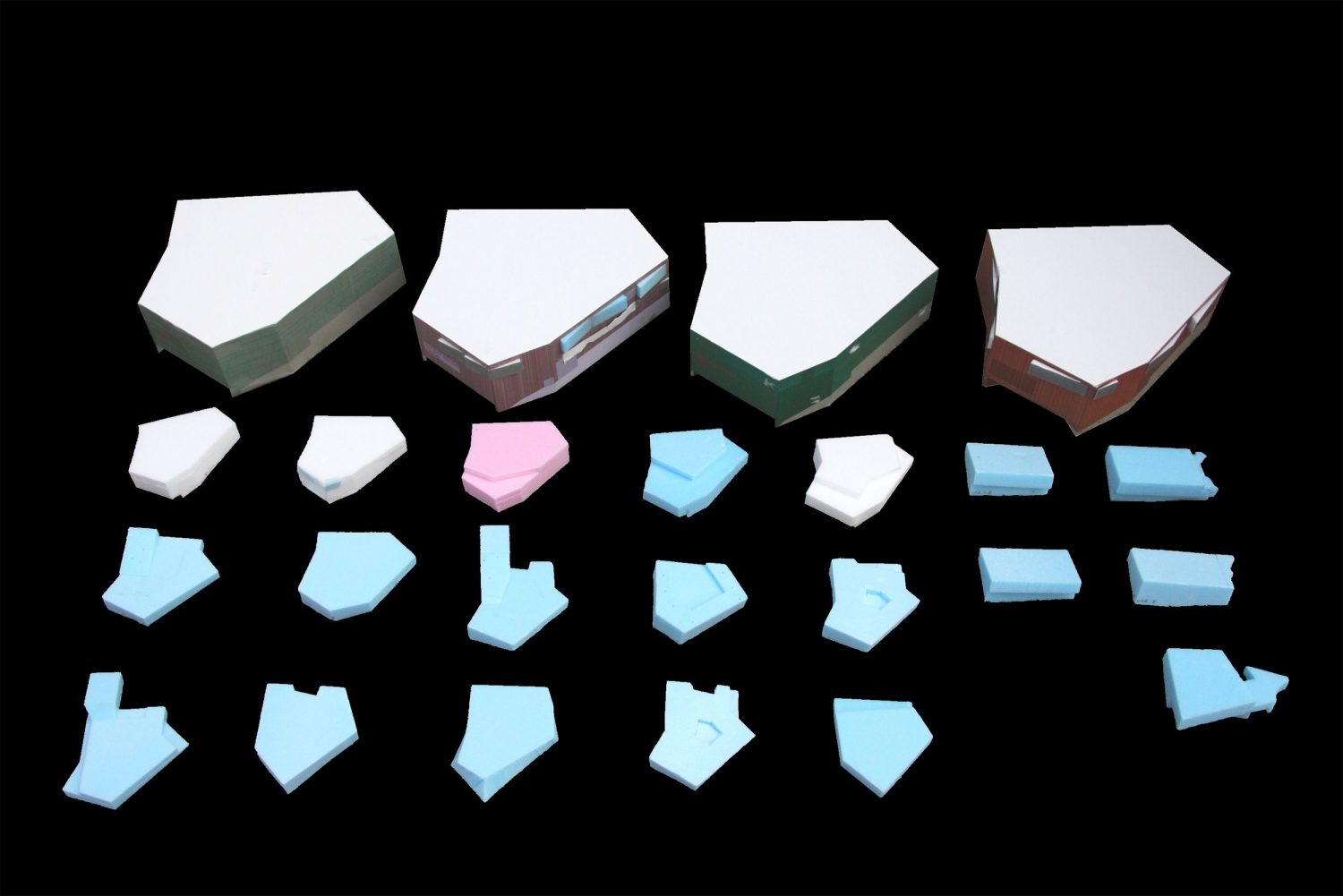
Cultural Center Les Arts

Gstaad has hosted the ‘Menuhin Festival’ and ‘Sommets Musicaux’ for decades. Reflecting the great international prestige of these festivals, future musical events are to be held in a new cultural center with a spacious concert hall, centrally located next to the station. This center will also house exhibition spaces and a restaurant.

The architectural and urban planning concept underpinning the design is inspired by the notion of a building that is imbued with a sense of the celebratory, yet at the same time is part of everyday life. The center’s architecture features cosmopolitan touches, while remaining rooted in the local context and regional traditions. The large building on a sloping site responds to the square in front of the train station and the adjacent smaller built structures by means of a moderately proportioned wing that extends over the tracks in an open, welcoming gesture.

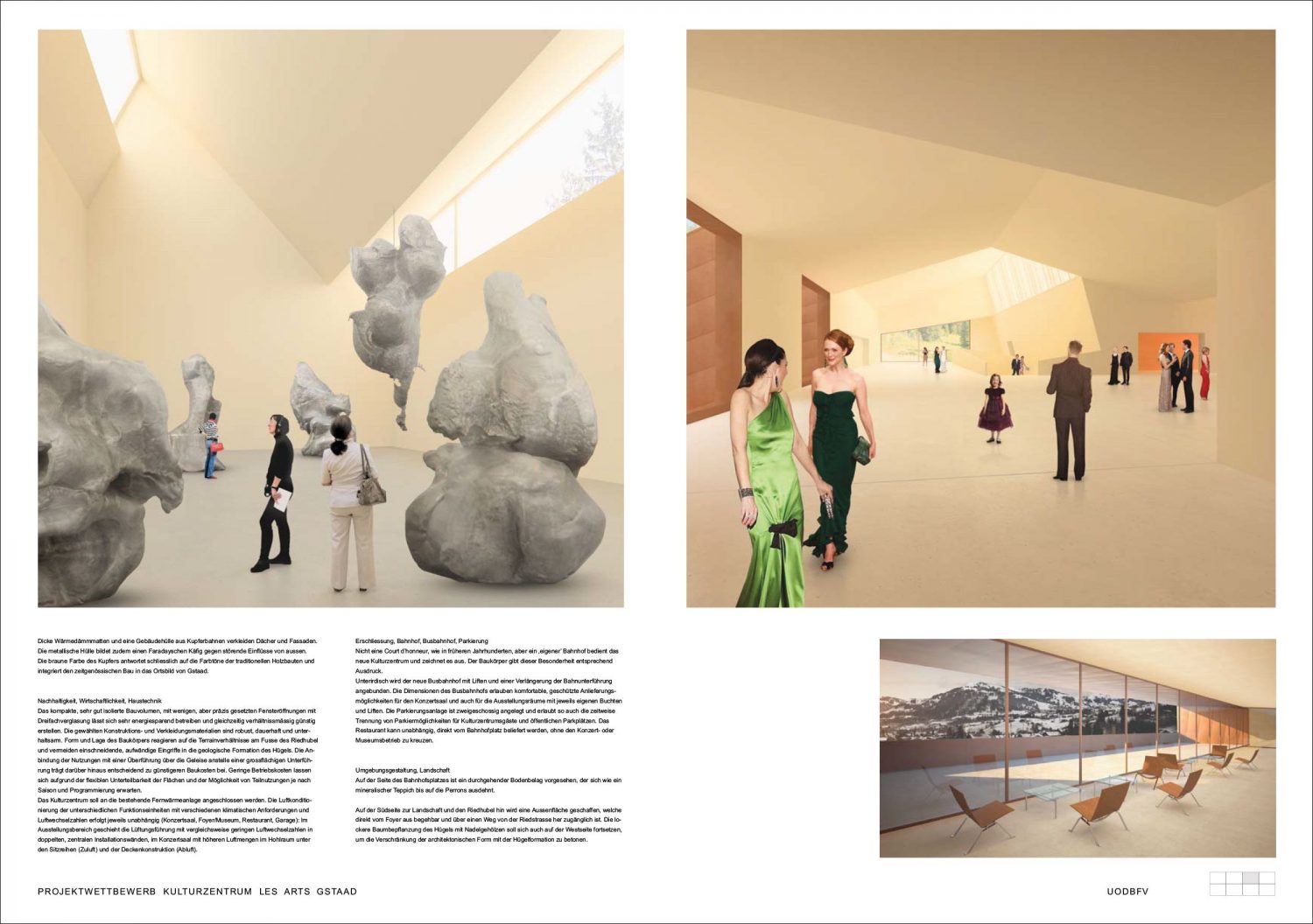
The roof, incorporating a variety of angles and different shapes, structures the building rhythmically and strikes a balance between expressive and traditional roof pitches. Above the exhibition space and the foyer, skylights are created by folds and bends in the roof. These convolutions settle into a more tranquil configuration over the concert hall and project outward to provide cover over the platforms and the smaller entrance volume on Bahnhofsplatz. Here, a wide stairway by the entrance provides access to the restaurant on the upper floor, which offers a view over the square. From this area the generously proportioned foyer leads into the concert hall and the exhibition spaces. Mineral materials were selected for the surfaces of the foyer and the museum area in the eastern part of the building. The rooms here have varied proportions and receive natural light via high shed roof elements or side windows. A circular path through the building leads down from the upper floor and back up again.

The design for the concert hall is based on a cuboid form. The finely modeled contours of its wooden paneling create a dense mesh of reflecting surfaces, producing rich, well-balanced acoustics. The visual impression in the concert hall is of a bright, warm, wooden space. Metallic particles - gold brass, nickel silver, and copper - shimmer in the pores of the wood, for the concert hall is interpreted as a massive spatial ‘instrument’: a space that captures and reflects sounds and therefore ‘shines forth’ in the materiality of wooden and metal musical instruments.

Two independent structures are utilized in the concert hall to ensure acoustic decoupling. The load-bearing structure is executed with concrete and steel girders, essential for the large spans and the varying configurations of the roof above the center’s various spaces. The shell of the building, which is composed of copper sheets, functions as cladding for the roofs and façades, while at the same time forming a Faraday cage to protect against electromagnetic interference from the nearby railway. In addition, the copper’s brown hue echoes the color palette of the traditional wooden buildings and integrates the contemporary structure into Gstaad’s townscape.

Location Gstaad, Switzerland

Programme Cultural Center

Competition 2010, 3rd Prize

Gross Floor Area 16‘100 m2

Competition Organzier Verein Les Arts Gstaad

Team GG Bettina Gerhold, Katharina Löble, Thomas Möckel, Roger Sidler

Landscape Architecture Schweingruber Zulauf Landschaftsarchitekten, Zurich

Structural Engineer Dr. Lüchinger + Meyer Bauingenieure AG, Zurich

Building Services Engineer Ernst Basler + Partner AG, Zurich

Building Physics Engineer Applied Acoustic GmbH, Gelterkinden

Fire Safety Makiol Wiederkehr AG, Beinwil am See

Traffic Engineer Ernst Basler + Partner AG, Zurich

Musée National des Beaux-Arts du Québec

Location Québec, Canada

Programme Extension of Musée National des Beaux-Arts du Québec

Competition 2009

Competition Organzier Musée National des Beaux-Arts du Québec

Team GG Daniel Friedmann, Luisa Wittgen, Thomas Möckel, Vanessa Tardy

Research Building GLC with Laboratories and Offices, ETH Zurich

Location Zurich, Switzerland

Programme Laboratory and office building «Departement Health Science and Technology» ETH Zurich

Competition 2010

Gross Floor Area 5'500 m2

Competition Organzier ETH Zürich Real Estate Management

Team GG Luisa Wittgen, Thomas Möckel, Armin Baumann, Arend Kölsch

Landscape Architecture Schweingruber Zulauf Landschaftsarchitekten, Zurich

Structural Engineer Dr. Schwartz Consulting AG, Zug

Building Services Engineer Waldhauser Haustechnik AG, Münchenstein

Fire Safety Makiol Wiederkehr AG, Beinwil am See