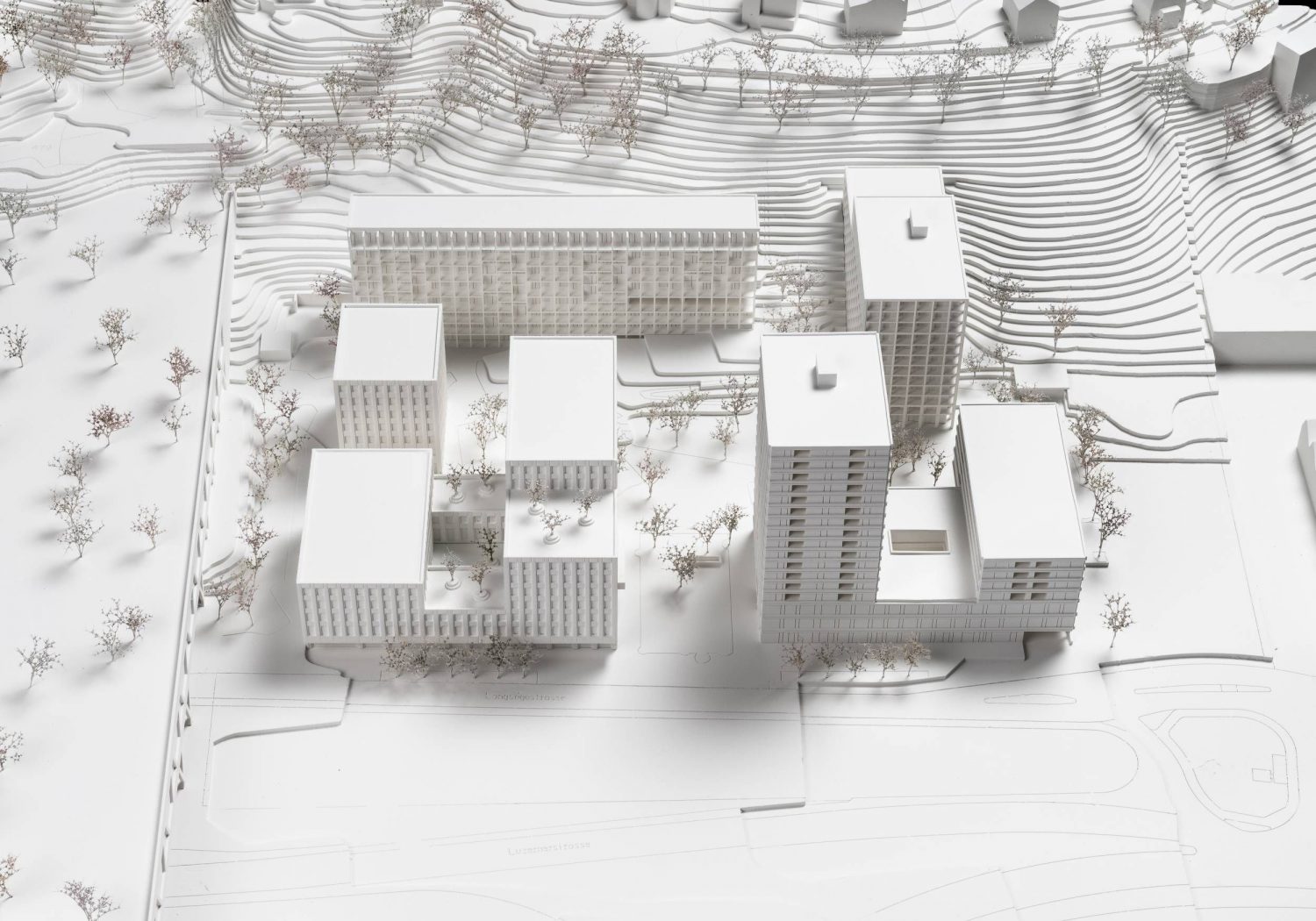
Next to the site of the Eichhof brewery, in proximity to the municipality of Lucerne, a development with five office, commercial and residential blocks arranged around a central open space is emerging. The plot is accessed from Langsägestrasse in the south, to the north it is bordered by a sloping green space. Part of this development are the two new buildings for the Social Insurance Centre WAS (Wirtschaft Arbeit Soziales) Lucerne, which will provide its services at this central location.
A stepped ten-storey administrative building is complemented by a free-standing seven-storey building in the north. The ensemble is composed of massive sculptural volumes. From up close, the light-coloured, rendered facades with regular window openings and pilaster strips convey a nuanced sense of scale with pronounced chiaroscuro. A cantilevered portion along the entire building length on Langsägestrasse shelters the employees’ entrances and the driveway to the underground parking. Toward the north, facing the central open space, an 18-metre overhang covers recreation areas with outdoor seating and further entrances. Integrated into the stepped building volume, a patio on the second floor and terraces on the fourth and eighth floor offer green resting places.
The new building is conceived as an urban block with clear, structurally ordered floor plans, which provide easy orientation for the employees and customers of the four operational divisions. The main entrance from the eastern forecourt leads into a generous vestibule with reception, waiting and consulting zones. The adjacent central foyer is naturally illuminated by four round roof lights and is visually connected by a gallery to the conference rooms on the first floor. The seminar rooms in the south can be separated with mobile partitions, or they can be opened towards the foyer for major events. Three interior cores access the upper storeys, which offer column-free structural spans of seven metres. The office spaces are varied in terms of space and orientation, allowing for multiple usage scenarios and flexible adaptation.
Both buildings are devised as massive constructions with solid masonry facades. Placed outside the inner load-bearing brick wall is an external layer of insulating bricks. The wood and metal windows are mounted above a low parapet and flush with the inside wall face. They have large, fixed glazed elements flanked by opaque ventilation flaps. Added outer sun shading is not necessary due to the low glazing proportion and the deep reveals. On the inside, curtains provide glare protection and function as sound absorbers.
The administrative buildings (main building 3rd to 9th storey and entire northern building) follow the concept “Vision 2226” with no heating, no cooling and no mechanical ventilation. The system is based on the thermal storage capacity and phase shift of heat absorption and release of building elements. The constructive conditions for this concept are met by the well-adjusted building envelope of 75–85 cm thick solid masonry, the low glazing proportion of 18 % and the ideal room layout with ceiling heights of three metres. Ventilation and climatisation are ensured by automated ventilation flaps next to the windows, which are regulated by a site-specific algorithm within the building control system. Low-tech hardware is operated efficiently by high-tech software. For power self-supply, a photovoltaic plant is installed on the roofs.