


The building tracts of the stone sculptor and mason’s school are situated on the flat part of the site such that they divide the parcel into an entrance area towards the driveway and into a service court towards the south. The steep portion of the parcel remains untouched.
The geological characteristics of the site and the necessity of pile foundations generate the skeleton construction technique for the building structure. The load-bearing construction consists of solid masonry columns or brick masonry infill, respectively. Thanks to the additional air cells of the brick masonry and the corresponding solidity of the columns, both the columns and the masonry infills reach the specified insulation value without requiring any additional insulation material. The ceilings of the school tract are made of pre-fabricated clay-hulled beam elements.
On the interior, the brick columns are finely stuccoed or limewashed. The flooring of the school tract is made with red clay or ceramic tiles, respectively. Thus, they are also made of fired material, though left untreated in contrast to the masonry. The masonry is stuccoed on the outside.
The architecture as well as the choice of materials for the stone sculptor and mason's school are consciously kept straightforward. The actual "richness" of the building will be formed by the works of the sculptor and stone mason apprentices. Student work should not just be displayed in the workyard or decorate a wall from time to time. Rather, it should become an integral part of the architecture of the school. Every year one or two "window openings" could be clad with stone jambs made by the students. The jambs would be fabricated from various types of stone. Their surfaces would be bush hammered, droved or abraded, and have text or be in half-relief. The architecture determines here only the size of the masonry opening and a maximum stone thickness with regard to the size of the finished window opening. The stonework should be mounted by the students themselves.
The windowsills made of weather-resistant, impregnated Bakelite plywood are consequently just temporary. They fulfill their purpose until the moment when they are replaced, piece by piece and year by year, by stone jambs and sills from the "production" of the trade school.
With regard to the use of stone jambs and stuccoed masonry, the stone sculptor and mason's school makes reference to the classical schoolhouse architecture of the region. The skeleton construction and the formation of the sawtooth skylights refer, in addition, to the industrial character of the school.


The historical building from the architects Rittmeyer & Furrer from 1914 houses the three institutions of library, natural science collection and art museum. After a temporary addition for museum functions could be constructed with private means, an expansion for library usage is to take place, as well.
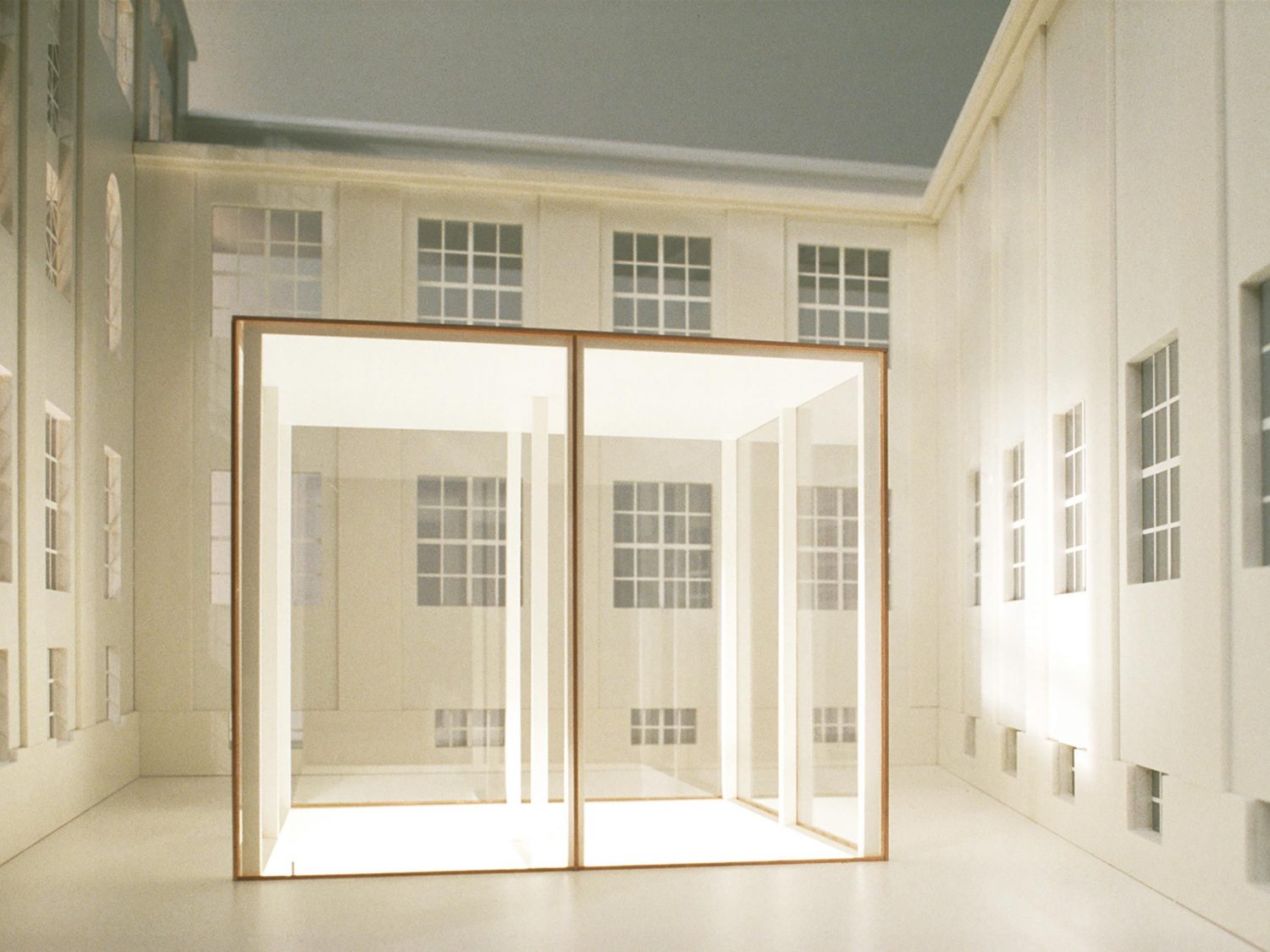
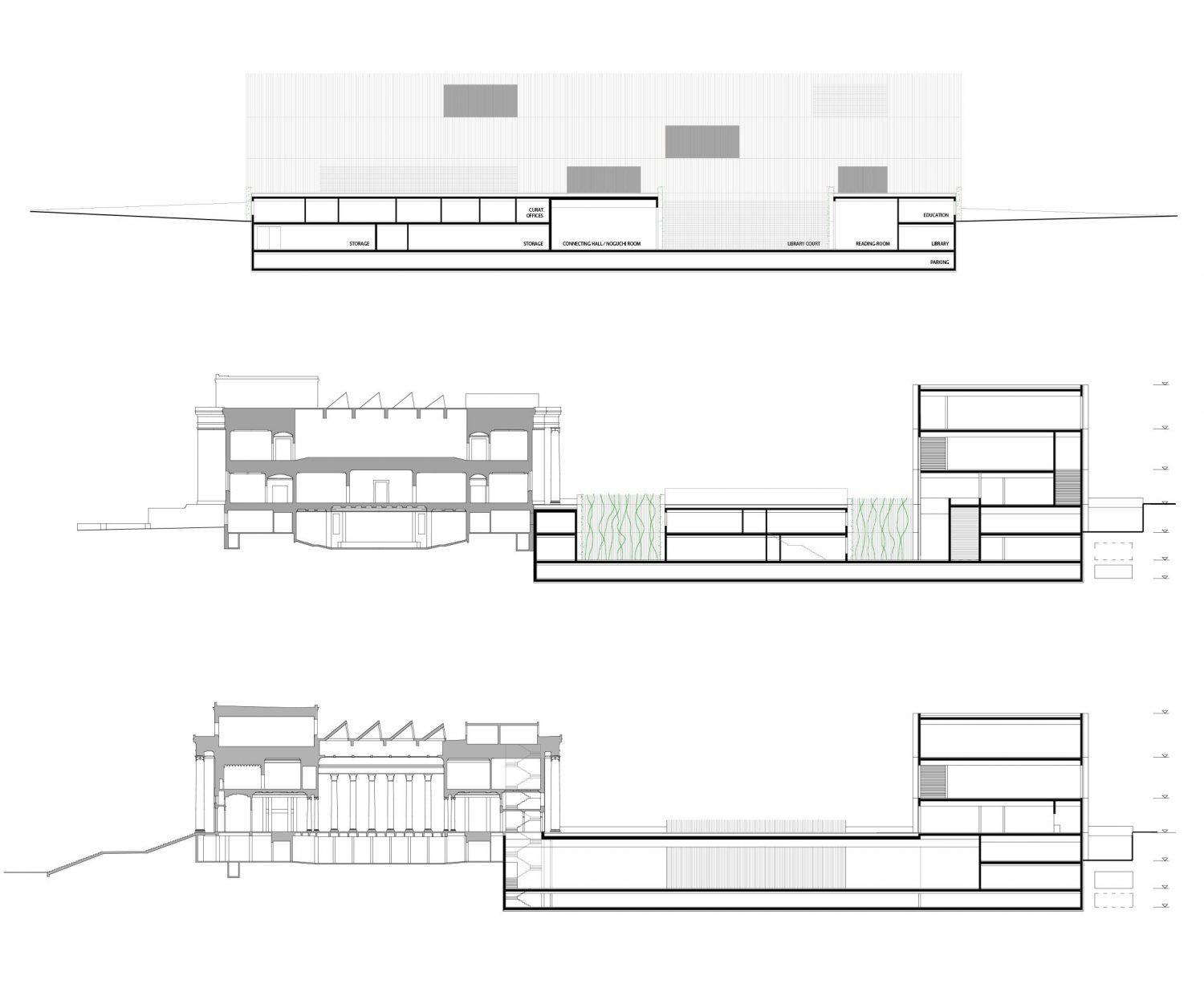
The project attempts to change as little as possible the historical building in its external appearance as well as in its interior. Thus, the façades are not affected and the existing exterior court, which serves to provide light and air, will not be transformed into an air-conditioned interior space. The main part of the library expansion—the new lending room, the new reading room and the study library—are found on those parts of the parcel not covered by the existing building.
The addition, which must make do with three leftover areas around and in the existing building, finds its own identity and ordering principle by virtue of the way in which it presents itself outwardly as an underground building with skylight volumes. With these elements, the new building is able to enter not just into a usage-based relationship, but more so into a precise architectonic relationship with the historical building. The composition of the intersecting, longitudinal stone volumes of the Rittmeyer & Furrer building is expanded and complemented by the translucent, glass skylight volumes of the new building.
During the day, the skylight volumes appear as large, white-glowing, glass volumes, while appearing as powerful, glowing lanterns at night.
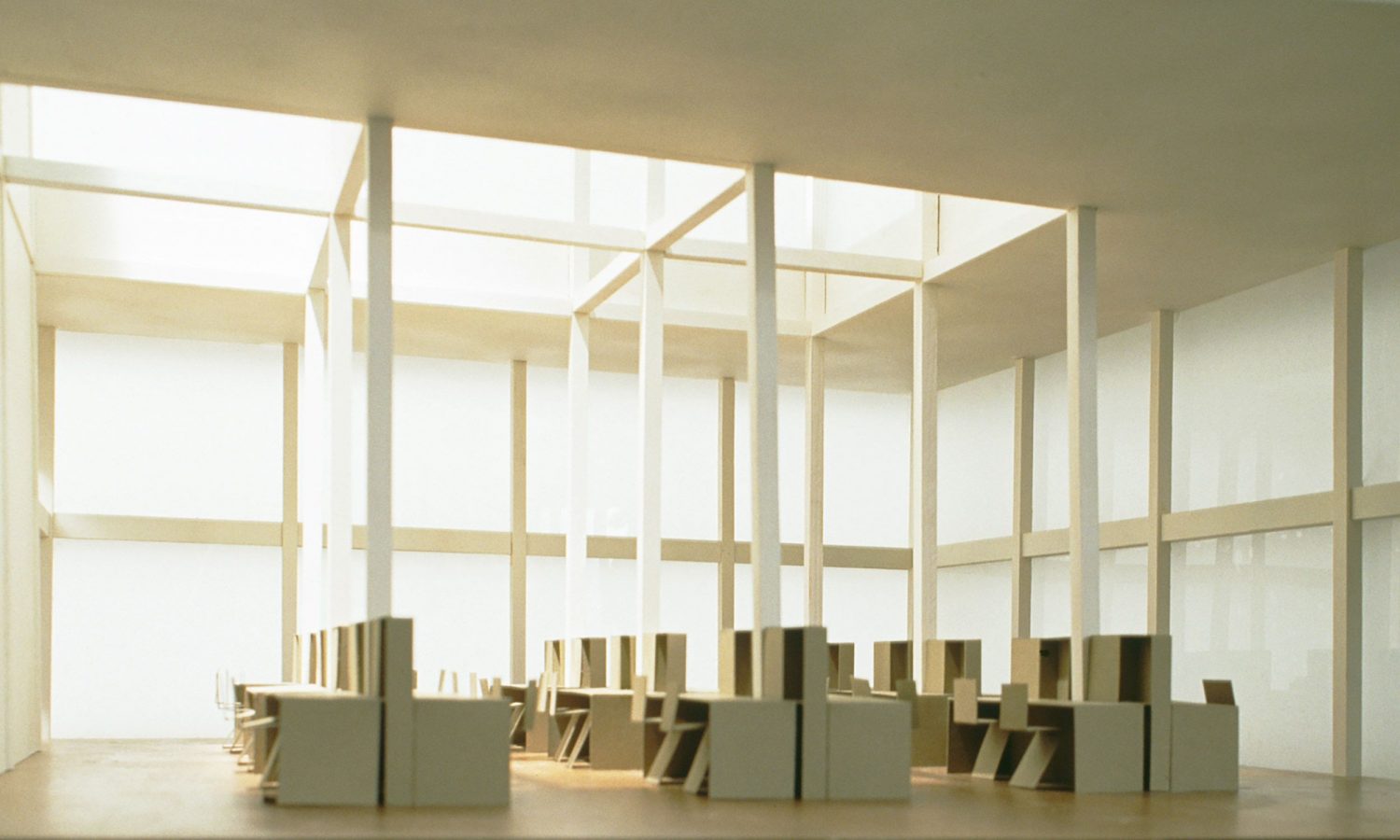
The skylight volumes are developed out of the column/level structure of the sunken building volumes and grow towards the light as pure skeleton structures. In the interior of the building, they form those rooms that are foreseen for intense, individual work and for the public: the reading and periodicals room, the study rooms and the lending and entrance area in the courtyard.
The project follows the ideal type of a library space: large, extra-high rooms with skylights, in which people spend time in the anonymous collective, while yet alone in singular concentration upon the object of their study. The structure of the load-bearing construction forms a delicate space division for the virtual separation of the visitors.
Attention is called to the three institutions by means of a large-format sign made with metal letters that is placed as a powerful piece of inlay work into the flooring of the forecourt and into the roofing surface of the new building, respectively. The large, inlaid typography, over which one walks and upon which one stands, refers through and beyond its signage function to the "deeper meaning" of the ground under the visitor's feet.
The common entrance to the three institutions through the portico is left unchanged, allowing the wonderful staircase from Rittmeyer & Furrer to be left almost entirely intact. A new staircase descending to the new main floor of the library supplements the existing main staircase that connects the three institutions today.


The layout of the new building complex and its relationship to the existing villa was specifically derived from the existing landscape architecture: an interplay of the formal “French” garden, which is located immediately next to the mansion and forms the middle of the complex, so to speak, and an “English” garden area that forms the transition to the open landscape.
Respecting the harmony between the villa and the geometric garden, the new volumes are freely placed in the “English” part of the park by volumetrically mirroring the designed garden-topography of the gardens, as it were.
The main building volume with the forum and conference rooms is set upon the artificial hill, providing an open view into the park and out beyond the treetops to the lake. The tract of guestrooms is oriented as a single-loaded structure towards the south and the landscape.
The space between the forum and the tract of guestrooms forms the entrance hall. From here one proceeds to a wide stairway along the tract of rooms down to the "French" garden, and continues from there along the garden wall to the dining rooms and meeting rooms of the villa.
One characteristic of the insurance business, redundancy, is reflected in the constructive scheme of the building. The construction of the heated spaces consists of two concrete, self-supporting walls with an insulated cavity in between. The unheated spaces are built with only one wall layer. Steel columns permit relatively large openings. They can be understood as a kind of "solid steel reinforcement" lay bare. Furthermore—like sunglasses—exterior, lightly-tinted, single-glazed sliding windows to the south, west and east form the primary sun shading in front of the interior, insulated sliding windows with clear glass. In the window cavity there is space for the additional, controllable sun and glare protection. Here the sandwich-window principle helps to protect the sun shading system from the wind.
The colored tint of the outer sun-shade glazing generates a slight coloration of the interior spaces. The various colors of the glazing produce a delicate polychromatic effect with the light in the entrance hall.


The project searches for a built synthesis between the past—the church destroyed in the war, the existing—the small chapel, and the future—the Diocesan Museum. The St. Kolumba church ruin is to be “built upon” and the “Maria in den Trümmern” Chapel from Gottfried Böhm is to be integrated within a new, larger building volume. Largely following the wall planes of the last church, the museum building will restore the volumetry of the St. Kolumba Church in a newly interpreted form. This way of thinking adopts the centuries-old tradition of changing, complementing and enlarging the church buildings “from within”, while retaining the location, the consecrated place.
While the ruin is stabilized and protected, it remains nonetheless recognizable. Analogous to the preservative nature of completing the window openings with masonry, the remains of the church façades will be built up to protect the open wall parapets threatened by erosion and the open historical excavation site.
The uppermost museum level, which almost completely covers the ruin, allows a space to be created over the site—an "interior" exterior space. It is a space whose walls and roof are full of holes—like its floor.
The museum building can thus become a protective roof and a protective envelope for the remains of the destroyed church, while housing, preserving and protecting ecclesiastical objects of art on the inside, anew. The museum becomes a connecting link between objects of art and a consecrated place—as housing for one and a "shield" for the other.
The small chapel is tied into the new volume as an autonomous building—like a stone in its setting. The museum opens up with a great court over the chapel, so that its main part, the octagon, stands under the open sky.
The museum is constructed primarily with two materials: concrete to bear the loads and black bricks to clad, enclose and protect. The primary structural elements in concrete—the space-defining pillars paired with structural wall slabs—densify in the uppermost floor into a spatial lattice of wall slabs, floors and ceilings.
The new supplementary masonry on the perimeter church walls and the skylight roof level, which is porous and unheated as well, consist of dark bricks laid offset to produce open gaps. This same brick, laid without gaps, however, forms the outer layer of the structural concrete walls, as well. The layers of masonry on the façades, with their varying degrees of porosity, allude to the closed, interior spaces lying behind them or the open outdoor spaces—reminding one with this attribute of the perforated construction of Cologne's Dome.
The museum spaces possess a skylight, a sidelight, or both, at times. The walls are made of unfinished concrete or can be painted—white, in color or with a gold tone like one of the works of art—the wall painting of Jannis Kounellis.


The project is to be an architectonic “tailored suit” for the task of building a service center for the Ernsting’s Family textile trading company in the industrial zone of the small town of Coesfeld. The site in the Coesfeld-Lette commercial zone, neighboring the distribution and delivery building and a concrete factory, suggests an architecture that exhibits a kinship with commercial buildings with respect to volumetry, as well as the choice of materials and construction.
The new building is placed close to the street in order to form a tension-filled configuration with the adjacent neighboring building and to leave as much space as possible for future expansion, in addition. As a result, the building is developed upwardly instead of downwardly. The initial, simple primary form of the volume is heightened to a complex figure through the addition of various volumes. The entrance hall, the canteen, the conference room as well as the tentacle-like footbridge are placed about the primary form.
The parcel that remains free to the south is the connecting link to the adjacent small-scale development with single-family houses. The area is to be divided into pattern-like green areas and surfaced areas. Poured, large-sized, concrete slabs with expansion joints form the paving for the outdoor terrace, the driveway and the parking spaces. The green areas are further subdivided either into elongated fields that are planted with trees whose dense foliage acts like a hedge, into areas whose fruit trees imply a grove, or into smaller areas of grass. They invite the employees to spend their lunch break outside during the warmer months and harvest the fruit of the trees.
The project not only includes conventional offices for administrative work, but also spaces for working with fabrics and clothing, reminding one of ateliers with respect to the room height and lighting conditions. The four-story reception space represents the spatial connecting element between the offices and the textile workshop spaces. In addition, it forms a place for small events and exhibitions.
The architecture of the building, which is understood as the service center for the 700 small Ernsting's Family Stores, makes reference to the visual identity of the company.
The characteristic colors and forms of the firm's corporate identity become architectonic components. They form the "fabric" from which the architecture is "tailored": red, white and black on the one hand, and a metal façade to carry the colors on the other—analogous to the delivery trucks that swarm out of Coesfeld each and every day.


The concept that informs both proposed solutions is based upon a new building to the north that connects with the existing historical building volume by means of a base element. The new building is understood as a modern counterpart to the existing building. While the older building presents itself as static, massive and opaque, the new building has the effect of being slender, high and translucent. The base level both links and separates the two distinct buildings to the same degree. While belonging to the new building and provided with analogous materials, the base can nonetheless be read as an “intermediate building”, as a “landscape structure”.
While works of art from the 17th, 18th and 19th centuries from China, Japan, America and Europe will continue to be exhibited in William Wight's historical 1930 edifice, "more contemporary" works are to be shown in the new building wing. This includes the collection of contemporary art, photography, African Art (as one of the inspirational sources of modern art), drawings and changing exhibitions.
The exhibition spaces for these objects of varying artistic nature are basically simple "containers", "rough-construction spaces" with respect to their spatial and materialistic formulation. They can be subdivided into smaller room components and be more completely finished. The coverings with fabrics on the walls and ceilings take up the principal of the textile-impregnated façade cladding and allow individual atmospheres to be generated for individual works and artistic disciplines.
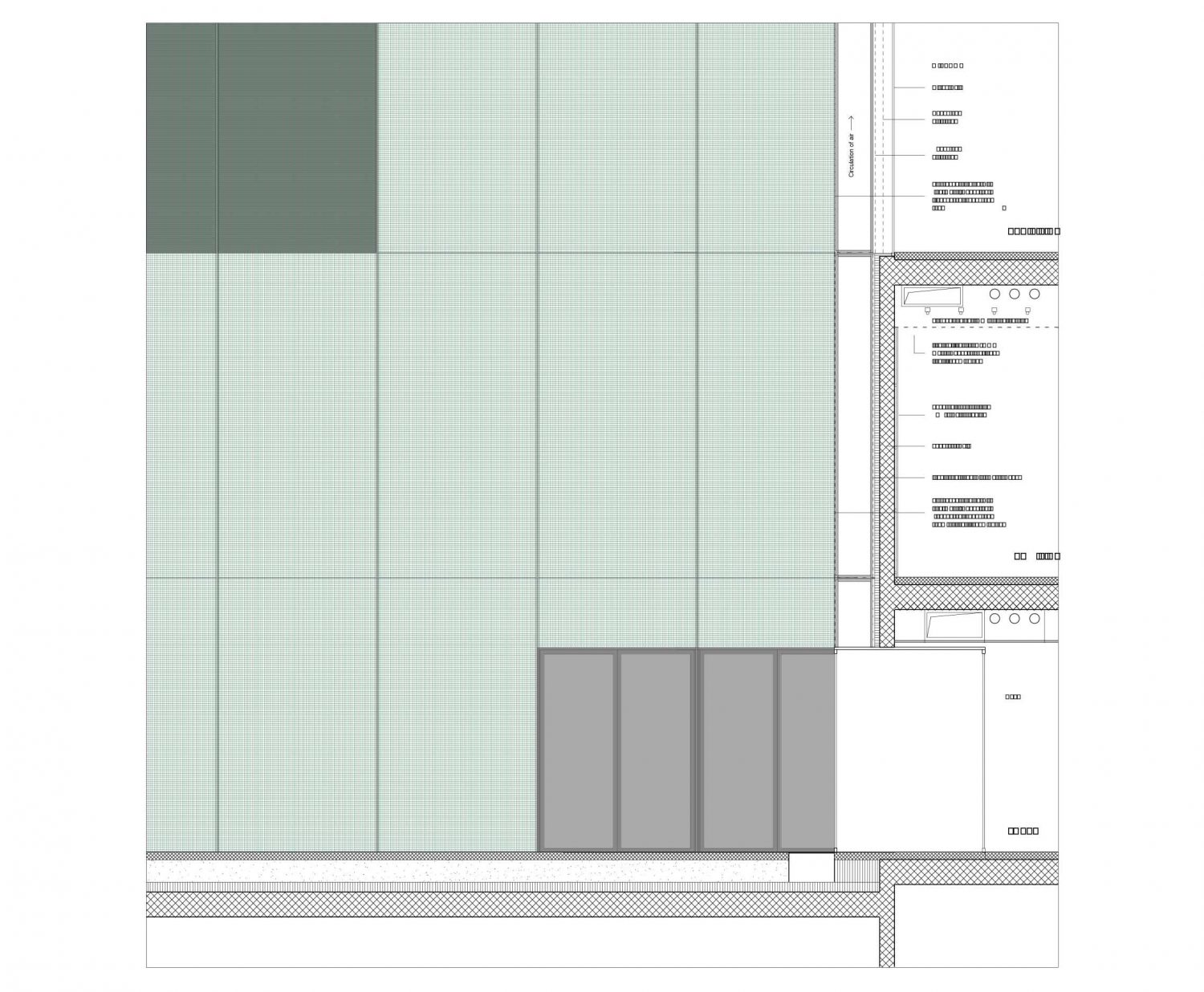
The illumination of the exhibition spaces can either take place almost completely with artificial light (proposal A) or else with daylight (proposal B). Daylight would enter through side glass walls that are covered on the interior with delicate textiles, distributing diffuse light into the exhibition spaces. The façade side in every room thus serves as a large-scale light source. Exterior blinds controlled by light-sensitive sensors adjust the quantity of light that is allowed to enter the spaces. Glass panels, with fine metal cloth placed two feet before the building volume, form the outermost façade envelope. This reduces the incident light as well as building heat gain and serves, in addition, to protect the building from the rain.
The façade envelope made with sheets of textile-impregnated glass wraps around the entire building volume. The insulation panels found behind the glass are likewise kept in place and protected by a fine, fabric-like metal cloth. Seen from afar, the superimposition of the metal cloth generates delicate interferences—a moiré-effect that seemingly causes the façades to gently sway. A play of light arises that refers to the actual function of the grids in the glass: to regulate the light entering the building interior.
Covering the base level with a courser metal cloth placed before its façade and used as a climbing lattice for plants expands the cladding theme by one additional variation. Virginia creeper vines, wisteria and ivy climb about these nets.
In the future, visitors enter the museum through the new building wing. A connecting passerelle leads visitors from the street into the ground floor of the new building, where a view is immediately offered of the representative entrance façade of the historical building.
The existing building and the new building are linked in two ways: by a wide outdoor path that leads over the roof garden of the base level, and by an exhibition space in the base itself lit by three sunken courts. Offset stairs connects the various levels of the new building. They are each placed at the façades and allow visitors to orient themselves and peer outside. Thus, a path through the building is created that one can recall and easily find, while meandering throughout the edifice to connect all of its exhibition spaces.



To build the “Cidade da Cultura” as a place giving identity to the emigrated, the seagoing and the domiciled Galician people, is to create an extraordinary place—to build a spatial monument. Compared with the expectation, the means employed are unexpectedly simple: the topography of the “Monte do Gaias”, four slightly varied cubical volumes and a connecting, plateau-like level all combine to form the “stage”. The “actors” are the view, the sun, the rain, the wind, the clouds, the vegetation that transforms with the seasons, and the people. The “play” is the past, the present and the future culture of Galicia.
For the Galician people who have emigrated in every direction of the compass, the four buildings are placed upon the ridge of the "Monte do Gaias" like "lighthouses" that are oriented to the north, south, east and west. They create an intermediate space that appears as a huge square compared with dense urban conditions, but that acts only as a large surface when compared with the expanse of the surrounding landscape. The buildings tend to mark the space more than they bound it. What does act to define, however, is the topography, the view to the west towards the city, and the view to the east to the more agrarian landscape with its implanted gardens and small parks.
The buildings are simple cubical volumes. They are specifically formed based upon their varying usages and their positions in the terrain. Common to all of the buildings is that they possess courtyards and that they are made of stone. The courtyards mediate between the large square and the small-scaled interior spaces of the buildings. This traditional building type allows the volumes to be permeable to visitors without having to be entered and "used" according to their functions.
The buildings are dedicated to seeing (Museum of Galicia), to hearing (Opera and Sound & Image Library), to learning/studying/reading (Library and Newspaper Library), and to speaking as well as interaction (Auditorium, Lecture Hall, Multi-Purpose Hall). The thematic combination of the uses and the consequential concentration of the volumes generate imposing, memorable buildings with corresponding effects seen both up close and from afar. The division into four buildings also simplifies the phased construction of the project.
The buildings are made of stone and are constructed layer by layer. Various sorts of stone from Galicia and singular stones from the entire world are either laid in courses or are poured as layers in concrete and then revealed once again by sandblasting and grinding. Either set as masonry or poured with concrete, the stones can be understood as the material memory of the history of Galicia, so to speak. Reflective metallic windowpanes contrast with the matt stone. In a literal sense their surfaces mirror the present.
The present-day agrarian landscape acts as a basis to structure the landscape interventions. In this area, like in all of Galicia, it is characterized by small-scaled patterns (Microfundismo). Individual gardens and park elements are "implanted" along paths into the agricultural pattern: for example a rain garden, a garden for the trees of the "Libredon", a place dedicated to the theme of the "Ultramar", a cabbage soup garden, a chestnut grove, a small eucalyptus forest, and more. The bush-like Matoral area to the west of the "Cidade" is to be successively reforested with native oak trees. A densified network of paths allows one to wander from garden to garden and station to station.


