Office and Service Center

The project is to be an architectonic “tailored suit” for the task of building a service center for the Ernsting’s Family textile trading company in the industrial zone of the small town of Coesfeld. The site in the Coesfeld-Lette commercial zone, neighboring the distribution and delivery building and a concrete factory, suggests an architecture that exhibits a kinship with commercial buildings with respect to volumetry, as well as the choice of materials and construction.

The new building is placed close to the street in order to form a tension-filled configuration with the adjacent neighboring building and to leave as much space as possible for future expansion, in addition. As a result, the building is developed upwardly instead of downwardly. The initial, simple primary form of the volume is heightened to a complex figure through the addition of various volumes. The entrance hall, the canteen, the conference room as well as the tentacle-like footbridge are placed about the primary form.

The parcel that remains free to the south is the connecting link to the adjacent small-scale development with single-family houses. The area is to be divided into pattern-like green areas and surfaced areas. Poured, large-sized, concrete slabs with expansion joints form the paving for the outdoor terrace, the driveway and the parking spaces. The green areas are further subdivided either into elongated fields that are planted with trees whose dense foliage acts like a hedge, into areas whose fruit trees imply a grove, or into smaller areas of grass. They invite the employees to spend their lunch break outside during the warmer months and harvest the fruit of the trees.

The project not only includes conventional offices for administrative work, but also spaces for working with fabrics and clothing, reminding one of ateliers with respect to the room height and lighting conditions. The four-story reception space represents the spatial connecting element between the offices and the textile workshop spaces. In addition, it forms a place for small events and exhibitions.

The architecture of the building, which is understood as the service center for the 700 small Ernsting's Family Stores, makes reference to the visual identity of the company.

The characteristic colors and forms of the firm's corporate identity become architectonic components. They form the "fabric" from which the architecture is "tailored": red, white and black on the one hand, and a metal façade to carry the colors on the other—analogous to the delivery trucks that swarm out of Coesfeld each and every day.

Location Coesfeld, Germany

Competition 1998

Competition Organzier Ernsting’s Family

Team GG Pascal Müller, Stefan Thommen

Extension of The Nelson-Atkins Museum of Art

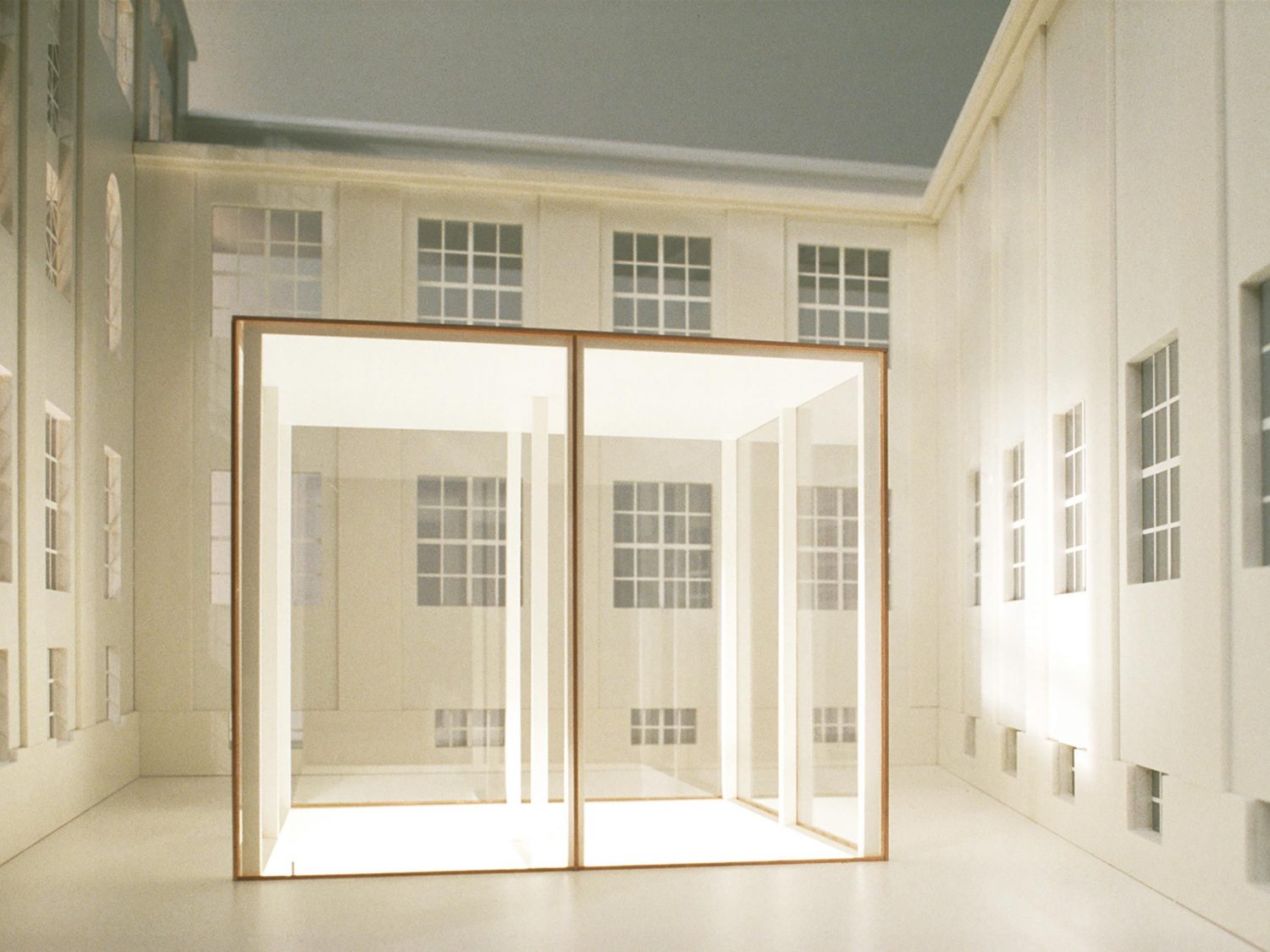
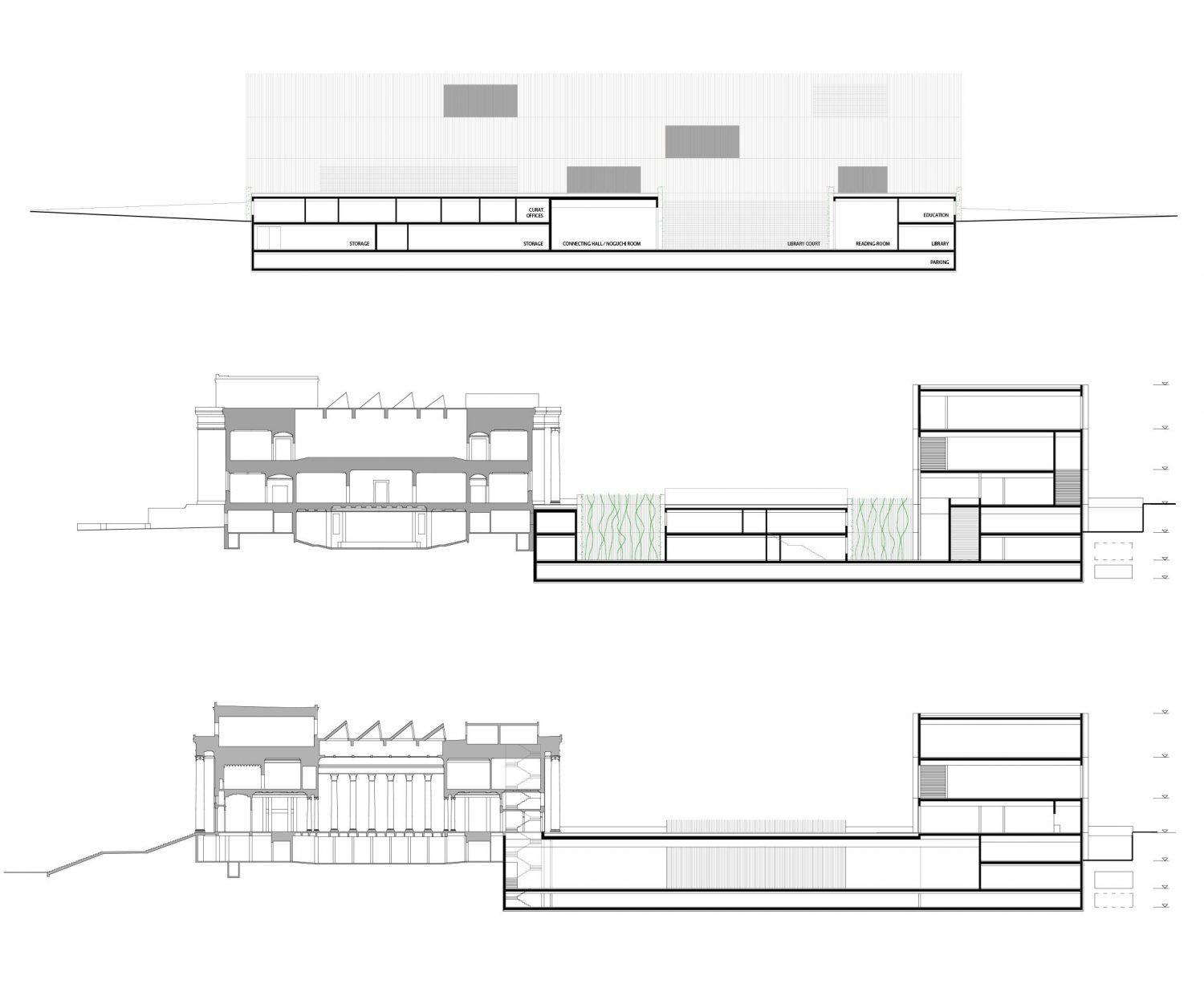
The concept that informs both proposed solutions is based upon a new building to the north that connects with the existing historical building volume by means of a base element. The new building is understood as a modern counterpart to the existing building. While the older building presents itself as static, massive and opaque, the new building has the effect of being slender, high and translucent. The base level both links and separates the two distinct buildings to the same degree. While belonging to the new building and provided with analogous materials, the base can nonetheless be read as an “intermediate building”, as a “landscape structure”.

While works of art from the 17th, 18th and 19th centuries from China, Japan, America and Europe will continue to be exhibited in William Wight's historical 1930 edifice, "more contemporary" works are to be shown in the new building wing. This includes the collection of contemporary art, photography, African Art (as one of the inspirational sources of modern art), drawings and changing exhibitions.

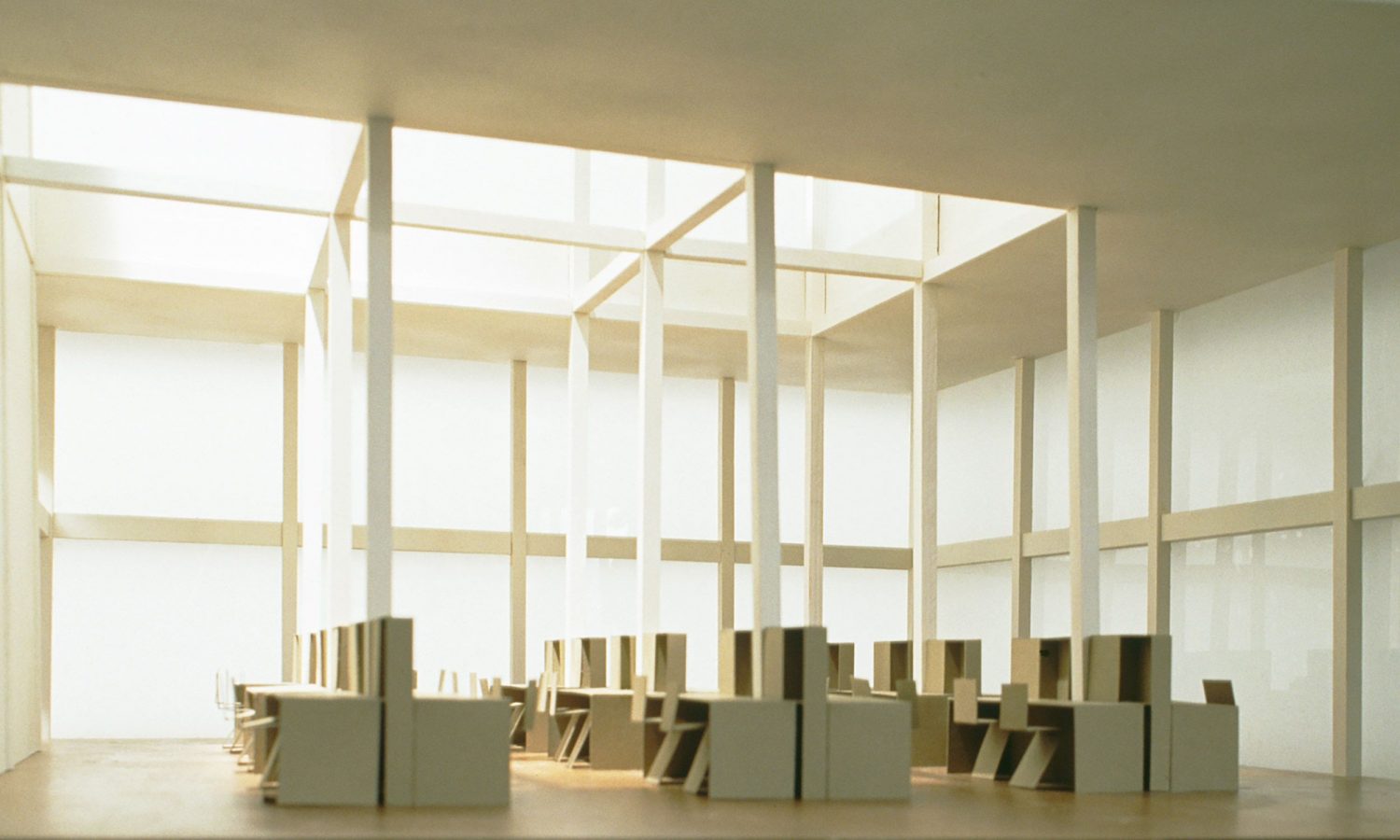
The exhibition spaces for these objects of varying artistic nature are basically simple "containers", "rough-construction spaces" with respect to their spatial and materialistic formulation. They can be subdivided into smaller room components and be more completely finished. The coverings with fabrics on the walls and ceilings take up the principal of the textile-impregnated façade cladding and allow individual atmospheres to be generated for individual works and artistic disciplines.

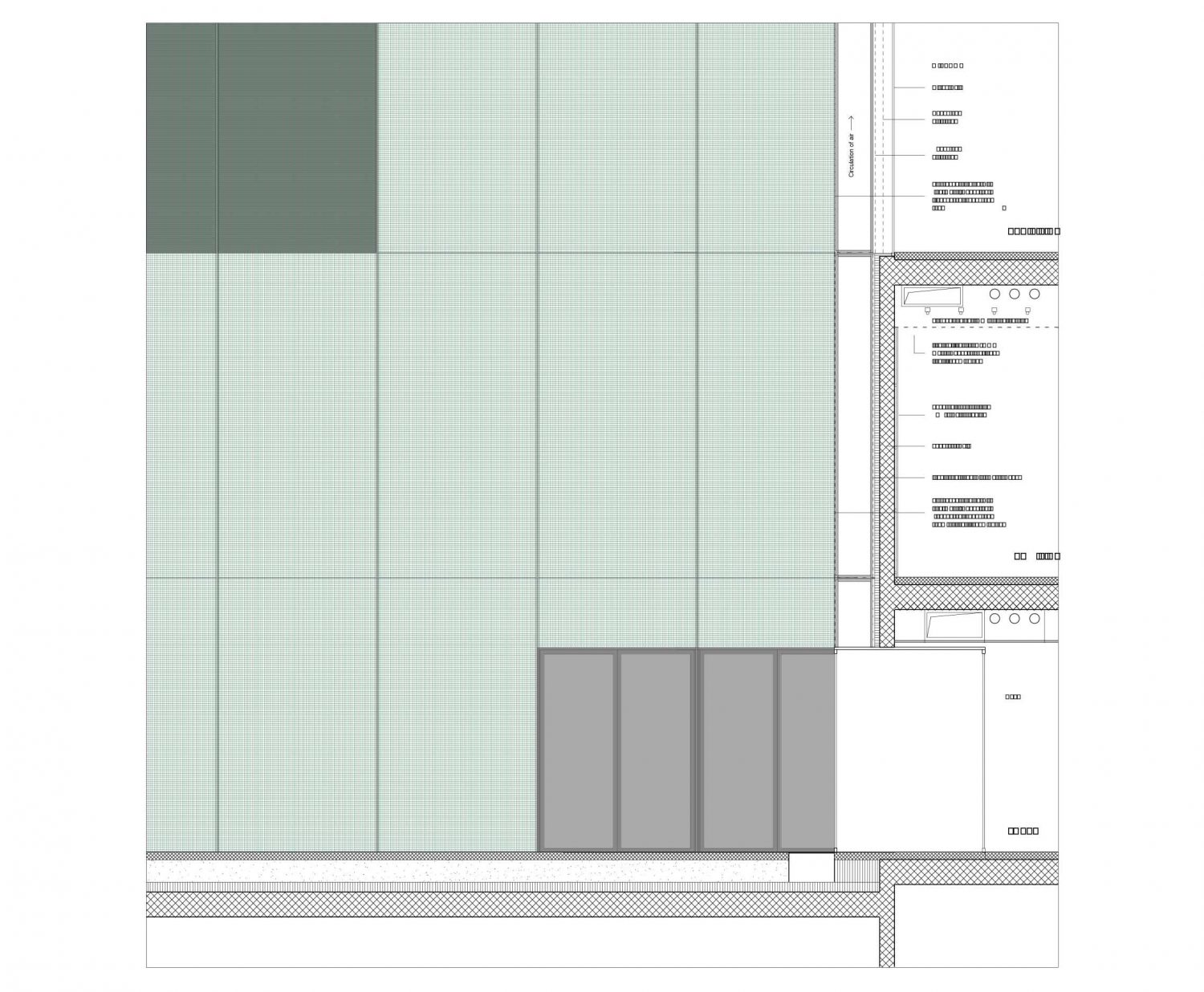
The illumination of the exhibition spaces can either take place almost completely with artificial light (proposal A) or else with daylight (proposal B). Daylight would enter through side glass walls that are covered on the interior with delicate textiles, distributing diffuse light into the exhibition spaces. The façade side in every room thus serves as a large-scale light source. Exterior blinds controlled by light-sensitive sensors adjust the quantity of light that is allowed to enter the spaces. Glass panels, with fine metal cloth placed two feet before the building volume, form the outermost façade envelope. This reduces the incident light as well as building heat gain and serves, in addition, to protect the building from the rain.

The façade envelope made with sheets of textile-impregnated glass wraps around the entire building volume. The insulation panels found behind the glass are likewise kept in place and protected by a fine, fabric-like metal cloth. Seen from afar, the superimposition of the metal cloth generates delicate interferences—a moiré-effect that seemingly causes the façades to gently sway. A play of light arises that refers to the actual function of the grids in the glass: to regulate the light entering the building interior.

Covering the base level with a courser metal cloth placed before its façade and used as a climbing lattice for plants expands the cladding theme by one additional variation. Virginia creeper vines, wisteria and ivy climb about these nets.

In the future, visitors enter the museum through the new building wing. A connecting passerelle leads visitors from the street into the ground floor of the new building, where a view is immediately offered of the representative entrance façade of the historical building.

The existing building and the new building are linked in two ways: by a wide outdoor path that leads over the roof garden of the base level, and by an exhibition space in the base itself lit by three sunken courts. Offset stairs connects the various levels of the new building. They are each placed at the façades and allow visitors to orient themselves and peer outside. Thus, a path through the building is created that one can recall and easily find, while meandering throughout the edifice to connect all of its exhibition spaces.

Location Kansas City, Missouri, USA

Competition 1999

Competition Organzier The Nelson-Atkins Museum of Art, Kansas City, USA

Team GG Urs Birchmeier, Arnault Biou, Caspar Bresch, Stefan Thommen, Roger Naegeli

Landscape Architecture Zulauf Seippel Schweingruber, Baden

Structural Engineer Aerni + Aerni, Zurich

Signage Trix Wetter, Zurich

Cidade da Cultura

To build the “Cidade da Cultura” as a place giving identity to the emigrated, the seagoing and the domiciled Galician people, is to create an extraordinary place—to build a spatial monument. Compared with the expectation, the means employed are unexpectedly simple: the topography of the “Monte do Gaias”, four slightly varied cubical volumes and a connecting, plateau-like level all combine to form the “stage”. The “actors” are the view, the sun, the rain, the wind, the clouds, the vegetation that transforms with the seasons, and the people. The “play” is the past, the present and the future culture of Galicia.

For the Galician people who have emigrated in every direction of the compass, the four buildings are placed upon the ridge of the "Monte do Gaias" like "lighthouses" that are oriented to the north, south, east and west. They create an intermediate space that appears as a huge square compared with dense urban conditions, but that acts only as a large surface when compared with the expanse of the surrounding landscape. The buildings tend to mark the space more than they bound it. What does act to define, however, is the topography, the view to the west towards the city, and the view to the east to the more agrarian landscape with its implanted gardens and small parks.

The buildings are simple cubical volumes. They are specifically formed based upon their varying usages and their positions in the terrain. Common to all of the buildings is that they possess courtyards and that they are made of stone. The courtyards mediate between the large square and the small-scaled interior spaces of the buildings. This traditional building type allows the volumes to be permeable to visitors without having to be entered and "used" according to their functions.

The buildings are dedicated to seeing (Museum of Galicia), to hearing (Opera and Sound & Image Library), to learning/studying/reading (Library and Newspaper Library), and to speaking as well as interaction (Auditorium, Lecture Hall, Multi-Purpose Hall). The thematic combination of the uses and the consequential concentration of the volumes generate imposing, memorable buildings with corresponding effects seen both up close and from afar. The division into four buildings also simplifies the phased construction of the project.

The buildings are made of stone and are constructed layer by layer. Various sorts of stone from Galicia and singular stones from the entire world are either laid in courses or are poured as layers in concrete and then revealed once again by sandblasting and grinding. Either set as masonry or poured with concrete, the stones can be understood as the material memory of the history of Galicia, so to speak. Reflective metallic windowpanes contrast with the matt stone. In a literal sense their surfaces mirror the present.

The present-day agrarian landscape acts as a basis to structure the landscape interventions. In this area, like in all of Galicia, it is characterized by small-scaled patterns (Microfundismo). Individual gardens and park elements are "implanted" along paths into the agricultural pattern: for example a rain garden, a garden for the trees of the "Libredon", a place dedicated to the theme of the "Ultramar", a cabbage soup garden, a chestnut grove, a small eucalyptus forest, and more. The bush-like Matoral area to the west of the "Cidade" is to be successively reforested with native oak trees. A densified network of paths allows one to wander from garden to garden and station to station.

Location Santiago de Compostela, Spain

Competition 1999

Competition Organzier City of Santiago de Compostela, Spain

Team GG Dalila Chebbi, Markus Lüscher, Arnault Biou, Stefan Thommen, Roger Naegeli

Landscape Architecture Zulauf Seippel Schweingruber, Baden

Training Center Roche Forum

The uniquely beautiful landscape of the Buonas peninsula site on the Lake of Zug was the point of departure for the architectonic concept. The strongly undulating terrain, patches of forest, stretches of pasture, single trees and two rural roads characterize the place foreseen for the new building—the scenic space surrounding the castle on the outermost portion of the peninsula. The design interprets and accents the rural characteristics of the place.

The siting of the building volumes on the land establishes a relationship between the same while simultaneously setting them apart. In their distribution and form they remind one of giant boulders in the landscape. The largest volume, the actual training center, is shifted to the southern edge of the gully, with a portion of its functions facing the ridge towards the lake. Both of the smaller volumes, the guest quarters, lie on the northern and western edges of the site. Smaller aboveground cubical volumes form the garage entrance and sporadic elements for lighting and ventilation. The garage itself is akin to a giant drift boulder placed into the terrain.

The form of the building—rectangles distorted into irregular polygons—allows the volumes to be adapted to the complex formations of the terrain. Intriguing interstitial spaces, halls, work areas and foyers are formed within the buildings by virtue of slight deviations from the right angle. The roof surfaces, tilted and folded for water drainage, re-form the cubes into irregular polyhedrons in the third dimension, as well.

The materiality of the new buildings is consequently stone-like. Like the exterior walls, the roof surfaces are made with two-layered concrete. Layers of concrete are poured that are "colored" with varying types of sands and gravels as "sediment-like" stratum in various thicknesses, allowing the process of pouring the concrete to become manifest. Primarily horizontal windows, at times irregular and at times regular in their placement, underscore the concept of the horizontal layering of the buildings. An exterior, slightly tinted glass used as a sliding window produces a first level of sun protection reminiscent of sunglasses. An inner sliding window takes over the insulating functions.

The access drives to the training center and the pedestrian paths between the buildings still maintain the characteristics of rural roads or garden paths—the roads are made with chip stone asphalt and the paths with gravel. The surroundings, the patches of forest, the stretches of pasture and the singular trees remain untouched. At the place where the parking garage is inserted into the ground of the gully, a slight embankment and leveling-out of the lowest point is to be made, generating a new kind, albeit artificial now, of small wetland. Birch trees, with their lateral root growth, are placed upon the underground, earth-covered building element and will grow with time into an airy grove of trees.

Location Buonas, Switzerland

Competition 1999

Competition Organzier F. Hoffmann-La Roche AG, Basel

Team GG Pascal Müller, Caspar Bresch, Christian Meyer

Landscape Architecture Zulauf Seippel Schweingruber, Baden

Structural Engineer Conzett, Bronzini, Gartmann AG, Chur

Electrical Engineer Elkom Partner AG, Chur

Building Services Engineer Waldhauser Haustechnik AG, Münchenstein

Parliament Building Vaduz

In 1987, Luigi Snozzi presented a plan for the redesign of the governmental district in Vaduz: A parliamentary building was to be added to the government building, set off by an undulating house wall at the foot of the Schlossberg hill. However, the voters rejected the plan in 1993.

The new project for a parliamentary building is based upon the location once proposed by Snozzi and continues the redesign of Vaduz town centre, which produced a first edificial result in 2000 with the opening of the art museum. Between the national museum and the administrator’s house in the north and the government building to the south, the new building stands as a mighty solitaire, dominating the state square in front of it, which has also been redesigned. The underlying concept of the parliamentary building is a mighty, orthogonal volume floating above an open ground and access storey. Cubes of glass seemingly carry the massive structure, while voluminous supports such as elevator, staircase and sanitary cores on the inside bear the loads. The concept recalls the Piloti system of modernity and the traditional building style portrayed by the town hall with its open ground floor. The optical transparency of the ground floor accentuates the visual correlation between the state square and the forested slope behind the new building.

From the glassed entry area with the wardrobe and the janitor’s box on the ground floor, a generously dimensioned staircase leads to the hall of parliament on the first floor, which is orientated towards the square and is surrounded by a foyer zone in the north and the covered walkway in the east, which provides views of the forest. The meeting rooms and the rooms of the parliamentary parties are located on the second floor above the hall of parliament; and above them, the library and the offices are located.

Technically, the building is constructed as a loadbearing structure cast in site-mixed concrete, which is braced by the access cores. The exterior shell is composed of a second concrete layer, which is characterized by squares matching the height of the floors and coloured with different types of sand. These squares show the individual stages in which the concrete was applied, while at the same time referring to the room units behind them. A sandblasting treatment in different intensities leads to further differentiation of the surface.

Text: Hubertus Adam

Location Vaduz, Lichtenstein

Competition 2000

Competition Organzier Government of the Principality of Liechtenstein

Team GG Christof Bhend, Pieter Rabijns, Katja Schubert, Mathias Brühlmann

Structural Engineer Aerni + Aerni, Zurich

New building HIT, ETH Hönggerberg
Building for research, teaching and services, e-Science Lab

The HIT building for the e-Science Lab is  part of the third extension phase on the Hönggerberg Campus of ETH Zurich and is located close to the northwest corner of the area. It follows the basic geometry composed of individual building complexes, already outlined in the original master plan, which are integrated into a generally orthogonal grid of streets. The five- and six-storey new building is composed of an angular building structure along the main roads in the north and the east, succeeded by a further angle – in such a manner that the overall structure seems to reflect the rectangle of the allotment and the imaginary cuboid shape of the volume on the one hand and opens up to the south and the west with its courts on the other. On these sides, extensions are feasible. The dual-storey opening on the east side creates an entry situation with a view into the first court.

The passageway leads onto the cafeteria to the left, over which the school management is located, and onto the main entry area of the HIT building to the right. Auditoriums and seminar zones are arranged in the eastern part of the northern wing, while the research areas enframe the northwestern court in a U-shape.

A reinforced concrete skeleton structure with bracing cores constitutes the supporting structure of the new building and guarantees the flexibility of utilisation thanks to the separation of construction and installation. The outer shell of the new building consists of a continuous glass façade with casement windows. A matt metallic coating in silk-screen print oscillates between opaque and transparent from one floor to the next, thus creating a colour progression which conceals the ceiling fronts and rouleaus and serves as a sun protection in the diffuse areas.

The overworked project, on the other hand, features a succession of balustrade coverings and permanent glazing with narrower ventilation wings. The greenish panes have dark stripes – at the level of the windows, due to the frames, as a rhythmical element in the area of the balustrades, which creates swinging colour progressions in a horizontal direction. The regular stripe design of the fallarm blinds additionally superposes and enhances the rhythmic effect.

Text: Hubertus Adam

Location Zurich, Switzerland

Competition 2001

Competition Organzier ETH Zurich

Team GG First Phase: Barbara Schlauri, Markus Seiler, Veronika Steiger, Sergej Klammer, Raul Mera
Second Phase: Barbara Schlauri, Christof Bhend, Esther Righetti

Landscape Architecture Zulauf Seippel Schweingruber, Baden

Structural Engineer Aerni + Aerni, Zurich

Electrical Engineer Elkom Partner AG, Chur

Building Services Engineer 3-Plan Haustechnik AG, Winterthur

Facade D. Kopitsis, Wohlen

Extension of Rietberg Museum

In 1952 the Rietberg Museum for non-European art moved into Villa Wesendonck, situated in Rieterpark, one of Zurich’s most beautiful parks. The villa, built in 1857 by Leonhard Zeugheer, is famed as one of the key examples of late Neoclassical architecture in Zurich. The new extension project was driven by the museum’s growing need for more space even after the museum expanded in 1978 to incorporate the adjacent Villa Schönberg (Alfred Friedrich Bluntschli, 1888), which in the meantime has been restored by Arthur Rüegg and Silvio Schmed.

The design is based on a three-story cube, which rises up from a subterranean rhizome-like connecting building. An ensemble is generated by introducing the extension building alongside the two existing structures - Villa Wesendonck and its former services building - creating a new and adequate presence for the museum institution. The extension welcomes visitors from the street side, while receding into the background when viewed from the park. The appearance of the historical park is thus scarcely altered.

On the ground floor the new building houses the ticket desk and museum shop, along with a multimedia room, which is conceived as a flexible spatial enclosure with sliding dividing walls. The new permanent exhibition is located on the two upper floors. Generously proportioned stairways and an underground hallway connecting the two buildings provide access to the area for temporary exhibitions.

This is designed as a flexible space for varied exhibition options and is artificially lit. In the new rooms for the permanent collection by contrast, natural light enters from above through skylights on the third level and on both floors through side windows that also offer vistas of the surroundings. The ceiling construction spans the entire space, allowing flexible uses of these rooms as well.

Above ground, the extension is clad with prefabricated concrete/glass-brick elements. Supplementing the windows, they also function as a source of diffuse natural light. The exterior of the building displays a subtle iridescent sheen, created by mixing quartz sand into the concrete and sand-blasting the cladding panels.

The design envisages just one simple change to Villa Wesendonck: a new stairway leads from the underground level directly into the villa’s existing staircase.

Location Zurich, Switzerland

Competition 2002, 3rd Prize

Competition Organzier Building Office of City of Zurich

Team GG Esther Righetti, Sarah Righetti, Barbara Schlauri, Raul Mera

Landscape Architecture Hager Landschaftsarchitektur AG, Zurich

Structural Engineer Dr. Lüchinger + Meyer Bauingenieure AG, Zurich

Electrical Engineer Elkom Partner AG, Chur

Building Services Engineer Waldhauser Haustechnik AG, Münchenstein

National Park Center

In Zernez, at the border between upper and lower Engadin, a visitor and administration center was opened in 1968 for the Swiss National Park, which was founded in 1914 and is the oldest of its kind in the Alps. Several decades later, the decision was made to adapt the center to contemporary needs, leading to a competition for reorganizing and expanding the functions that had, up to then, been housed in the historic Planta-Wildenberg Castle and other buildings.

The new concept envisions a coherent architectural and landscaping plan for the entire area reaching from the old village road to the new bypass, without however competing with the village’s existing landmarks. While the administration of the national park is accommodated in the castle and an auditorium in the neighboring service building, the information center is given its own new building. This structure deliberately does not borrow its typology from the castle, but rather expresses the new use with an independent appearance. The elongated, mostly single-story structure with its folded roof and body-like openings more readily recalls a ‘natural’ and ‘landscape’ form than a building.

The layout and positioning of the building volume allow it to be entered from all sides - from the castle courtyard, from the canton road and from the old main street of the village via a newly created square. On the inside, a network of pathways connects the three entrances, simultaneously structuring the public areas, the non-public areas, and the areas subject to entry fees. Visitors move through the exhibition on a ‘circuit tour’ punctuated by opportunities to look out onto the landscape, the mountains, the village, and the sky. The exhibition rooms are designed as continuous areas, which can also be flexibly divided into smaller room units. Alternating zones of dark and light are illuminated from the side and above.

The load-bearing structure for the roof and walls is made of concrete, which on the interior is partially left untreated and in other areas plastered, painted, or faced in wood. The exterior façades and roofs are clad in local scree. Together with the gravel areas outdoors, these take up a dialogue with the built environment and the natural landscape of the nearby national park.

Location Zernez

Programme Visitor foyer, info desk, exhibition rooms, hall for 150 people, shop, seminar rooms, tourist office, storage areas

Competition 2002
in collaboration with Othmar Brügger, Davos

Competition Organzier Stiftung Schweizerischer Nationalpark

Team GG Volker Mencke, Barbara Schlauri

Structural Engineer Walter Bieler, Bonaduz

Residential Towers Kattendijkdok

Location Antwerp, Belgium

Programme 90 apartments

Commission 2002

Planning/Construction 2002–2004 (not realized)
Urban planning in collaboration with Diener & Diener Architekten, Basel/Berlin, and David Chipperfield Architects, Berlin

Gross Floor Area 600 m2

Competition Organzier Project² NV/SA, Antwerp, Belgium

Team GG Volker Mencke

Contact architects ELD, Antwerp, Belgium

Letzigrund Stadium

The new Letzigrund stadium, where the annual athletics meeting is held, is conceived as a combination of a football and an athletics stadium and is also suitable for the staging of other large events.

The football field is eccentrically situated within the athletics courses in such a manner that the ideal geometry of the surrounding oval grandstand is slightly distorted. Further differentiations arise due to the additional utilisations, which are distributed diversely on the ground floor zone: While the platform area of the stadium is reduced to a narrow strip in the area of the Badenerstrasse, Herdernstrasse and Baslerstrasse, which results in a pronounced overhang of the grandstand structure, the layer becomes larger on the northwestern side, where the main usages, which attract large amounts of people, are concentrated – a restaurant with a conference centre and a gym, which can also be used as a press centre. In addition there are special rooms for the different operators – as well as cloakrooms, showers, training facilities and massage rooms on the basement floor. An important feature is the highly flexible usage, according to the type of event.

The floating, funnel-shaped volume of the stadium body is made up of a voluminous steel support structure. Partitions follow the geometry of the running course and are fixed on the outside with bracings. The braced girder, composed of four parts, is buckled three times following a standard pattern. The first element is the protruding grandstand support, the second one constitutes the grandstand wreath, the third one forms the protruding roof, while the fourth holds the lighting wreath. Grid wire meshwork covers the bracing outer sides of the grandstand construction producing the effect of a bodylike volume depending upon the viewing angle.

The main entries are to be found in the east and the south, i.e. at the corners of the allotment designed as forecourts; the grandstand with its extreme overhang, is a welcoming gesture.

The stadium surround, which includes two further sports fields in the northeast, can be also be differentiated spatially using fences, in such a manner that the utilisations can be adapted to the respective type of event.

Text: Hubertus Adam

Location Zurich, Switzerland

Competition 2003

Competition Organzier City of Zurich, Building Department, School, and Sports Department

Team GG Volker Mencke, Christof Bhend, Ulrike Horn, Raul Mera

Landscape Architecture Zulauf Seippel Schweingruber GmbH Landschaftsarchitekten, Baden

Structural Engineer Dr. Lüchinger + Meyer Bauingenieure AG, Zurich

Electrical Engineer Elkom Partner AG, Chur

Building Services Engineer 3-Plan Haustechnik AG, Winterthur