Housing Complex Zollikerstrasse

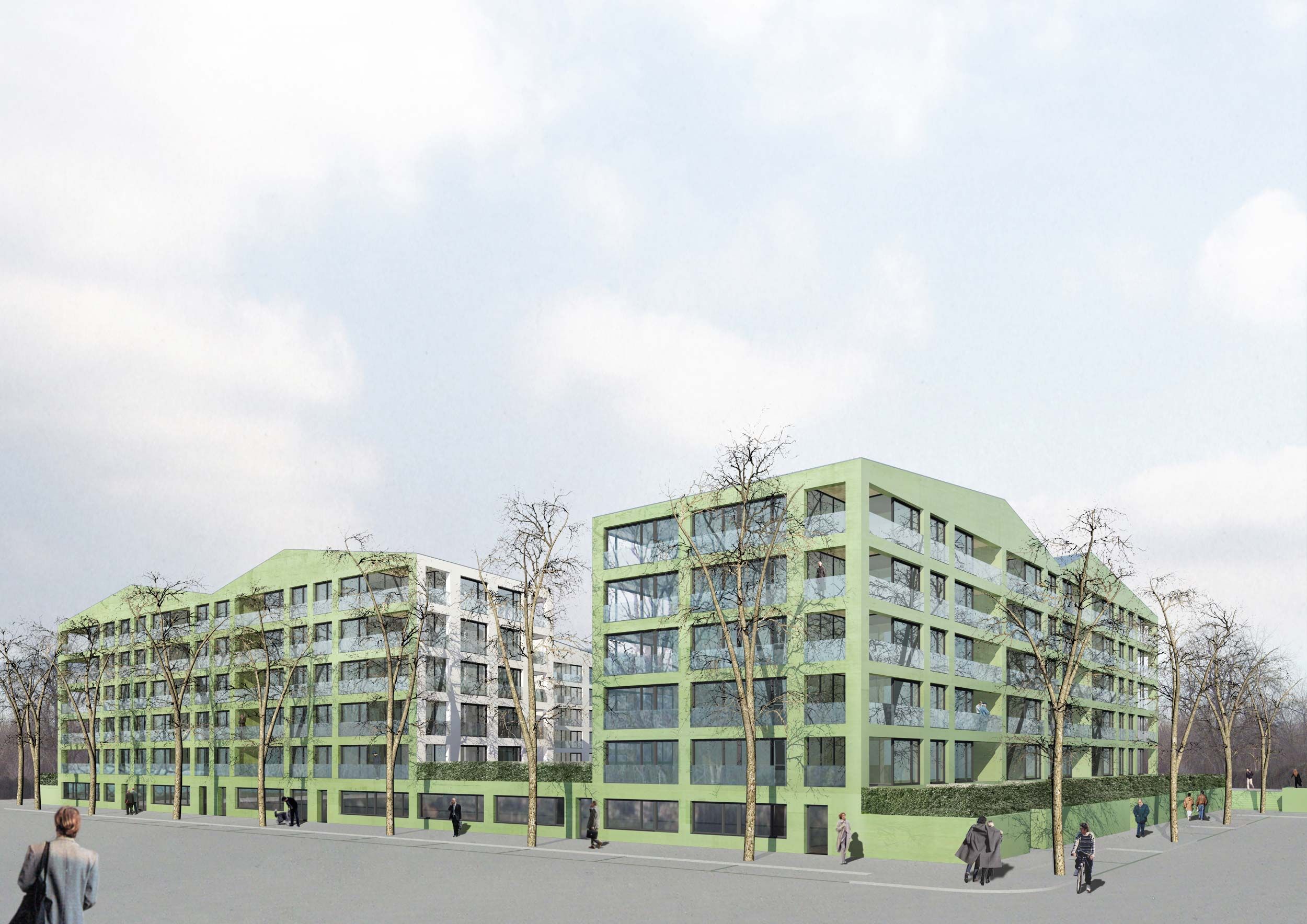
The impressive existing trees on the site of the former villa – a copper beech, a redwood, and a pine tree – influenced the architecture of the replacement buildings in several ways. The trees had an impact on the position, shape, materials, and also the colors of the new structures, calling for a specific architectural reaction to the immediate surroundings.

The new built volume is much larger than the previous building and is divided into two units. An unusually narrow space establishes a visual connection between the shady garden beneath the trees on the street side and the private garden to the west. The narrow interspace is widened and opened up by reflections in the façades’ glazed surfaces, which visually “duplicate” the garden.

Location Zurich, Switzerland

Programme Two houses, 8 owner-occupied apartments, 2 studios, underground parking 14 pitches

Competition 2005, 1st Prize

Planning/Construction 2006–2011

Client Floor Owners' Association Zollikerstrasse, Zurich

Gross Floor Area 2‘896 m2

Team GG Monica Knechtle

Site Management Agora Baumanagement, Zurich

Total Contractor Gross Generalunternehmung AG, Brugg

Landscape Architecture Hager Partner AG, Zurich

Structural Engineer Basler & Hofmann AG, Zurich

Electrical Engineer Ernst Basler + Partner AG, Zurich

Building Services Engineer Ernst Basler + Partner AG, Zurich

Building Physics Engineer IPA, Energieberatung und Bauphysik, Volketswil

Colours with Pierre André Ferrand, Geneva/ La Chaux-de-Fonds

Housing Complex Villa Pax

Location Baden, Switzerland

Programme Two houses, 7 owner-occupied apartments, underground parking 15 pitches

Competition 2008, 1st Prize

Planning/Construction 2008–2011

Client private
Client's Representative: AK Bautreuhand, Zurich

Gross Floor Area 2‘275 m2

Team GG Nicolai Rünzi, Ivana Vukoja, Karsten Buchholz

Site Management Witzig Architekten, Zurich

Landscape Architecture Balliana Schubert Landschaftsarchitekten AG, Zurich

Structural Engineer MWV Bauingenieure AG, Baden

Electrical Engineer P. Keller + Partner AG, Baden

Building Services Engineer Nanotech AG, Baden

Building Physics Engineer Mühlebach Akustik + Bauphysik, Wiesendangen

Housing Development Zellweger-Areal

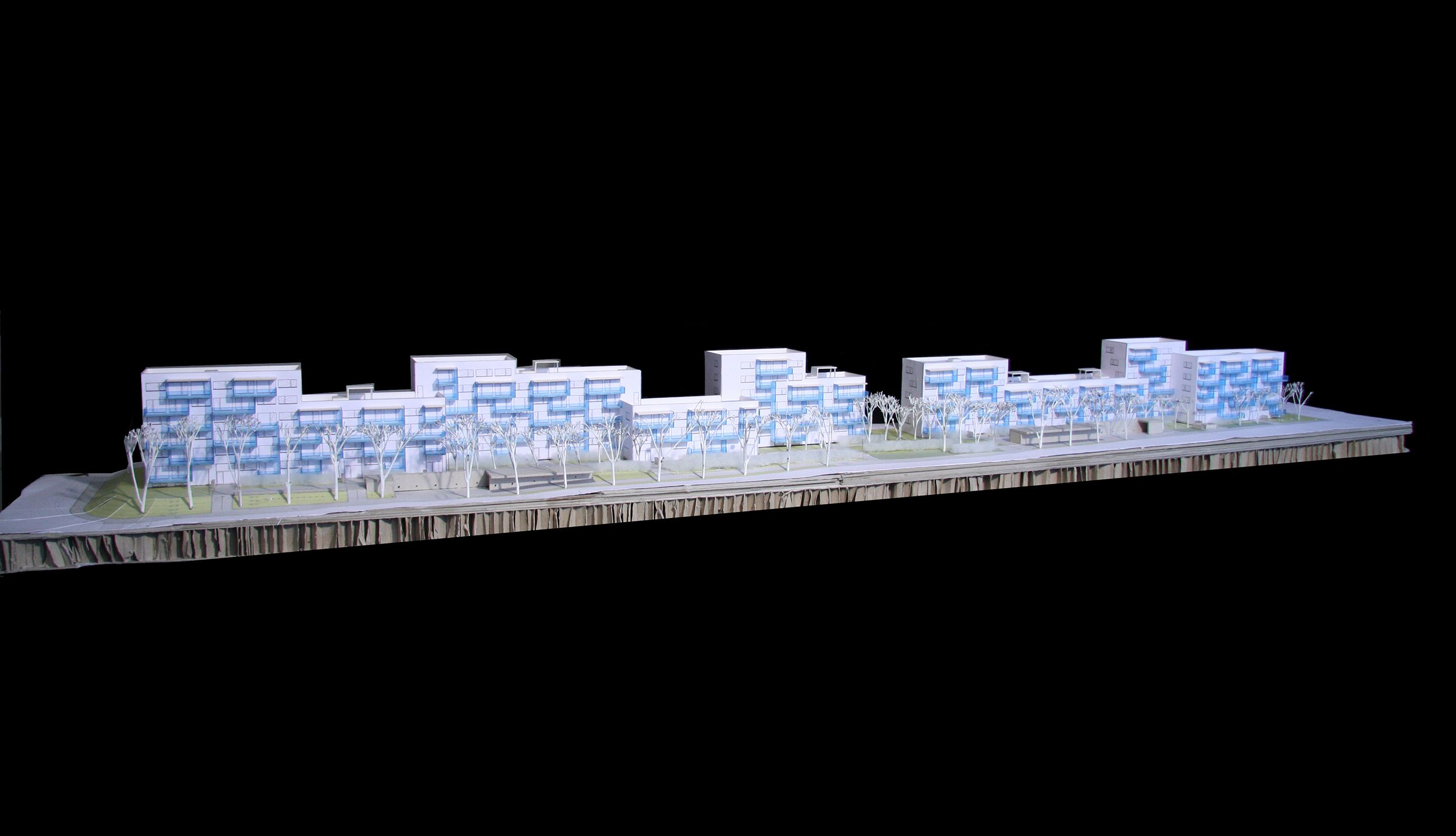
The Zellweger complex, set on a former industrial site, boasts outstanding landscape features. Two large ponds, originally created to generate energy from hydropower, a stretch of river, and a park-like area with mature trees define the site. The site is demarcated by the pond Zellweger-Weiher and the Aabach stream. Two residential buildings of differing heights are positioned here in alignment with the promenade of plane trees by the pond in the north and the tree-lined course of the stream in the southeast. The two buildings create an L-shaped green area between them, opening up to the west onto a group of trees and an existing high-rise office building.

Broad paths lead to the buildings through the open garden area, beneath which the garage is located. Pines are planted on the gently contoured lawn like green sculptures. The private front gardens at ground level are set off from the public green areas with spruce wood fences. These are framed by open, elegant concrete structures that also provide parking spaces for bicycles and contain mailboxes and shafts providing natural ventilation for the underground garage.

The northern eight-story building along Weiherallee contains 74 rental apartments, a bistro, two nurseries and a day care club. The building on the new Zellwegerweg, set along the Aabach, ranges from three to five stories in height and houses 61 rental apartments along with a multi-purpose common room. Most of the apartments in both buildings have living/dining/kitchen areas that extend through the building, opening onto both the green inner courtyard and the pond or stream. The principle of the living/dining room extending from front to back was articulated differently in the two buildings. In the building on Zellwegerweg the space narrows in the middle to form an entrance area and then widens again to either side to form distinct zones for the living room and eat-in kitchen at opposite ends of the apartment. The rooms are arranged around the periphery of this central space. In the building on Weiherallee the entrance area provides access to the rooms and leads to the living/dining room that runs across the apartment. The subtle angling of the balconies offers outdoor areas of varying depths and provides a formal echo to the large-scale angled sections of the two buildings, adding a lively and sculptural touch to the volumes of these two housing ensembles.

The façades are articulated by layers of rhythmically offset thermally modified spruce wood planks and openwork prefabricated concrete parapets, which protrude somewhat beyond the wooden cladding to protect it from the weather. On the balconies, the concrete band projects further forward to form the parapet.

Location Uster, Switzerland

Programme Two structures in a parkway with 135 apartments, common room, bistro, day care, two nurseries, two underground parkings 149 pitches

Competition 2008, 1st Prizes

Planning/Construction 2009–2013

Client Zellweger Park AG, Uster
Client’s Representative: Odinga und Hagen AG, Uster

Gross Floor Area 24‘713 m2

Team GG Daniel Friedmann, Reto Killer, Eric Sommerlatte, Karsten Buchholz

Site Management b+p baurealisation ag, Zurich

Landscape Architecture Hager Partner AG, Zurich

Structural Engineer Schnetzer Puskas Ingenieure AG, Zurich

Building Services Engineer Ernst Basler + Partner AG, Zurich

Building Physics Engineer Mühlebach Partner AG, Wiesendangen

Art within Architecture Lutz / Guggisberg

Würth Haus Rorschach

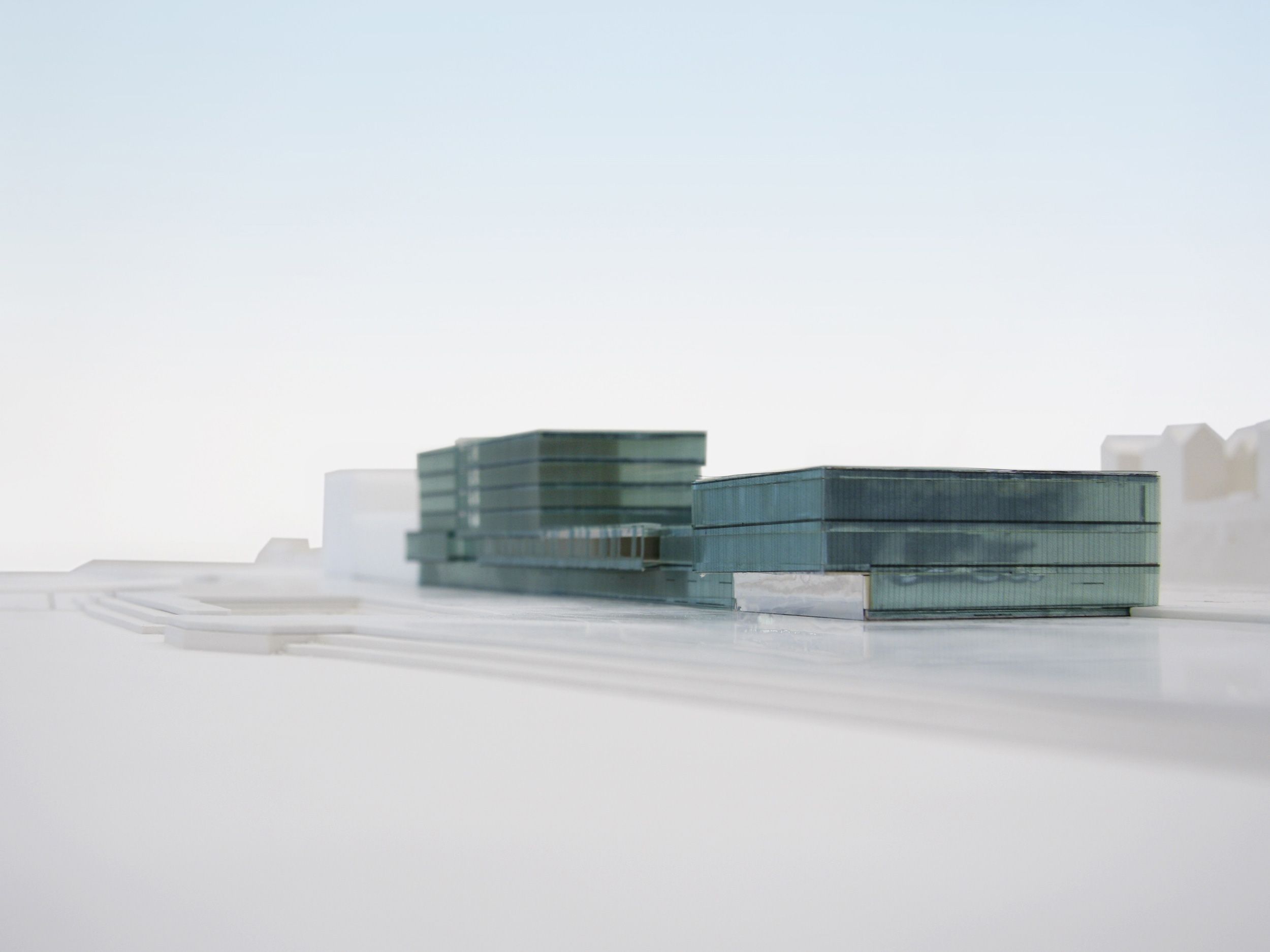
A greenish crystalline building responds to the unusual location of the site, set between the edge of Lake Constance and Churerstrasse. Walkers and passers-by experience a glass structure that oscillates between transparency and shiny reflective surfaces that multiply the natural beauty of the setting. The architecture affords views out to the surroundings, glimpses into the building, and sightlines through it to the park and lake.

The interior offers staff and visitors generously proportioned sequences of rooms - workspaces, communication areas, and leisure zones - as well as providing space for product presentations and art exhibitions. The structure responds to the train station building with lower volumes and reacts to the expanses of the park and lake with a higher segment. There are plans to add an extension on the eastern side in a future phase of construction. Toward the street, the volumes give shape to a range of external spaces through precisely defined projections and setbacks: in the middle is the entrance area, to the east the vehicle access and workshop zone, and to the west Bahnhofsplatz, the station square, which is expanded toward the lake. Maple trees set in a perpendicular configuration characterize this space, and also continue as rows along Churerstrasse.

Approaching from the station, a broad canopy signals the main entrance. The various user groups - visitors, people attending courses, and company staff - enter the building through a large lobby and are guided from this point to the different parts of the building. On the ground floor and first floor, the public functions - training and conference rooms, as well as the restaurant - are grouped around a foyer with an open courtyard in the center and are linked by a sweeping stairway. Both the conference area and the separate exhibition spaces can be accessed directly from the exterior, allowing the option of using these areas independently from the rest of the building. The exhibition area guides visitors from the entrance to two different-sized exhibition rooms, which are located on the first floor of the southern part of the building and are naturally lit from above. The structure of the shed skylight over the exhibition spaces simultaneously supports the enormous projecting canopy over the entrance. Office space extends over four stories in the highest part of the building, which is not open to the general public. Informal meeting areas with balconies facing the lake, transparent or closed-off meeting rooms, and individual offices alternate here with open-plan office areas.

A double glass envelope encases the building. The inner layer is made up of triple glazing and metal-clad thermal insulation. The external, back-ventilated layer is composed of offset greenish glass panes equipped with a fine mesh insert with a metallic luster. This creates a rhythmically articulated glass curtain that provides protection against wind from the lake and noise from the street and also against excessive heat and cold. The predominance of glass in the building materials is continued on the roof in the form of CIS photovoltaic panels.

Location Rorschach, Switzerland

Programme Administration Building with Training and Conference Centre, 630-seat auditorium, museum, restaurant, cafeteria, hardware-shop, workshops

Competition 2009, 1st Prize

Planning/Construction 2009–2013

Client Würth International AG, Chur
Owner's representative: Walter Dietsche Baumanagement AG, Chur

Gross Floor Area 32'200 m2

Team GG Luisa Wittgen, Nicolai Rünzi, Bettina Gerhold, Thomas Möckel, Matthias Clivio

Site Management Walter Dietsche Baumanagement AG, Chur

Landscape Architecture Atelier Girot, Gockhausen

Structural Engineer Dr. Lüchinger Meyer Bauingenieure AG, Zurich

Electrical Engineer Bühler + Scherler AG, St.Gallen

Building Services Engineer Waldhauser Haustechnik AG, Basel

Building Physics Engineer Kopitsis Bauphysik AG, Wohlen

Fire Safety Makiol + Wiederkehr, Beinwil am See

MSRL Boxler MSRL Engineering, Jona

Ventilation Engineer Waldhauser Haustechnik AG, Basel

Acoustical Engineer Müller-BBM GmbH, Planegg, Germany

Daylighting Consultant Institut für Tageslichttechnik Stuttgart, Germany

Lighting Consultant Licht Zentrale, Nürnberg, Germany

Plumbing Tomaschett + Cioce AG, Rorschach

Facade Reba Fassadentechnik AG, Chur

Signage Trix Wetter, Zurich

Colours (partiell) Harald F. Müller, Oehningen, Germany

Address Churerstrasse 10, CH – 9400 Rorschach

Hotel and Office Building – Greencity

The mixed-use district Greencity, based on the principles of the 2000-watt society*, is under development on the former industrial site Sihlpapier Manegg in southern Zürich. Situated between the railroad tracks and the motorway, the seven-storey hotel and office building together with its eleven-storey neighbours forms the head of the new district facing the city centre. This ensemble frames a public courtyard, adjoining the elongated Maneggplatz. The oblong, lower building faces the tracks and street to the west as well as the courtyard. The latter is widened to piazza-like proportions by a tapering of the volume towards the north. Three covered recesses lead to the entrance halls of the different occupants. On the façades, overlapping horizontal and vertical elements of brown anodized sheet aluminium alternate with wood/metal windows and slender ventilation flaps. Depending on the point of view, openings and cladding, structure and envelope interpenetrate.

The international design competition for the site was based on a preliminary plan that stipulated tall building volumes next to the motorway for offices and services. Gigon / Guyer’s urban design was awarded first prize and further development was split between two architecture firms.

The present project was initially planned exclusively as office space, and in a second phase, exclusively for hotel use. The uses are now combined: one-third office space, two-thirds hotel. The office space occupies the southern part of the upper floors and includes a lobby, staircase and lift core. The ground floor here houses a day-care centre with a separate entrance. The hotel reception welcomes guests on the street side, whereas the breakfast room and bar face the courtyard.

A load-bearing skeleton of concrete columns, floor slabs and cores allows for various uses. The façade reflects the flexible partition grid of the floors as well as the construction, but at the same time this is overridden by the subtle offsets of the cladding, window frames and ventilation flaps between storeys. The tilting of the metal profiles contributes to multiple readings of the façade – creating impressions that are suitable both for the offices and the hotel.

In accordance with the core-and-shell model, hotel and office tenants fit out their own spaces. However, lobbies, staircases and lift cores, connecting outside and inside, lower and upper floors, are coherent in appearance: polished concrete flooring echoes the load-bearing structure, while dark brown metal surfaces refer to the building envelope.

* Up to 2000 people will live in Greencity, 3000 will work or study there. Among the goals are a commitment to mostly renewable energy sources, eco-friendly mobility thanks to the central suburban railway station, numerous bicycle parking spaces and open, car-free spaces in the district.

The ambitious energy specifications are met by the building through the use of geothermal heating, insulation layers of 20–24 cm, as well as photovoltaic panels on the roof. In the office spaces, heating and cooling ceiling elements, which also include ventilation inlets, provide efficient distribution. Exhaust air is centrally extracted at the cores. The hotel rooms are heated and cooled with pipes embedded in the ceiling rendering; the air ducts are installed above the prefabricated bathrooms. These and other measures ensure that the building can be LEED Platinum certified.

Location Zurich, Switzerland

Programme 7-storey hotel and office building, day-care centre, hotel with 174 rooms, 594 beds (Core and Shell: Gigon/Guyer, Interior fit-out: tenants), underground parking

Competition 2012, 1st Prize

Planning/Construction 2016–2021

Client Client: Losinger Marazzi AG, Zurich
Owner: Credit Suisse Anlagestiftung, Zurich

Gross Floor Area 16‘505 m2

Team GG Michael Winklmann (Team Manager 08/2012), Stefan Thommen (Team Manager –07/2012), Karla Pilz, Thomas Möckel, Lena Ehringhaus, Natalie Koerner

Site Management Losinger Marazzi AG, Zurich

Total Contractor Losinger Marazzi AG, Zurich

Landscape Architecture Vogt Landschaftsarchitekten AG, Zurich

Structural Engineer Wismer + Partner AG, Rotkreuz

Electrical Engineer IBG B. Graf AG Engineering, Baar

Building Services Engineer Balzer Ingenieure AG, Winterthur

Building Physics Engineer Gartenmann Engineering AG, Zurich

Fire Safety Gruner AG, Zurich

Office High-rise Andreasturm

The office high-rise Andreasturm is situated on a triangular plot of land that has become available between the spread of railway tracks at Oerlikon station. The pentagonal tower, the property of the Swiss Federal Railways, is 80 m high, with 22 above-ground and four below-ground storeys.

Precisely placed cantilevers on the 12th floor divide the building into a middle and a head section, making it look slender or flat from a distance, depending on one’s vantage point.

An expansive base anchors the structure in its surroundings and opens it up on three levels. The main entrance with public facilities and a small, new plaza face the traffic-calmed Andreasstrasse. The premises of anchor tenant Amstein + Walthert are accessed directly from the higher railroad platform while the delivery entrance is on the lower street to the rear.


A well-appointed, double-height lobby welcomes tenants and visitors, who reach the upper stories via the lift lobby. An open staircase leads up to the first floor and the main tenant‘s reception desk. The tenant’s public spaces are arranged around a central core: a “piano nobile” with conference rooms, a gallery and a staff restaurant in the protruding portion of the base.

The skeleton of the high-rise is reinforced concrete with a double-shell element façade. Flat slabs span up to 9.30 meters between the core and the prefabricated concrete supports along the façade. The column-free spaces allow for flexible layouts and workplaces with natural daylight. The double-shell façade consists of an inner layer with slender windows that can be individually opened, and exterior glazing with horizontal parapet bands, into which copper and gold coloured inlays have been laminated, their tone varying to match the angled surfaces of the façade. The appearance of the building changes depending on the weather and lighting: at times, the tower may look like a flat, reflecting surface; at others, one can see the filigree vertical structure of the interior.

Location Zurich-Oerlikon, Switzerland

Programme 26-storey office building (4 underground, 22 above ground), 1,200 workplaces, offices, conference area, restaurant, retail, underground parking
Tenants: engineering office, medical centre, start-ups, university institutes

Competition 2-phase, 2013, 1st Prize

Planning/Construction 2013–2018

Client SBB AG, Zurich
EBP Schweiz AG, Zurich

Gross Floor Area 35‘517 m2

Team GG Annette Gigon, Mike Guyer, Stefan Thommen, Mathias Rösner, Rodrigo Jorge, Thomas Möckel, Leyla Ilman

Site Management Ghisleni Planen und Bauen GmbH, Zurich

General Contractor GGG Gigon Guyer Ghisleni Generalplaner Andreasturm AG

Landscape Architecture Studio Vulkan, Zurich

Structural Engineer WaltGalmarini AG, Zurich

Electrical Engineer Amstein + Walthert AG, Zurich

Building Services Engineer Amstein + Walthert AG, Zurich

Building Physics Engineer BAKUS Bauphysik & Akustik GmbH, Zurich

MSRL Amstein + Walthert AG, Zurich

Heating/Cooling Amstein + Walthert AG, Zurich

Ventilation Engineer Amstein + Walthert AG, Zurich

Acoustical Engineer BAKUS Bauphysik & Akustik GmbH, Zurich

Lighting Consultant Ernst Basler + Partner AG, Zurich
Tenant fitout A+W: Reflexion AG, Zurich

Facade Reba Fassadentechnik AG, Chur

Sustainability «DGNB Platin»

Interior Design Tenant fitout A+W: Annette Gigon / Mike Guyer Architects, Zurich
Trix Wetter, Zurich

Signage Integral Ruedi Baur, Zurich

Office Building Claridenstrasse 35

The new office building of the Balzan Foundation is located in central Zurich, close to Paradeplatz. Like the previous office building from the 1960s, it stands alone, but it is integrated into the existing perimeter block through its placement and size. The façade, articulated by horizontal elements of artificial stone and vertical metal profiles, echoes the inner load-bearing structure of concrete floor slabs and steel composite columns. The publicly accessible ground floor as well as the fourth and the top floor are accentuated by an expanded grid within the façade composition. Visitors are welcomed by a two-storey entrance hall facing the city. In memory of the institution’s founder, terrazzo flooring and sumptuous light fixtures lend the spacious entry Italian «grandezza».

The interior fit-out of the premises for the tenant, an audit and consulting firm, was conceived and created in tandem with the core and shell construction. The layout of the partitions, built-in furnishings and the custom-designed LED lighting are thus an integral part of the architecture.

The structural and energy concept of the building was optimized in order to add another storey within the specified building height, but without sacrificing room height. The loadbearing and bracing core, moderate spans and distances between columns ensure slender ceilings despite the strips of sound-absorbing elements and the pipes of the thermo active component system which are invisibly embedded in them. Ventilation with decentralised façade units and central extraction allows raised floors with minimal thickness. For heating and cooling, the compact building volume is connected to an anergy grid fed with lake water. A photovoltaic system is installed on the roof.

On the outside, the polished concrete of the prefabricated façade elements covering the edges of the floor slabs refers to the terrazzo surfaces of the interior, whereas the vertical profiles of anodized aluminium conceal both the loadbearing columns and the slender, individually operable ventilation flaps. The profiles are rectangular or round, closed or perforated, so that they can be read as both columns and «fresh air ducts».

A spacious forecourt along the street takes the place of the former parking lots. Broken stone slabs with greened gravel joints along with trees and shrubs recall the front yards once common in the erstwhile residential neighbourhood.

Location Zurich, Switzerland

Programme Office building, 7 floors above ground, 2 basement floors of the existing building, two-storey entrance hall, offices, meeting rooms, boardroom, 2 terraces, common room, underground parking with car lift

Competition 2015

Planning/Construction 2015–2018

Client Internationale Balzan Stiftung-Fonds

Gross Floor Area 4‘062 m2

Team GG Stefan Thommen, Daniela Schadegg, Ivana Beljan

Site Management Ghisleni Partner AG, Rapperswil/ Zurich

Landscape Architecture Schmid Landschaftsarchitekten GmbH, Zurich

Cost Planning/Scheduling Ghisleni Partner AG, Rapperswil/ Zurich

Structural Engineer Dr. Lüchinger + Meyer Bauingenieure AG, Zurich

Electrical Engineer Amstein+Walthert AG, Zurich

Building Physics Engineer BAKUS Bauphysik & Akustik GmbH, Zurich

MSRL Amstein+Walthert AG, Zurich

Heating/Cooling Amstein+Walthert AG, Zurich

Ventilation Engineer Amstein+Walthert AG, Zurich

Acoustical Engineer BAKUS Bauphysik & Akustik GmbH, Zurich

Facade gkp fassadentechnik ag, Aadorf

Traffic Engineer Enz Partner GmbH, Zurich

Extension Josef Albers Museum Quadrat

Location Bottrop, Germany

Programme Exhibition space, museum education, depot, workshop, library, office, material storage, technique

Competition 2017, 1st Prize

Planning/Construction 2017–2021

Client Stadt Bottrop, Fachbereich Immoblienwirtschaft

Gross Floor Area 1‘963 m2

Team GG Annette Gigon, Stefan Thommen, Sarah Haubner, Daniel Hurschler

Landscape Architecture Büro Drecker, Bottrop, Germany

Structural Engineer pbr Planungsbüro Rohling AG, Frankfurt am Main, Germany

Electrical Engineer pbr Planungsbüro Rohling AG, Osnabrück, Germany

Building Physics Engineer a°blue GmbH, Hamburg, Germany

Fire Safety Das Ingenieurhaus Borgert Keller Witte, Bornheim, Germany

Acoustical Engineer a°blue GmbH, Hamburg, Germany

Lighting Consultant Institut für Tageslichttechnik Stuttgart, Germany

Address Im Stadtgarten 20 46236 Bottrop, Germany

Depot and Studio for an Artist

A two-storey building for the works of the artist Pierre André Ferrand.
Depot and storage space on the ground floor; archive, workshop and exhibition space on the upper floor.

Location Lully, Switzerland

Programme Studio, depot, archive, storage hall

Feasibility Study 2016 (not realized)

Client Pierre André Ferrand

Gross Floor Area 150 m2

Team GG Annette Gigon, Damien Andenmatten