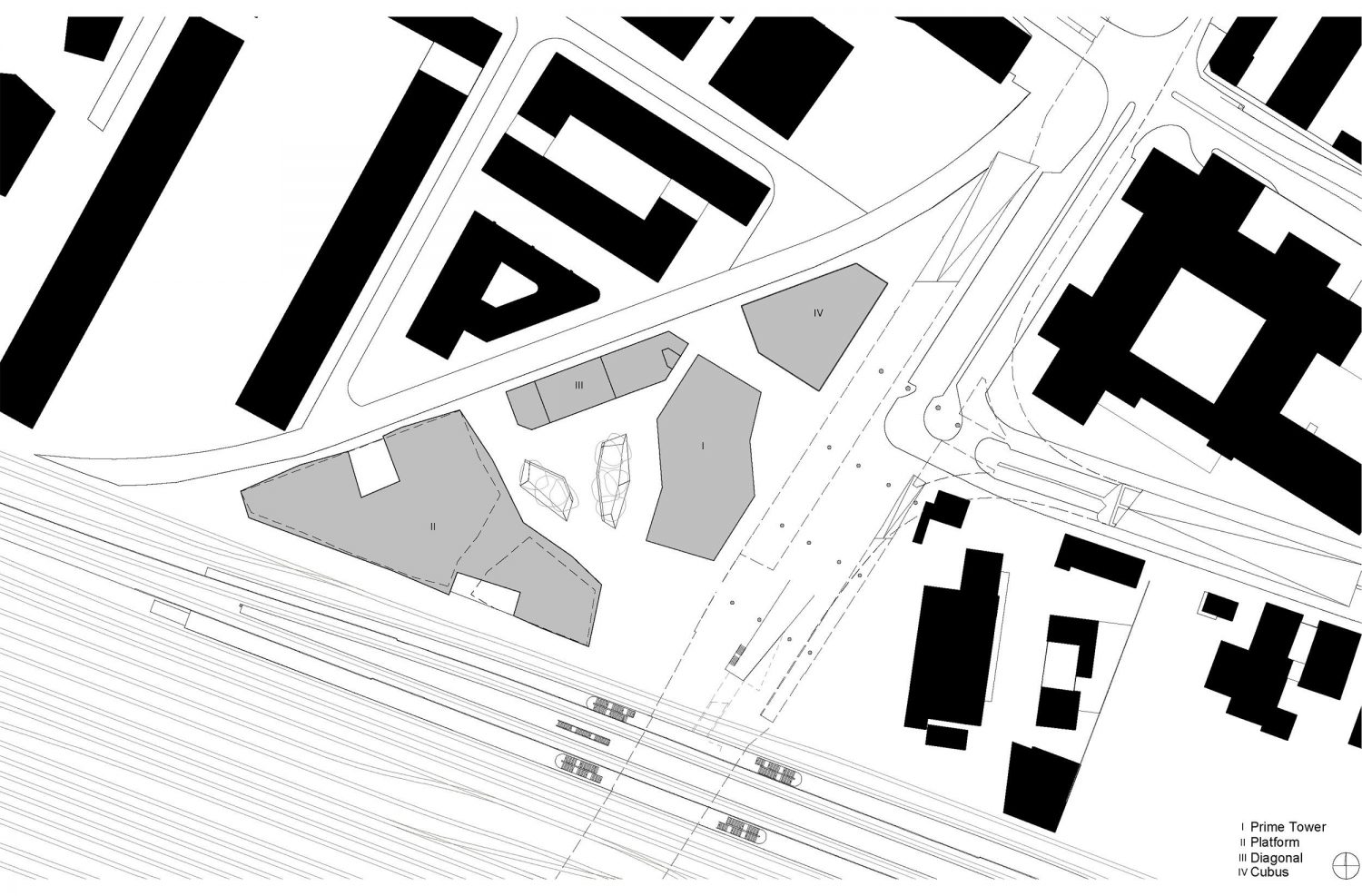
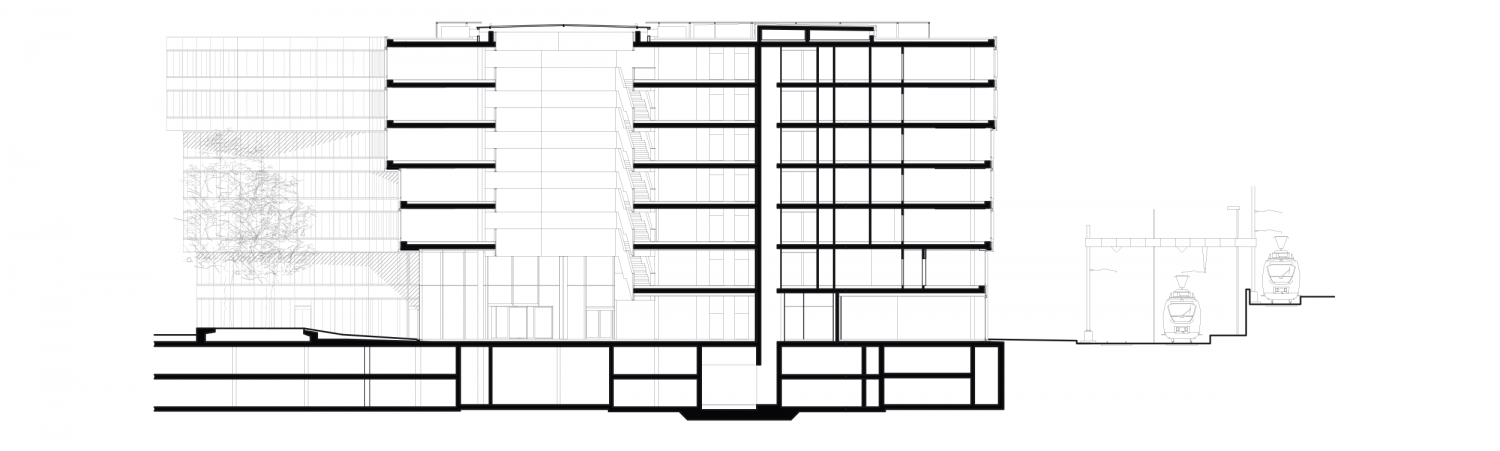
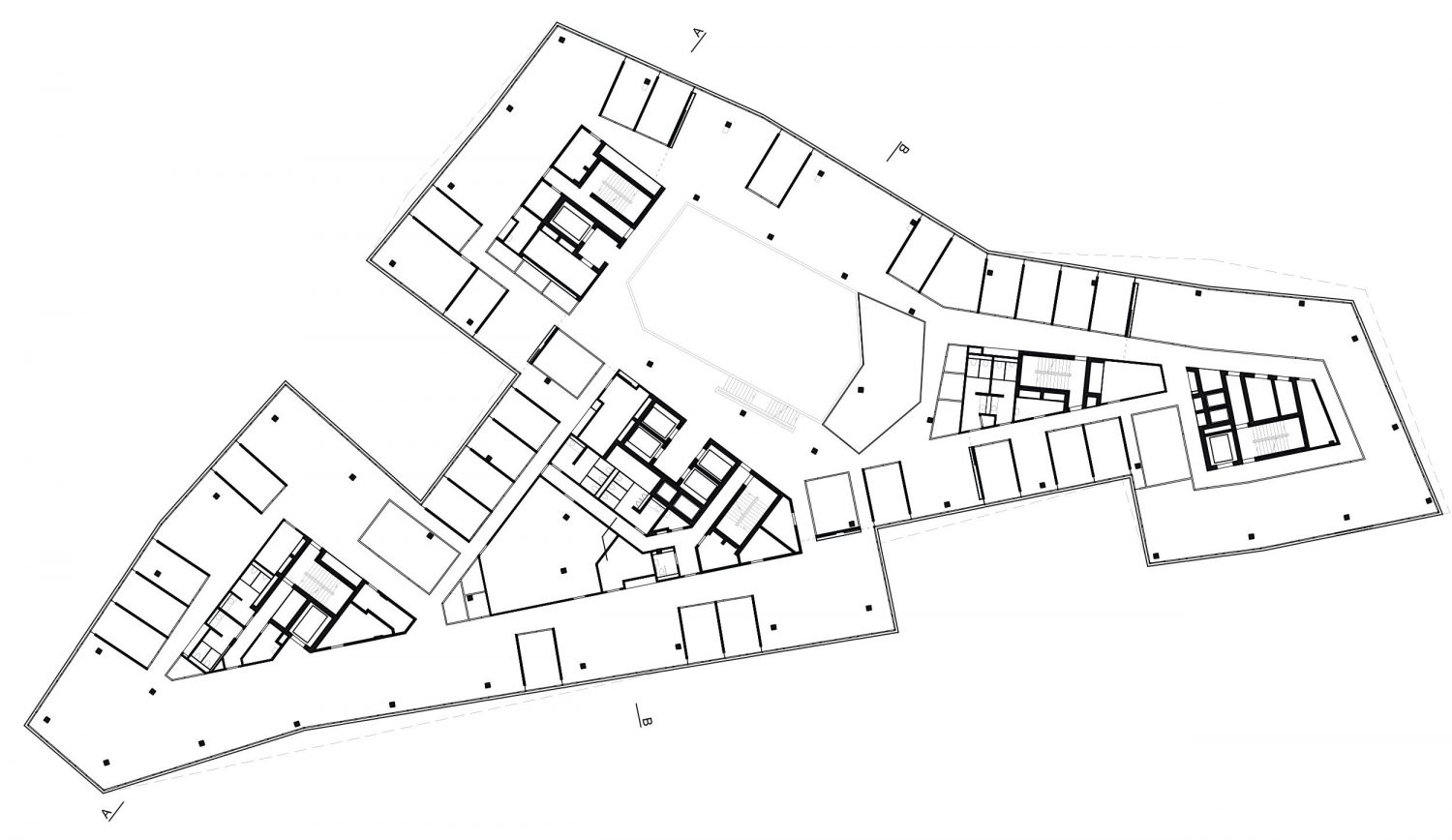
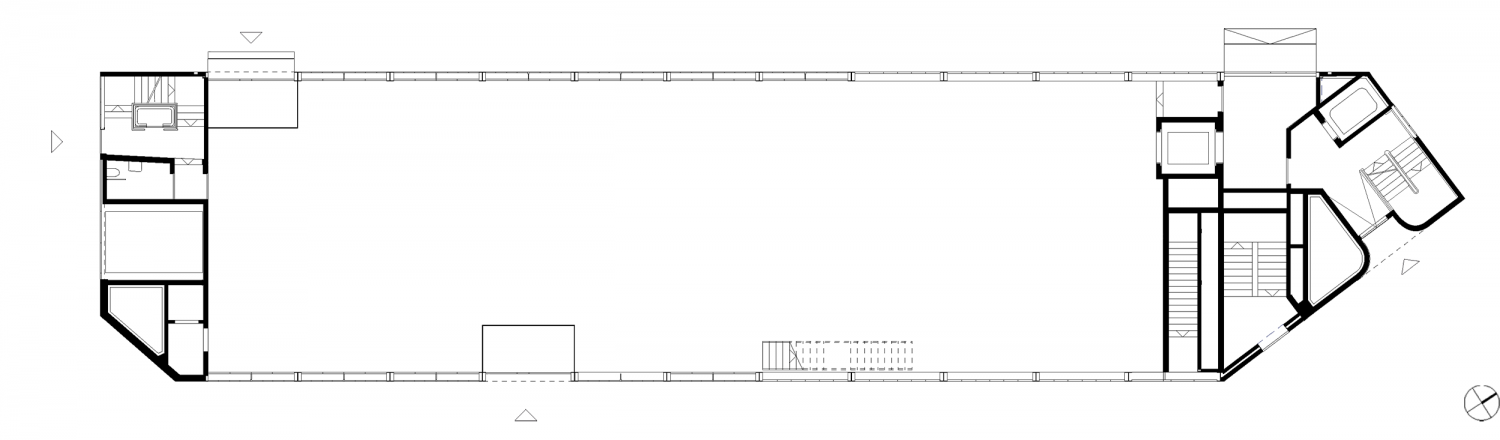
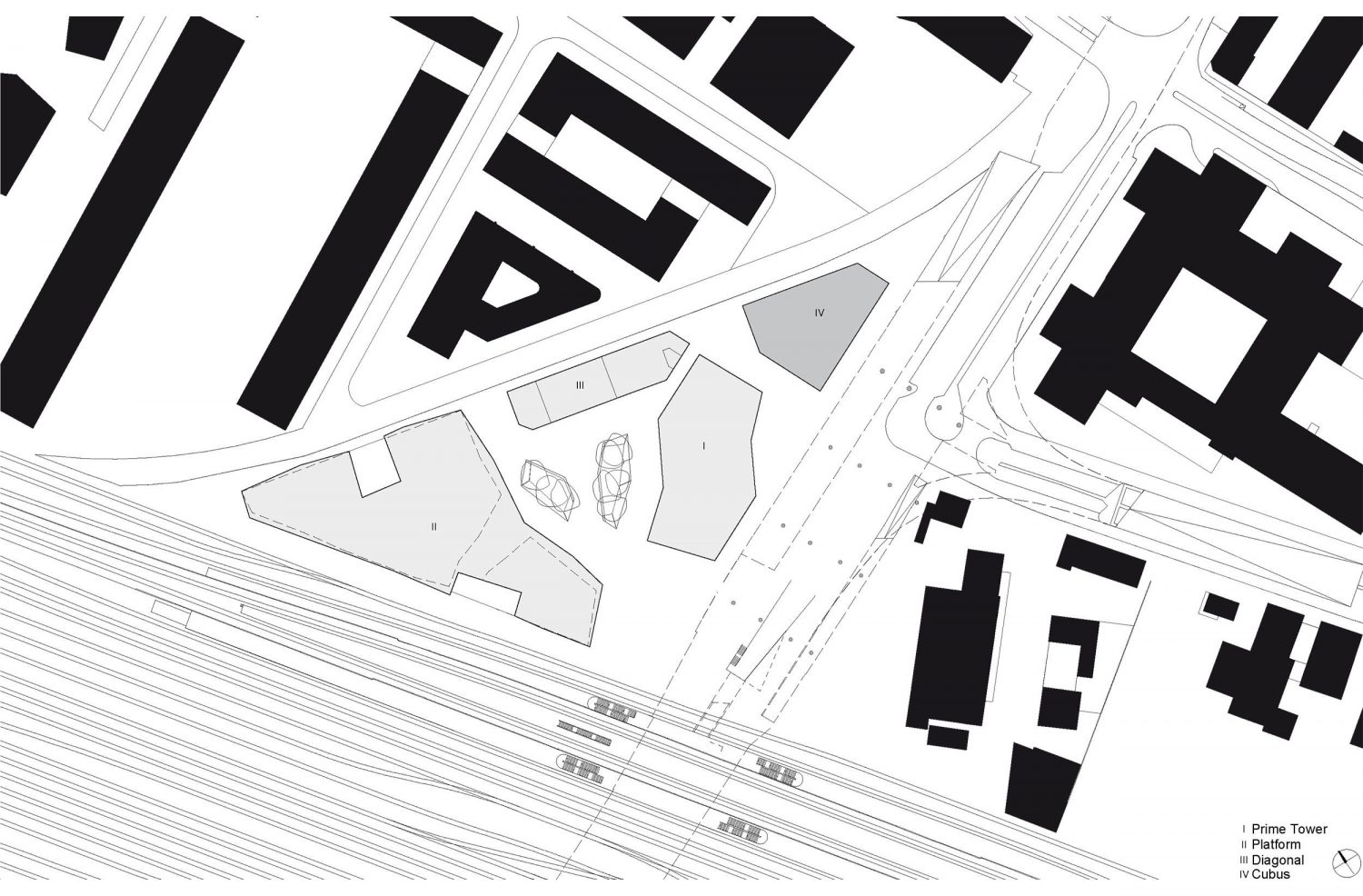
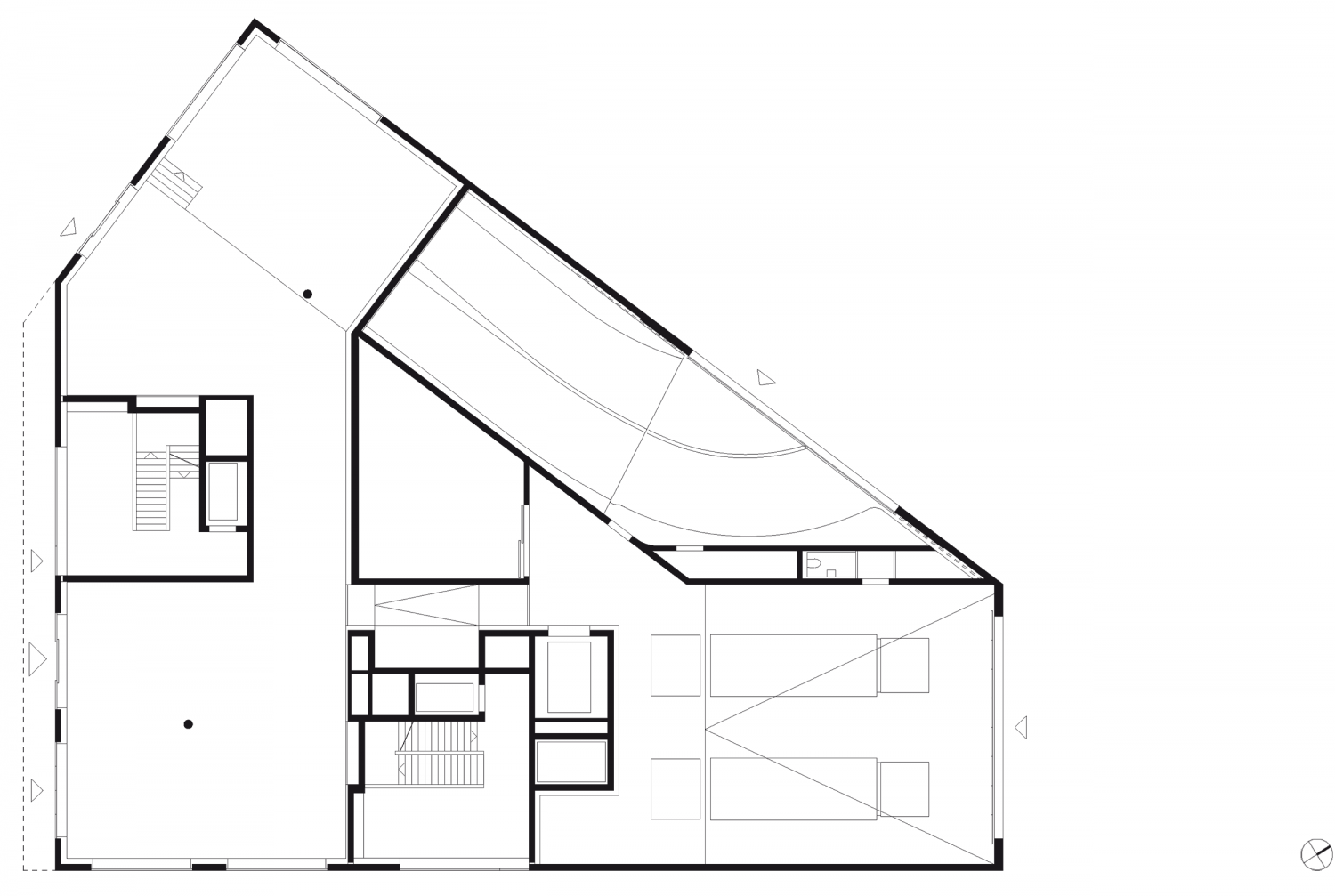
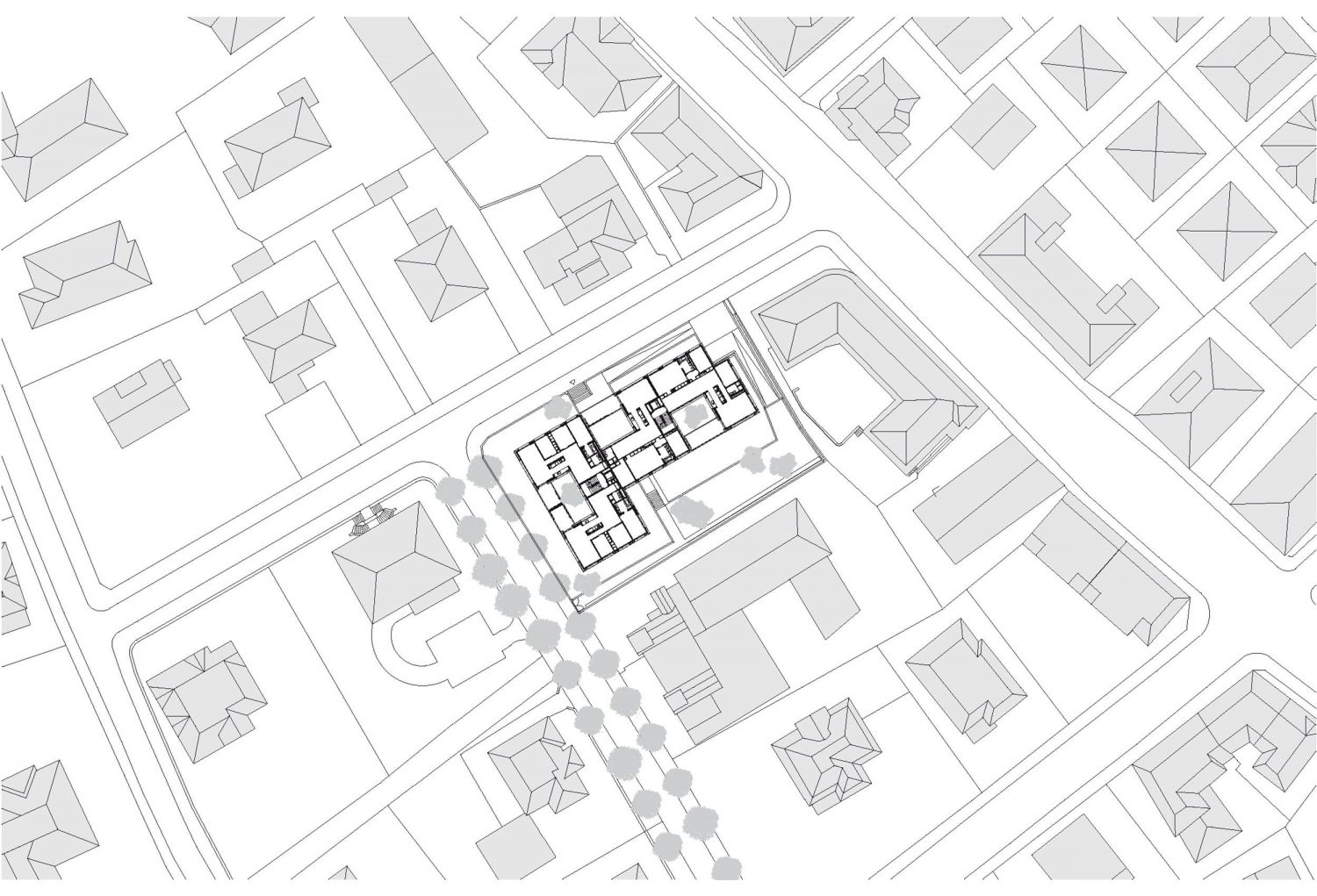
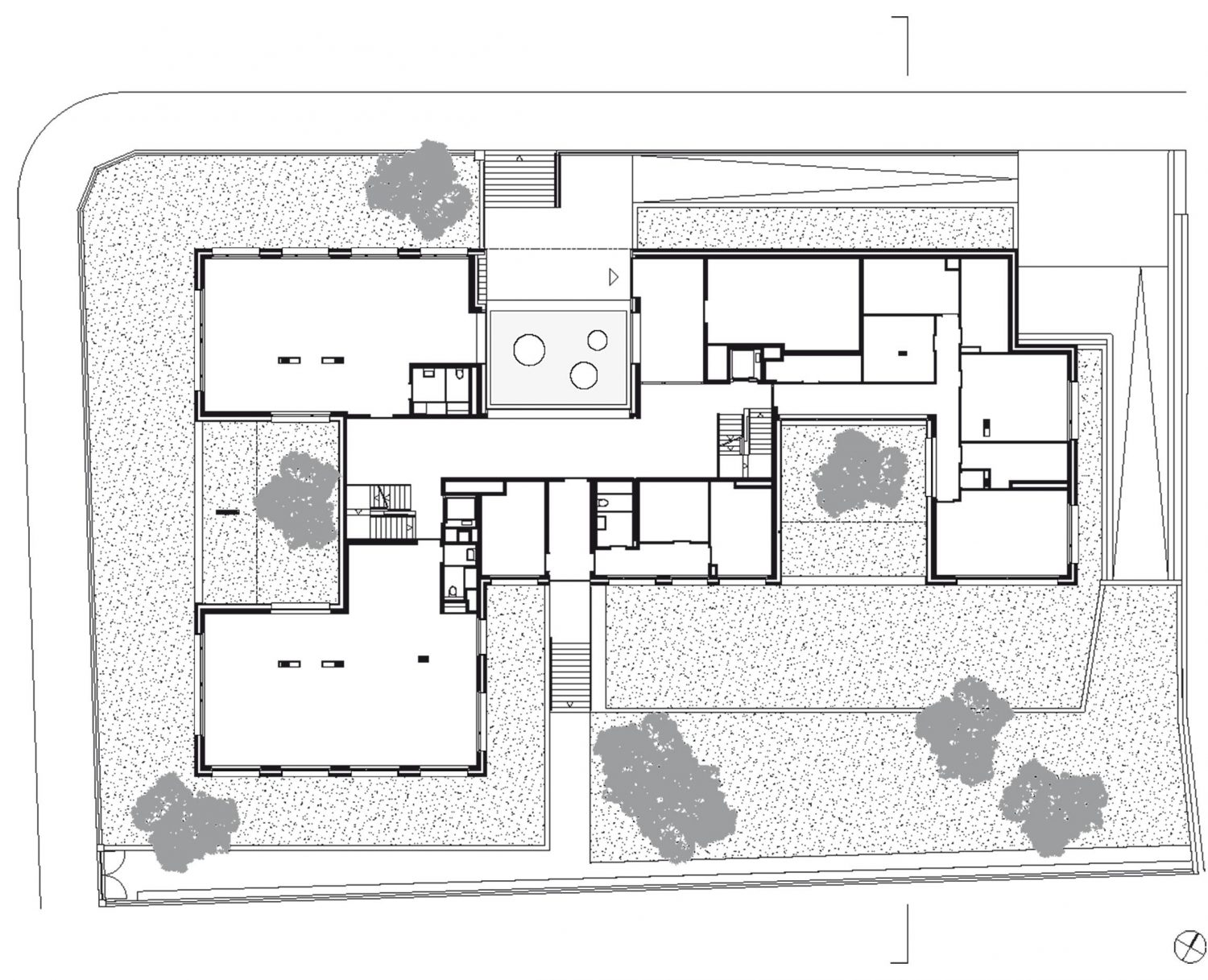
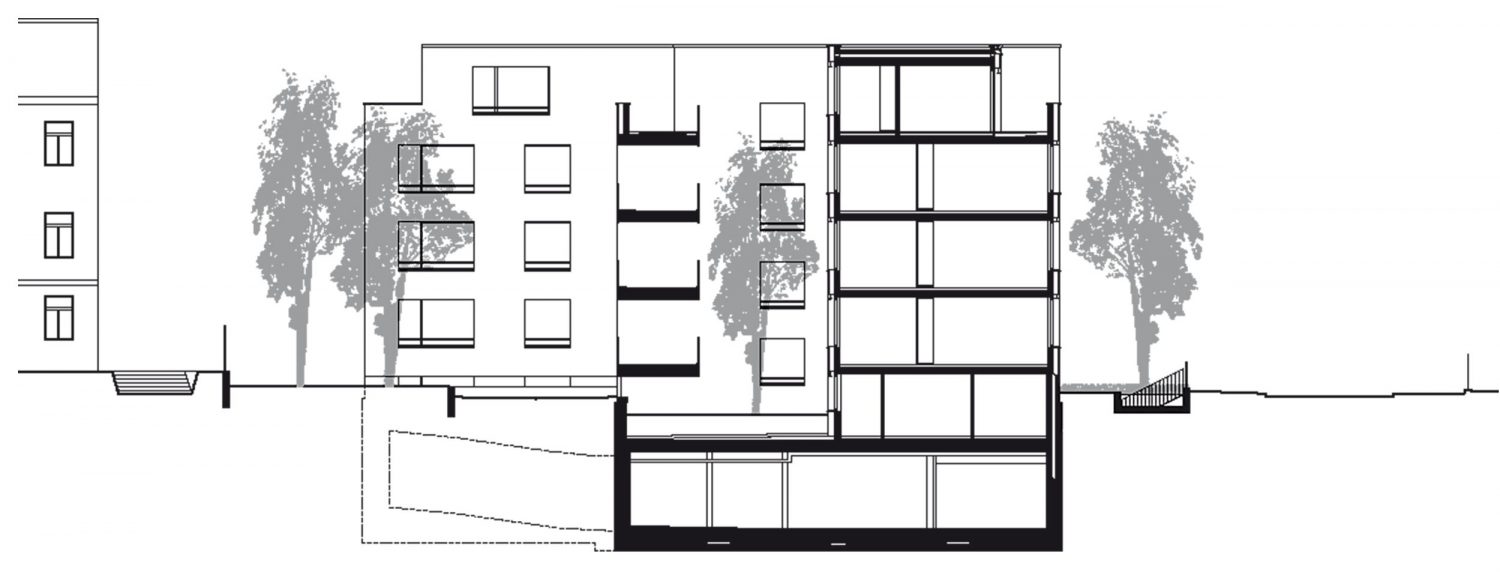
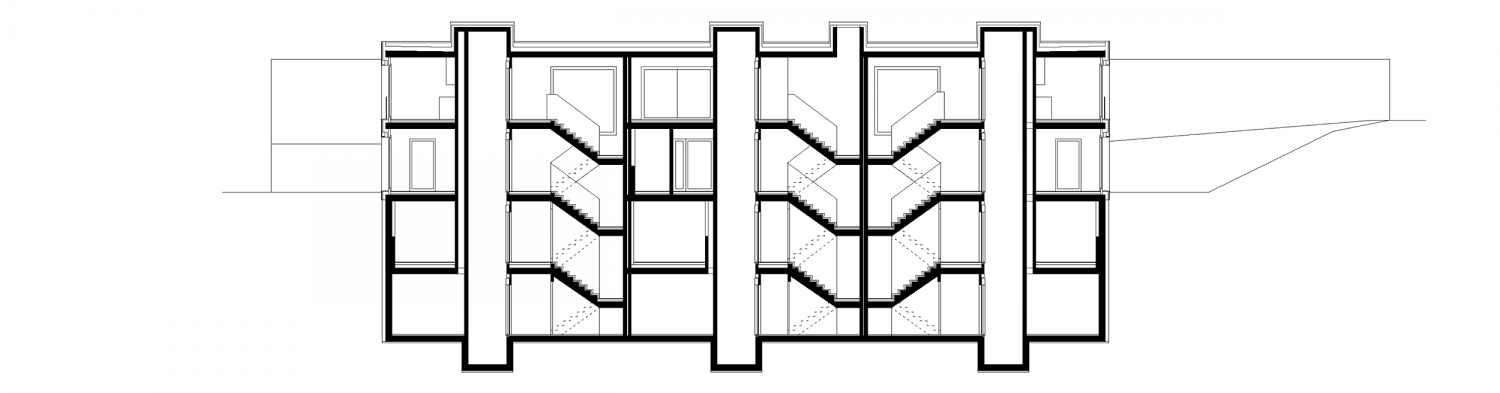
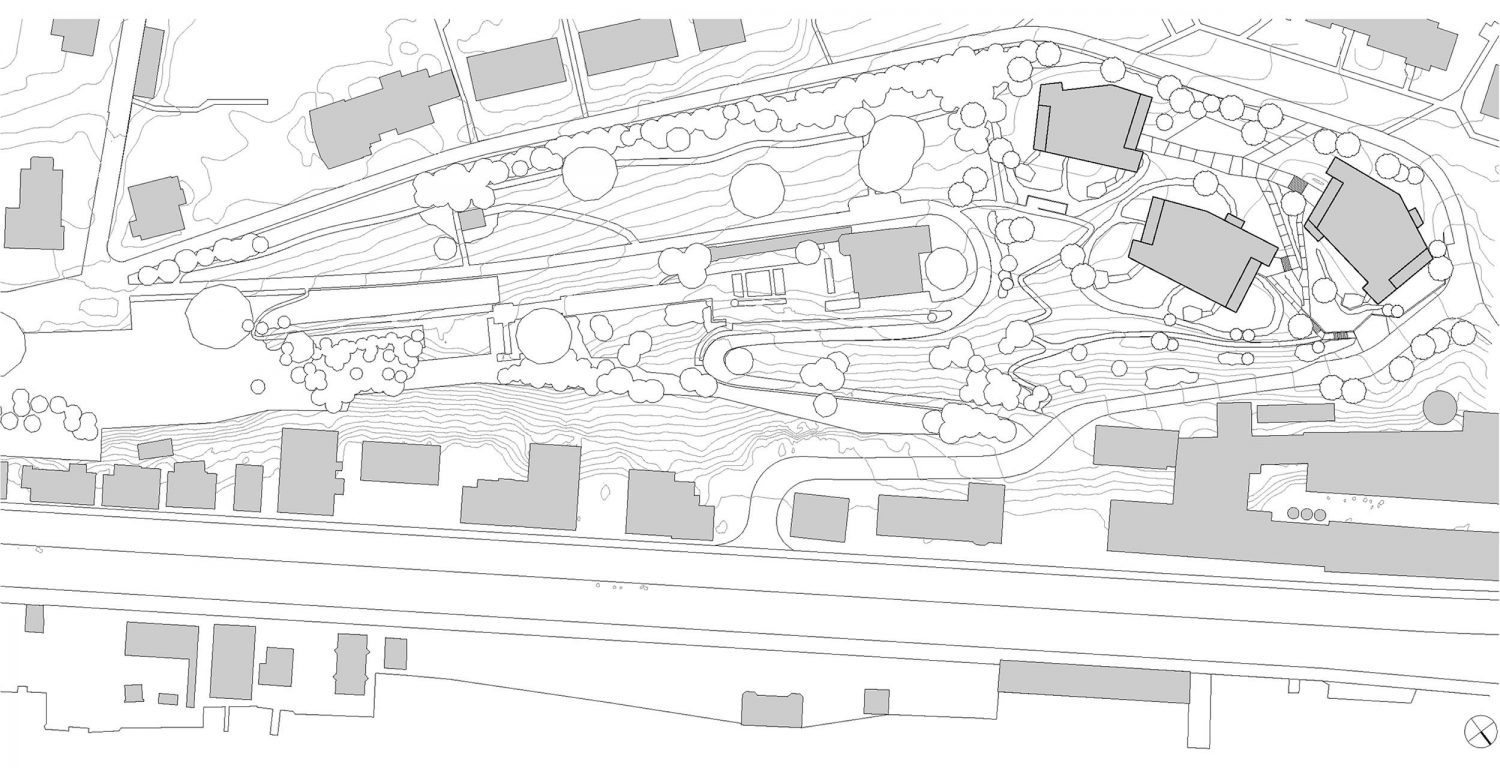
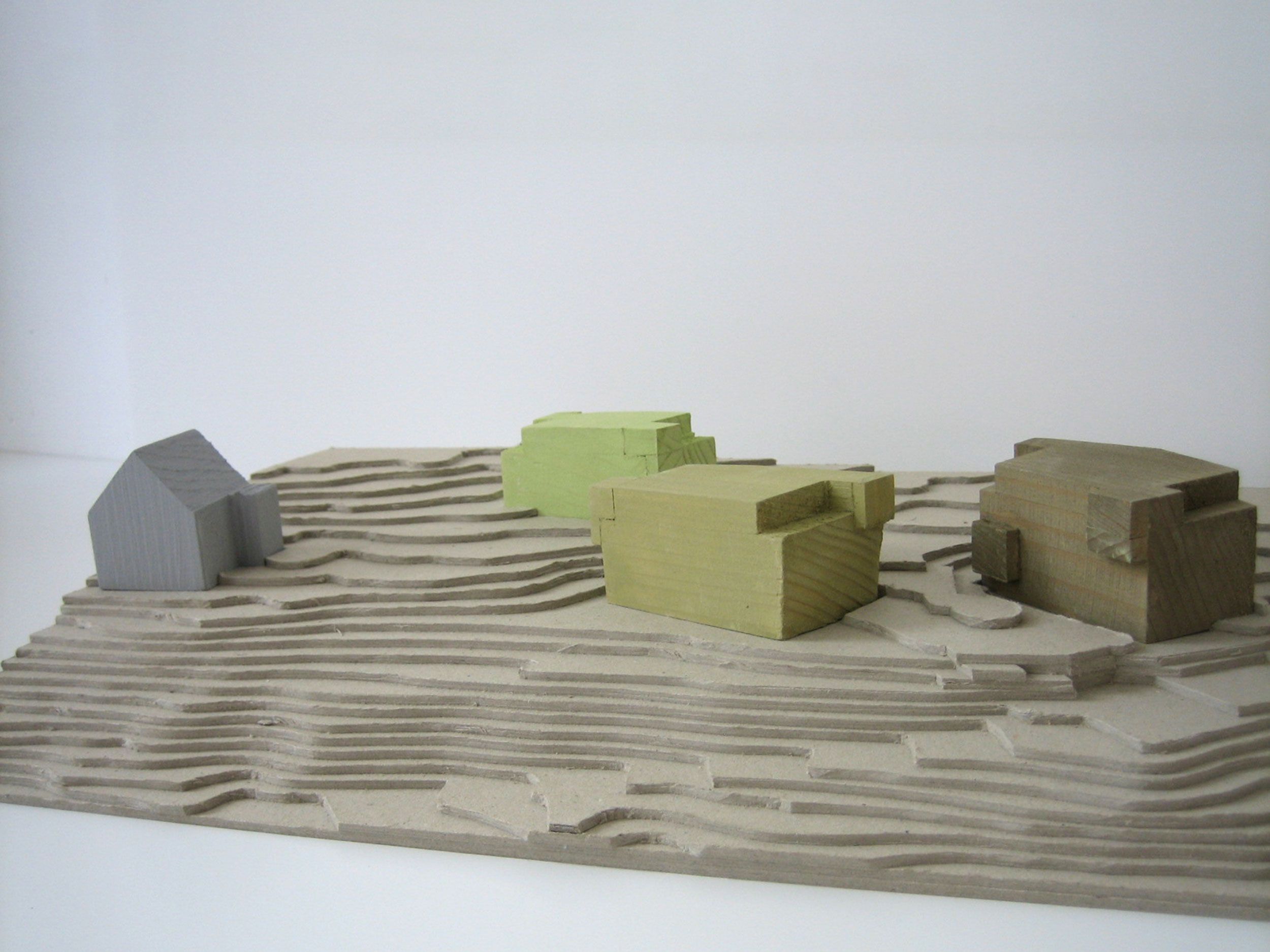
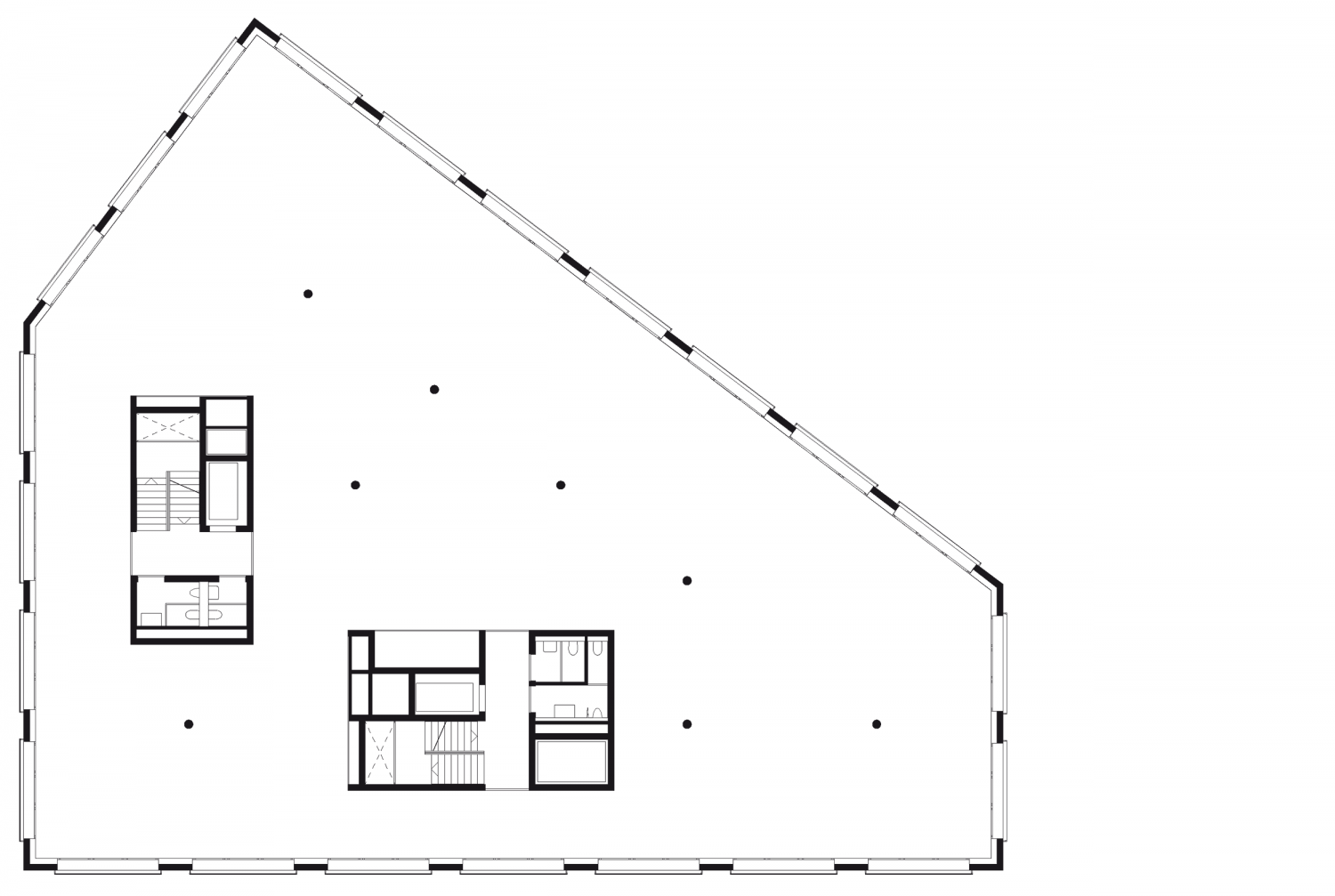
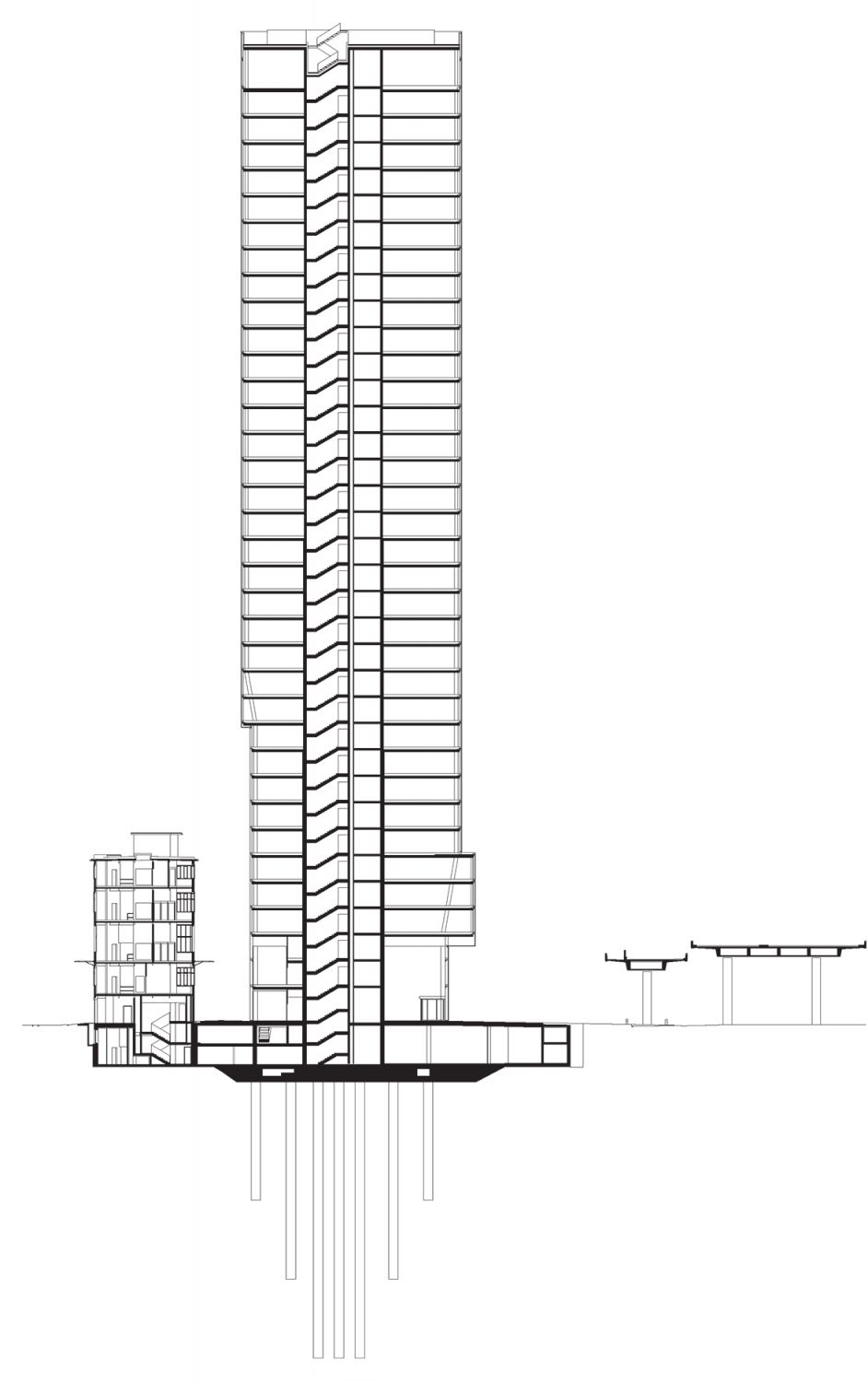
The Cubus annex building, a seven-story structure with a pentagonal ground plan, houses offices on the upper floors and at ground level retail outlets, access to the parking garage, and deliveries for the entire complex. Of note here is that, due to the excellent public transport connections to this site, relatively few parking spaces are required. The load-bearing structure is executed in white-pigmented exposed concrete. Externally fixed glazing panels give the façade its character and help to reduce noise from the elevated road nearby.
Project Category: Buildings
Prime Tower Office High-rise
with Annex Buildings Cubus and Diagonal, Maag-Areal
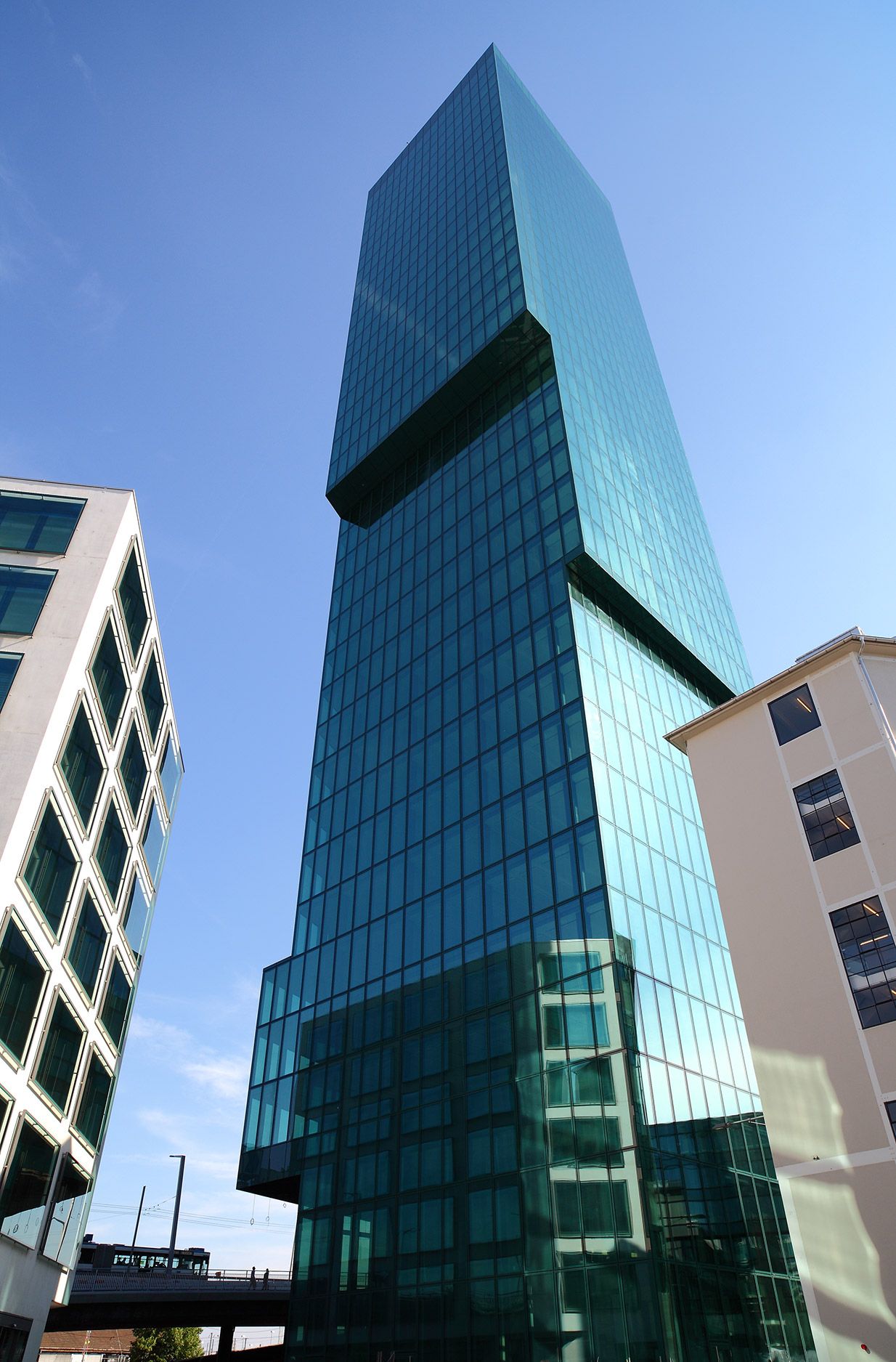
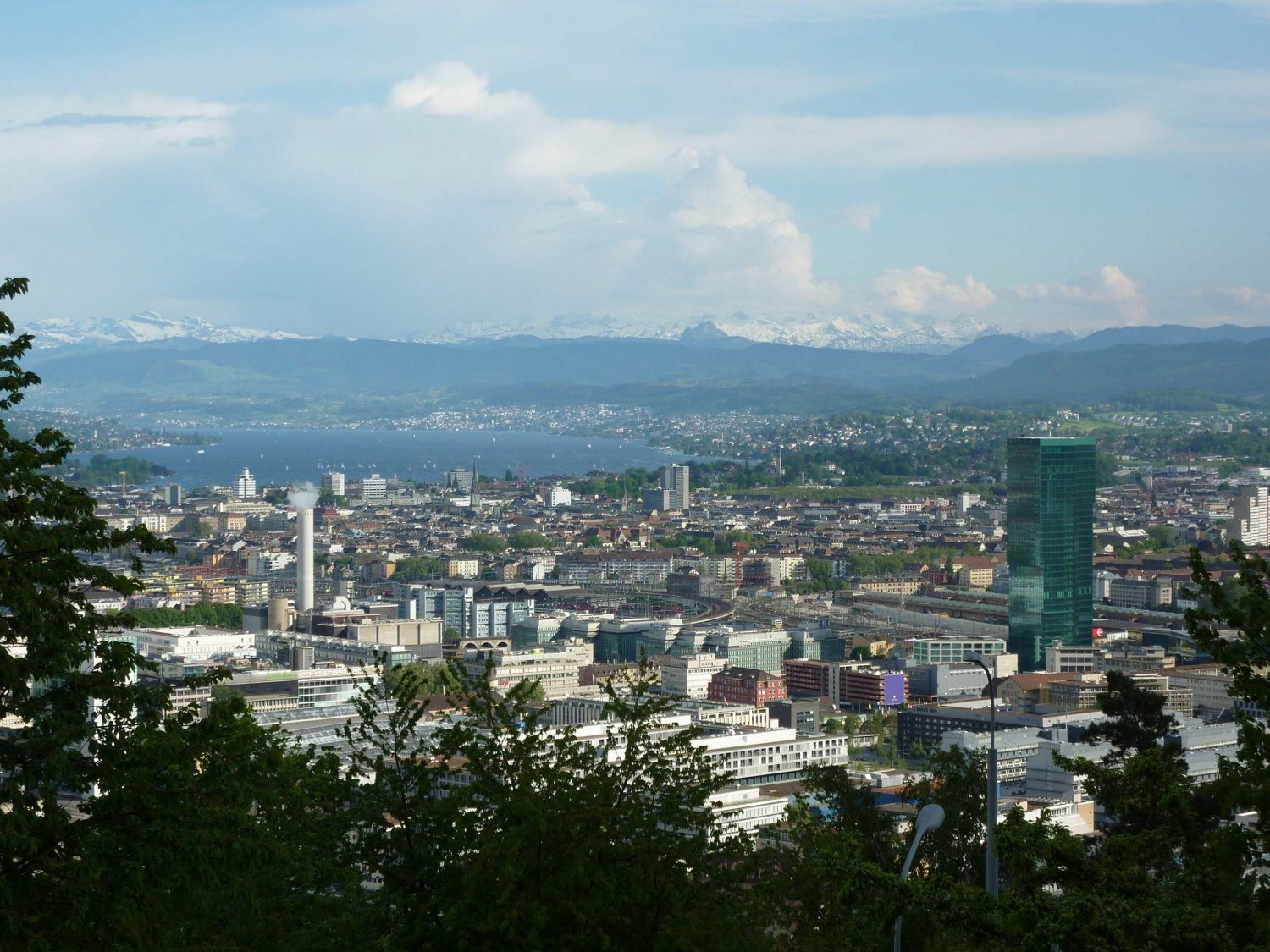
The location of the Prime Tower and its two annexes, the Cubus and Diagonal buildings, is part of a formerly almost inaccessible industrial site that is gradually being converted into a business and residential district with associated services. Situated in the immediate vicinity of Hardbrücke railway station and 126 meters in height, the high-rise is the tallest in Switzerland for the time being. It is not only a distinctive feature of the neighborhood, but also a landmark for the up-andcoming district of Zurich West.
The concept underpinning the Prime Tower is of a building that might be said to assume many guises, although its fundamental structure and the means deployed are relatively straightforward. The design aimed to find a floor plan arrangement that would maximize the number of well-lit workplaces, while also seeking to create a striking architectural form evoking differing impressions depending on the position from which it is viewed. The outcome of these efforts is a building on an irregular octagonal ground plan that confounds conventional expectations by broadening toward the top.
In terms of urban planning, the building’s significance is twofold in relation to its impact when seen from nearby or from a distance. From afar, it appears as an abstract, elegant volume formed from greenish glass that changes depending on whether it is seen from the side (from the north or south) or head-on (from the east or west). The planes of the façade, oriented in various directions, reflect the light and the surroundings in different ways, articulating and subdividing the volume into what might be called gigantic “pixel surfaces”. The impression the building makes when seen close-up also changes with the spectator’s standpoint. These close-up views reveal that the projecting portions of the tower exert an integrating effect on the surrounding buildings.
At Geroldstrasse, an inviting outdoor area between the high-rise and the new neighboring Cubus office building leads to the entrance of the Prime Tower and toward the planned Lichtstrasse. In the southwest, a plaza is created in conjunction with the existing listed Diagonal building and the new Platform office building beside the railway.
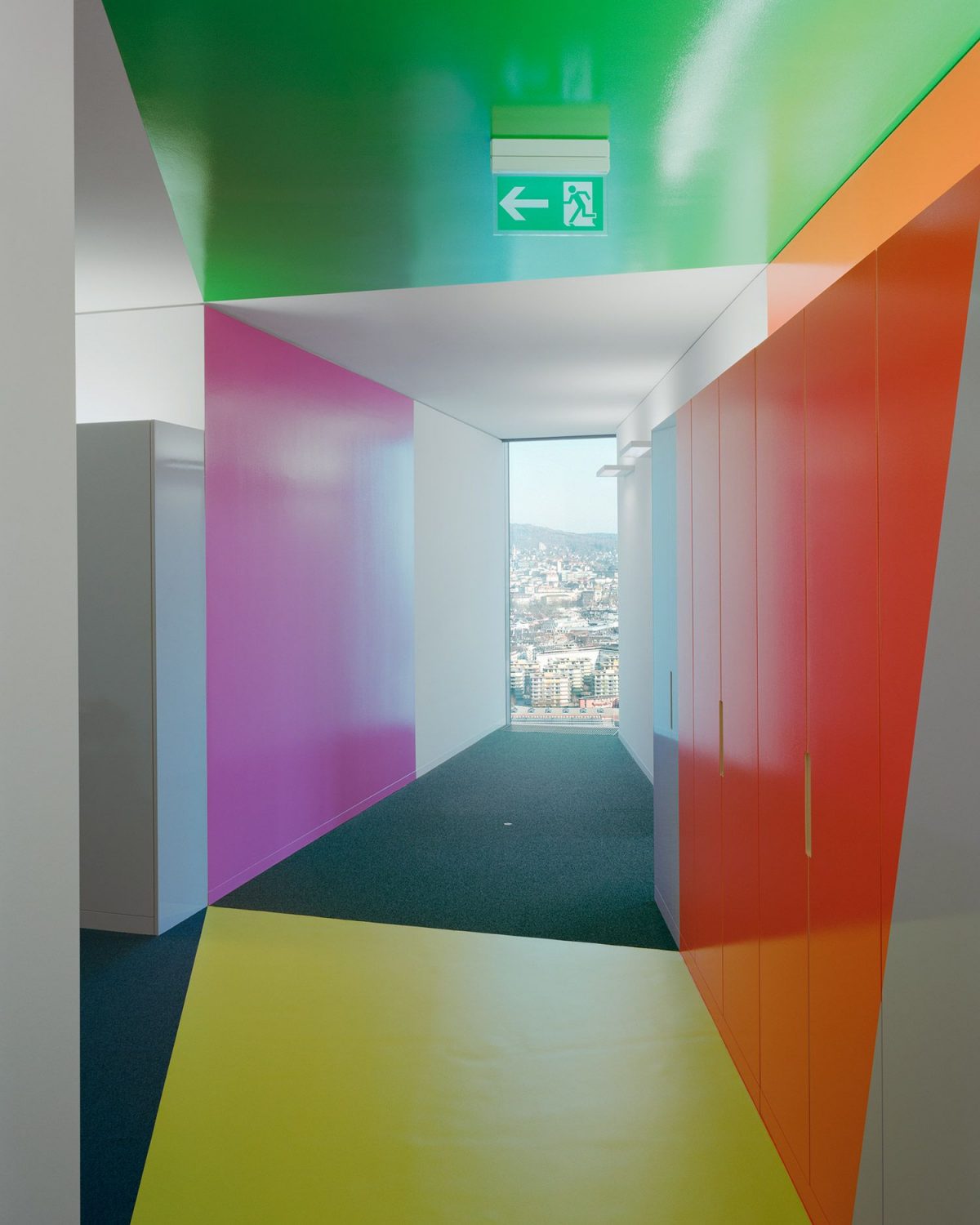
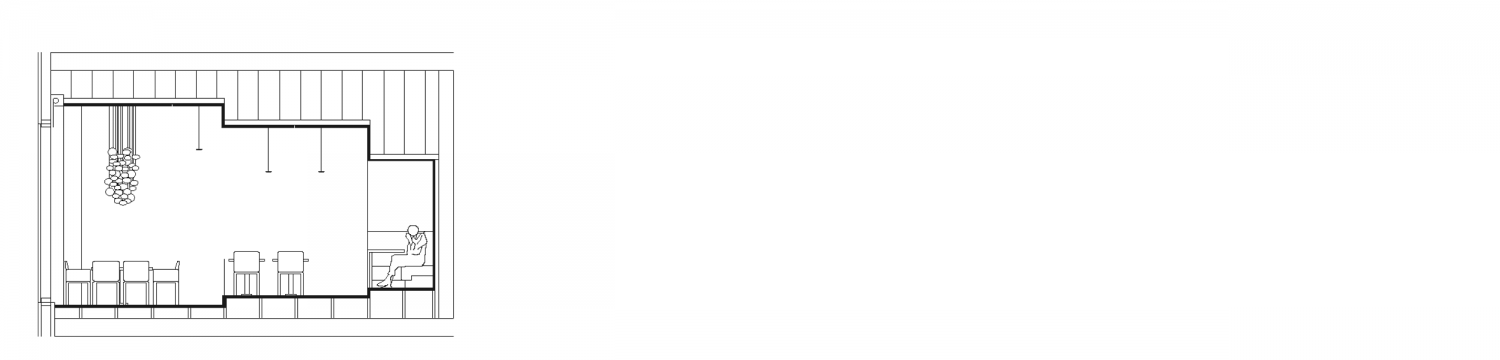
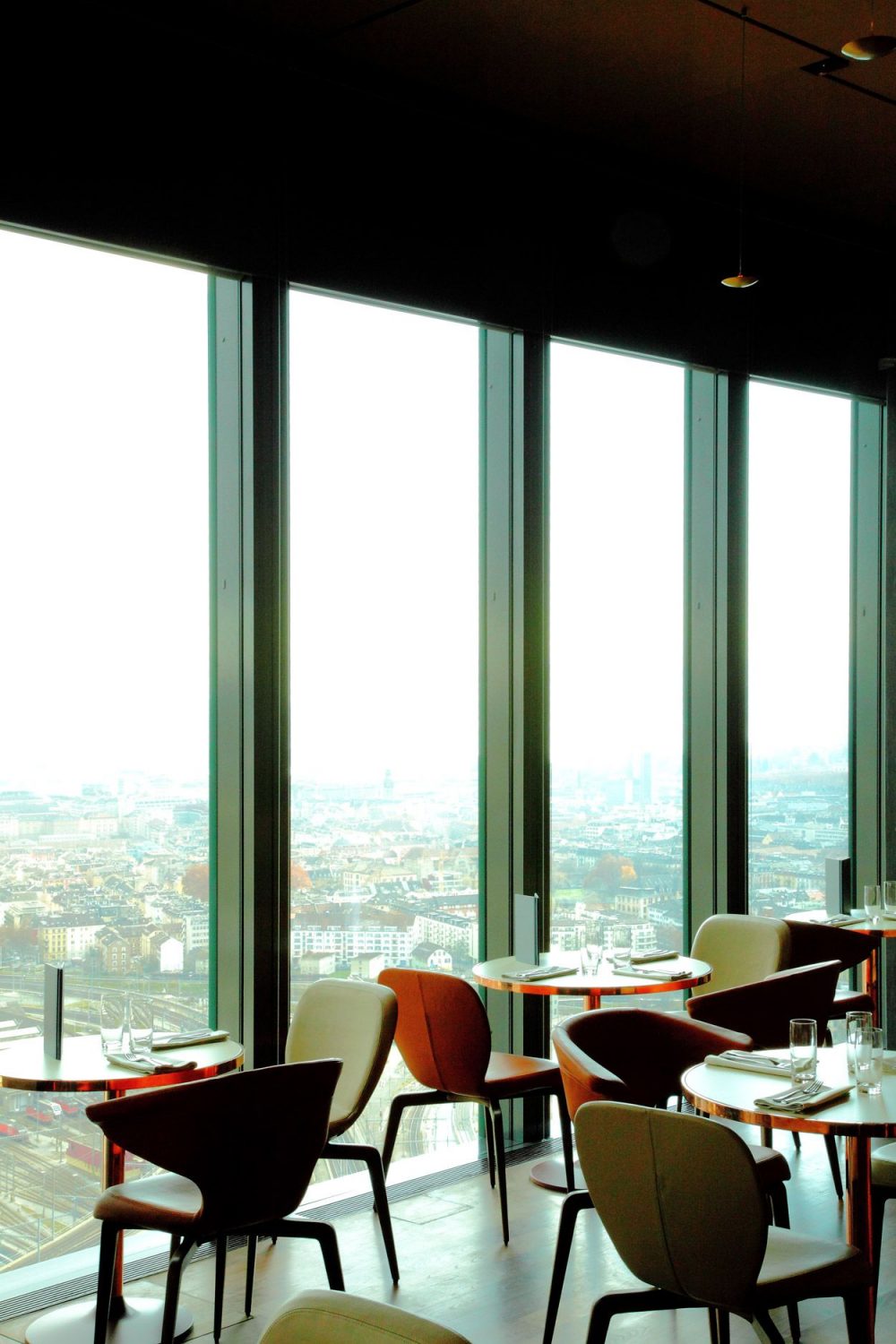
The ground floor of the Prime Tower houses retail spaces and a coffee bar for use by both office employees and passers-by. Special features on the top floor include a public restaurant, bistro with a bar, and a lounge, while a private conference area is available on the floor below.
The cores and emergency stairs are arranged so that up to four tenants can occupy offices on the same floor or, conversely, one business can occupy several floors with internal atriums and staircases. The projecting portions of the building create additional office space on the higher and therefore more soughtafter floors, as well as providing greater variety when using the space for different types of offices.
The load-bearing skeleton structure of the tower is made of concrete with reinforcing cores. The variously sized cantilevered projections are supported by slanting the supporting columns over two or three stories. The façade is constructed from insulated triple glazing with a greenish tint. To enhance workspace conditions, and to meet fire regulations, which require smoke ventilation, alternating windows can be opened parallel to the building. The prefabricated windows are frameless on the exterior. They grant the polygonal building the multifaceted appearance of a greenish crystal.
Housing Complex Diggelmannstrasse
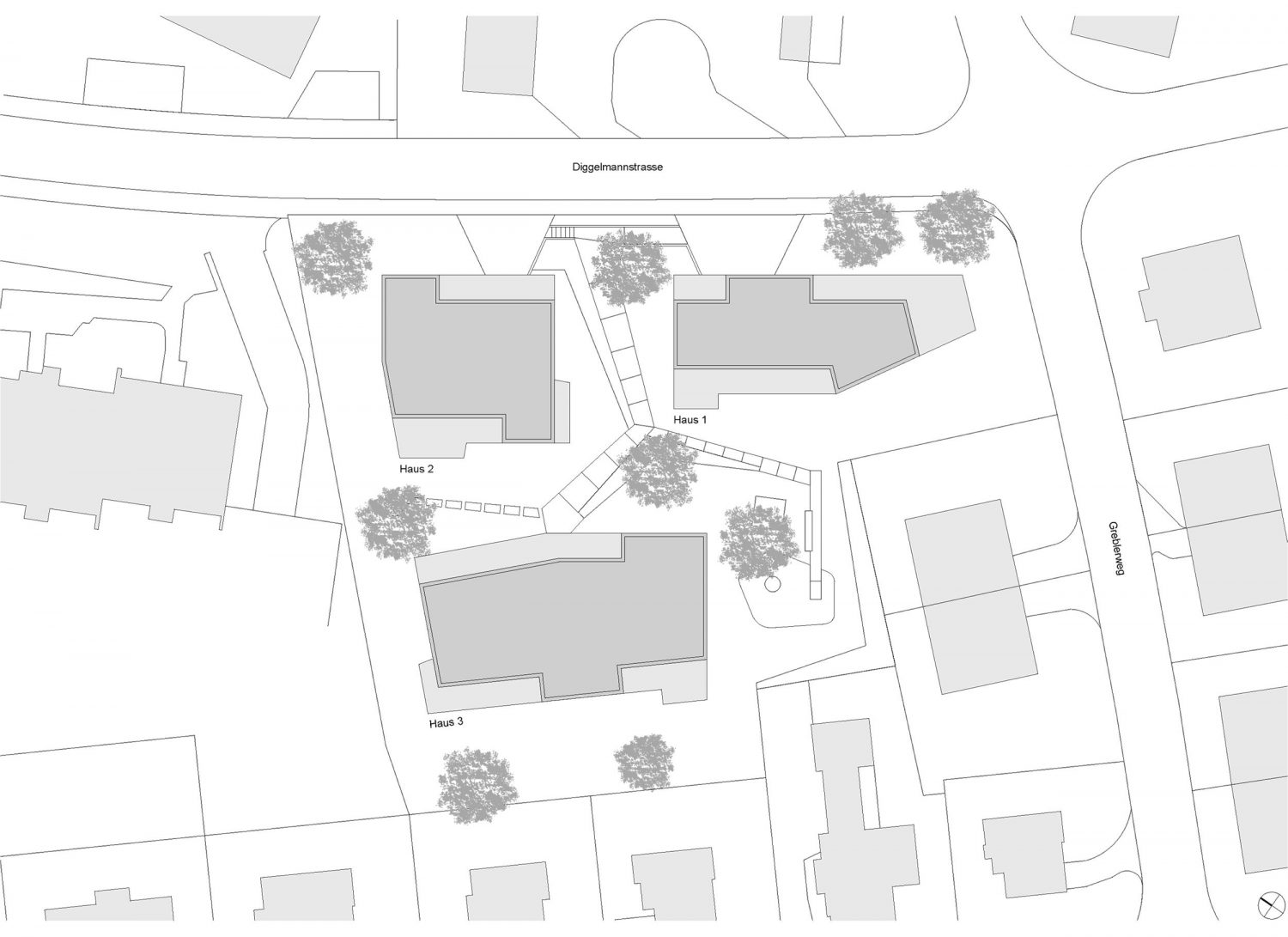
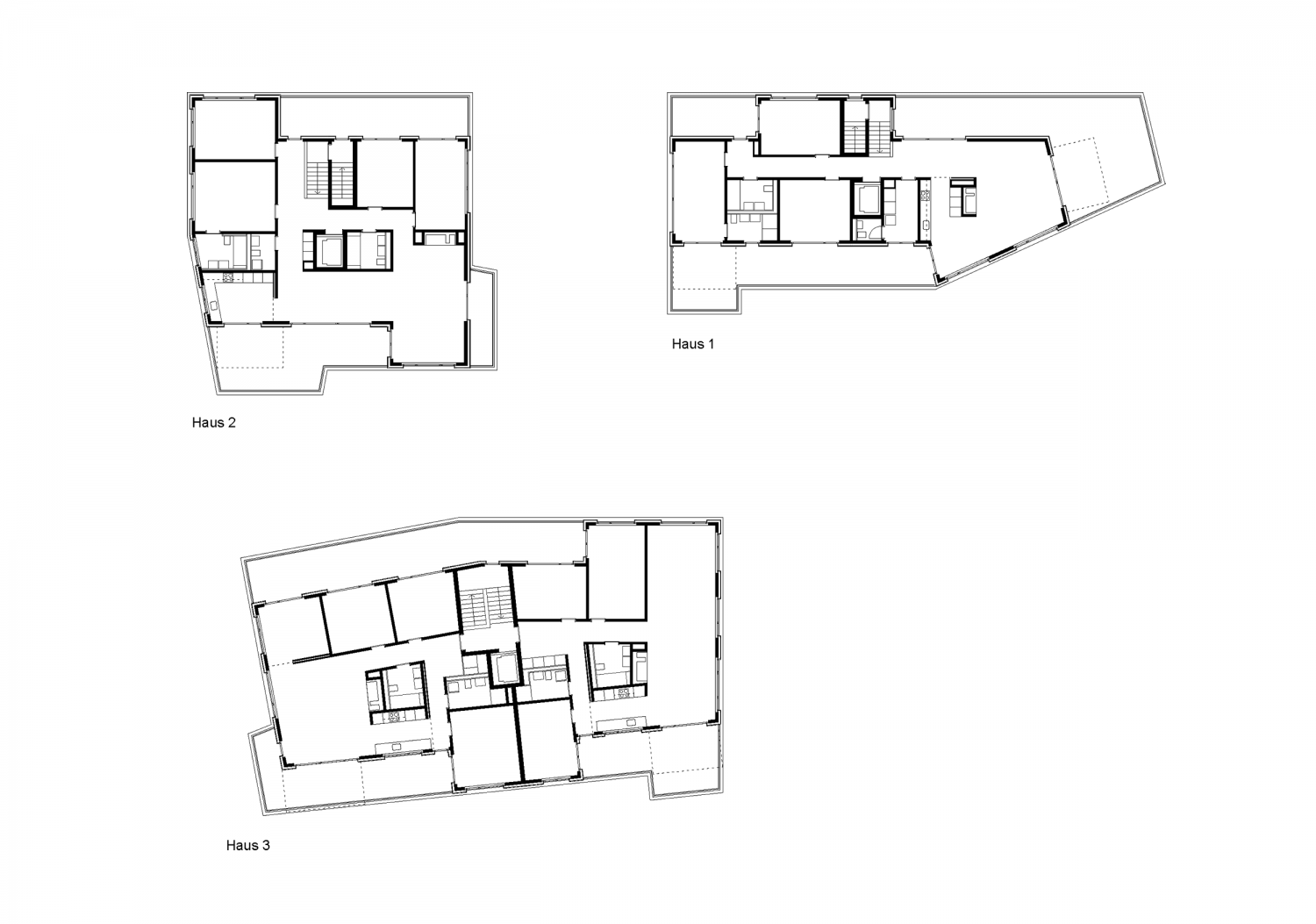
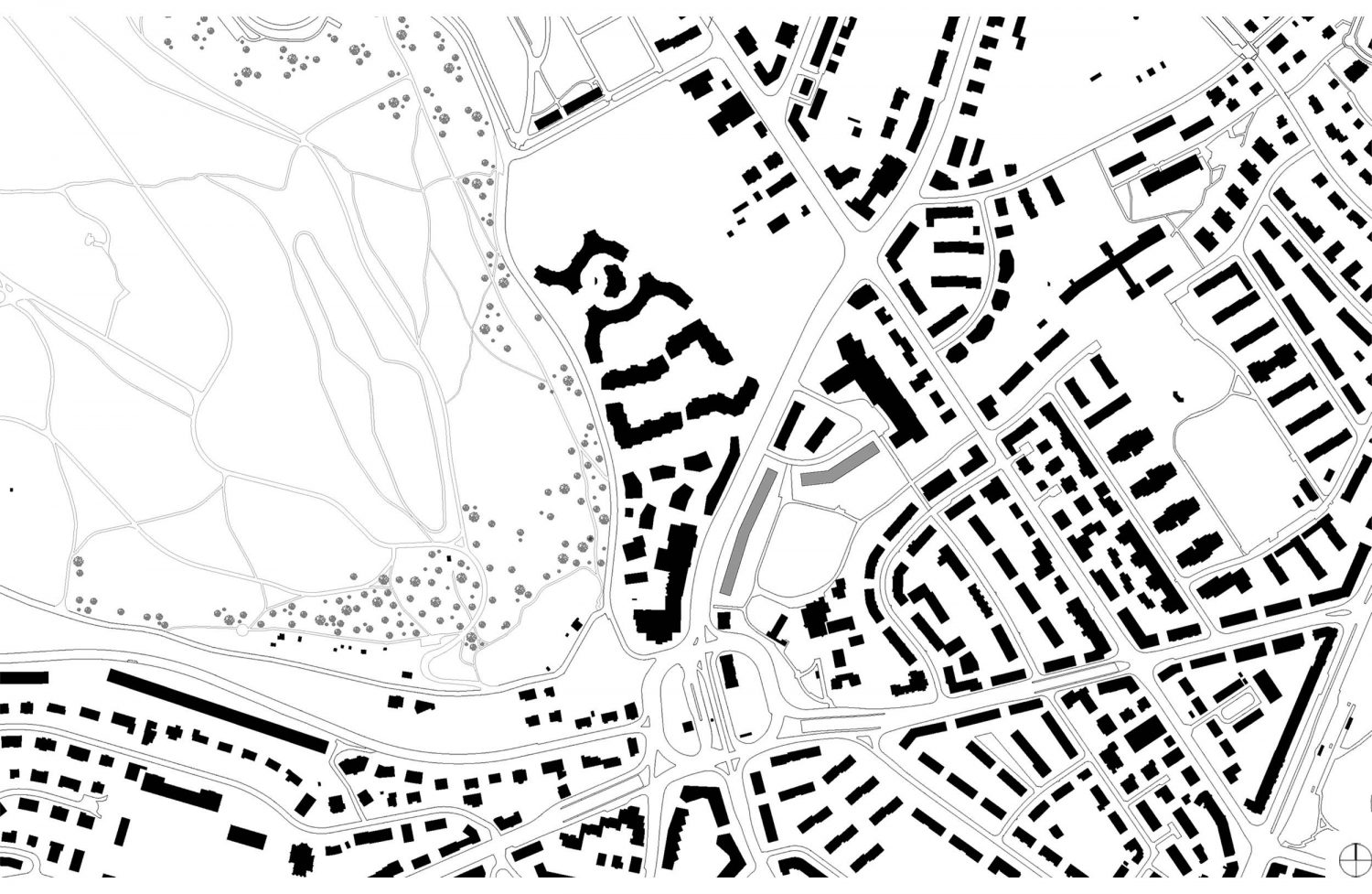
The small-scale and heterogeneous structure to be found in Zurich’s Albisrieden residential district was the reason for dividing up the projected volume into several units. The multiple occupancy buildings with their polygonal volumes and varied footprints are grouped together on one plot. The materials used provide a common link, with the overall color scheme defining the buildings as a group, but also differentiating them and establishing a correlation with the surrounding built environment.
Access to both buildings in the north is gained directly from the street at basement level. A path leads to the building behind, to the south. It forms part of a star-like figure made of large slabs set in a continuous stretch of lawn. Deciduous trees accentuate the open space and provide shady areas for relaxation.
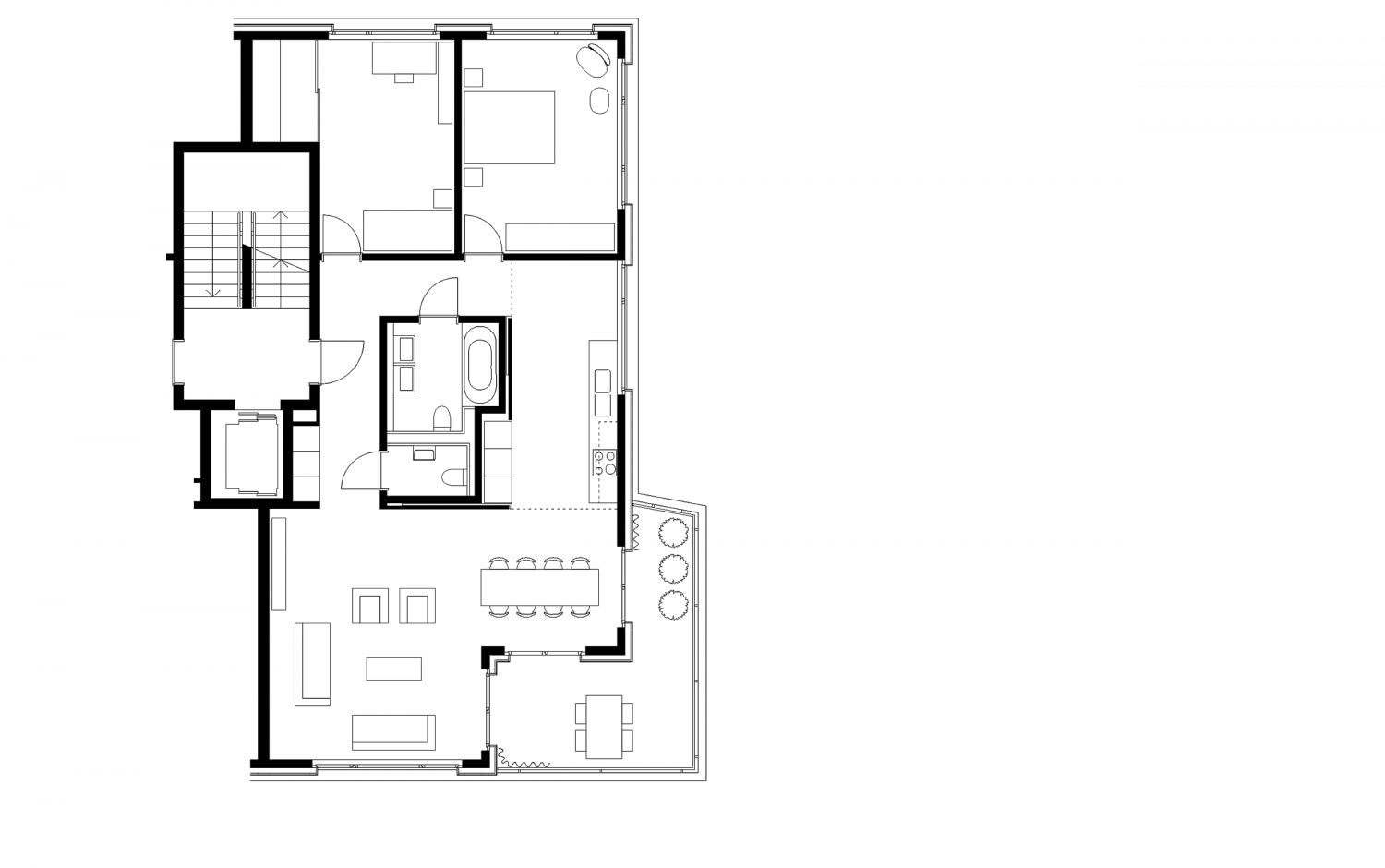
The apartments have between 2 and 4 bedrooms and varied, polygonal floor plans. Generously-sized balconies facing different directions lead off the living areas. The amount of direct sunlight and the degree of privacy required on the balconies can be ‘adjusted’ using curtains. The kitchens can be left open to the livingdining areas or closed with sliding doors.
The façades are articulated by alternating bands of windows and sill-height walls, which link the projecting balconies and recessed roof terraces to form one entity. The rear-ventilated cladding of colored, enameled glass sheets alternates with translucent glazed panels of the same color around the balconies and terraces.
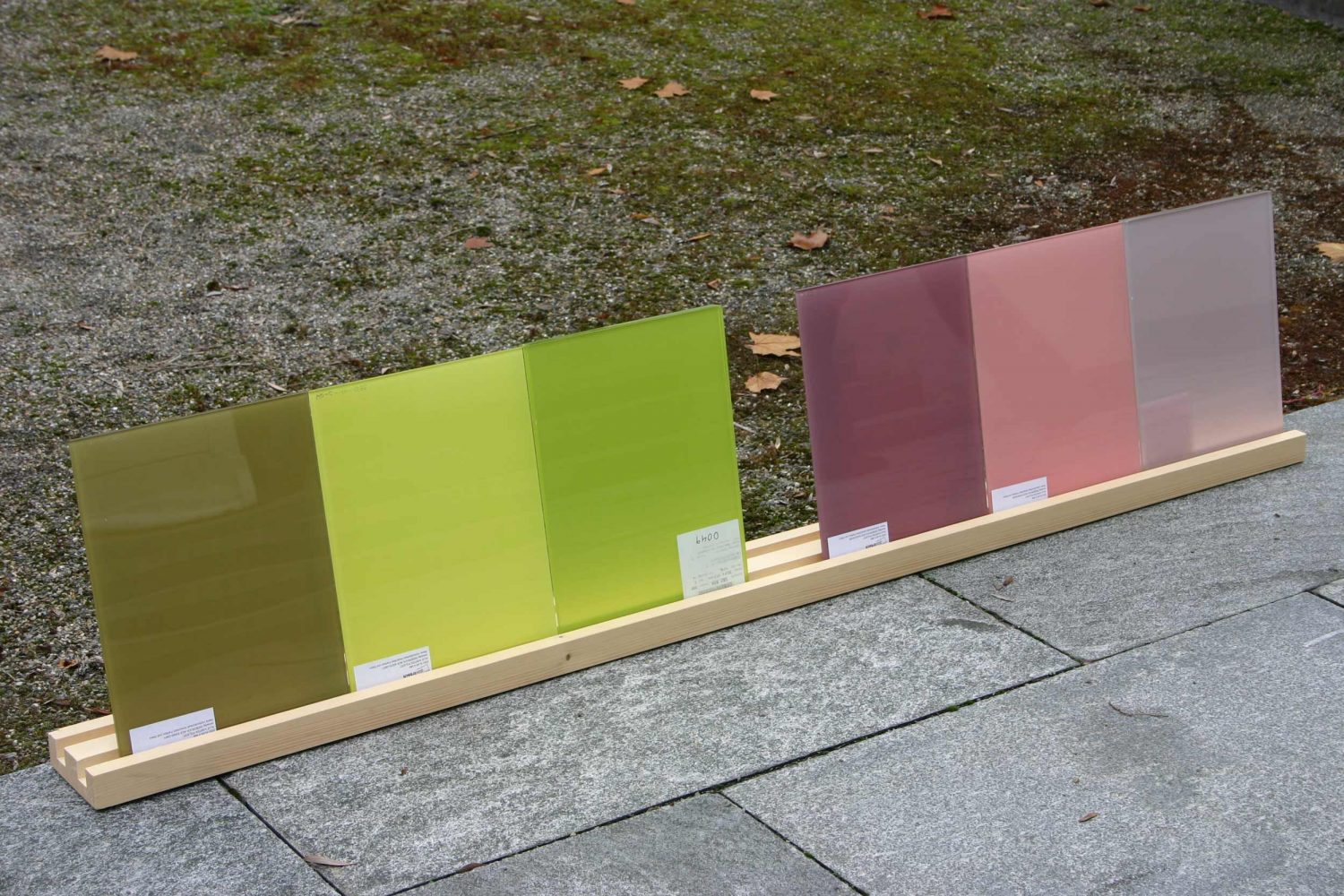
The color scheme was devised in close cooperation with the artist Adrian Schiess. The two colors selected for the smaller buildings closer to the road are a yellowish-green up to sill height and a purple shade for the wall areas between the windows. A combination of pink and beige was chosen for the larger building in the garden to the south. The overlapping reflections across the colored glazed panels interweave not only the ‘color layers’ of the buildings, but also the neighboring structures, trees, and the color of the sky to form part of the optical impression created.
Housing Development Brunnenhof
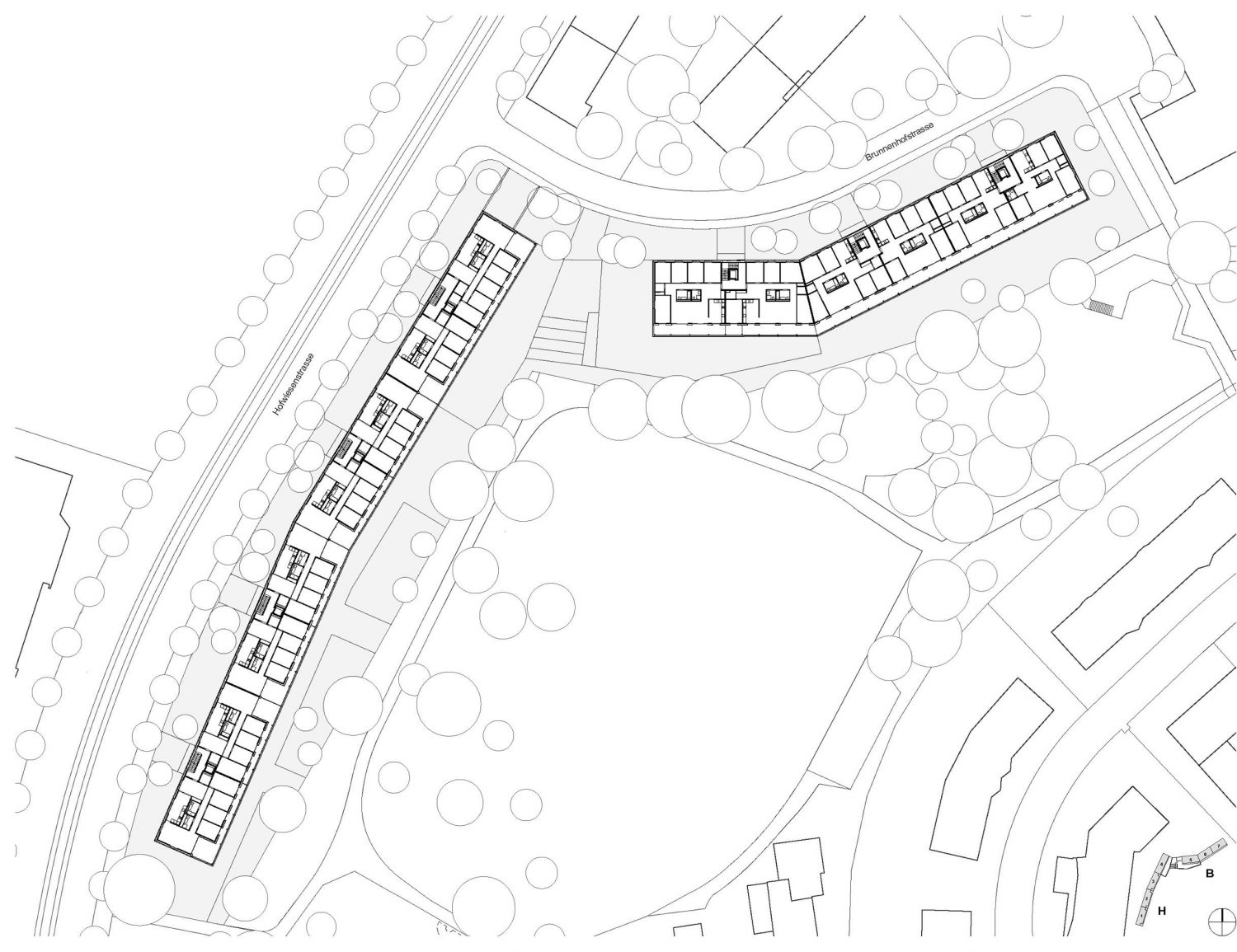
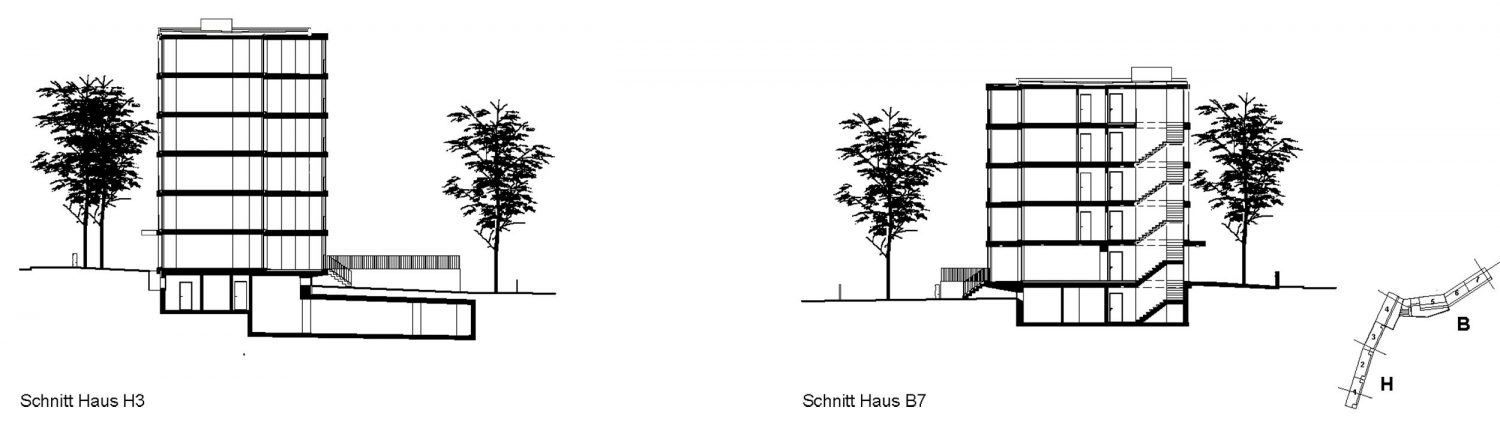
The former, noise-exposed three-story apartment buildings owned by the Foundation for Large Families in Zurich have been replaced by two slightly angled, elongated volumes of different heights. The larger, six-story building follows Hofwiesenstrasse but is oriented toward the park, which it shields from the street and hence from traffic noise. The smaller, four- to five-story building on Brunnenhofstrasse is in a certain sense within the park, surrounded by green on both sides with its height corresponding to that of the neighboring buildings. Both buildings are conceived as ‘stacks’ of horizontal slabs which cantilever to varying degrees and form generous balconies on the park side.
For the noise-affected building on Hofwiesenstrasse, access to the apartments is via longitudinally arranged staircases and spacious entryways that adjoin the eat-in kitchens. All bedrooms face the quiet park side and are connected by a projecting balcony. The living rooms extend through the apartment, facing both east and west and giving onto the park-side balconies.
Within the smaller Brunnenhofstrasse building, the living rooms are positioned along the façade and look onto the park to the south and southeast via adjoining balcony areas. In the four-story north- and south-facing part of the building, the eat-in kitchens are connected to the living rooms on the south side, while in the angled part of the building the kitchens enjoy the evening sun.
A circuit-like layout grants all apartment types spaciousness, freedom of movement for both children and adults, and enhanced flexibility of use. The latter is further augmented in the ground floor apartments by means of extra rooms between them that can be used by either apartment. The entrance lobbies on the ground floor are connecting rooms that link to the park and provide space for strollers, scooters, and toys. The naturally lit laundry and drying rooms are located in the basement, adjacent to the stairs.
A kindergarten and nursery are housed at the end of both buildings where the pathway to the park is situated. A multi-purpose common room takes the most prominent position at the corner between street and pathway. A continuous hedge along the street creates a green zone that provides the necessary privacy for the slightly elevated ground floor apartments. The park-facing apartments are elevated by half a story to allow the inclusion of a garden and play area between the park and the building. The hedges that run alongside the building approaches establish the border between these zones and the park.
The façades are formed by the balconies and the concrete bands that wrap horizontally around the building. Between them, floor-to-ceiling windows alternate with colored glass panels, joining together with sliding glass shades to create an interplay of reflecting and matt, opaque and translucent or transparent surfaces. The color concept was developed together with the artist Adrian Schiess. Facing the street, the glazing is dark blue and violet, while toward the park the tonality flows over large areas from blue tones to orange to yellow. The impression of the fluid, changing play of colors is enhanced by the varying positions of the sliding elements - ultimately the residents modify and create new color compositions every day, even every hour.
Préau des Enfants
The Préau* des Enfants is part of the art centre « Espace de l’Art Concret » that inhabits the Château de Mouans-Sartoux. At the initiative of the founder, the small exhibition pavilion for the art education programme was created shortly after the new museum building opened.
The structure, located in the château’s park, can be reached on foot via different paths. Similar to a large window, it opens toward nature and frames it. The horizontal structure of the light-coloured pavilion, made of exposed concrete, contrasts with the dark, vertical tree trunks.
The solid walls and roof of the Préau converge toward the centre like wings. A free standing wall in the middle, with integrated, weather-protected display cases on both sides, acts as a partition of the open space, so that courses and events can take place simultaneously. Two long, low benches made of solid wood along the open sides provide room for entire school classes and can be used to sit on or as shelf space.
The inside walls are smooth and painted white. On the outside, the concrete is left raw, with an organic texture from its visible wood formwork. In this manner, the object-like building fits into its sourroundings, between contemporary art and nature.
* French for a covered open schoolyard pavilion
Housing Development Neumünsterallee
The building turns a corner at the intersection of Neumünsterallee and Signaustrasse, creating a sunny garden area between its two wings that faces southeast. In addition, portions cut out of the overall volume form small courtyards on three sides, resulting in a meandering shape that links outside and inside spaces. One of the cutouts faces the morning sun and the garden, another the noonday sun and the avenue of plane trees, and the third the evening sun and the gardens of the villas opposite. Bridge-like balconies frame the courtyards, emphasizing the main volume of the building and, at the same time, offering views into its depths. Thanks to these ‘balcony bridges,’ the courtyards, which measure approximately 7.5 by 8.5 meters, receive daylight not only from above but from the side as well.
The apartments angle around the courtyards, thereby substantially enlarging the sense of space therein. The three main stories accommodate two 5.5-room units facing the East and West Courts and two 4.5-room units facing the South Court; the top floor holds one 4-room unit facing the East Court, one 2.5-room unit facing the West Court, and a 7-room unit facing the South Court.
The courtyards allow optimal use to be made of the building’s considerable depth, because they ensure that the living spaces as well as the kitchens and the large bathrooms can all be supplied with natural daylight. The heart of each flat is a spacious hallway. Laterally illuminated from the courtyard, it is a link between the private bedrooms and the living room. Its use is not defined, but it can function, for example, as a dining room or study, or provide space for children to play. The living room opens onto the lateral terrace and the outside and has direct access to the kitchen, which also faces the courtyard.
The ground floor is lowered slightly below street level so that a half flight of stairs and a ramp lead down to the large lobby of the building, which is illuminated from the central courtyard and provides access to the two circulation cores. There are also studios that can be accessed directly from the lobby and rented as office space or for recreational activities.
The load-bearing structure of the building consists of concrete walls and slabs. Wood/metal windows, 20-centimeter-thick thermal insulation, and plaster skim on rear-ventilated cladding slabs form the shell of the building, which meets the Minergie® (energy-saving) standard.
In collaboration with the artist Adrian Schiess, the walls in the courtyards were coated with silvery paint to ‘guide the light,’ while the outside façades are painted a darker gray. The lobby is rendered in a luminous copper color, and the spectrum of iridescent ‘light-suffused’ shades continues inside the flats, where the doors of the built-in wardrobes have been given a high-gloss, mother-of-pearl finish.
A pool of water in the central courtyard reflects the light from the sky and forms the focal point of the entrance area. The other courtyards are planted with tall, delicately leafed ash trees. The slightly staggered levels of the garden each have their own vegetation. Ground-covering evergreen shrubs and grouped bushes form together with the preserved garden wall and wrought-iron fence the traditional front garden area. The area to the southeast, designated both for adults and for children at play, consists of a grassy lawn with groups of trees.
Three Single Family Row Houses
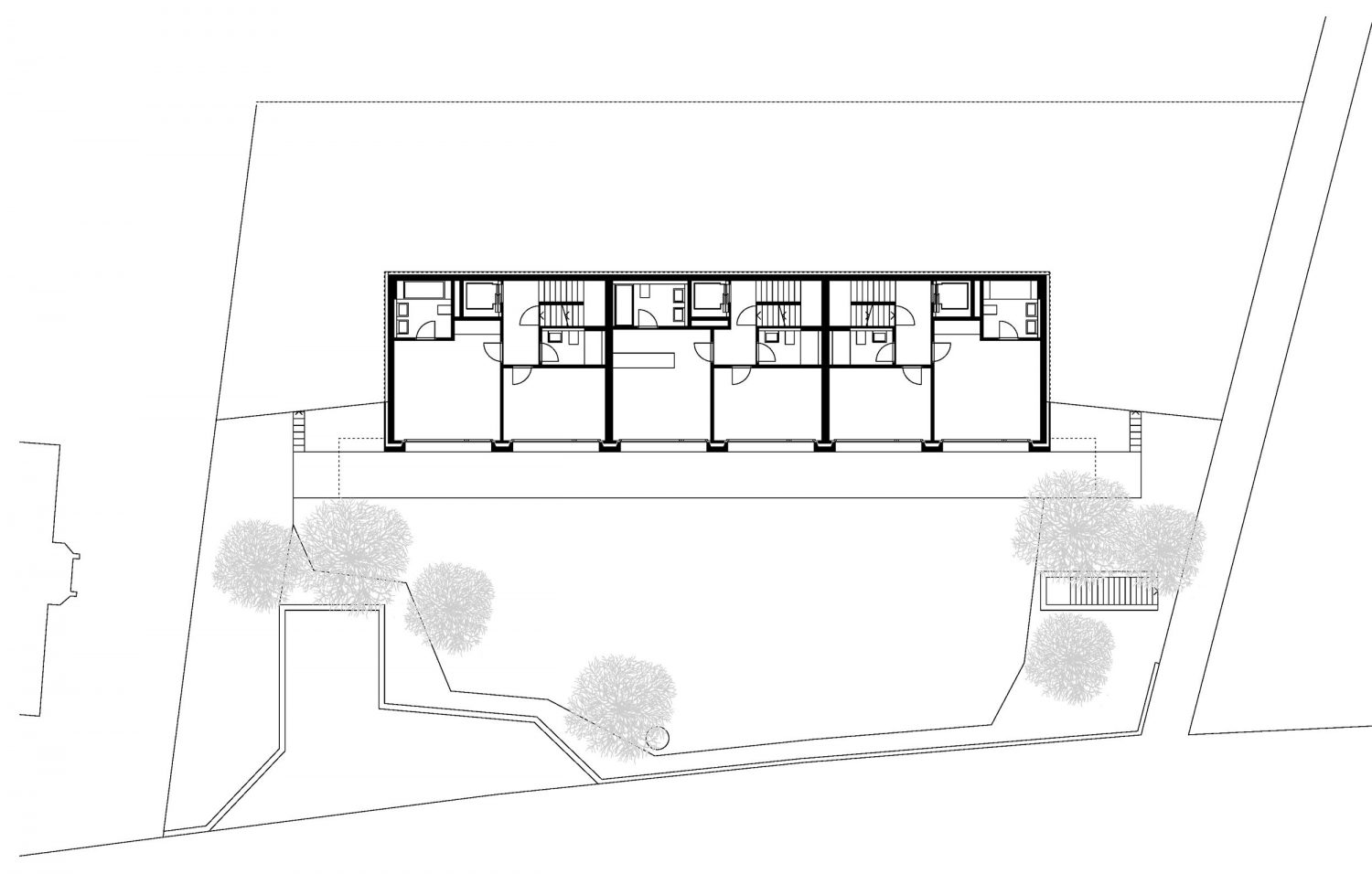
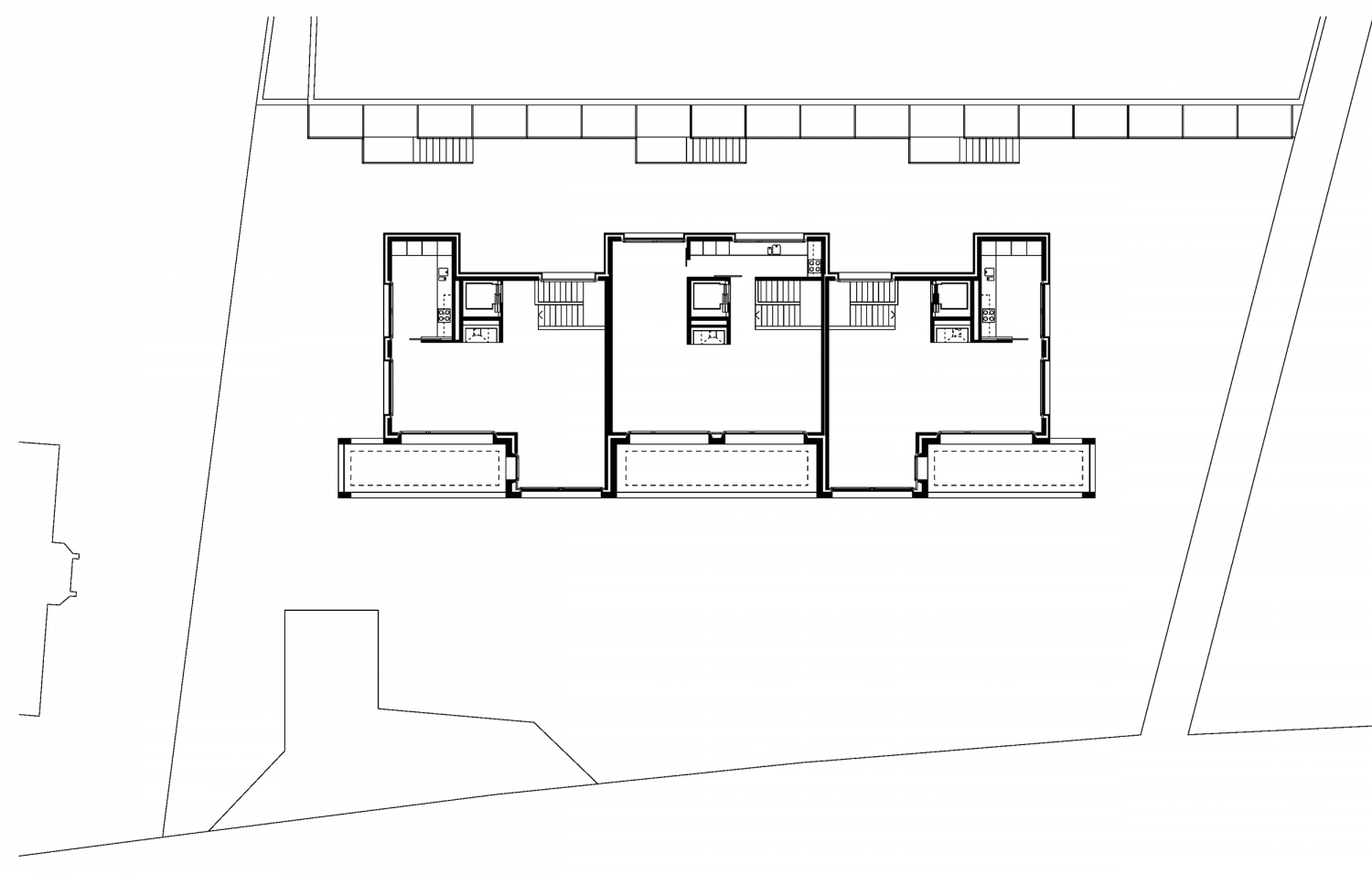
The building, comprising three residential units, is a long, flat volume that runs parallel to the lake, to the street, and to the supporting wall in the middle of the property. Two storeys of balconies running the entire length of the façade that faces the lake include overhanging indoor rooms that extend beyond the length of the building on both sides. They underscore the orientation towards the lake of the two upper storeys.
The body of the building along with the supporting wall to the west creates a clearly defined slope-side entrance area. This is accessed by a metal staircase along the supporting wall, which is painted and overgrown with climbing plants. Overhanging volumes mark and protect the three entries, which access the units on the floor in the middle.
The building consists of two complete floors and a ground floor built into the slope, with a parking garage underneath. The living and dining areas as well as the adjoining balconies are situated on the top floor of the building to take maximum advantage of the lake view. On the floor below, in addition to the entrance, there are two large rooms of different sizes, which can be used as studies, guest rooms or bedrooms. There are two more rooms on the ground floor, which is level with the garden. The interior – kitchen, bathrooms and the arrangement of the rooms – were adapted to the needs of the respective owners.
Thanks to loadbearing outside walls and interior partitions, it was possible to individualize the floor plan of each unit. The skeleton-like layer of balconies facing Weidstrasse is concrete, the other three façades are clad in rear-ventilated panels seamlessly covered with fine-grained plaster. A metal-like iridescent silver unifies the masonry and, in combination with the naturally anodized aluminium window frames, the glass balustrades that reflect the silver, and the aluminium steamed fabric blinds, it generates an overall effect based on the play and reflection of the light. The pink of the supporting wall along the access path both contrasts and complements the over-all metallic and silver colouring of the building.
A few scattered trees are placed on the meadow in front of the building. Bushes along the borders of the lots ensure the privacy of the garden areas. Elongated bands of concrete alternate with gravel on the ground of the rear entrance space and the outdoor seating areas. The roof, planted with undulating rows of thyme in various shades of pink, optically extends the gardens of the neighbouring buildings above.
Housing Complex Park Grünenberg
One of the goals of this project was to make the existing Park Grünenberg the key theme of the new housing development. Three residential buildings were set in the western area of the park, formerly a landscape garden, while the architectural section of the garden to the east, along with the listed villa (Robert Bischoff and Hermann Weideli, 1910) were preserved as is. The new volumes are arranged and formed in a manner that guarantees vistas and perspectives onto the park or the lake. In conjunction with the vegetation, these polygonal volumes give the impression of a colorful “rock garden”.
The material used for the façades and construction is concrete – or “cast stone”. The exterior concrete shells extend into cantilevered structures, forming and bearing balconies. The concrete surfaces are finely sandblasted and coated with a glaze of mineral pigments. The artist collaborating on the color scheme, Pierre André Ferrand, envisioned a different tone for each building – dark gray, ochre, and yellow – each containing the color green. The appearance of the pigments themselves is completely matt, similar to a colored powder coating. From the outside, large windows reflect the surrounding trees, the sky, and the lake, while affording sweeping views from inside the apartments.
The careful arrangement of the apartments with their varying layouts enables each to benefit from the buildings’ orientation and location. In the smallest building (A), situated to the south, two apartments share each floor, enjoying either the virtues of slightly more lake views and evening sun in summertime, or more southern light. For the larger buildings located to the east and north (B and C), a variety of apartment types ensures that each is provided with both optimal natural light and vistas to the lake. The eight different types range from single-story units oriented toward three sides, to others with a living room that extends all the way through the building, to duplexes.
In analogy to the former landscape gardens, the green areas between the buildings are dotted with scattered trees and copses. Blooming bushes and evergreen shrubs adorn and organize the green spaces and distinguish the public areas from private gardens. The pathways are laid out as light-colored concrete surfaces that broaden and narrow, their effect comparable to large, level slabs of rock within the landscape.
Extension/Renovation of Historical Villa, Kastanienbaum
The existing, late Neoclassical villa was built in 1860 in the Italian country-house style as a summer residence within a large park overlooking Lake Lucerne. It is thought to be the work of Xaver Waller. In 1927, the villa’s interior was extensively altered and an extension was built to house the kitchen.
For the villa’s current owner, a remodeling project was developed involving various degrees of intervention. The modifications ranged from cleaning, the removal of wallpaper, repairs and restorations, to a series of individual, explicitly dialectical interventions, and finally the replacement of the kitchen annex with a new building. However, the decision was made not to reconstruct the spatial and structural characteristics of the original building.
Proposed restoration involved repairing the sandstone window surrounds, sanding and oiling the parquet flooring, and transforming some single-glazed windows into double-glazed ones using the existing wooden frames and glass. Of special note is the small room in the tower. Stripped of wallpaper, the walls here exhibited such a remarkable patina, along with a number of pencil drawings made by previous workers, that it was decided not to renovate them.
Selective interventions included the construction of a brass fireplace in the large salon and the installation of a chrome steel kitchen unit in the center of the former small salon. The renovation of the bathrooms (the original positions of which were retained) likewise belongs in this category. They were furnished with new fittings, oak flooring, and walls of etched mirrors. In the large bathroom a freestanding bathtub was specially commissioned.
The most radical intervention was the demolition of the kitchen annex, which was in poor repair. Replacing it is a garage with adjacent workshop. The annex building, the roof of which serves as a terrace, is accessible from both the house and the garden. Trellises cover the walls of the single-story concrete structure and continue up above the roof, forming a pavilion over the terrace. In this way, the annex acquires dimensions and proportions in keeping with those of the villa. Architectural features typical of nineteenth-century villa gardens, such as gazebos and coach houses, are in a sense interwoven in this structure and physically connected with the house. The villa, annex, and grounds are also linked in terms of color: the green of the villa’s sandstone is echoed in the colored concrete, and the olive-green hues of the trellis match the greenery of the park.
Residential and Retail Building
The Dutch town of Almere is not a place that has grown successively, but was planned on a drawing board, originating after the war as polder land reclaimed from the Ijsselmeer Lake. The masterplan for the new, enlarged town center was developed by the OMA architecture studio. A striking characteristic of this city center area is an artificially raised, curved slab (‘Gebogen Maaiveld’), which connects the existing retail center with the Weerwater Lake as a new pedestrian level. Underneath this floor slab is an area for local east-west vehicular traffic, as well as for deliveries, parking, and buses. The new residential and retail building is situated at the highest point of the curved slab, where access roads lead to the ‘underworld’ of services and infrastructure.
The masterplan envisioned the combined residential and retail structure to be a high and very deep building volume with a footprint measuring 27×55 meters. With a trapezoidal floor plan that bends inward on both sides, it was possible to achieve the maximum possible amount of natural light for the residential spaces within the given perimeter. The volume does not rise up in a straight vertical line, but inclines toward the south and east while broadening as it ascends.
On the ground and first floors the retail areas are occupied by the Hema department store chain, with the second floor used as storage space. Both basement levels serve as a parking garage. Originally conceived as condominiums, a total of 72 apartments are now offered for rental over eight floors. As a result of the expansion of the building volume toward the top, larger, south-facing apartments can be offered on the higher, more desirable floors. The floor plans are largely derived from the tunnel formwork technique commonly used in the Netherlands.
On the residential floors the building form is defined by the bands of glazed balcony parapets. In plan the glazed façade of each apartment describes an obtuse angle, thereby forming triangular balcony spaces as well as providing privacy from the neighboring balconies. The jagged shape of the floor plan repeats to a lesser extent the principle followed by the greater building volume of maximizing surface area and natural light.
The façade is wrapped entirely in glass: color-enameled glazing is employed for the cladding of the ground floor, while the parapets of the apartment balconies consist of safety glass laminated with colored film. The residential areas have floor-to-ceiling windows to maximize natural light. The color concept for the building’s façades was developed in collaboration with the artist Adrian Schiess: orange for the corners facing the south and east, light green toward the pedestrian area, light blue facing north, and finally, highly reflective silver for half of the two longest, angled façades toward the north and south. The inward- and outwardslanting glazed surfaces reflect the sky and surroundings, while the obtuse-angled surfaces additionally reflect the building itself as well as the nearby exterior spaces. The immediate surroundings thus play an integral part in how the building is perceived.