Remodeling of the Kunstmuseum Basel and Laurenzbau Library

The expansion of the Kunstmuseum Basel into the neighboring former bank building enabled important improvements to be made to the spatial organization of the museum building and allowed additional exhibition space to be created. Both historic buildings – the Kunstmuseum, constructed in 1936 by the architects Rudolf Christ and Paul Bonatz, and the Laurenzbau, formerly home to the Nationalbank and built in 1926 by the architects Suter & Burckhardt – were in need of structural modifications in several areas in order to fulfill their new functions. The plan to build an extension for temporary exhibitions, as considered during the 2001 competition, was abandoned.

The character and extent of the various restructuring measures ranged from the creation of new spatial relationships to the reconstruction of original conditions, and also included light restorative retouching. The reconstruction work was carried out in various stages in order not to disrupt the functioning of the museum.

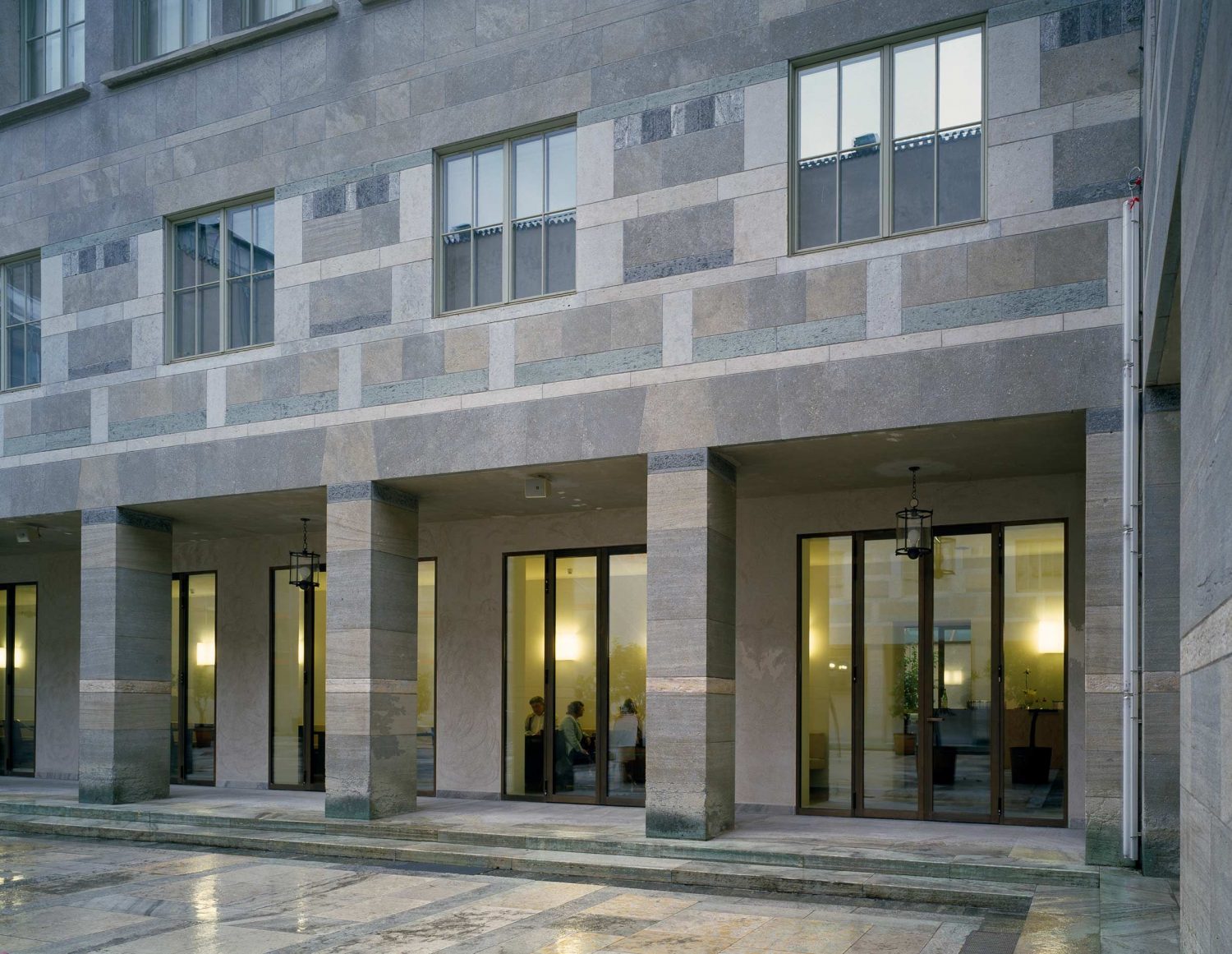
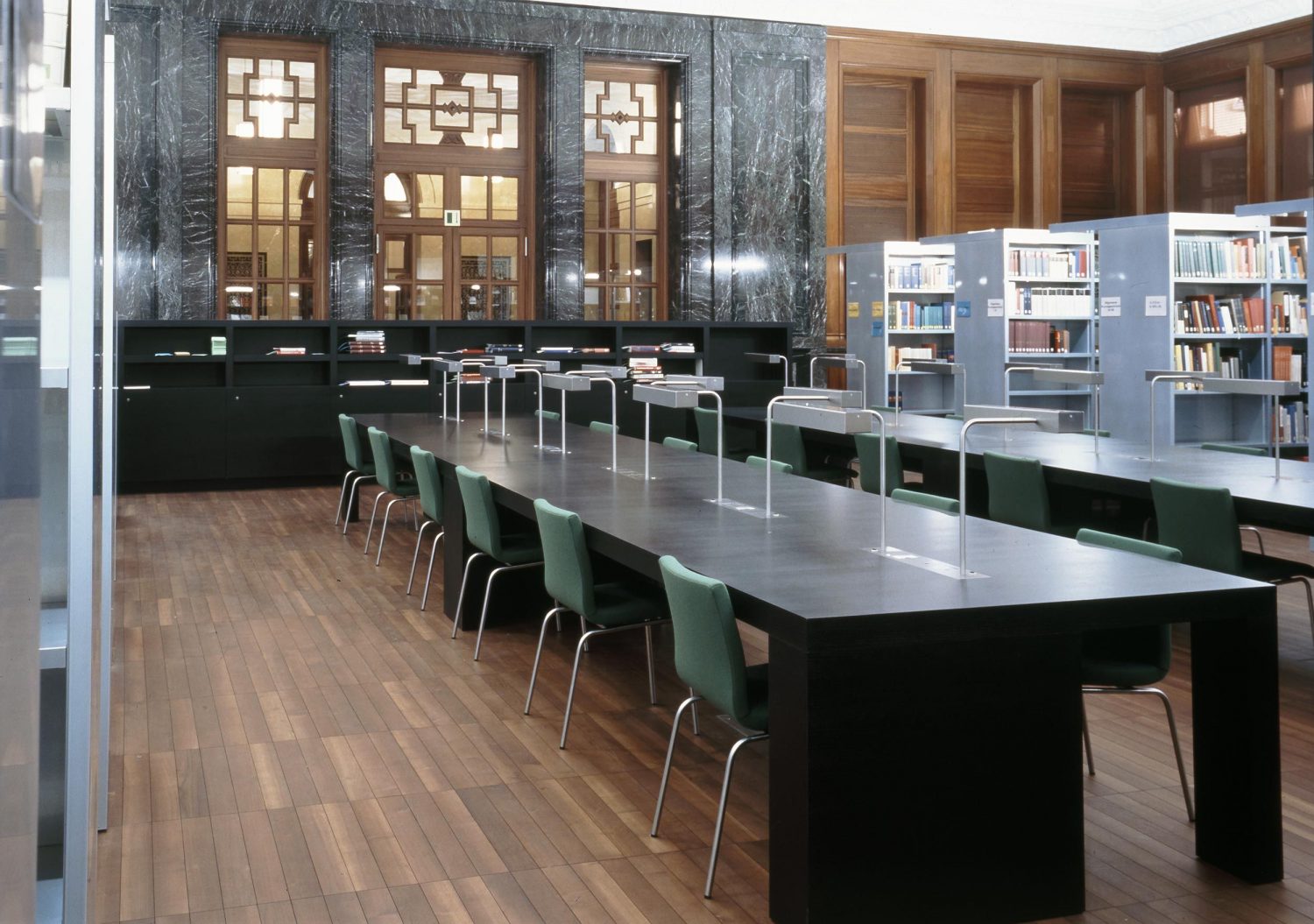
In the museum building, the former library rooms were converted into exhibition spaces and a bistro. Large new display cases, doors, and windows in the arcades open up the museum to the street and provide a welcoming countenance for museum visitors and restaurant clients. A gray sandstone staircase and ramp rises from the red-gray veined sandstone flooring of the arcades and leads to the entrance of the new bistro. The narrow former library hallway now functions as the bistro’s dining area. Sitting on the elongated leather sofa, the guests look through the glazed doors at the comings and goings in the great sculpture and entrance court. In the adjoining bar, the focal point is the bar itself, which is made of highly polished brass. This treatment of the material produces a striking contrast to the matt, dark brown tones of the related material, architectural bronze, used for the windows and doors - this is true of both the historic elements and the new additions.

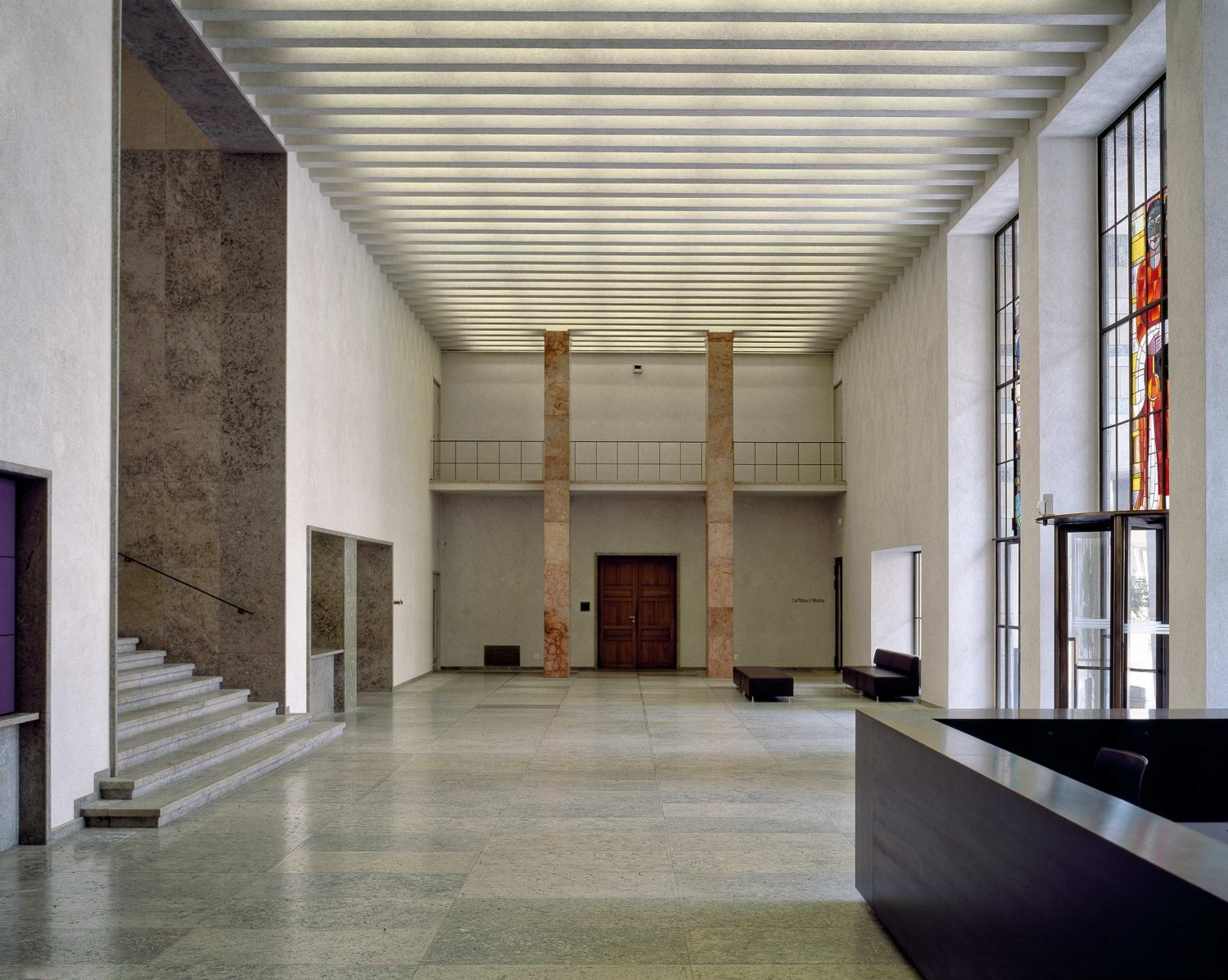
The gallery encircling the small courtyard and the high entrance hall were only gently renovated, with all interventions designed to restore the hall’s function as the central starting point and orientation area for all visitor services. The few modifications to this space included a light wash of paint, new lighting, and the island-like placement of the ticket desk. Freeing up the gallery around the small courtyard on the ground floor represents a further important strategy in this reconstruction project. This gallery corridor was historically used as an exhibition space, but over the years it has also accommodated a cafe and cloakroom. Provided with new lighting, freshly stuccoed walls and ceilings, and a reduced number of door openings, the gallery now forms a generous exhibition space for contemporary sculpture and reliefs.

Location Basel, Switzerland

Programme New spatial organisation, various remodelling measures and reconstruction of the Art Museum and Laurenzbau; conversion of the former library in the Art Museum into exhibition spaces and a bistro, refurbishment of the copper-engraving cabinet; renovation of the entry hall and the sculpture gallery, remodeling of the Laurenzbau into a library/reading room

Competition 2001, 1st Prize (Extension and Reconstruction)

Planning/Construction 2003–2007 in four phases (Reconstruction without Extension)

Client Building and Planning Office, Main Building Division
Construction Department of Canton Basel City

Gross Floor Area 6‘500 m2

Team GG Planning/Construction: Christian Maggioni (Project Manager), Florian Isler
Competition: Barbara Schlauri, Sergej Klammer, Christof Bhend

Site Management Annette Gigon / Mike Guyer Architects, Zurich
Collaborator: Thomas Hochstrasser

Structural Engineer Rapp Infra AG, Basel

Electrical Engineer Elektrizitäts AG, Basel

Building Services Engineer Aicher, De Martin, Zweng AG, Lucerne

Furnishings Annette Gigon / Mike Guyer Architects, Zurich
with Hannes Wettstein, Zurich

Photos © Heinrich Helfenstein

Awards Bautenprämierung des Heimatschutz Basel, 2007

Remodeling of the Kunstmuseum Basel

Laurenzbau Library

Detached House in Zurich

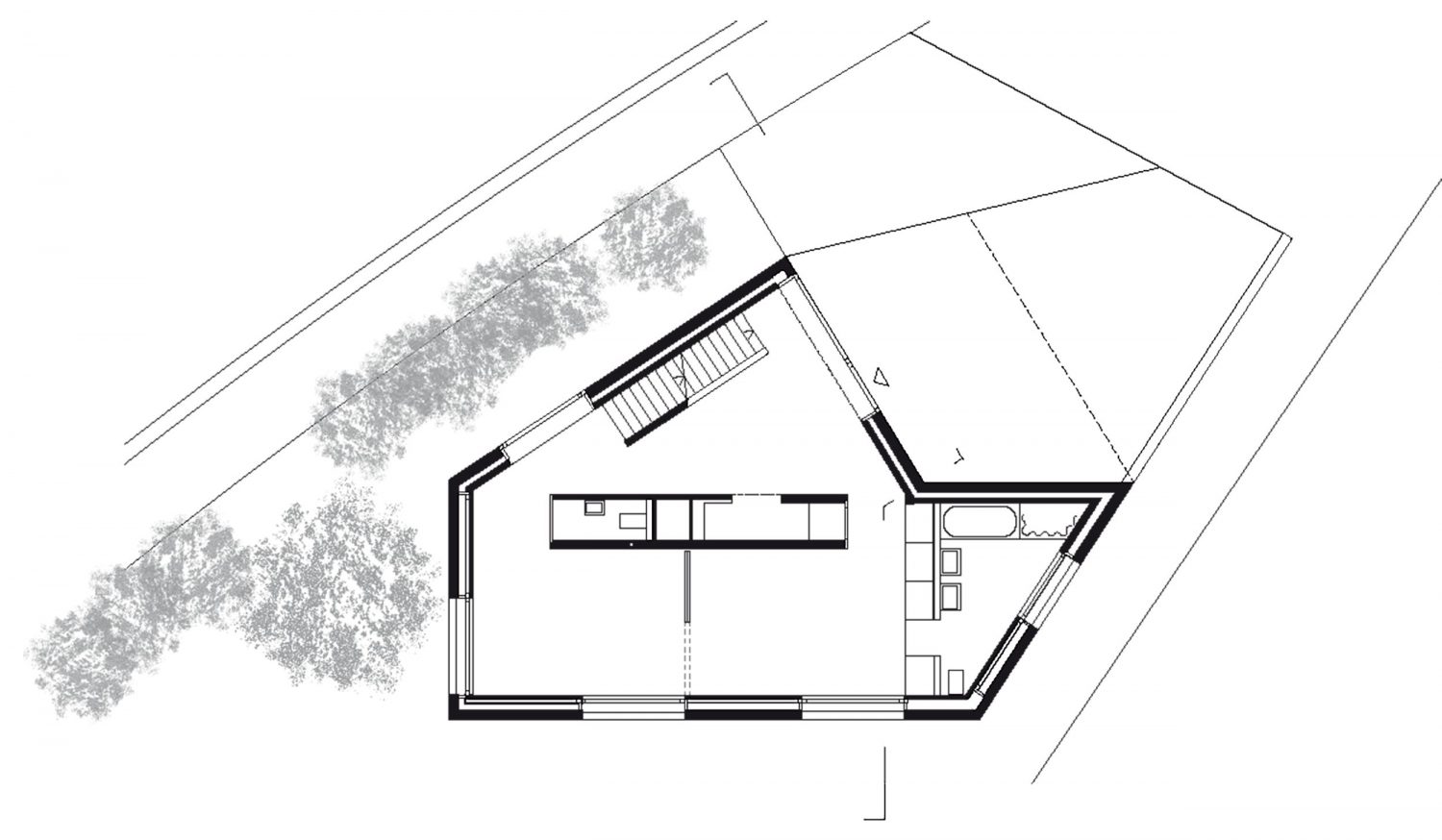
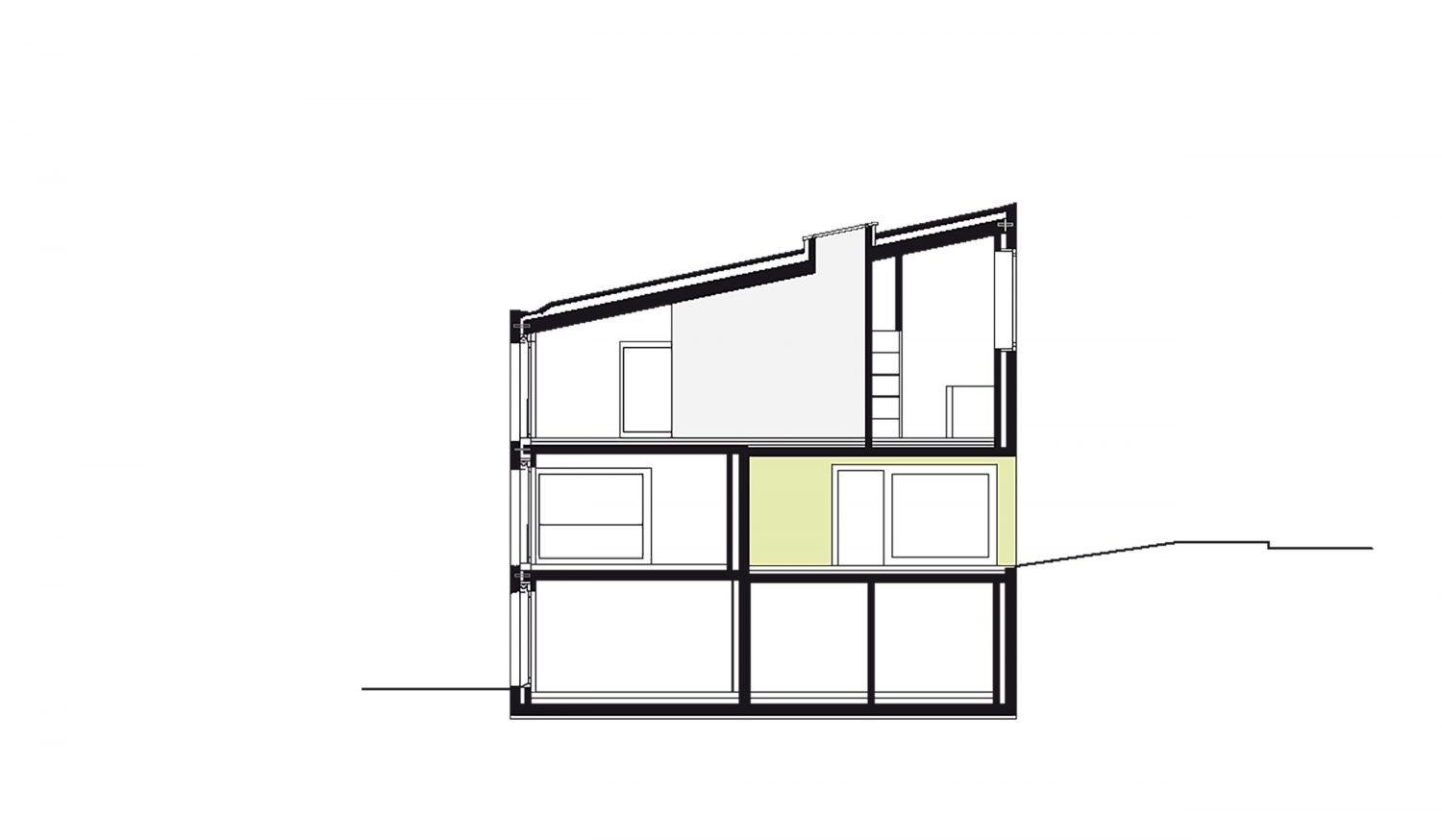
Facing south, the hexagonal volume of the detached house in Zurich is inscribed within a trapezoid-shaped plot on a steep incline. An inclined volume with a slanted roof was conceived, which resulted from going to the maximum building height possible at all six corners of the building.

The main entry to the house is located on the north side underneath a large cantilever that provides a sheltered exterior space. Inside, the entrance area is arranged into zones by “space-containing” walls with an integrated wardrobe, cabinets, and guest bathroom. This allows the adjoining bedroom and study to be separated off via sliding walls, or alternatively connected into one continuous space. The children’s bedrooms are located on the lower ground floor. They are accessed via a central space that merges into the “garden room”, which can also be utilized as a guest room, playroom, or study. On the upper floor, under the slanted roof, is the main living area with an exceptionally high ceiling that rises from 2.4 to 5.2 meters. This room is also organized around a “space-containing” central wall in order to allow these zones of varying height and breadth to be utilized for living, cooking, work, and play.

On the ground floor, colored surfaces of dark green and light orange accentuate the lighting effects in each room. On the upper floor, a new color concept for the main wall is to be devised periodically. The general interplay of color and space can be observed and experienced during the course of daily life, almost as if it were an ongoing experiment. The first concept was for a bright yellow-green that reacted strongly to the light, while the second was a bright raspberry, and the current incarnation is a sprayed-on high-gloss color gradient with iridescent pigments.

The exterior walls and roof consist of load-bearing concrete. The large windows are opened by sliding them into a recess between the outer concrete and inner brick wall. To the north the windows have wide frames and are mounted flush with the wall. The concrete of the roof and the outer walls is a dark gray and a mossy green-yellow. The crossover from colored to uncolored doesn’t occur at the corners, but on the faces. Dense vegetation of blooming shrubs and berry bushes lines the borders of the property and forms a ‘clearing’ in which the green/gray building is set.

Location Zurich, Switzerland

Programme Single-family house

Commission 2001

Planning/Construction 2001–2003

Client private

Team GG Markus Seiler (Project Manager), Pieter Rabijns

Site Management Annette Gigon / Mike Guyer Architects Zurich
Collaborator: Markus Seiler

Landscape Architecture Zulauf Seippel Schweingruber, Landschaftsarchitekten, Baden

Structural Engineer Dr. Lüchinger + Meyer Bauingenieure AG, Zurich

Building Services Engineer 3-Plan Haustechnik AG, Winterthur

Colours Adrian Schiess, Zurich and Mouans-Sartoux, France

Photos © Maurice Haas
© Lucas Peters
Filmstills: © Severin Kuhn

Housing Development and Remodeling Pflegi-Areal

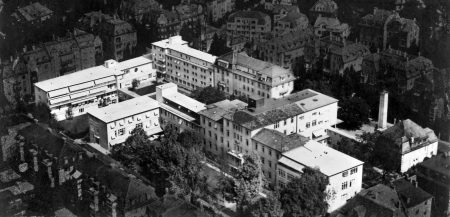
The quality of the building stock of the former hospital ‘Pflegerinnenschule Zürich’ indicated a clear allocation of the new functions – offices and housing – within the existing and newly constructed buildings. It was possible to retain the buildings to the southwest by Pfister Architects from 1933/34 and convert the former hospital wards into offices, while the heterogeneous hospital buildings to the northeast were replaced by housing.

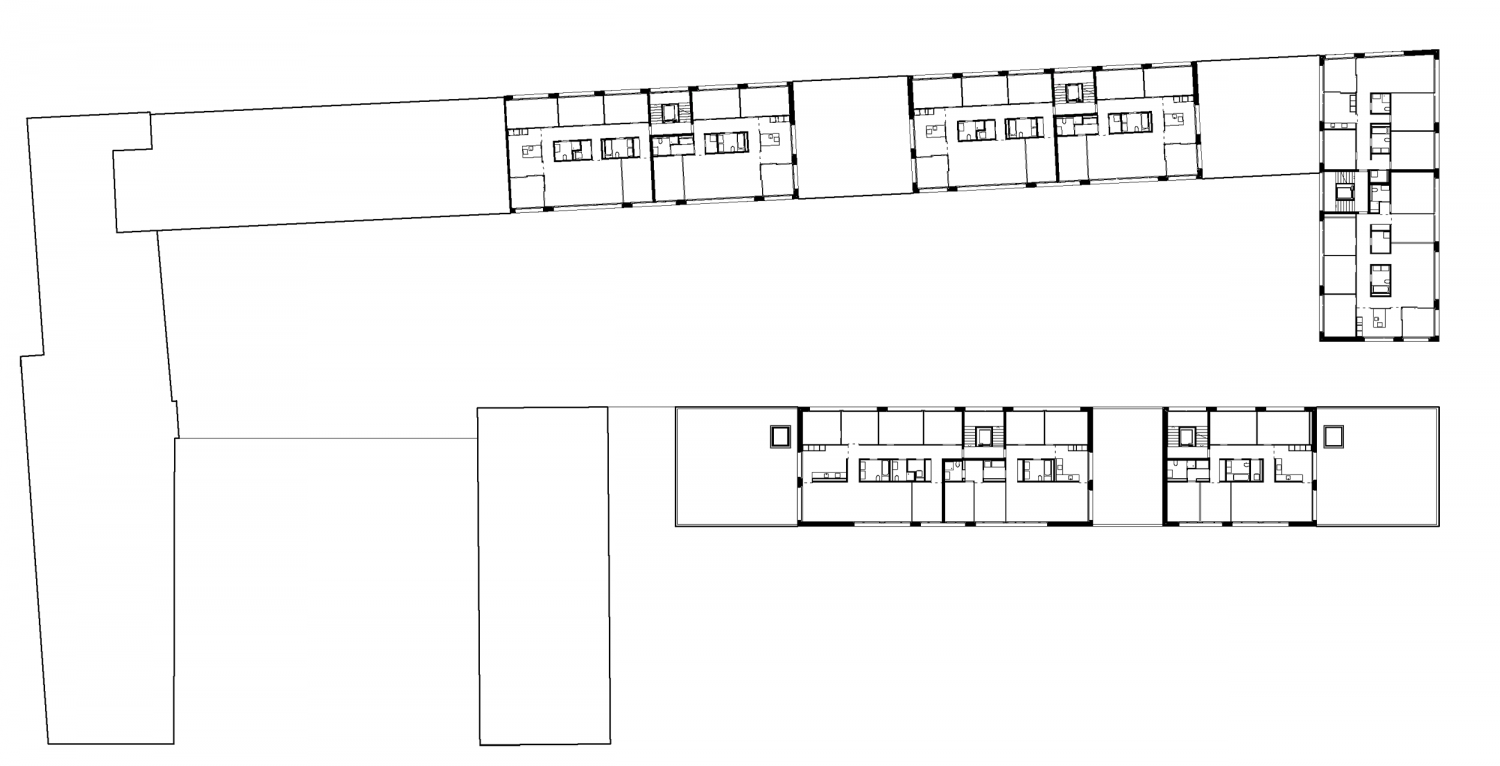
Despite substantial interventions, the goal was to retain the spatial character of the large-scale facility. Akin to the former hospital building complex and the neighboring freestanding houses, the new buildings form a hybrid ensemble between a closed block development and individual building volumes.

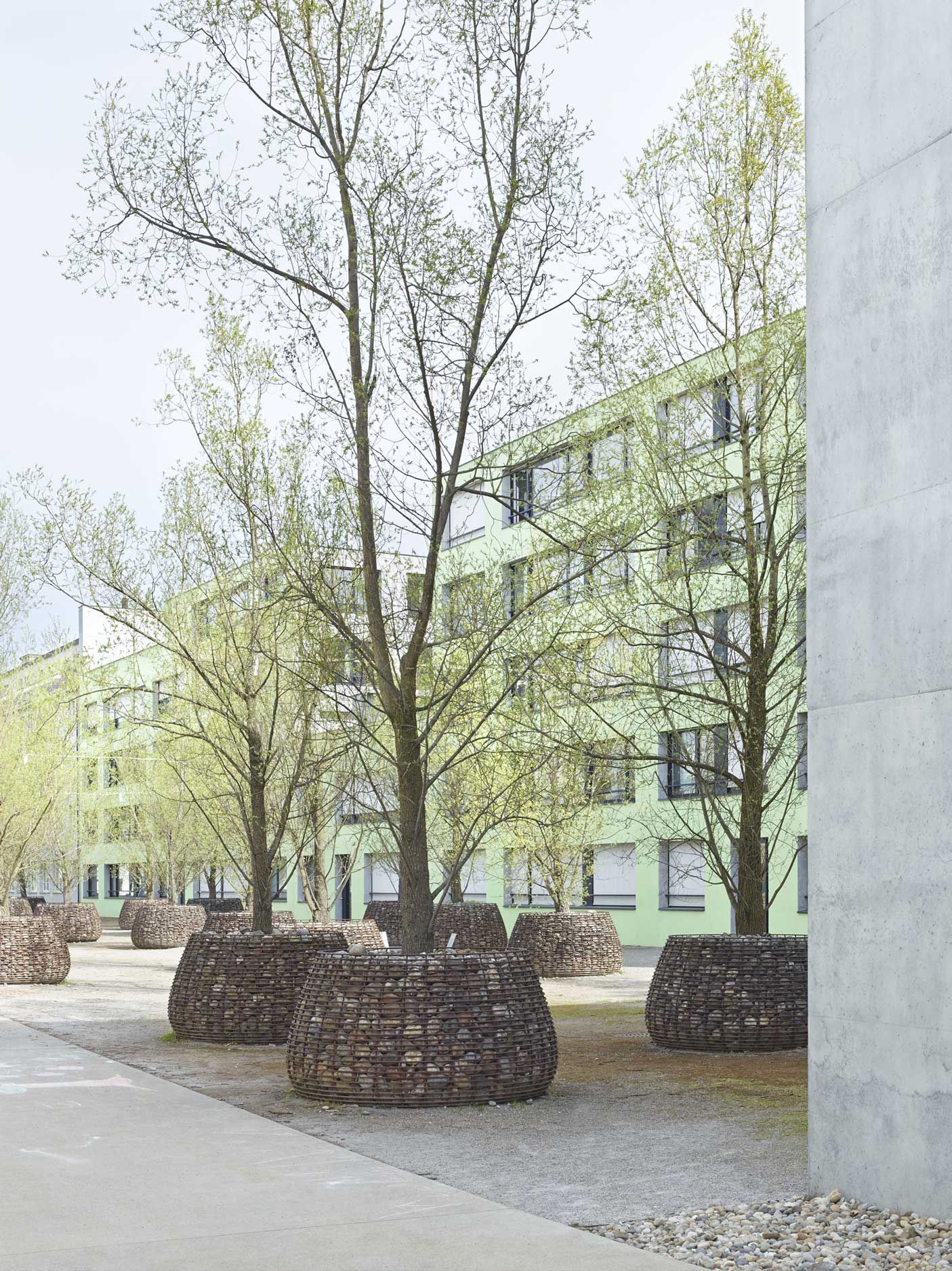
Together with the existing buildings, the new housing complex demarcates and defines three large exterior spaces: the garden, the Samaritan Court, and the Carmen Court. The former patients’ garden, with its beautiful trees, was left almost untouched. The Samaritan Court serves as new access area for the underground parking garage and offers drop-off and parking space. The Carmen Court, in place of the former nurses’ garden and lying atop the new parking garage, now stretches across the entire length of the site. The ground here consists of fine gravel as well as large poured concrete slabs, which form a wide access path to the apartment entrances. Willows are planted in large baskets made of steel reinforcement bars and filled with stones and earth. Set atop the garage roof, these baskets form a nutrient-rich habitat as well as providing root space and acting as a counterweight for the trees.

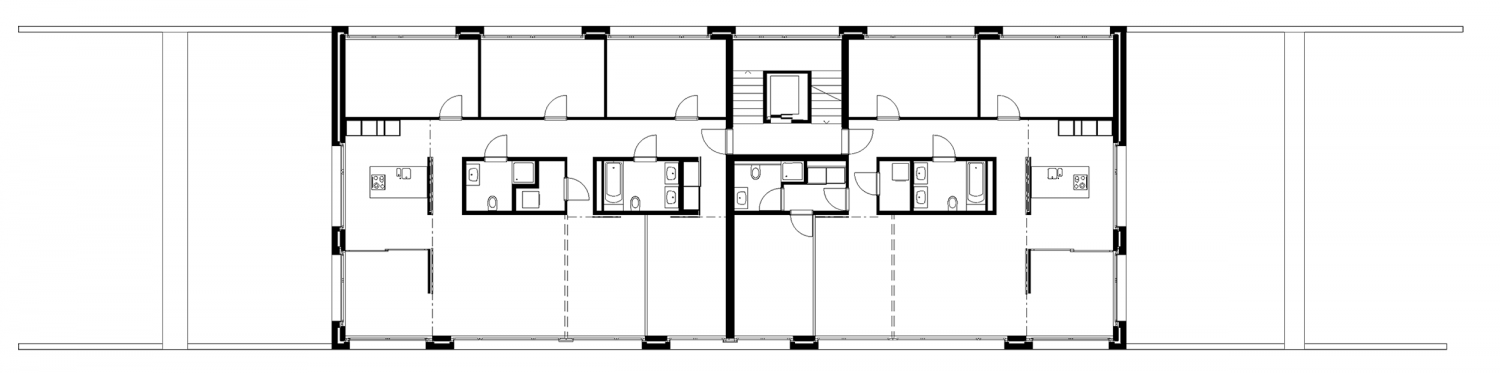
Housing in the newly constructed buildings consists primarily of single-level apartments with generous floor plans. A total of forty-eight apartments with twenty-two different floor plan types offer 2.5 to 6.5 rooms. In addition, nine work studios were built at courtyard level. To cater to contemporary living/working constellations, some ground-level apartments are connected with the courtside studio spaces via internal stairs. Placing the ancillary and service spaces at the center of the apartments permits free circulation, while the load-bearing use of the service core allows for minimal, as well as conventional room divisions. Several apartments have exterior spaces in the form of terraces. Most of them, however, possess a kind of “fresh-air space”, also called a “seasonal room”. It transforms into an open loggia in good weather and can be used as a normal, heated interior space during the rest of the year.

Concrete is used for the basic construction as well as for the interior flooring. Gravel and sand, two ingredients of concrete, form the floor surfaces outside and on the roofs. The load-bearing cores and double-layered exterior walls form the support structure. Generous window openings provide the apartments with ample daylight and a sense of space. The highly perforated wall surfaces become skeleton-like structures and give the apartments – analogous to the existing buildings – a pragmatic, urban air.

Colors applied in the form of mineral-based, highly matt pigments contrast with the unpretentious, commonplace expression of the architectural language. The use of color was developed in collaboration with the artist Adrian Schiess as a means of defining the atmosphere of the outdoor spaces (Carmen Court, garden). Thus, only three of the long façades are painted, while the street front, the short façades, and the reveals were left unpainted. The colors chosen are yellow-green and white in the Carmen Court, and blue toward the garden. The yellow-green tone on the southwest façade of the Carmen Court colors the light and reflects its hue when the sun shines onto the opposite, white-painted façade, thereby “bathing” the entire courtyard space. The blue coat of paint on the garden side mingles with the green of the trees to transform the old garden into a blue-green “landscape space” – right in the middle of the city.

Location Zurich, Switzerland

Programme New construction with 48 apartments, 11 studios, 1 doctors surgery, underground parking 112 parking spaces; Remodeling of the existing building (former hospital) into office spaces

Competition 1999, 1st Prize

Planning/Construction 1999–2002

Client Stiftung Diakoniewerk Neumünster
Schweizerische Pflegerinnenschule, Zurich

Gross Floor Area 15’199 m2

Team GG Planning/Construction: New Buildings: Christian Maggioni (Project Manager), Gaby Kägi, Philippe Vaucher, Ivo Lenherr, Arnault Biou
Existing Buildings: Christian Maggioni (Project Manager), Andrea Fiechter, Eva Geering
Competition: Gaby Kägi, Pascal Müller

Site Management New Buildings: Ruoss Witzig Architekten, Zurich
Existing Buildings: Annette Gigon / Mike Guyer Architects, Zurich, Collaborators: Peter Steiner (Construction Manager)

Landscape Architecture Zulauf Seippel Schweingruber, Baden

Structural Engineer Basler & Hofmann AG, Zurich

Building Services Engineer Basler & Hofmann AG, Zurich

Building Physics Engineer Basler & Hofmann AG, Zurich

Colours Adrian Schiess, Zurich and Mouans-Sartoux, France

Photos © Seraina Wirz
© Heinrich Helfenstein
Historical aerial view: © Baugeschichtliches Archiv, Wolf-Bender

Awards Auszeichnung für gute Bauten der Stadt Zürich, 2005


Donation Albers-Honegger Espace de l’Art Concret

The new museum for the Espace de l’Art Concret (EAC) was built on the occasion of the donation of the Albers-Honegger Art Collection, parts of which had been displayed since the 1990s on a rotational basis in the castle of Mouans-Sartoux. The castle rooms will mainly be used for temporary exhibitions in the future. The new museum is the second freestanding annex on the castle grounds, following a children’s painting studio called the Espace Art, Recherche, Imagination designed by architect Marc Barani. A third small building, the Préau des Enfants, was erected shortly after the museum. Both are set in a steeply sloping wooded area within the surrounding park.

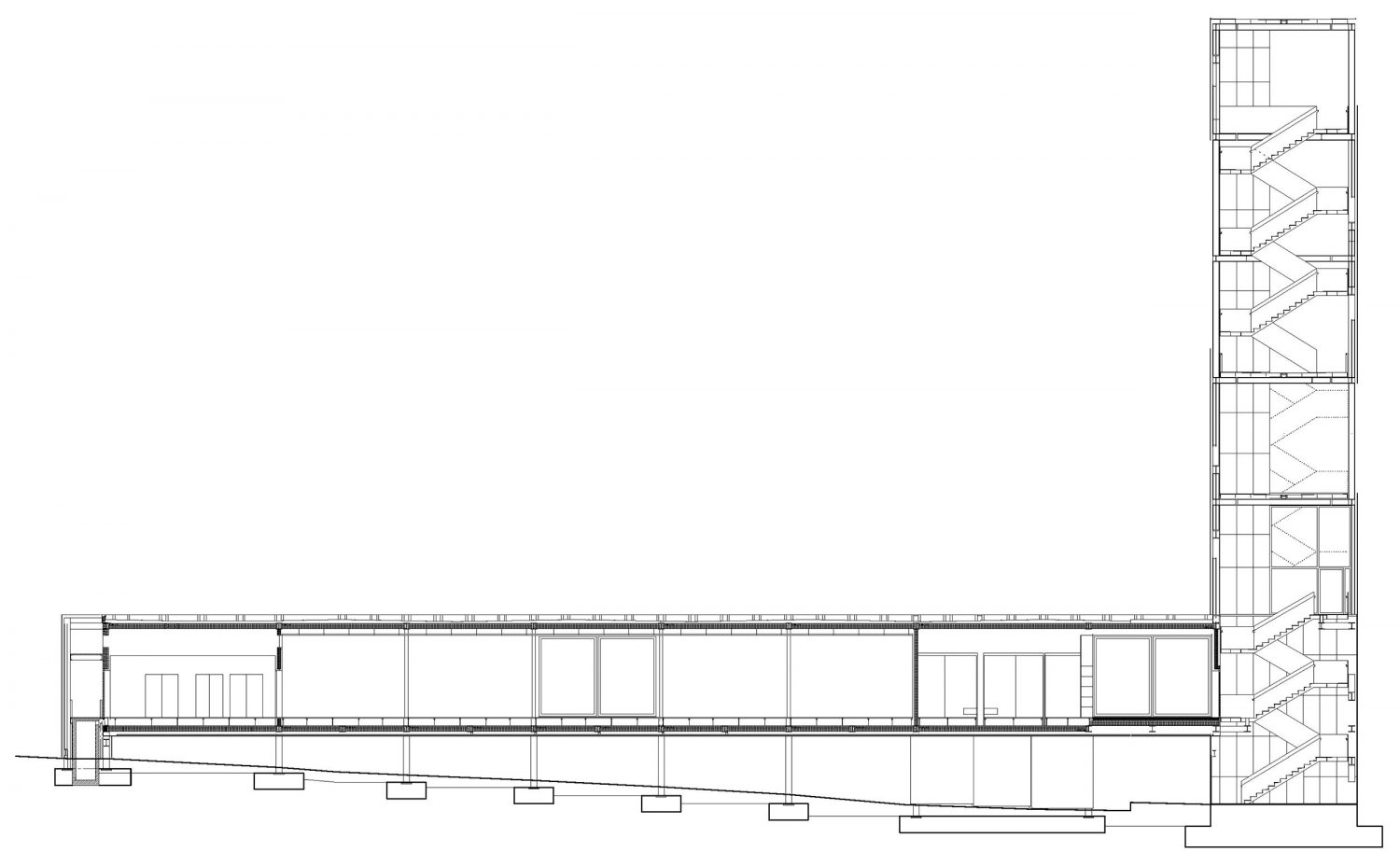
The museum building’s minimal, square-shaped ground plan and its tower-like structure with cantilevered elements made it possible to insert it into the wooded site with as little disruption to the existing trees as possible. Its position on a slope enables ground-level access at various building levels. A projecting section forms both the entrance to the museum and a bridge to the path outside. The access area for the public conference space and for deliveries also projects from the main volume of the building.

The museum entrance is elevated half a story above the first exhibition level. The galleries, connected by open stairs, are arranged at half-story level and form a spiral tour through the building. Two closed, sky-lit staircases serve as escape routes and also offer visitors a short path back to the entrance after finishing their tour. In addition to the lift, these staircases form an interior vertical connection between the conference space and the other rooms on the lower levels.

The arrangement of the galleries along the façades, the lateral lighting via the windows, and particularly the proportions of the spaces recall those of a large home rather than resembling a classic museum. Although the windows do not provide the even illumination often thought desirable in galleries, this solution meets the express wishes of the donors, who wanted natural light that would enable the works of art to engage in a vivid dialogue with the world outside and to be seen under a variety of lighting conditions. The windows are placed at differing heights in the galleries. Double-paned and resembling box-type windows, the outer pane of glass is affixed to the exterior of the façade to offer primary protection from wind and rain, while the inner pane, which can be opened, provides thermal insulation. Between the two windows, and thus shielded from the weather, fabric blinds afford protection from the sun. The blinds can be closed if desired, transforming the windows into sources of pure light, like glowing panels.

The building is constructed of poured concrete, which is painted a light yellowgreen, in anticipation of the moss and algae that the nearby trees will eventually cause to cover it. Intriguingly, this color generates two diametrically opposed effects. On the one hand, it glows in contrast to the surroundings; on the other, it forms a harmonious background for the changing colors of the trees.

The donors’ commitment to art education is expressed again in the nearby Préau des Enfants, an open concrete structure in the forest where the children’s drawings and painting studies are exhibited.

Location Mouans-Sartoux, France

Programme Museum, 14 exhibition spaces, entry hall, conference room, offices and secondary rooms

Competition 1999, 1st Prize

Planning/Construction 2001–2003

Client Ville de Mouans-Sartoux, France
Etat, Ville, Conseil Régional PACA, France
Conseil Général des Alpes-Maritimes, France

Gross Floor Area 1’829 m2

Team GG Planning/Construction: Mike Guyer, Gilles Dafflon (Project Manager), Eva Geering, Katja Fröhlich
Competition: Mike Guyer, Eva Geering, Dalila Chebbi, Michael Boesch (I)

Site Management BET G.L. Ingénierie, Nice, France

Structural Engineer BET G.L. Ingénierie, Nice, France
Preliminary Design: Dr. Lüchinger + Meyer Bauingenieure AG, Zurich

Electrical Engineer BET G.L. Ingénierie, Nice, France
Preliminary Design: Elkom Partner AG, Chur

Building Services Engineer BET G.L. Ingénierie, Nice, France
Preliminary Design: 3-Plan Haustechnik AG, Winterthur

Photos © Serge Demailly
© André Morin

Housing Development Broëlberg II

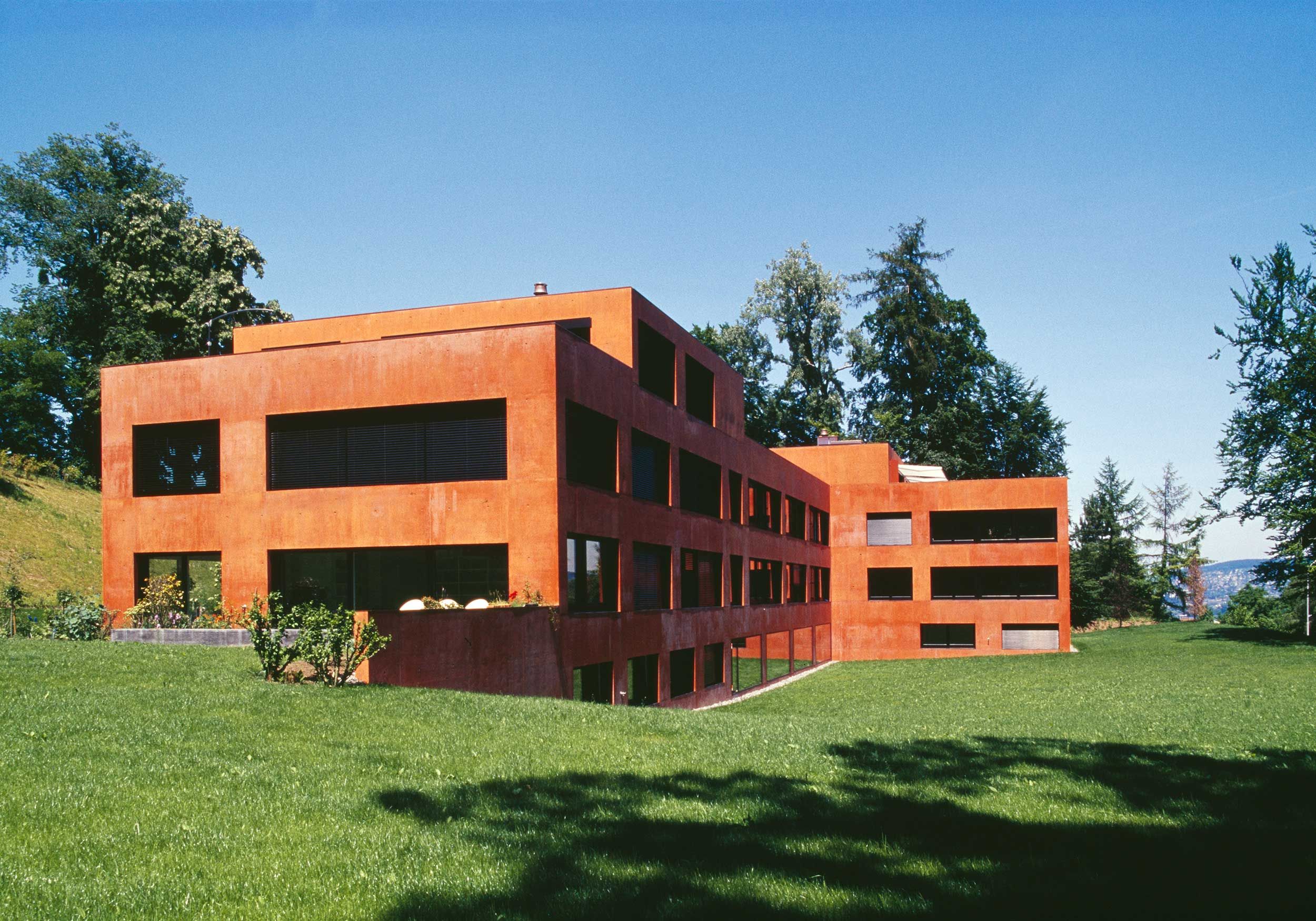
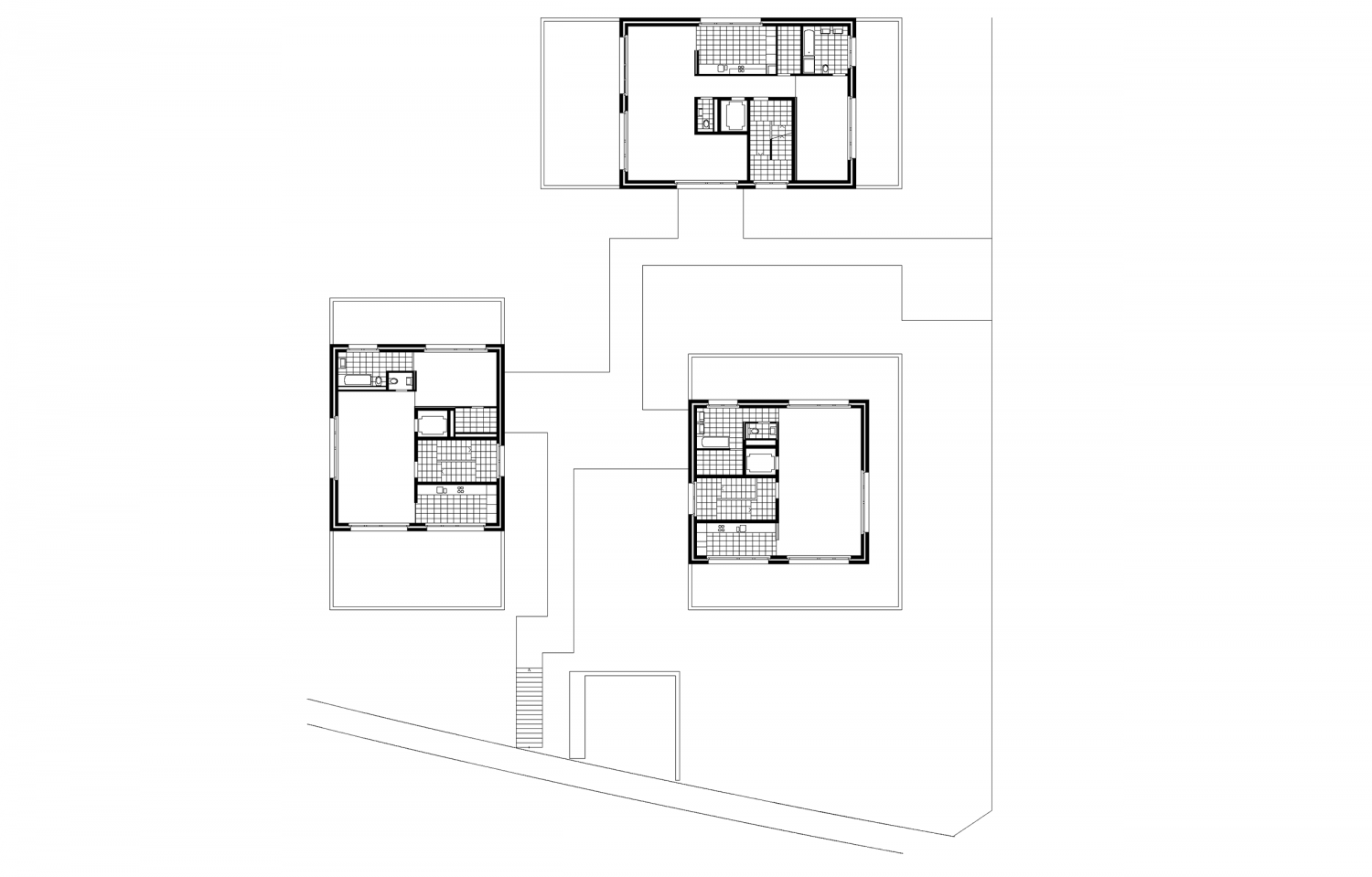
The complex is located in the eastern part of Broëlberg Park in a hollow between the old manor house and a villa built in the 1950s. Through variations in shape, height, and depth, the angled complex responds to the features of the site: the topography, the surrounding groups of trees, and the view to the lake.

The qualities and aspects of the site are reflected in a multitude of different apartment types. The structural cores for stairs, elevators, kitchens, bathrooms, and service installations define the living areas. These areas can be further subdivided with non-load-bearing walls, allowing individual arrangements ranging from traditional rooms to an open space.

Closely linked to kitchen and living room, the glazed loggias become focal points in the apartments. On the ground floor they access an outdoor patio and on the top floor large terraces. Shifts in the ground plan allow each apartment to face in several directions. The height of the rooms (2.70 m), the large horizontal openings with sliding windows, and the dark, solid oak floors throughout lend the apartments a sense of spaciousness.

Outside, the smooth, seamless, fairfaced concrete enhances the volumetric presence of the building. Its orange-red tone, pigmented with iron oxide, complements the saturated green of the surroundings in summer and harmonizes with the dark brown of the bare trees in winter. The color scheme was developed in close collaboration with Harald F. Müller. The windows with their dark brown anodized aluminum frames reinforce the twofold reading of the façade as a grid or perforated wall.

An elongated lobby provides access to the building and leads to two sets of stairs with an elevator serving each. Along one side of the hallway the color of the façade continues on the inside and is additionally accentuated through the windows, which are mounted flush with the exterior and have an orange-red painted frame on the interior. The green of the park and the orange of the façades are reflected in the lacquered, natural concrete wall opposite. The worked surfaces of the lobby and staircases mediate between the colorful exterior façades and the white plaster walls in the apartments. Lamps placed alternately in the ceilings and walls complement the effects of space, material, color, and light.

Location Kilchberg, Switzerland

Programme 13 apartments of varying types, underground parking with 28 parking spaces

Commission 1999

Planning/Construction 1999–2001

Client Dr. Otto P. Haab, Küsnacht
Baukonsortium im Broëlberg c/o HALIMA, Kilchberg

Gross Floor Area 3‘925 m2

Team GG Architecture/Construction Management:
Pascal Müller, Carmelo Hochstrasser, Esther Righetti

Site Management Annette Gigon / Mike Guyer Architects, Zurich

Landscape Architecture Zulauf Seippel Schweingruber, Landschaftsarchitekten, Baden

Structural Engineer Dr. Lüchinger + Meyer Bauingenieure AG, Zurich

Electrical Engineer Elkom Partner AG, Chur

Building Services Engineer 3-Plan Haustechnik AG, Winterthur

Building Physics Engineer Wichser + Partner AG, Dübendorf

Colours Harald F. Müller, Öhningen, Germany

Photos © Harald F. Müller
© Heinrich Helfenstein

Three Houses on Susenbergstrasse

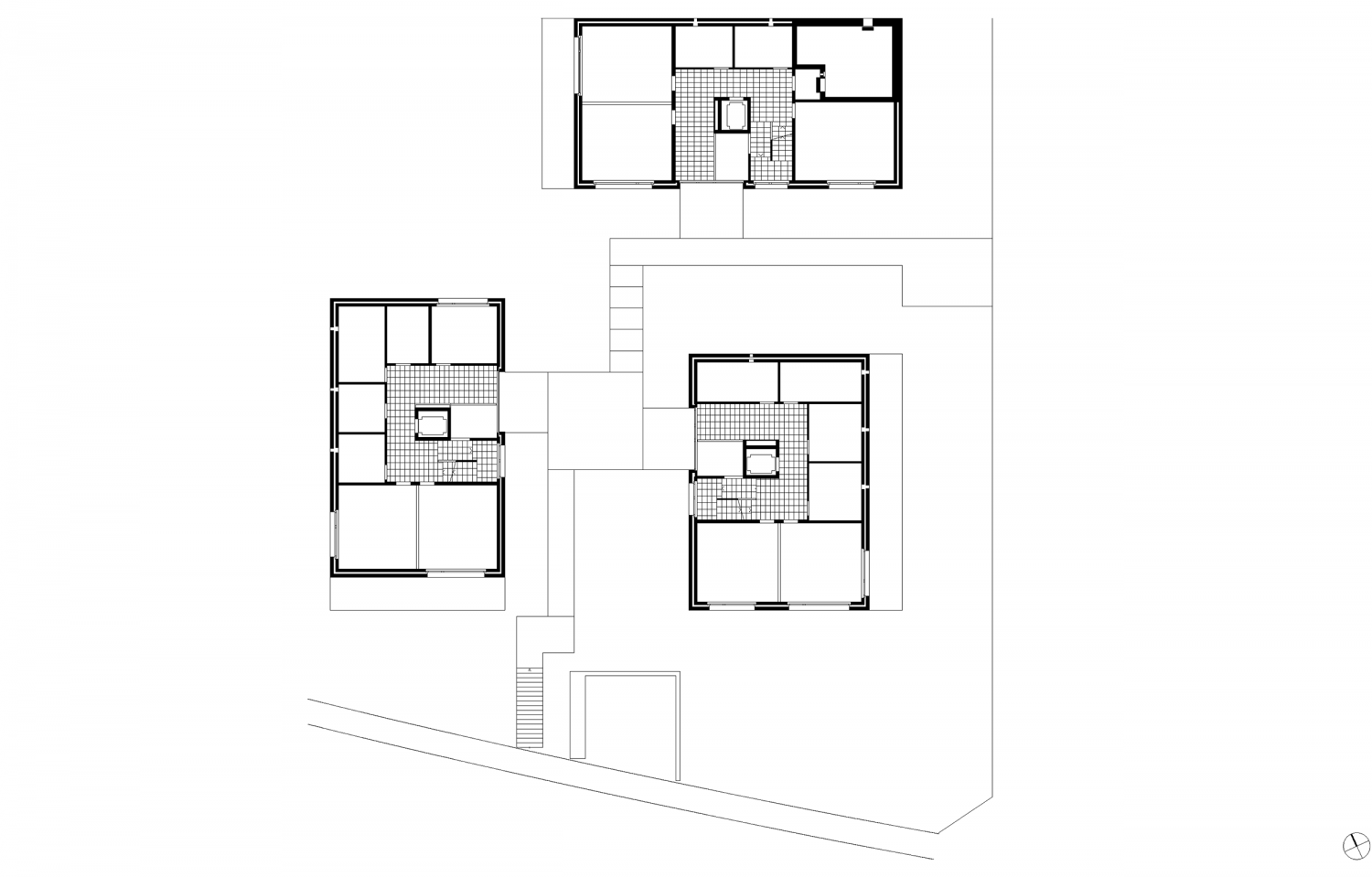
The articulation of the building mass into three volumes takes place within the context of the small-scale, “fine-grained” housing structure in the immediate and extended upscale neighborhood on the Zürichberg. In contrast to the solitary houses and villas, the building volumes react to each other by means of their proportions and with respect to their openings.

The division into three buildings allows the apartments to be oriented in all four directions, which also provides natural light and ventilation for the bathrooms and kitchens. The apartments are laid out in such a way that the service spaces - wet rooms, kitchens, bathrooms, and ancillary spaces - act as closed cores that generate a spatial articulation of the open “living space area”. The area thus defined can be easily subdivided into more conventional rooms or living spaces using large sliding doors. Nevertheless, this living area can still be understood as a continuous space aligned with the four points of the compass and correspondingly proportioned and formed.

The four-sided orientation of the apartments is differently accentuated depending on the varying location of the loggias to the east, south, and west. The loggias themselves are conceived as projections from the concrete façades that form narrow open-air rooms along the entire length and width of the building volumes.

The building structure is determined by the space-forming, load-bearing cores of the service blocks. A double-layered concrete façade completes the support framework. The exterior layer, made of in-situ concrete, forms the cantilevered loggias and the perforated parapets of the penthouses. The floor surfaces are made of concrete in various forms and finishes: poured concrete flooring for the living space areas, prefabricated polished cast stone tiles for the secondary rooms, and unpolished tiles for the terraces.
Mineral-based pigments, applied to the concrete with silicate, enable a highly matt, pollen-like “powdered” building surface. An additional intention was to attain the individualization of the three buildings by varying the colors used, while simultaneously emphasizing their compositional coherence. The final coloring was achieved in collaboration with the artist Adrian Schiess. The smallest building is painted a bright yellow, the largest, north-facing one is in grayish green with pink-painted loggias, and the medium-sized building is yellowish apricot with the west-facing façade painted light blue.

Location Zurich, Switzerland

Programme Three apartment buildings with nine apartments, six offices/studios, two activity rooms, basement garage

Competition 1998, 1st Prize

Planning/Construction 1998–2000

Client Zürcher Frauenverein (ZFV)

Gross Floor Area 2‘700 m2

Team GG Planning/Construction: Peter Steiner (Project Manager), Samuel Thoma
Competition: Michael Widrig

Site Management Generalunternehmung Göhner Merkur AG, Zurich

Landscape Architecture Zulauf Seippel Schweingruber, Baden

Structural Engineer Dr. Lüchinger + Meyer AG, Zurich

Colours Adrian Schiess, Zurich and Mouans-Sartoux, France

Photos © Heinrich Helfenstein

Awards Auszeichnung guter Bauten im Kanton Zürich 2001

Archaeological Museum and Park Kalkriese

Due to numerous archeological finds, the site in the northwestern part of Germany near Kalkriese is considered to be the location of the famous Battle of the Teutoburg Forest / Varus Battle between the Romans and Germanic tribes in the year 9 AD.

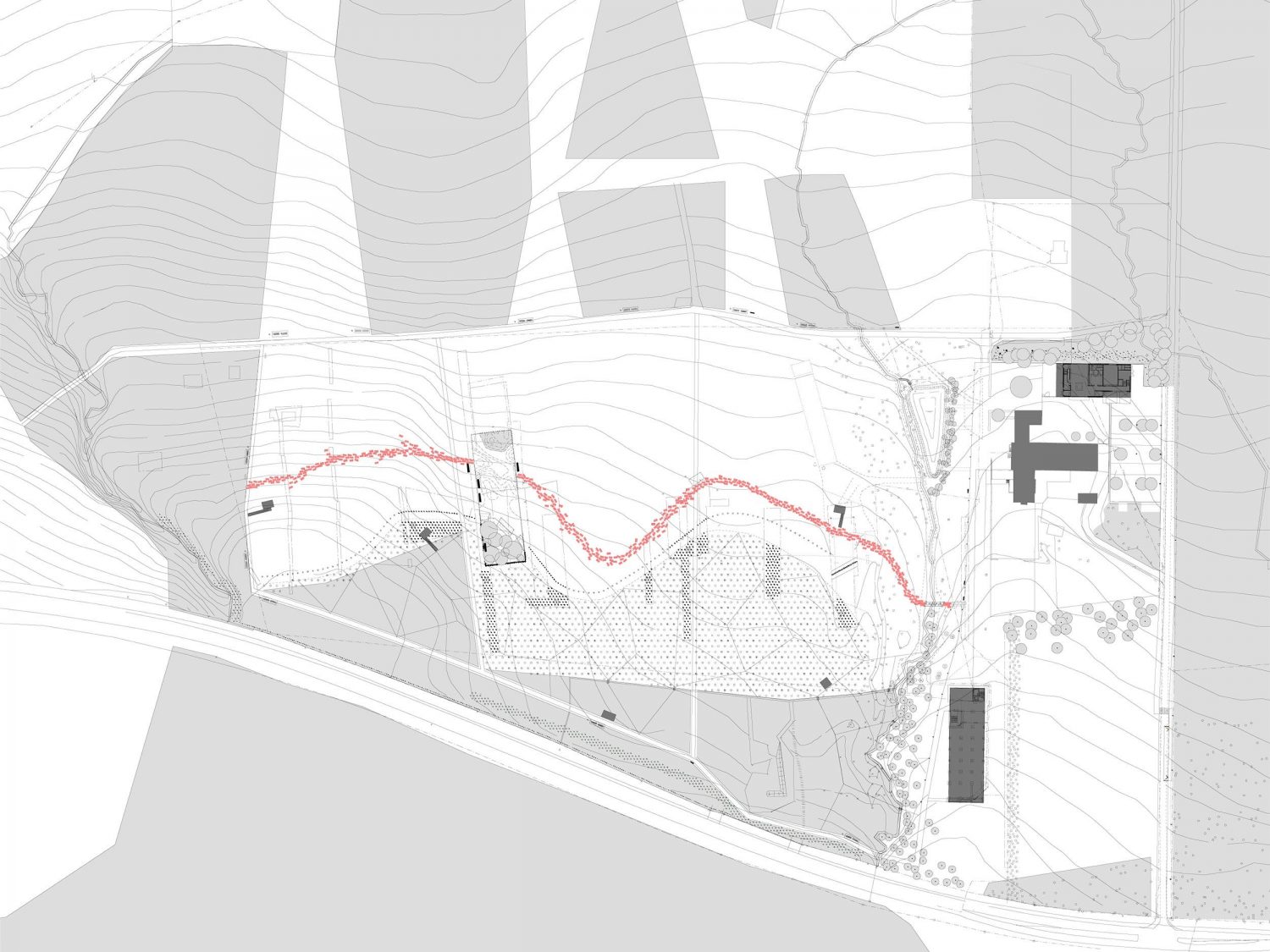
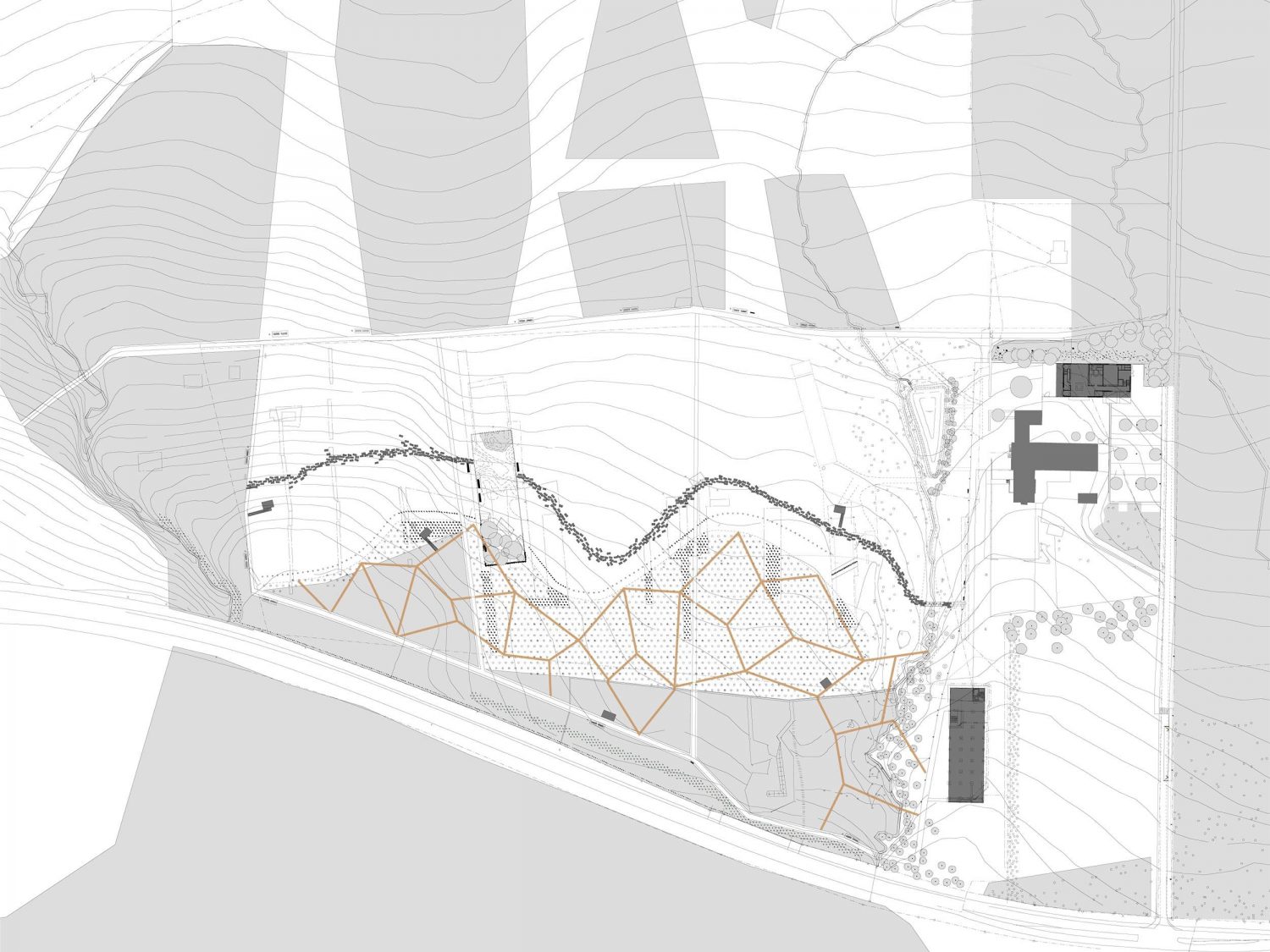
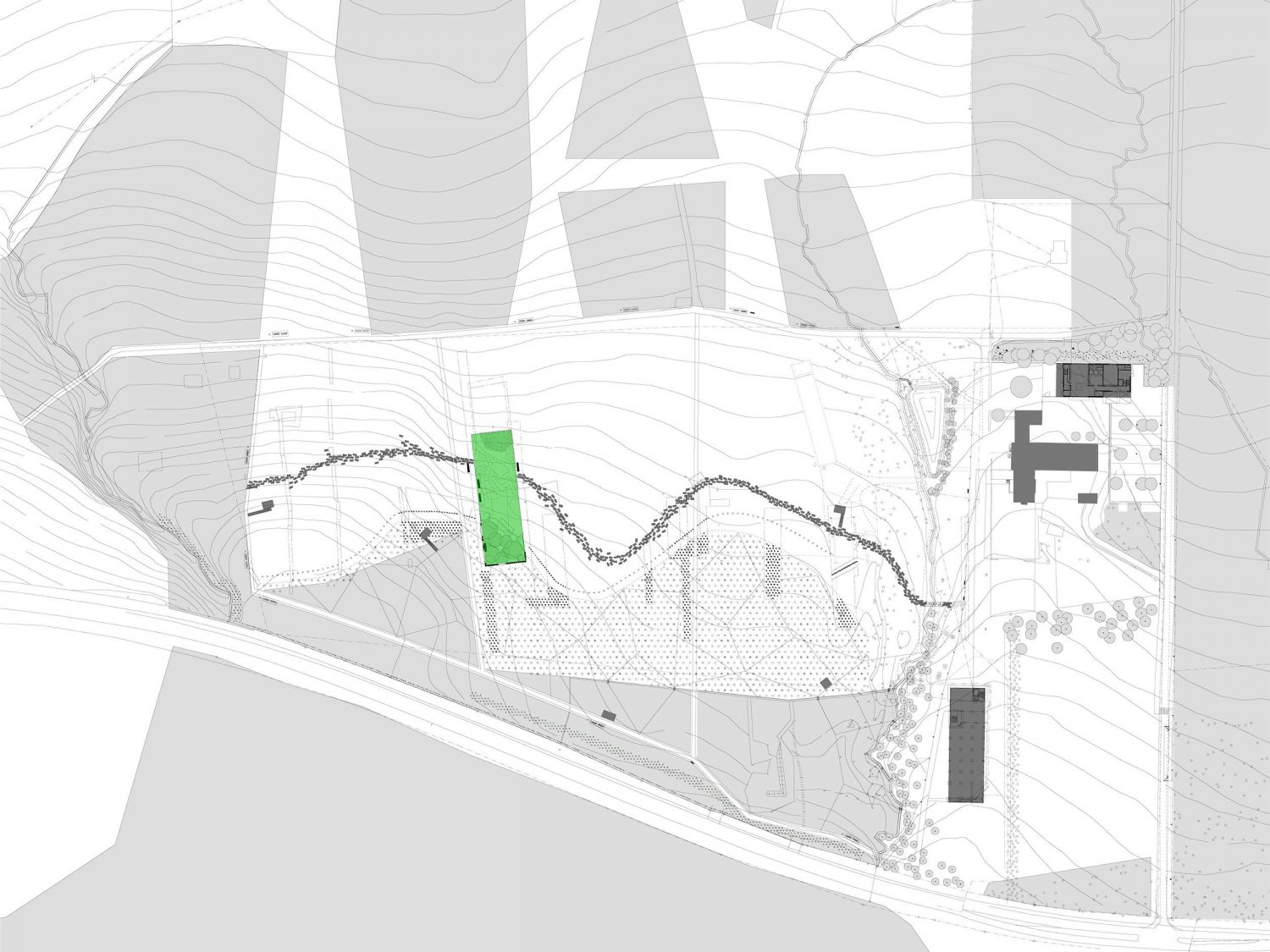
The interventions, the architectural means employed and the landscape design, are minimal and primarily abstract. A few measures spark the visitor’s imagination of the events that took place in this landscape: the visualization of the former rampart with iron poles, trees cleared away and reforestation, a partial “reconstruction” of the former, lower terrain, three pavilions as well as three path systems on the grounds. Irregularly placed large iron slabs retrace the possible route of the Roman Legions and form a path for visitors to access the former battlefield. A net-like pattern of wood-chip paths symbolizes the positions of the Germanic warriors, their camouflage, their silent attack. Contemporary agricultural gravel paths allow visitors to “switch sides”. Proceeding from one iron slab to the next on the so called “Roman path”, visitors collect pieces of information from the ground, not unlike archeological work. Step by step, an image of the historical battle forms in their minds.

Location Osnabrück, Germany

Programme 20 hectares former agricultural parcel “marked” as location of the famous “Battle of the Teutoburg Forest” (9 AD): 3 path systems of paths, visualization of presumed course of ramparts, forest clearance/reforestation, partial “reconstruction” of former landscape; construction of a new museum building with viewing platform 40 m in height; 3 pavilions: “Seeing”, “Hearing”, “Questioning”; conversion of former farmstead into visitor center with restaurant, shop, children’s museum and offices

Competition 1998, 1st Prize
in collaboration with Zulauf Seippel Schweingruber Landscapearchitects, Baden

Planning/Construction 1999–2002

Client Varusschlacht im Osnabrücker Land GmbH
Museum and Park Kalkriese, Germany

Gross Floor Area 2‘290 m2 (Museum and Pavilions)

Team GG Planning/Construction: Volker Mencke (Project Manager), Caspar Bresch, Christian Brunner, Massimo Wüthrich
Competition: Markus Lüscher

Site Management pbr Planungsbüro Rohling AG, Osnabrück, Germany

Landscape Architecture Planning/Construction: Zulauf Seippel Schweingruber, Landschaftsarchitekten, Baden
Construction Manager: Heimer + Herbstreit, Hildesheim, Germany

Structural Engineer Gantert + Wiemeler Ingenieurplanung, Münster, Germany

Exhibition Design Integral Concept, Paris/Baden: Ruedi Baur (1st Exhibition concept Museum), Lars Müller (Exhibition concept pavilions)

Photos © Heinrich Helfenstein
© Klemens Ortmeyer

Awards BDA-Preis Niedersachsen, Landesverband Bund Deutscher Architekten, 2003
Deutscher Stahlbaupreis, 2003
Weser-Ems-Preis für Architektur und Ingenieurbau, 2001

Museum

Landscape

Pavilion «Seeing»

Pavilion «Hearing»

Pavilion «Questioning»

Kunstmuseum Appenzell

formerly: Museum Liner Appenzell

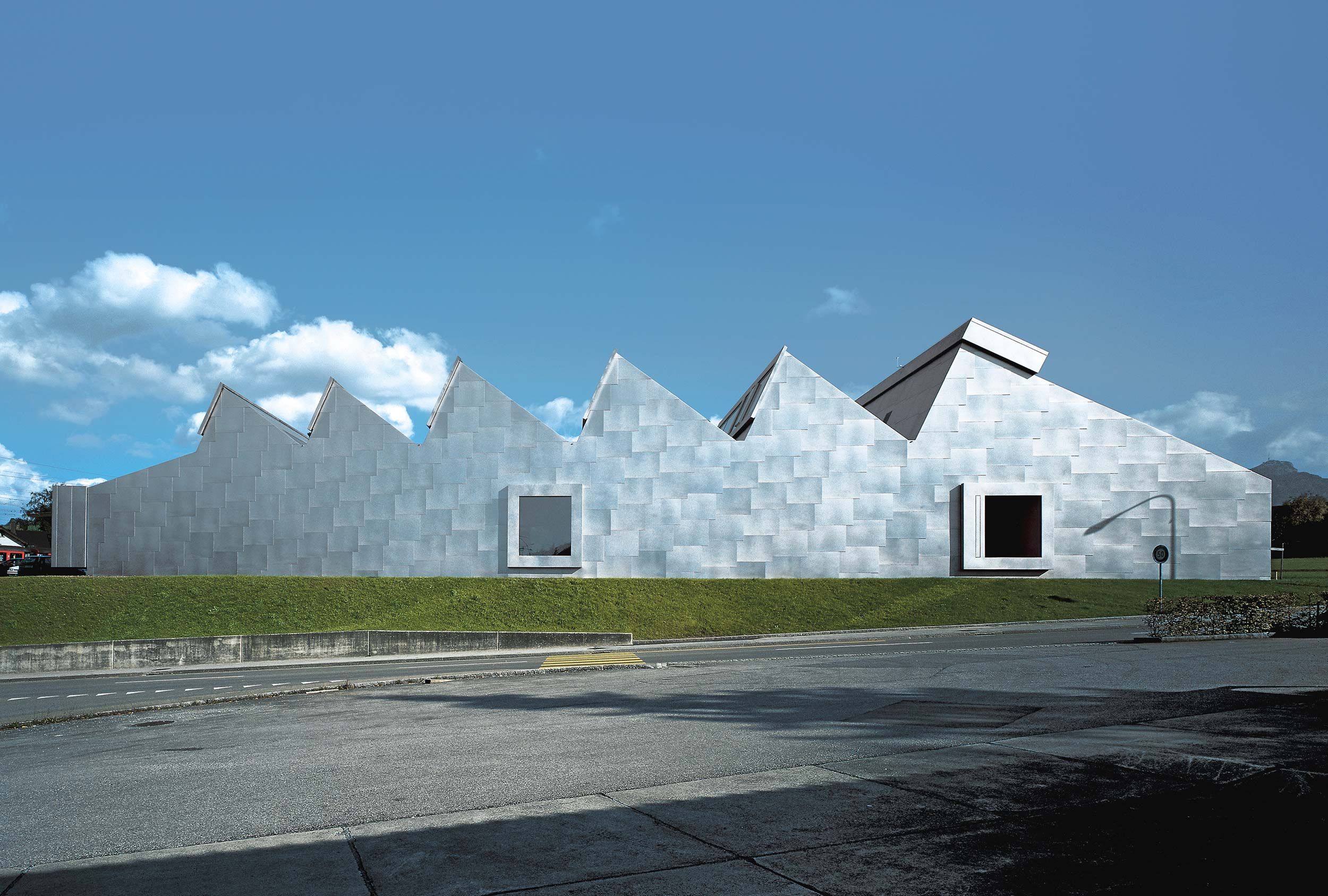
The museum building, dedicated to the oeuvre of Appenzell artists Carl August Liner and his son Carl Walter Liner, belongs to the category of the monographic museum. However, the rooms are not designed to house particular paintings by either of these two artists, but rather, are dimensioned to accommodate changing presentations of the work of father and son as well as exhibitions of contemporary art. The rooms are therefore more general than specific in nature. They are quiet, simple spaces that seek neither to exaggerate nor to compete with the works of art. They show a minimum of detail, have bright walls, poured concrete floors, and are illuminated by daylight coming in through windows set in the gabled roof overhead.

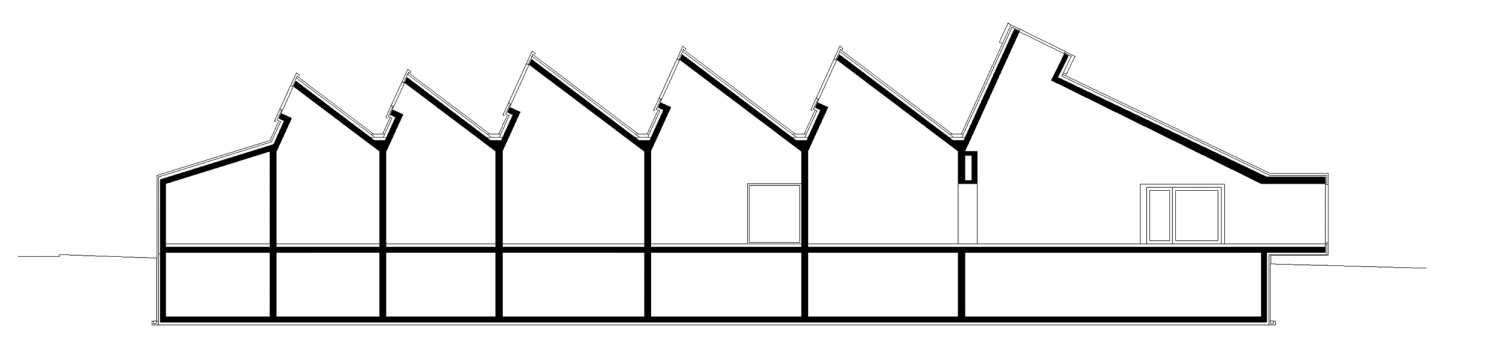
The dimensions of the rooms are relatively small to provide a concentrated and focused ambience for the individual paintings. The total exhibition area is divided into ten rooms, each measuring between 30 and 50 m2 in size. The varying size of the rooms is generated by an asymmetrically positioned wall running the length of the building as well as intersecting axes that define the spaces in decreasing size from south to north. The alignment of the doorways from room to room may be straight or shifted, allowing visitors to follow a direct or a meandering course through the museum. Two windows offer a view outdoors and facilitate orientation within the building. A small reading room and a room for slide and video presentations are placed at the north end of the building - that is, in the middle of the museum tour. The architectural opener for visitors is the spacious lobby with a counter for tickets and sales. As the first and largest room in the museum, it also functions as a place for receptions and lectures.

The building is constructed using in-situ concrete and aerated concrete masonry. Due to the massive construction and the north-orientated roof-lights only minimal climate control is necessary in the galleries. The vestibule projecting from the building volumetry is made of exposed concrete, illustrating the materiality and compactness of the construction on the exterior.

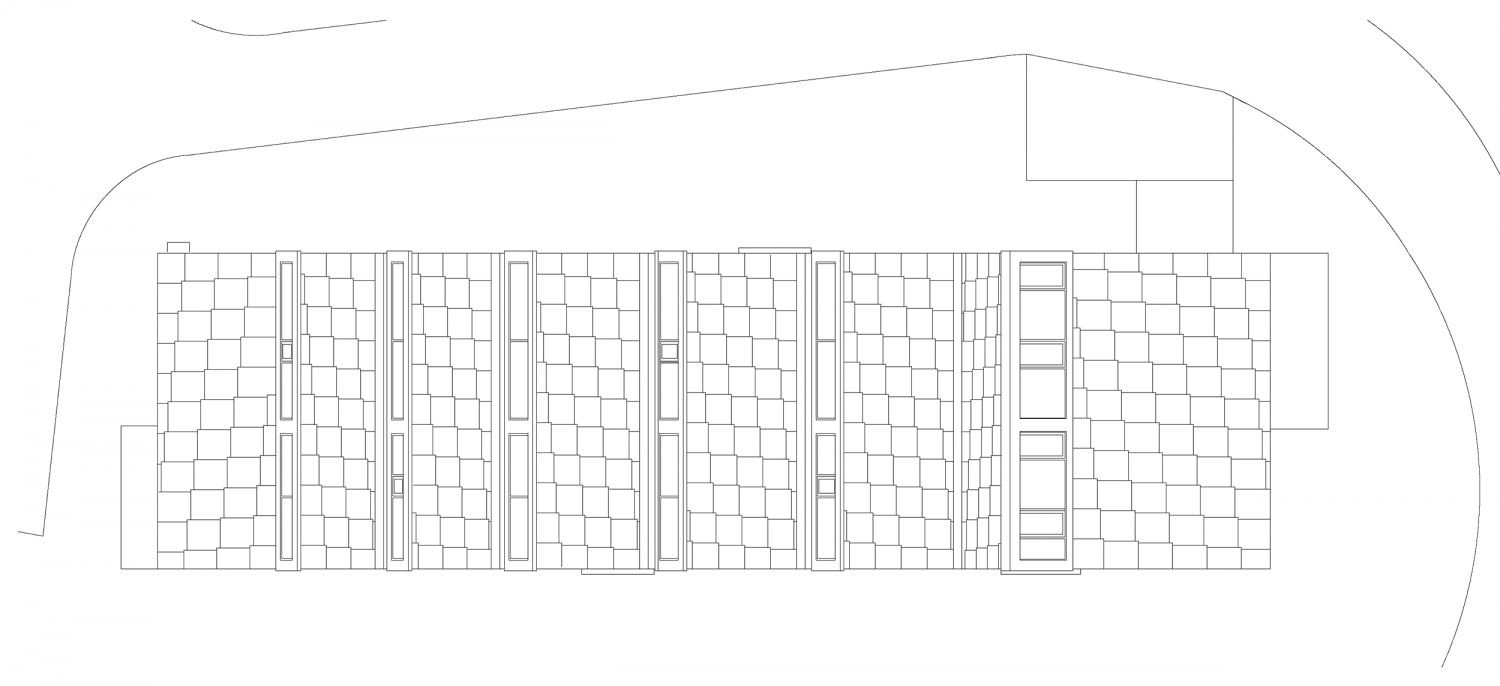
The illumination of the exhibition spaces, whose gables vary in height and breath, results in a 'zigzag form’ in the building volumetry. It reminds one, in a distant way, of the rows of gable roof buildings in the Appenzell villages, as well as of the more regular sawtooth roof forms of industrial and agricultural buildings. The roofs are clad in sandblasted sheets of stainless steel in order, on the one hand, to attain a diffusion of the reflected light, while on the other hand, a neutrality of the colour temperature. The facades are clad in the same material. The overlapping cladding and its shimmering grey colour show a distant resemblance to traditional Appenzell architecture with its shingled facades (and roofs that were once shingled as well) weathered to a silvery grey. The combination of facade and roofing in the same material produces an overall, irregular volume, like a small mountain range against the background of the Alpstein massif.

Location Appenzell, Switzerland

Programme 12 connected exhibition spaces, each measuring 30–50 m2, reading and media room, lobby with cloakroom; offices, technical and storage spaces

Commission 1996

Planning/Construction 1996–1998

Client Stiftung Museum Carl Liner Vater und Sohn

Gross Floor Area 1‘644 m2

Team GG Annette Gigon, Mike Guyer, Urs Birchmeier (Project Manager)

Site Management Annette Gigon / Mike Guyer Architects, Zurich
Collaborator: Daniel Kaufmann

Landscape Architecture Kienast Vogt Partner, Zurich

Structural Engineer Aerni + Aerni Ingenieure AG, Zurich

Electrical Engineer Elkom Partner AG, Chur

Building Services Engineer Waldhauser Haustechnik AG, St.Gallen

Daylighting Consultant Institut für Tageslichttechnik Stuttgart, Germany

Lighting Consultant Lichtdesign Ingenieurgesellschaft mbH, Cologne, Germany

Signage Trix Wetter, Zurich

Photos © Heinrich Helfenstein
© Gaston Wicky

Awards Mies van der Rohe Award for European Architecture, 1999 – Finalist

Extension and Renovation Oskar Reinhart Collection «Am Römerholz»

With the addition and alterations to the ‘Römerholz Villa’, the building once again undergoes a transformation. In 1915, the Geneva architect Maurice Turrettini, commissioned by then-owner Heinrich Ziegler-Sulzer, erected the building in the style of a French Renaissance country house. In 1924 Oskar Reinhart purchased the house and commissioned the same architect to build a gallery addition to accomodate his growing art collection. After his death in 1965, Oskar Reinhart bequeathed the building with its internationally prominent collection to the Swiss Confederation. After extensive alterations in 1970, the ground floor of the residential part of the building and the gallery spaces were made accessible to the public as a museum. The most recent alteration and renovation work can be traced to changing requirements with regard to lighting, operations and security that are required of contemporary museum spaces. Priority is laid therein upon the improved presentation of the high-quality works of art.

The architectonic means used to satisfy the varied requirements range from the replacement of two existing exhibition spaces with newly constructed ones, to simple renovation work, up to near-complete restoration of the historical spatial disposition and materials*. Hence, the commission divides itself into a plethora of differentiated interventions. This includes, for example, the spatial separation of the entrance space from the cloak room, in order to create more space for receiving guests; the restoration of the spatial arrangement in the former dining room; the reconstruction of former windows in order to illuminate certain sculptures; the reconstruction of the earlier parquet flooring in the gallery spaces; as well as the addition of etched panes of glass hung before the lantern skylight of the large gallery and the installation of sensor controlled louvers to regulate the light intensity.

The most far reaching changes are the three new exhibition spaces that mark the transition between the former residence and the gallery area. Corresponding to the works on display, the three spaces possess various sizes and proportions. The larger room is to house oil paintings, while the two smaller rooms are planned to display light sensitive graphic works. All three spaces are naturally lit; electronically regulated louvers lessen the intensity of the light. The skylights on the ceiling have the appearance of glowing lit panels and distribute light evenly into the space.

On the exterior, the new exhibition halls with their recessed skylights appear as closed, step-tapered volumes in concrete. Akin to a joint placed between the residence and the gallery wing, they terminate the entrance court on its shorter side. Like the existing gallery wing, the roof surfaces are covered with copper sheet. Large, pre-fabricated concrete elements form the cladding of the walls and the recessed skylight lanterns. Jura limestone and copper, two of the primary materials of the existing villa, were mixed into the concrete as powdered ingredients. The limestone and the copper powder in combination lead to a quick acting oxidation and to a green shift in colouration of the concrete. As water, enriched by copper ions, drains from the roof, the colouration process of the façade will increase over time. By virtue of this accelerated patinisation, the new building should make a kind of ‘journey through time’ towards the two, older, historic building elements - in the sense of an ‘alchemistic’ adaptation of the new building to the genius loci.

* Additional information:
The federal government passed general spending limits at the beginning of the planning phase, which also affected the retrofitting budget for the Oskar Reinhart Collection "Am Römerholz". Funds were cut in half, so that a comprehensive renovation was no longer feasible. In 2009/2010 a separate renovation phase took place without Gigon/Guyer participating. This included the construction of a new shelter space for cultural artifacts, the restaurant kitchen, the restrooms, the museum education spaces, and modifications of the technical equipment, by P&B Architekten.

Location Winterthur, Switzerland

Programme Renovation and remodelling existing Villa «Römerholz»: Entrance area, exhibition rooms, café
New building: exhibition spaces

Competition 1993, 1st Prize

Planning/Construction 1995–1998

Client Federal Office for Construction and Logistics, Bern

Gross Floor Area 136 m2 (three new build exhibition spaces)
Net Internal Area (SIA 416): 1‘000 m2 (total renovated exhibition space)

Team GG Planning/Construction: Andreas Sonderegger (Project Manager), Markus Jandl, René Kümmerli
Competition: Raphael Frei, Michael Widrig, Judith Brändle

Landscape Architecture Kienast Vogt Partner, Zurich

Structural Engineer Dr. Deuring + Oehninger AG, Winterthur

Electrical Engineer Elkom Partner AG, Chur

Building Services Engineer Waldhauser Haustechnik AG, St.Gallen

Daylighting Consultant Institut für Tageslichttechnik Stuttgart, Germany

Lighting Consultant Lichtdesign Ingenieurgesellschaft mbH, Cologne, Germany

Signage Trix Wetter, Zurich

Photos © Andrea Helbling
© Harald F. Müller

Detached House Canton Zürich

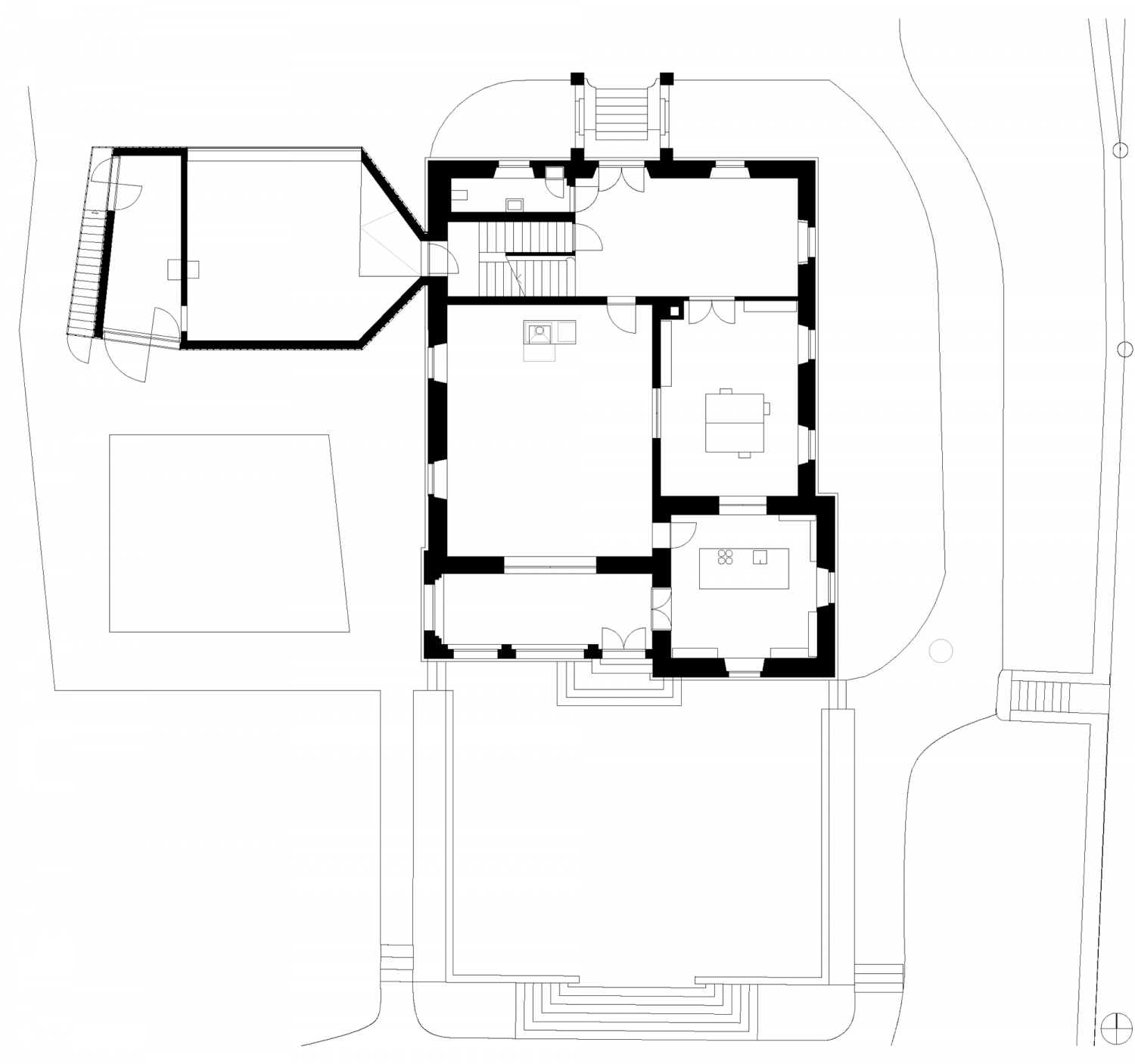
The parcel is situated on the edge of the village’s single-family house zone, tangent to orchards and in view of the nearby lake. Strict local building codes are intended to preserve the pastoral quality of the area around the lake. The building is positioned near the northern boundary, which adjoins the agricultural area, and set parallel to the lake and to the land’s slope. This siting insures that all rooms have either a lake view to the north or a maximum amount of sunlight. A garden, defined by a high espalier and a gardening shed, defines the green area to the south between the neighbouring houses. The spatial structure within the house makes corridors unnecessary. On the ground floor, a dining room with a view towards the garden to the south is set in front of the kitchen and other rooms. This plan organisation is repeated on the upper floor: a foyer serves as the children’s playroom.

Within the slope prescribed by the building code, the roof is folded across the entire volume in a wave-like motion. Beginning at the garage, it ascends sharply in the area of the staircase. Above the attic, it flattens out again and then, on the far side of the gable, extends in a continuous surface towards the northwest, where it forms an eave against the side most susceptible to heavy weather. All of the ancillary spaces are thus located directly beneath the slope of the roof.

The house is constructed in single-unit solid insulating masonry. The wooden windows are mounted on the inside, forming deep, wood-clad embrasures. Folding shutters in the open position fit into the embrasures. In the closed position, the window openings give the impression of being “'barricaded” in a box-like way, so to speak. All woodwork, except for the sills, is painted red. The house's outermost protective layer is comprised of a mineral-based lime-cement stucco and untreated concrete tile, also made out of lime and cement. In the rain, the roof and façade turn dark gray and then dry out again like a watercolour painting.
Location Canton Zurich, Switzerland

Programme Single-family house

Commission 1992

Planning/Construction 1992–1994

Client private

Team GG Dieter Bachmann (Project and Construction Manager), Michael Widrig, Roberto Azzola, Eva Geering

Site Management Annette Gigon / Mike Guyer Architects, Zurich

Structural Engineer Aerni + Aerni, Zurich

Photos © Christian Kerez