New Social Insurance Centre WAS (Wirtschaft Arbeit Soziales)
Areal Eichhof West

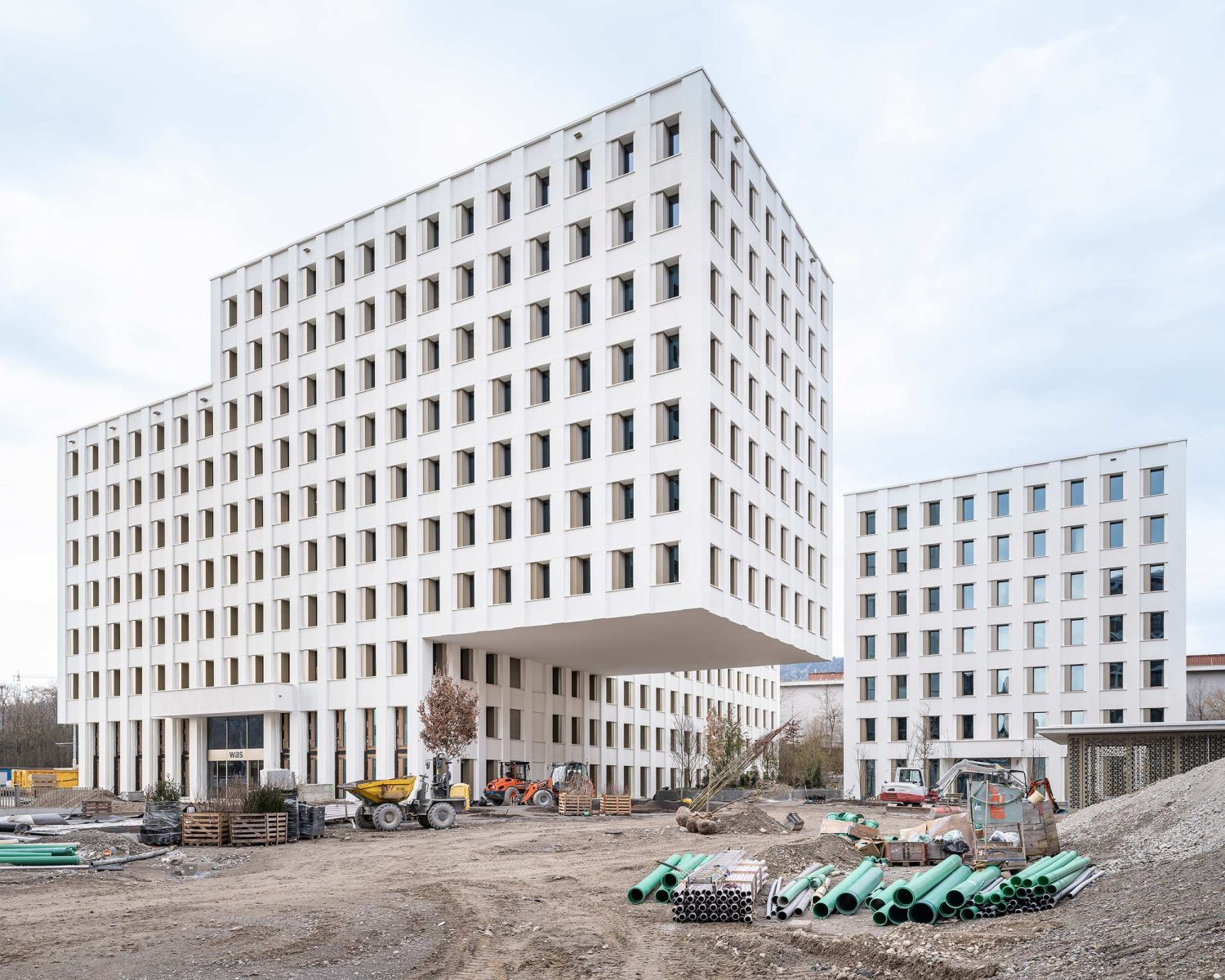
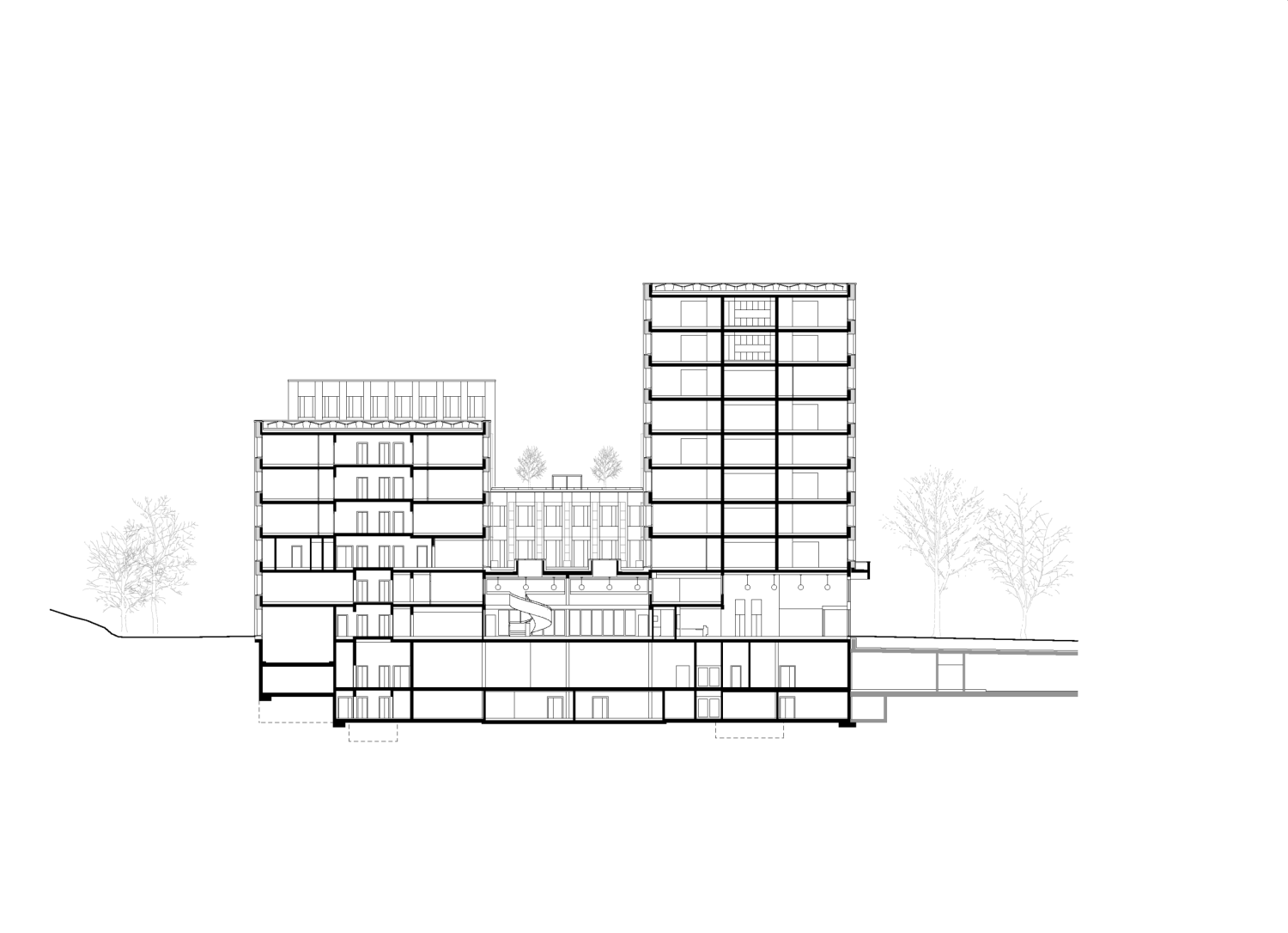
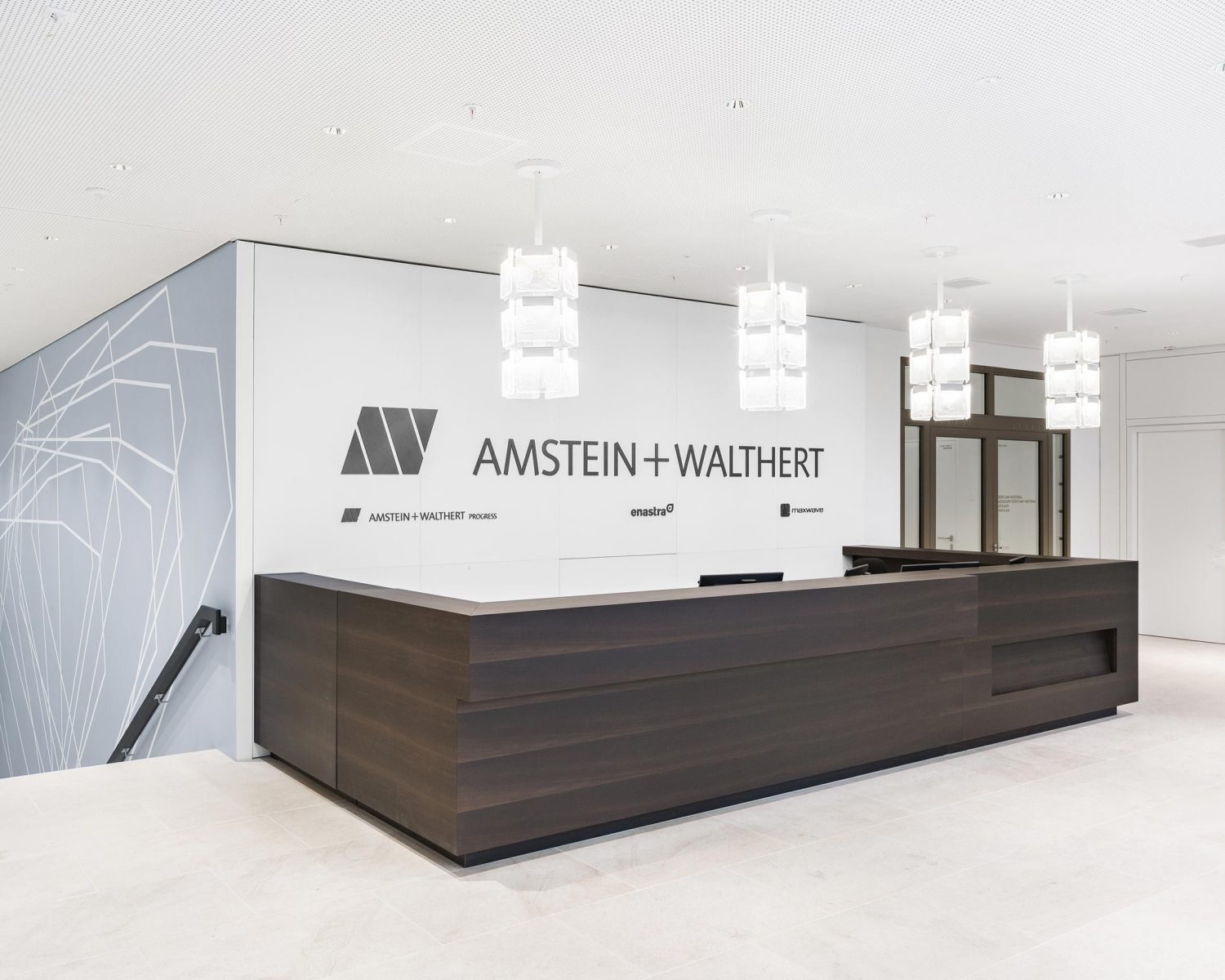
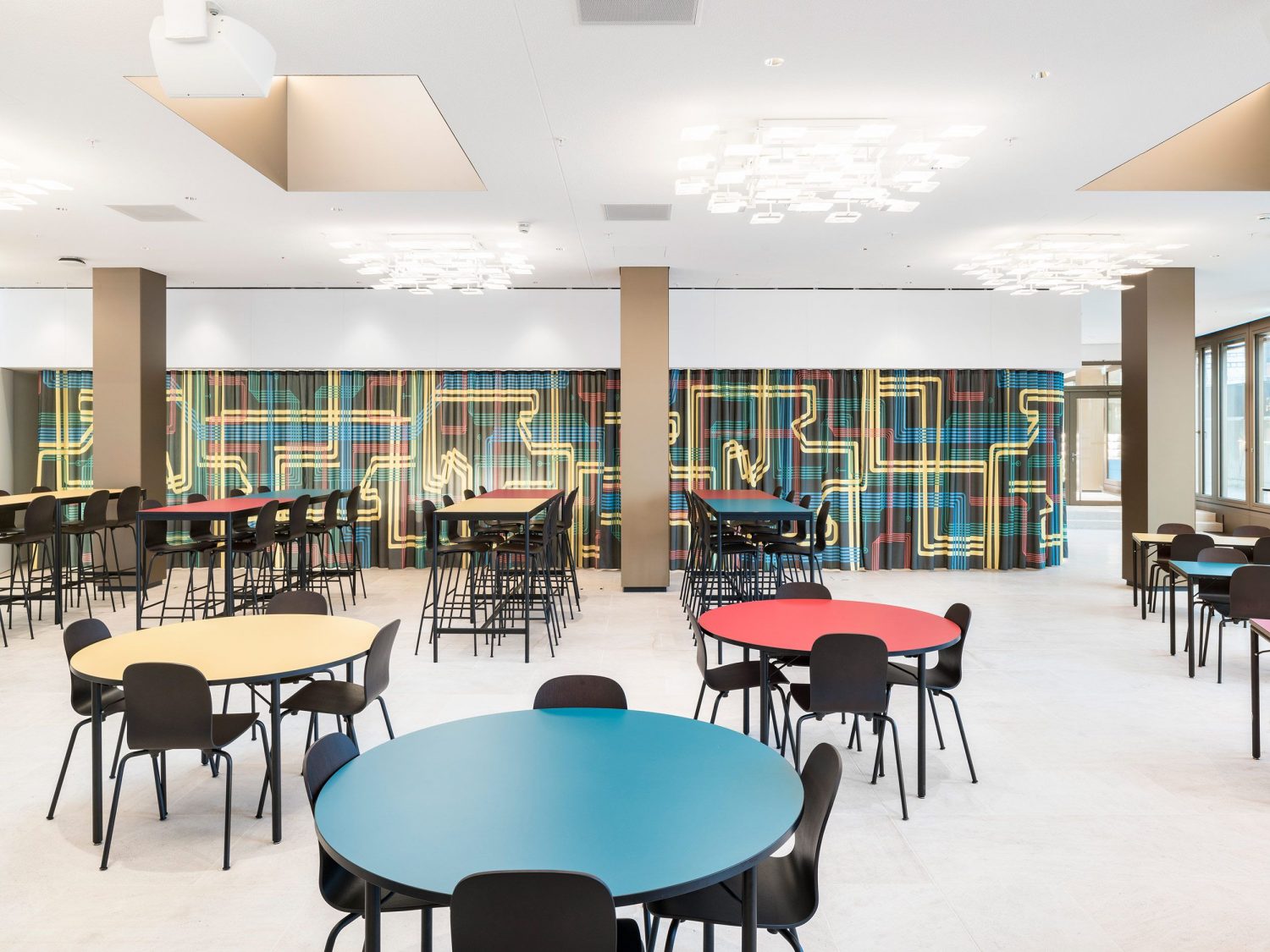
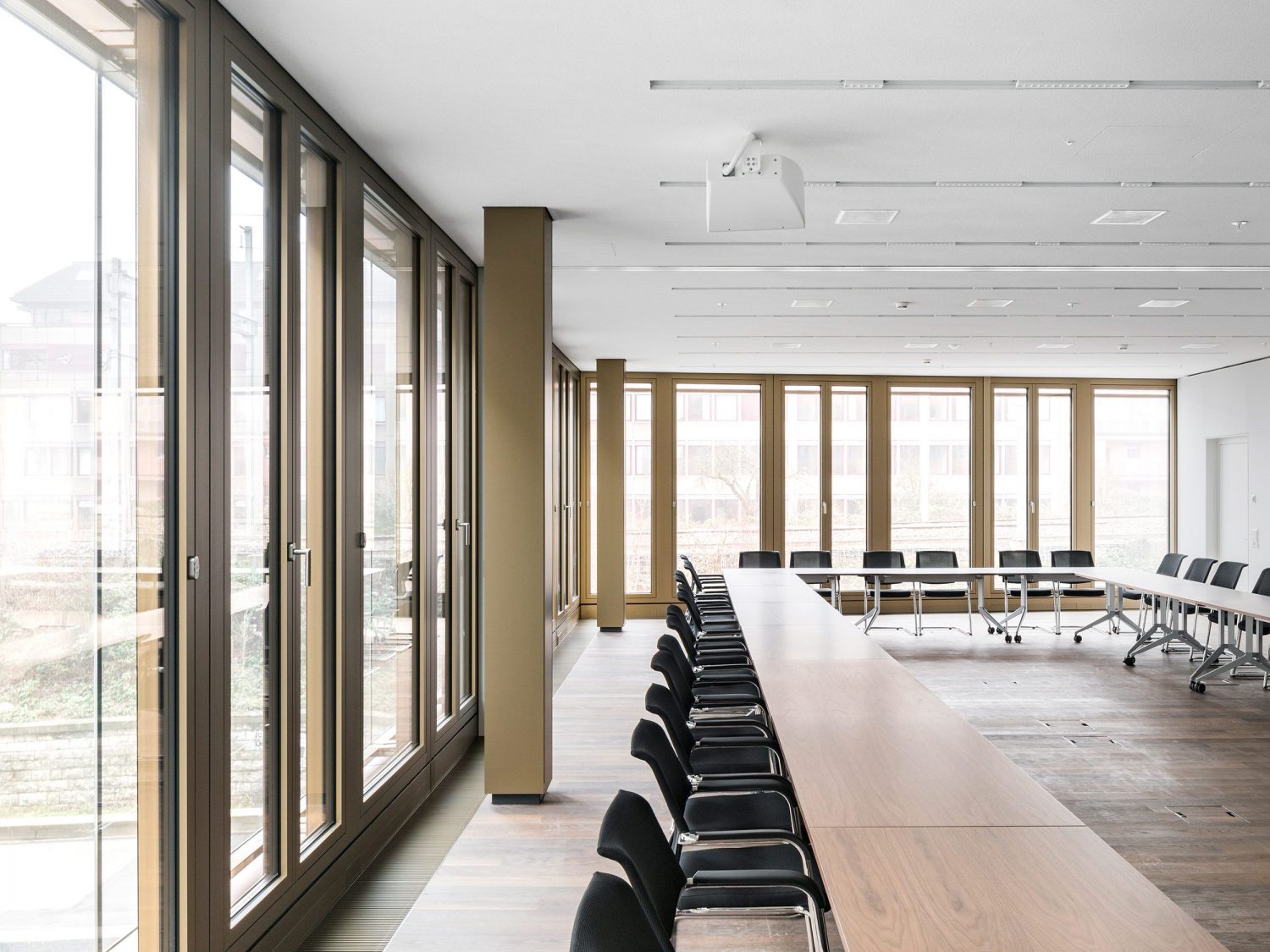
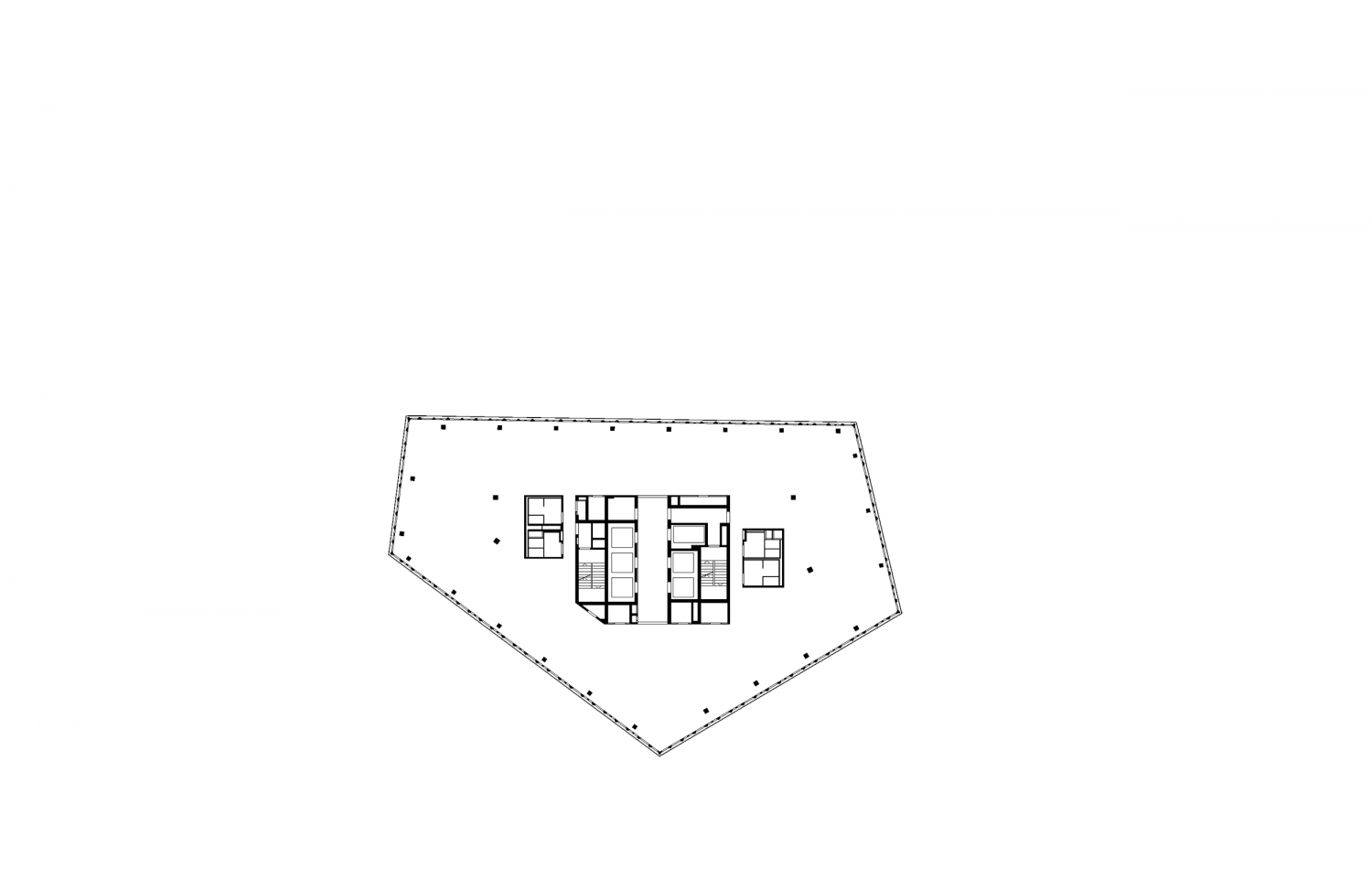
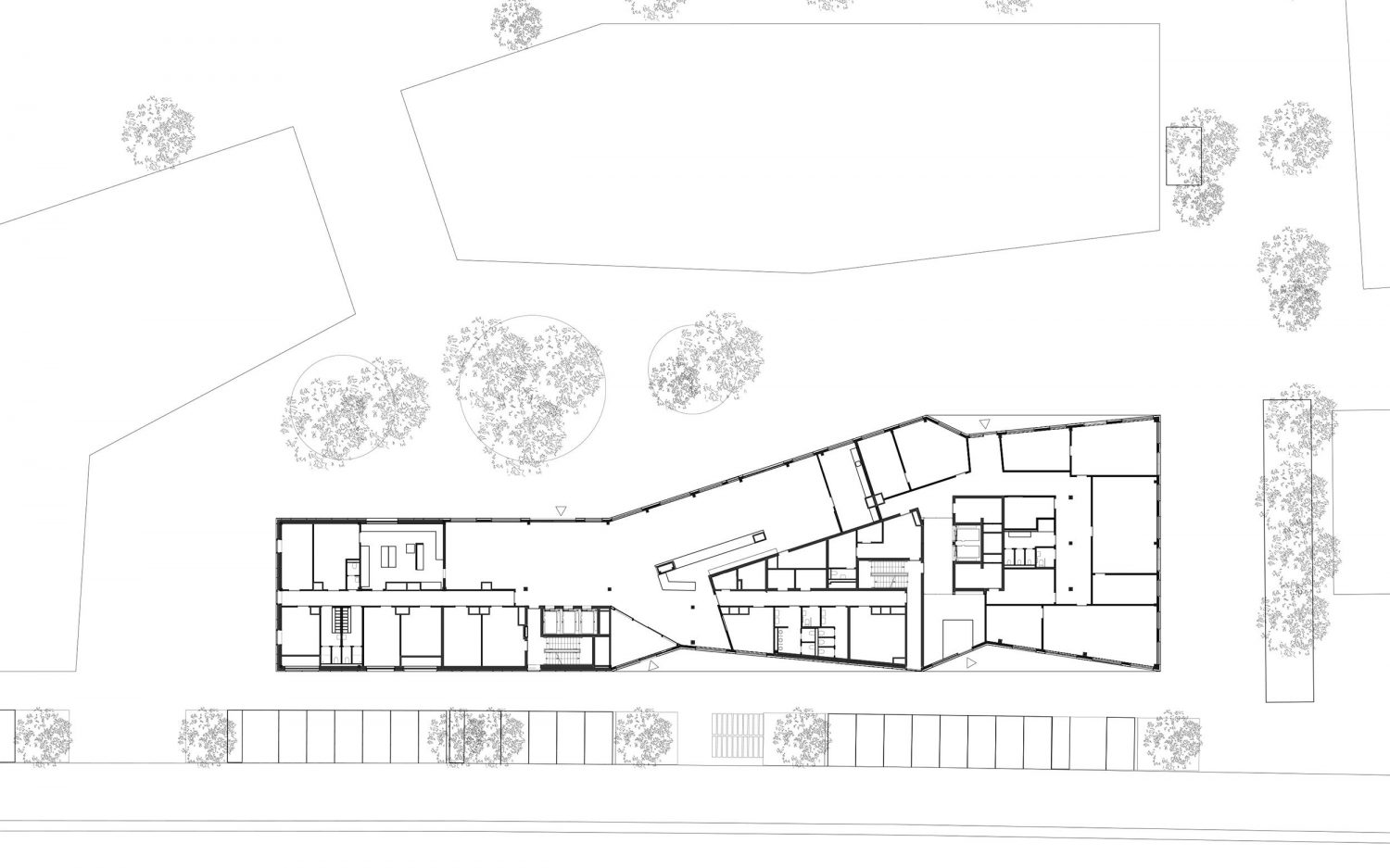
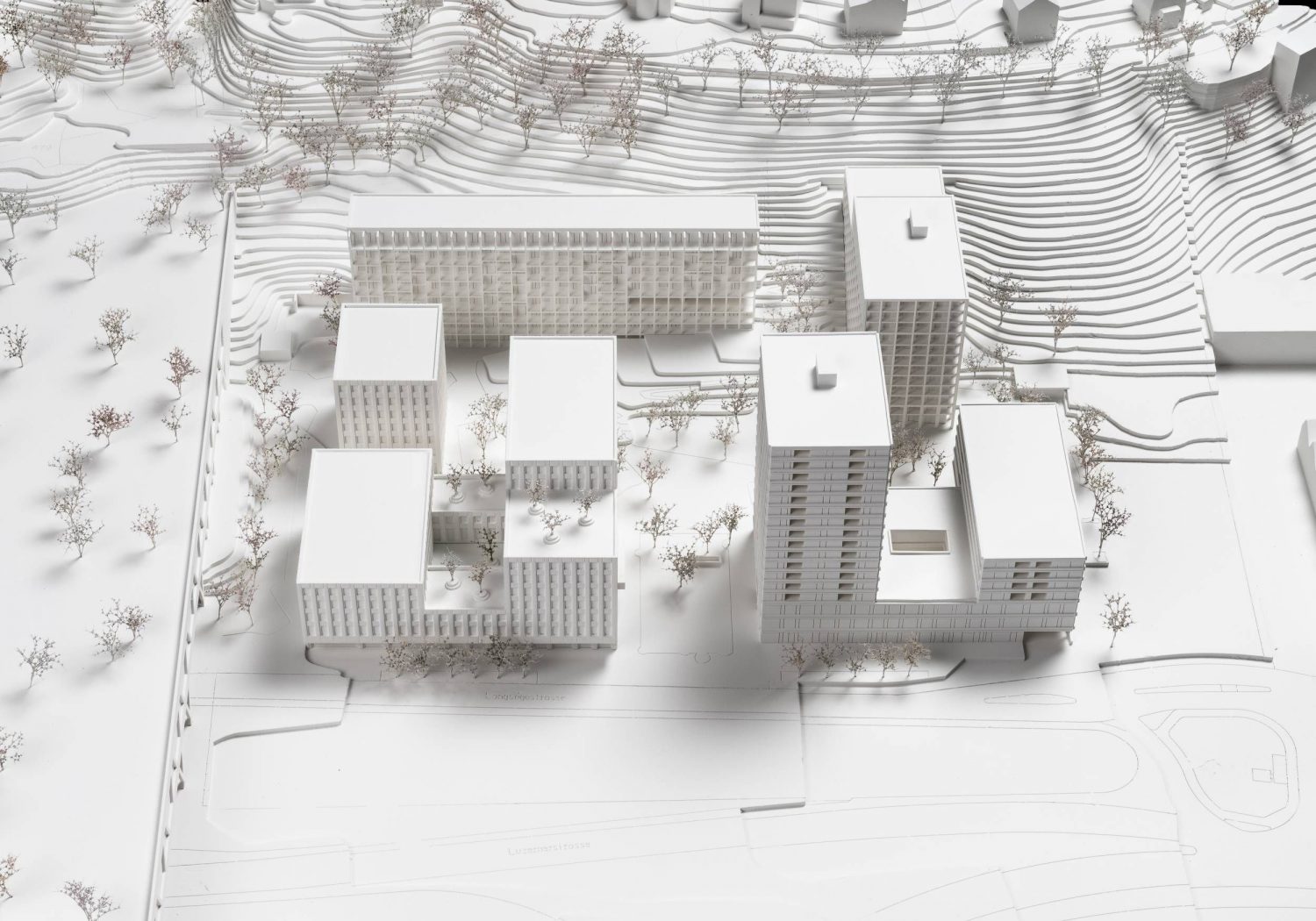
Next to the site of the Eichhof brewery, in proximity to the municipality of Lucerne, a development with five office, commercial and residential blocks arranged around a central open space is emerging. The plot is accessed from Langsägestrasse in the south, to the north it is bordered by a sloping green space. Part of this development are the two new buildings for the Social Insurance Centre WAS (Wirtschaft Arbeit Soziales) Lucerne, which will provide its services at this central location.

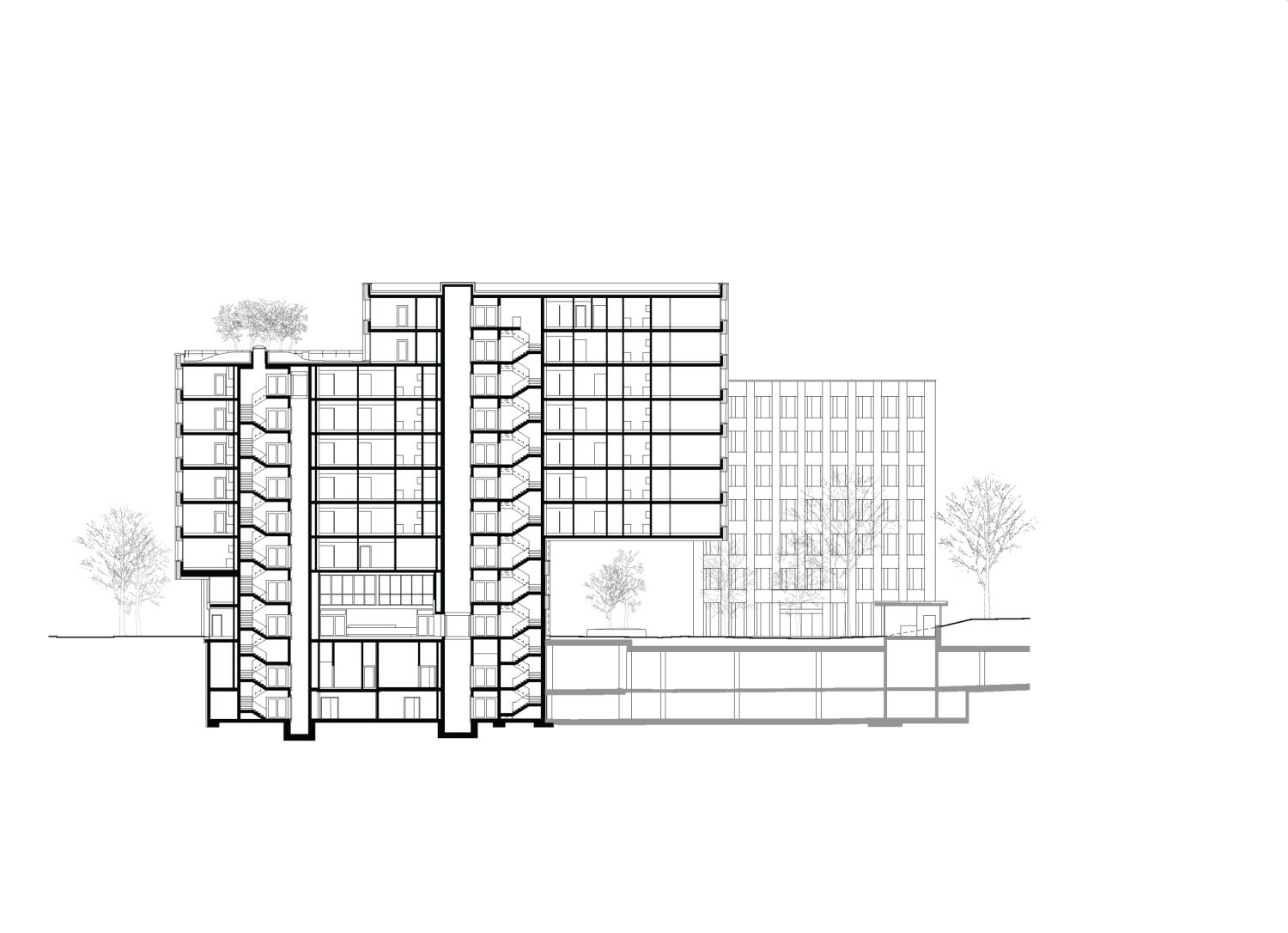
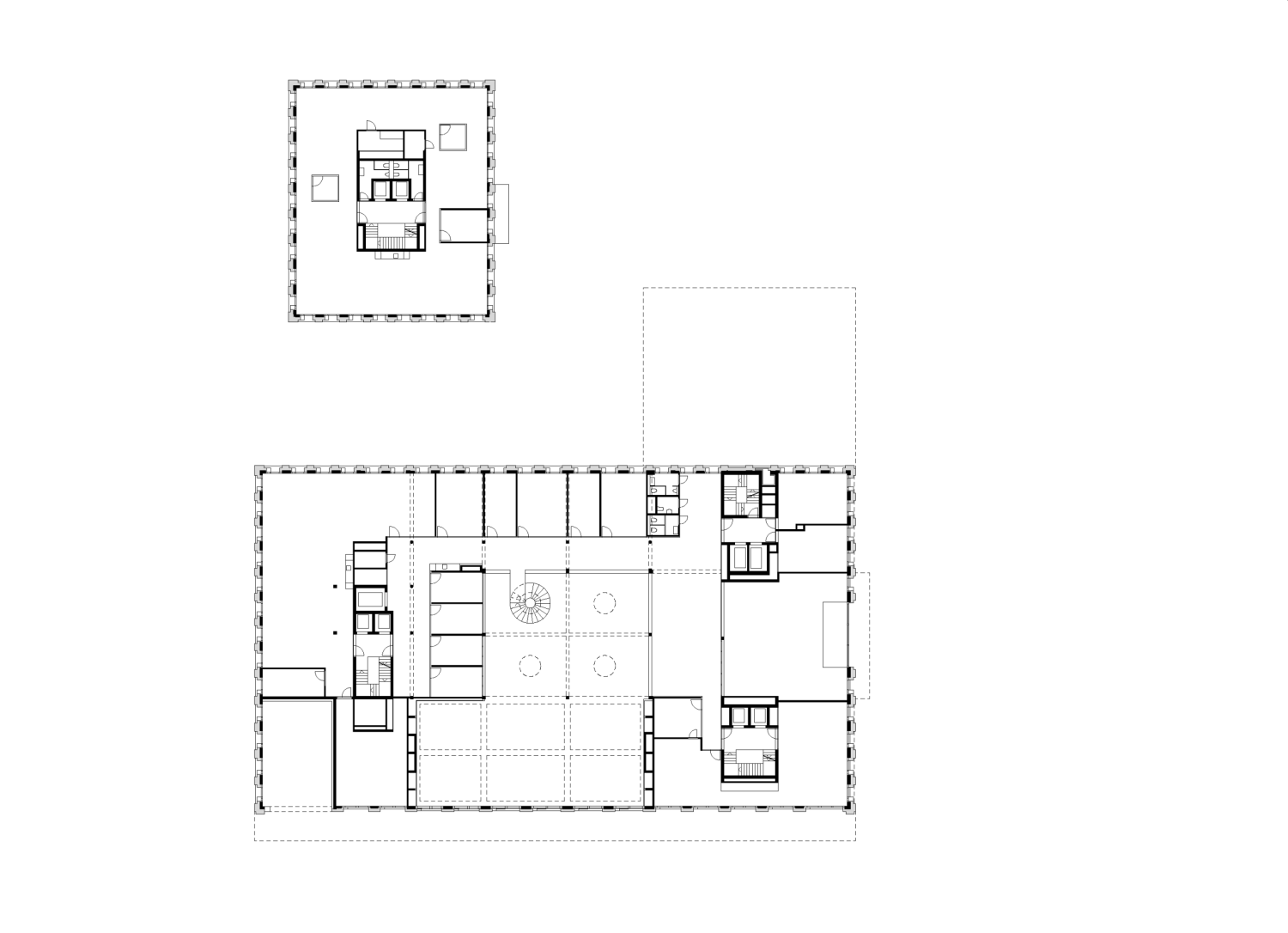
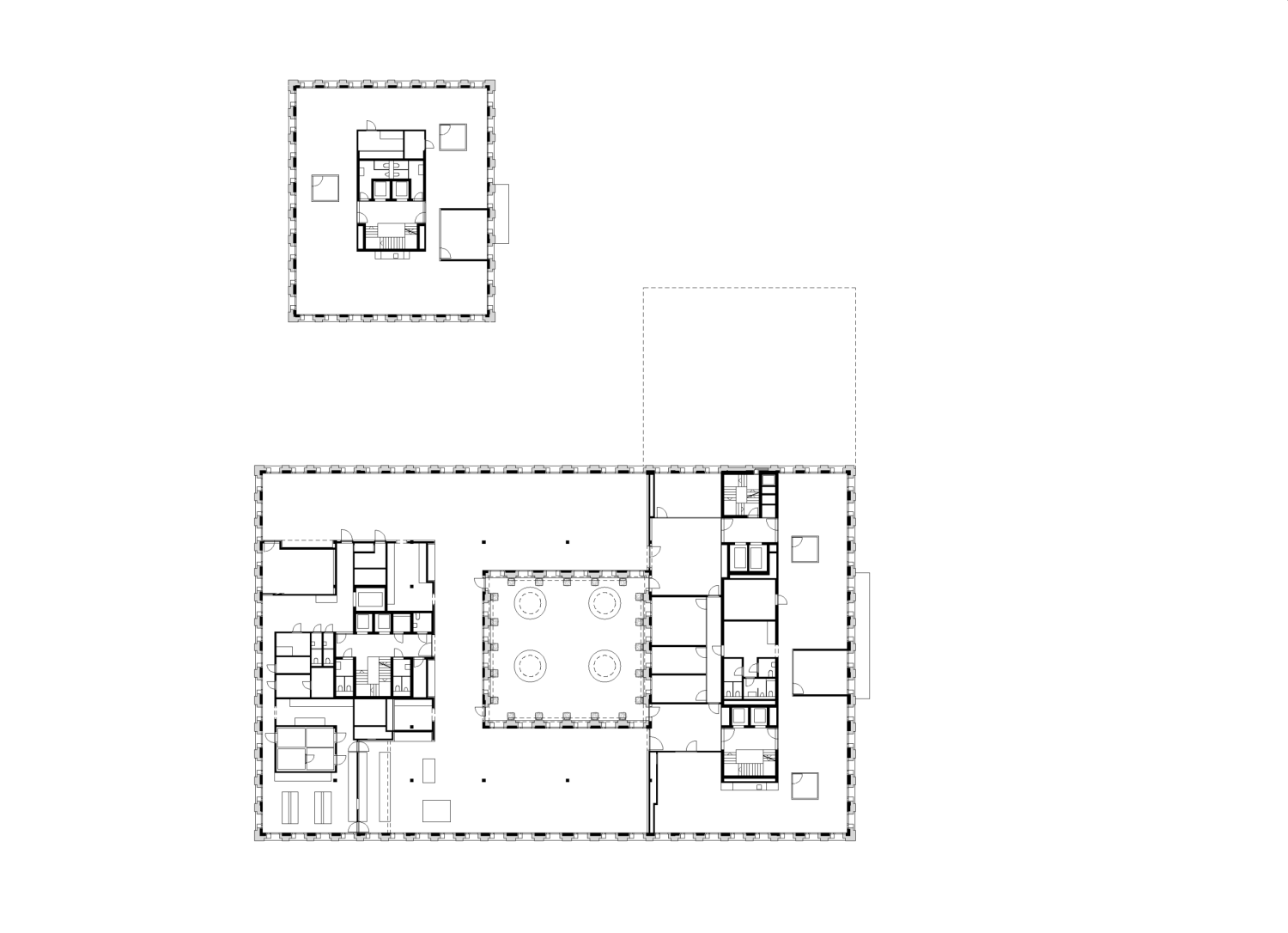
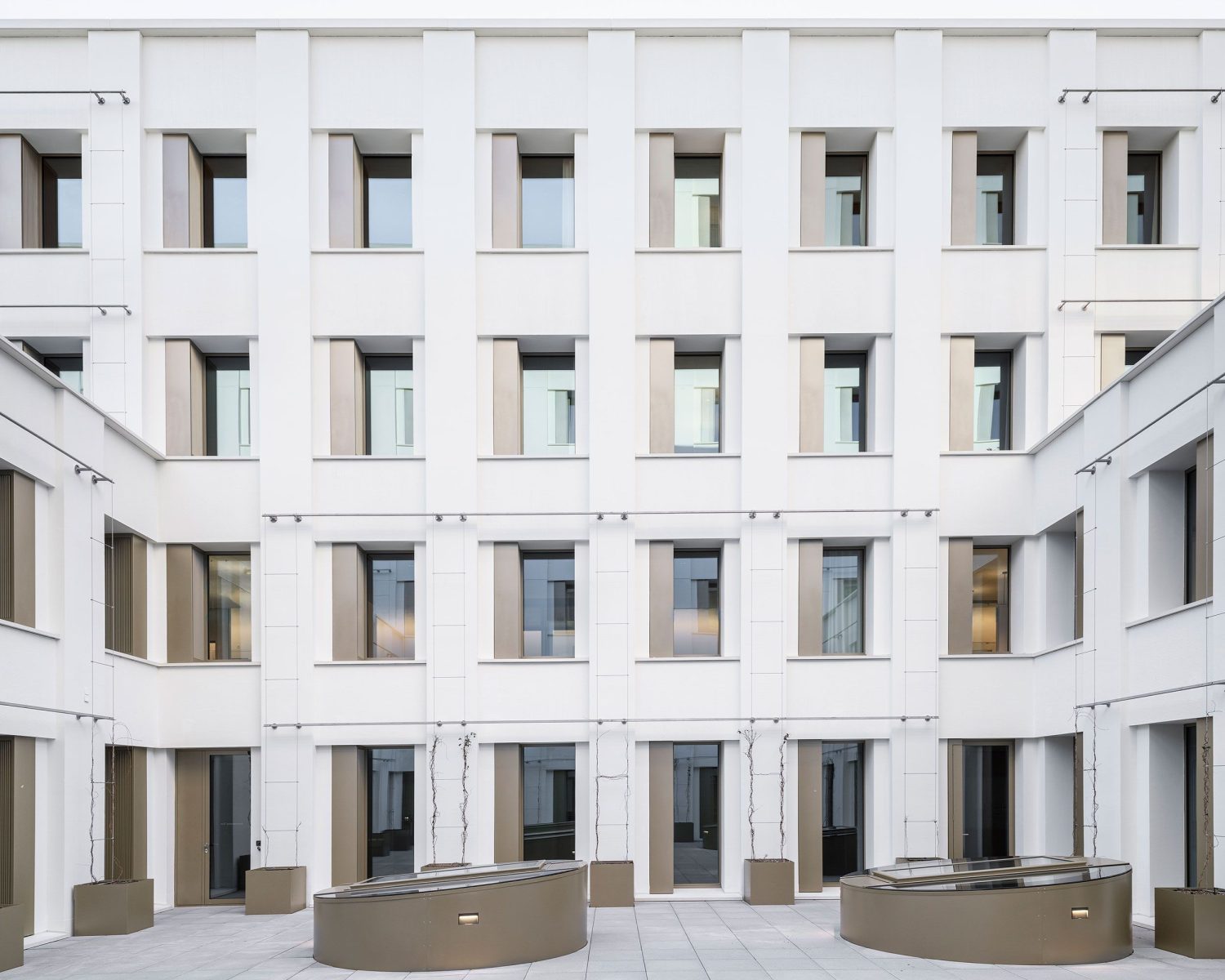
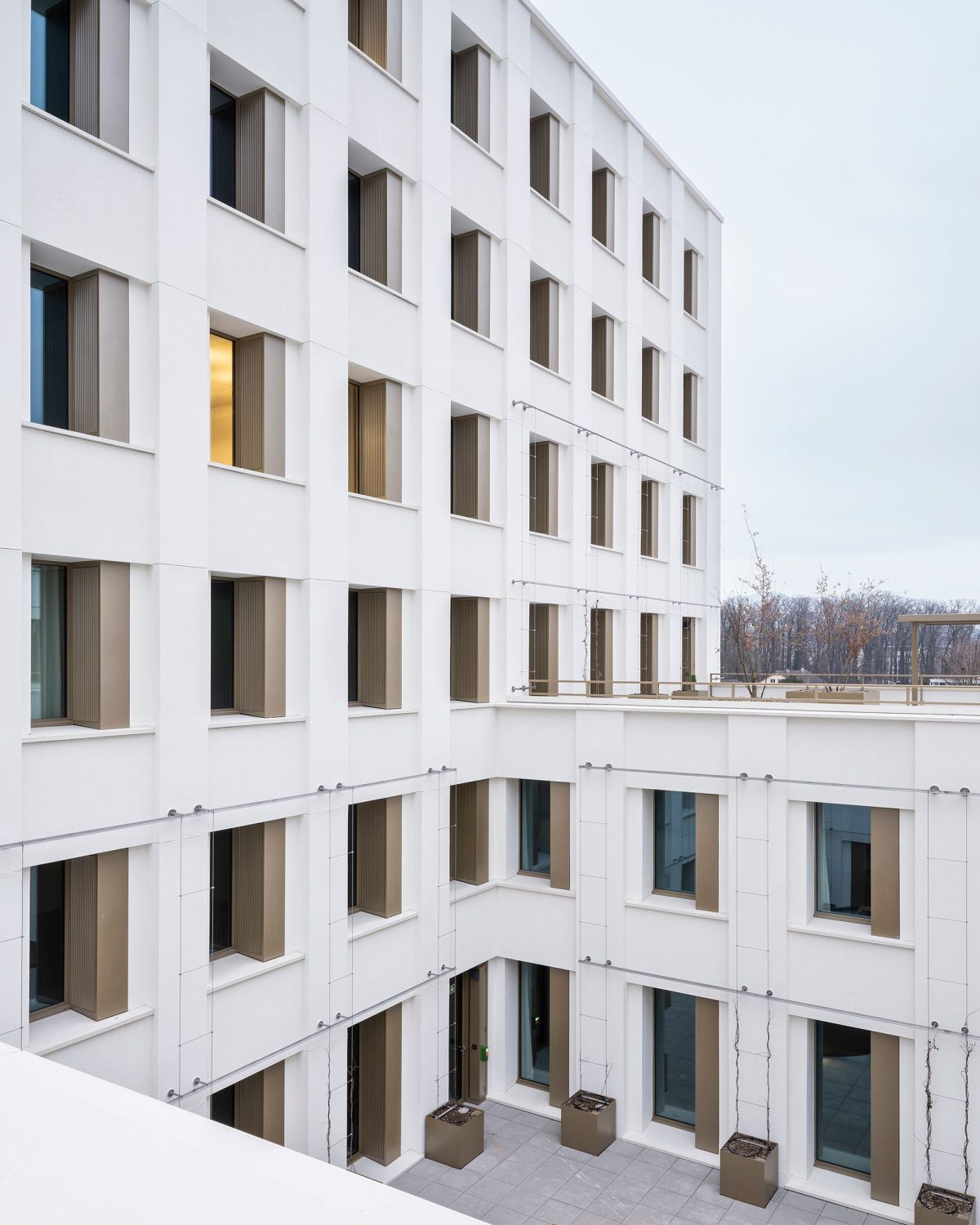
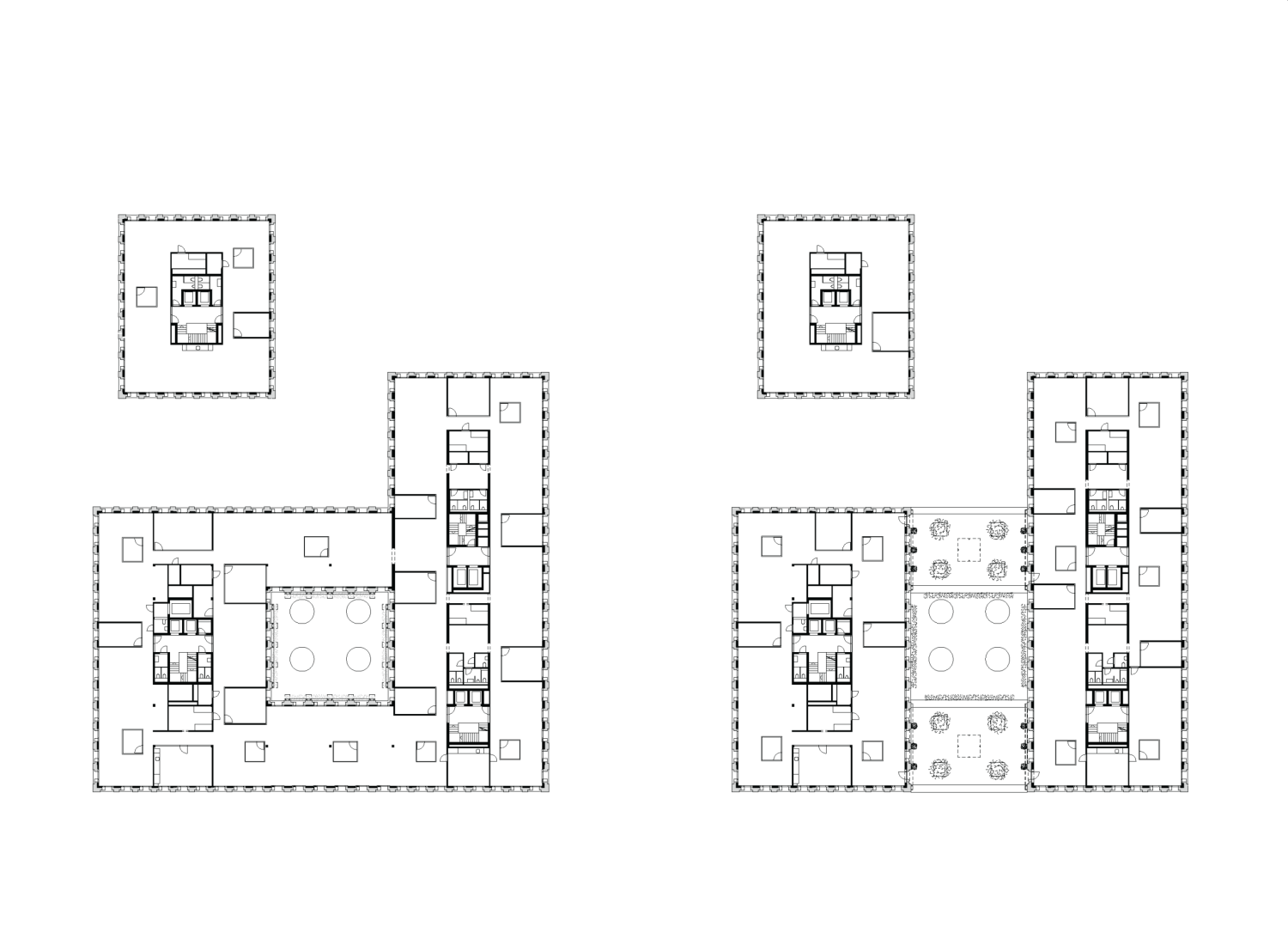
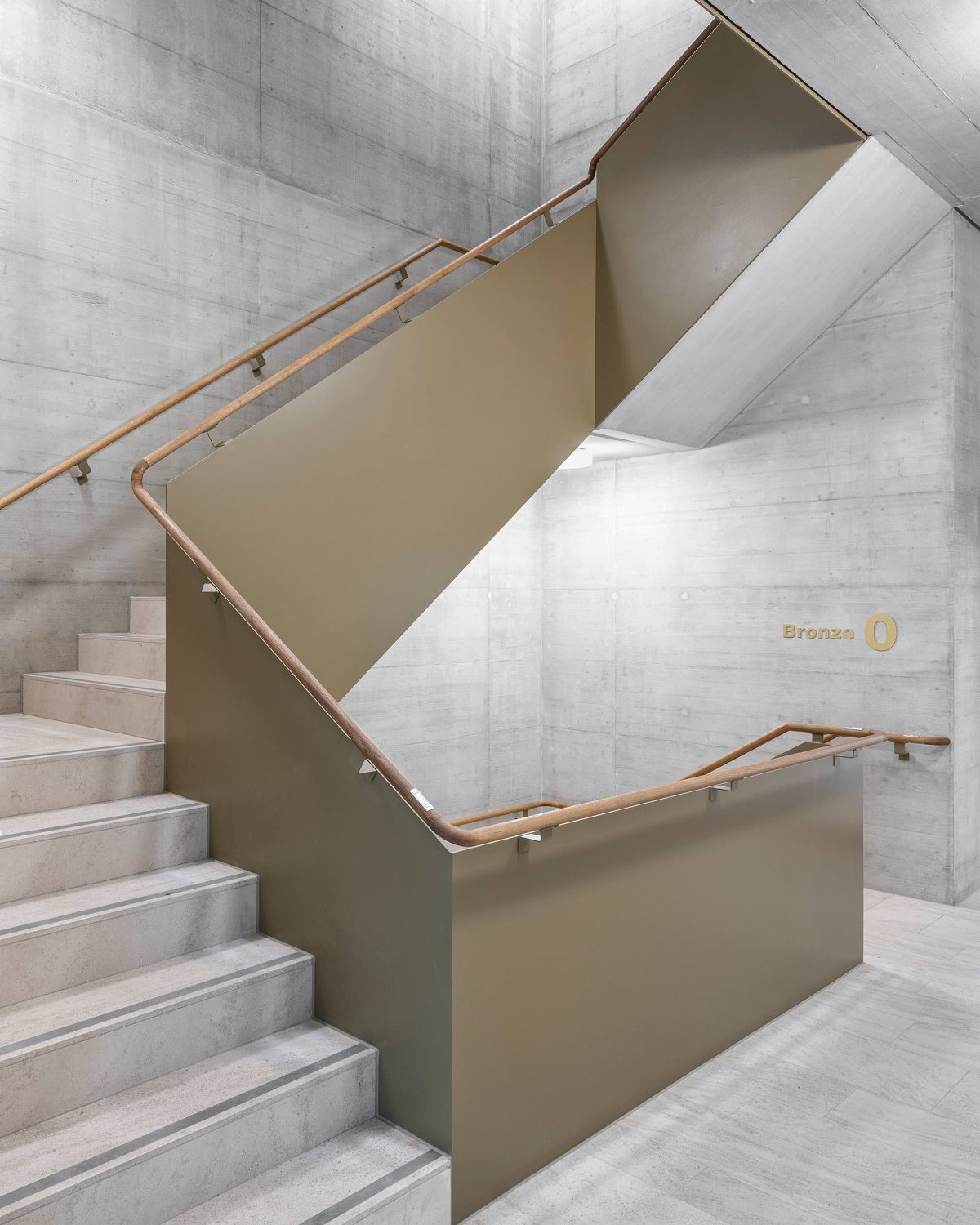
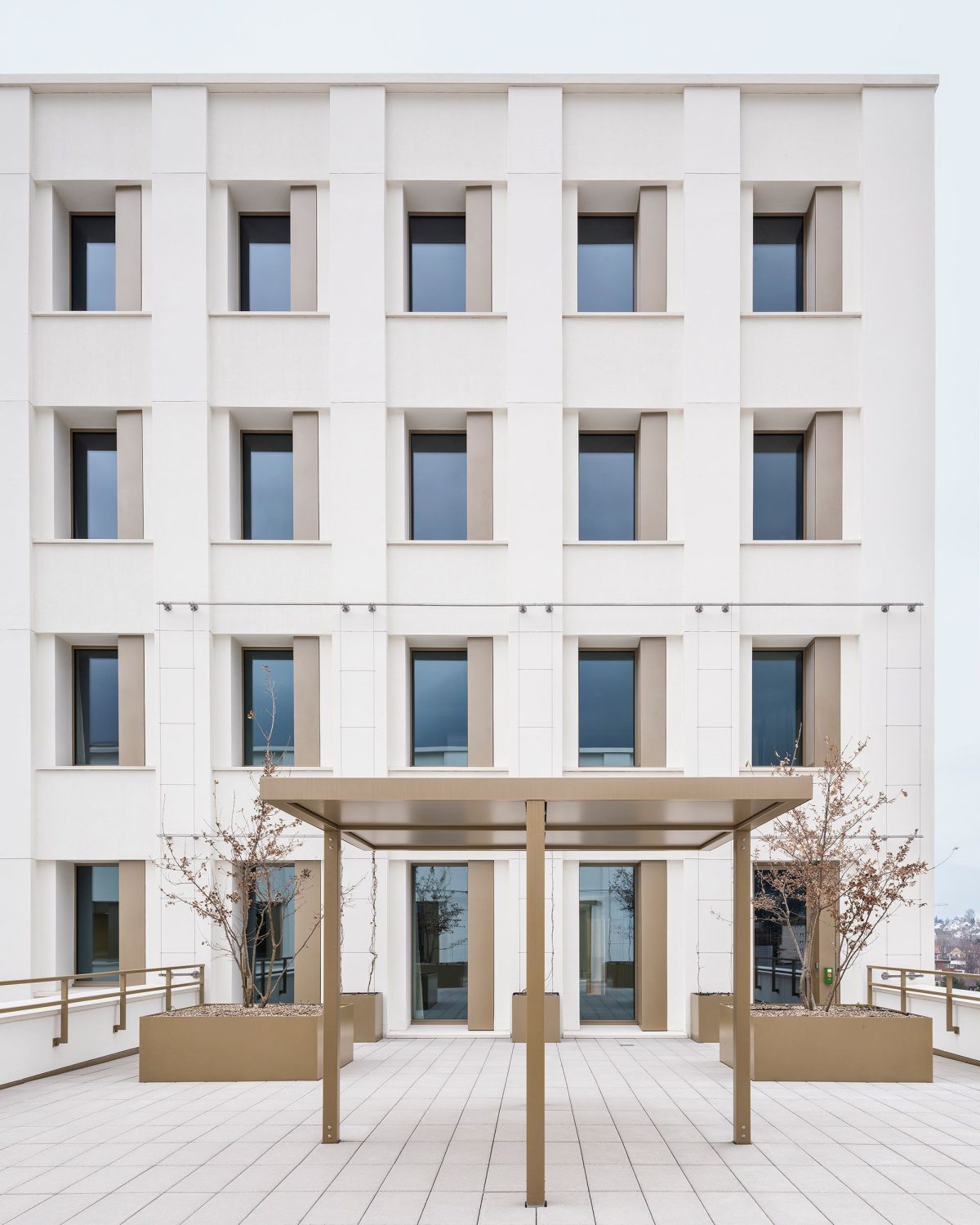
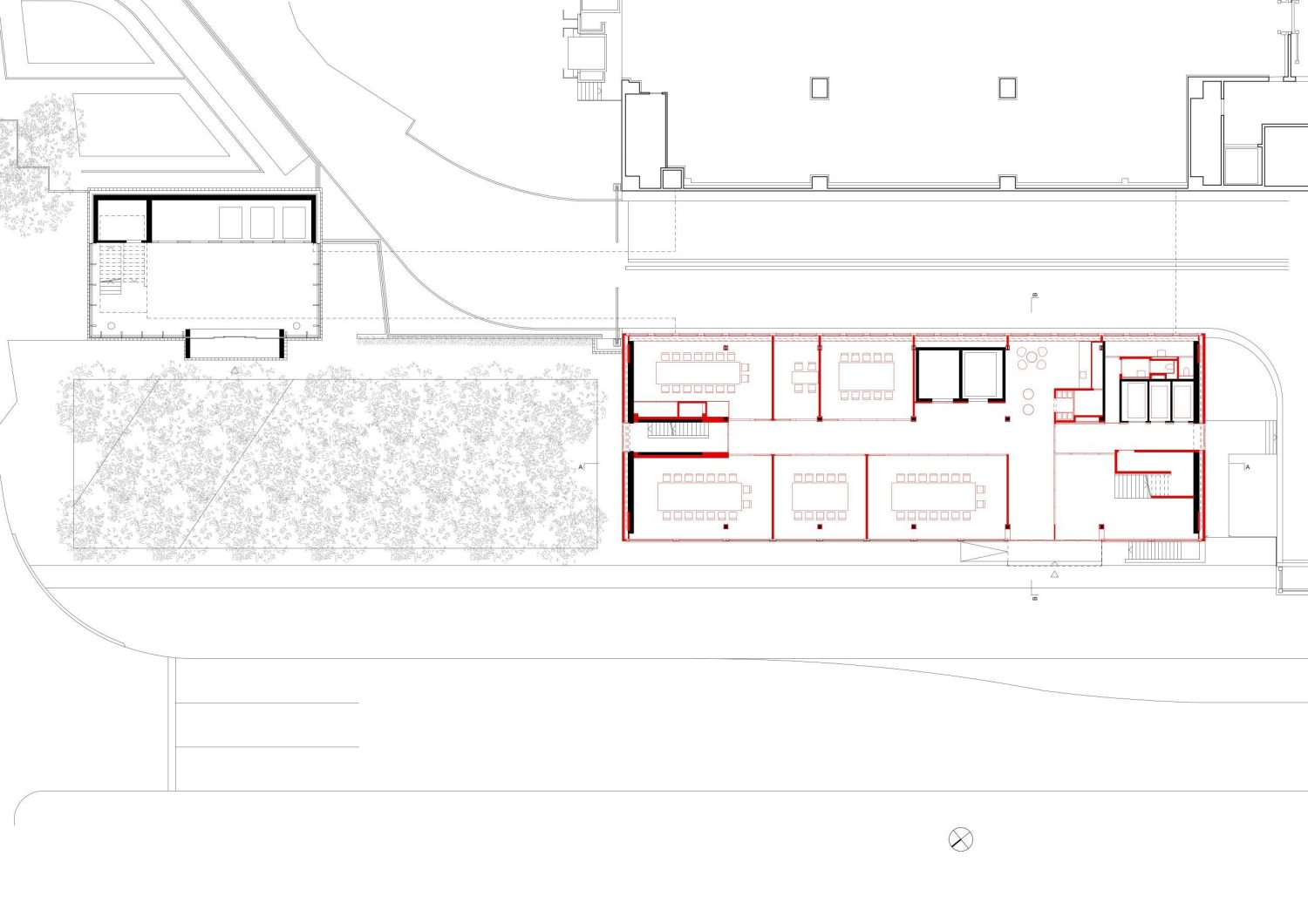
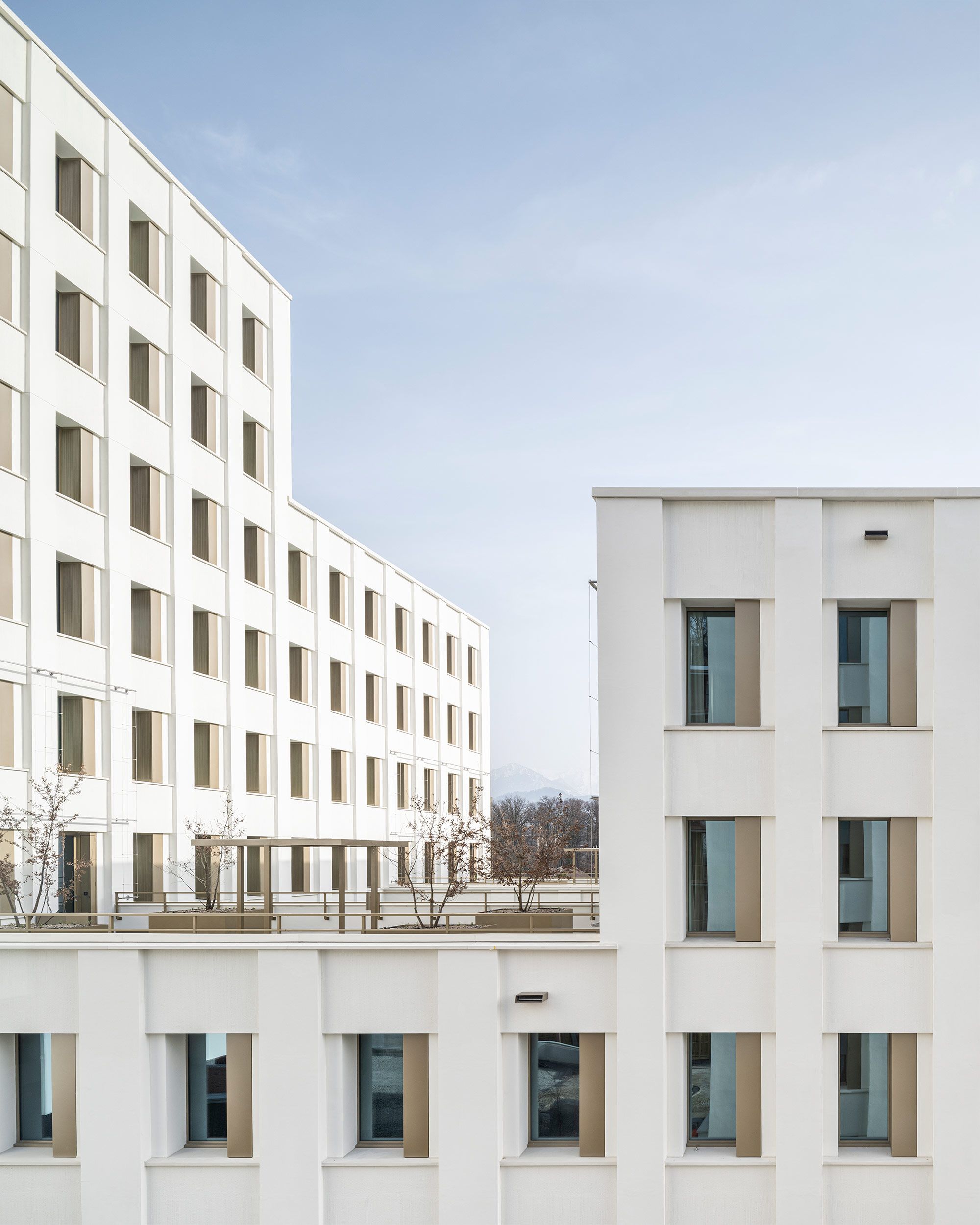
A stepped ten-storey administrative building is complemented by a free-standing seven-storey building in the north. The ensemble is composed of massive sculptural volumes. From up close, the light-coloured, rendered facades with regular window openings and pilaster strips convey a nuanced sense of scale with pronounced chiaroscuro. A cantilevered portion along the entire building length on Langsägestrasse shelters the employees’ entrances and the driveway to the underground parking. Toward the north, facing the central open space, an 18-metre overhang covers recreation areas with outdoor seating and further entrances. Integrated into the stepped building volume, a patio on the second floor and terraces on the fourth and eighth floor offer green resting places.

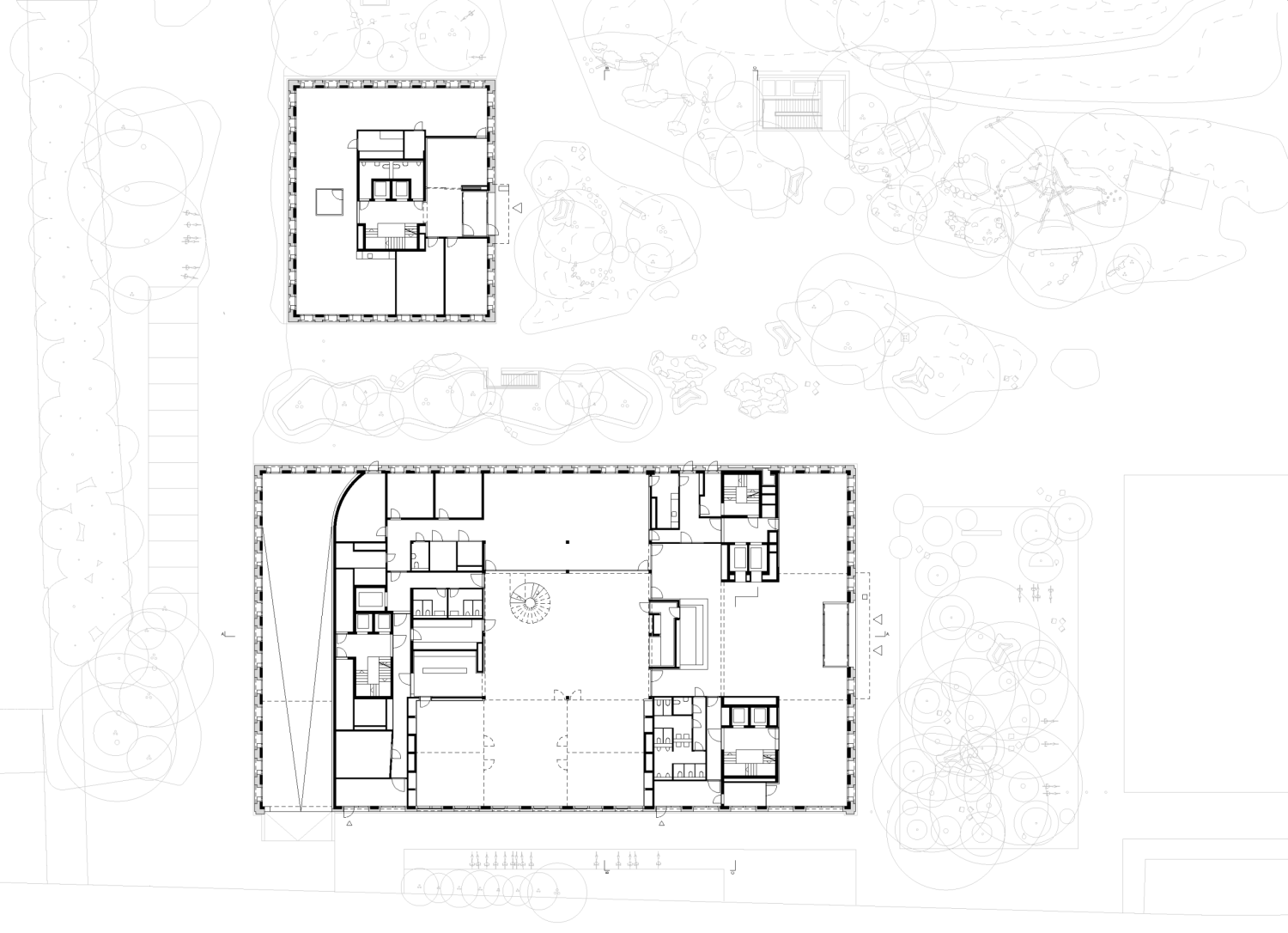
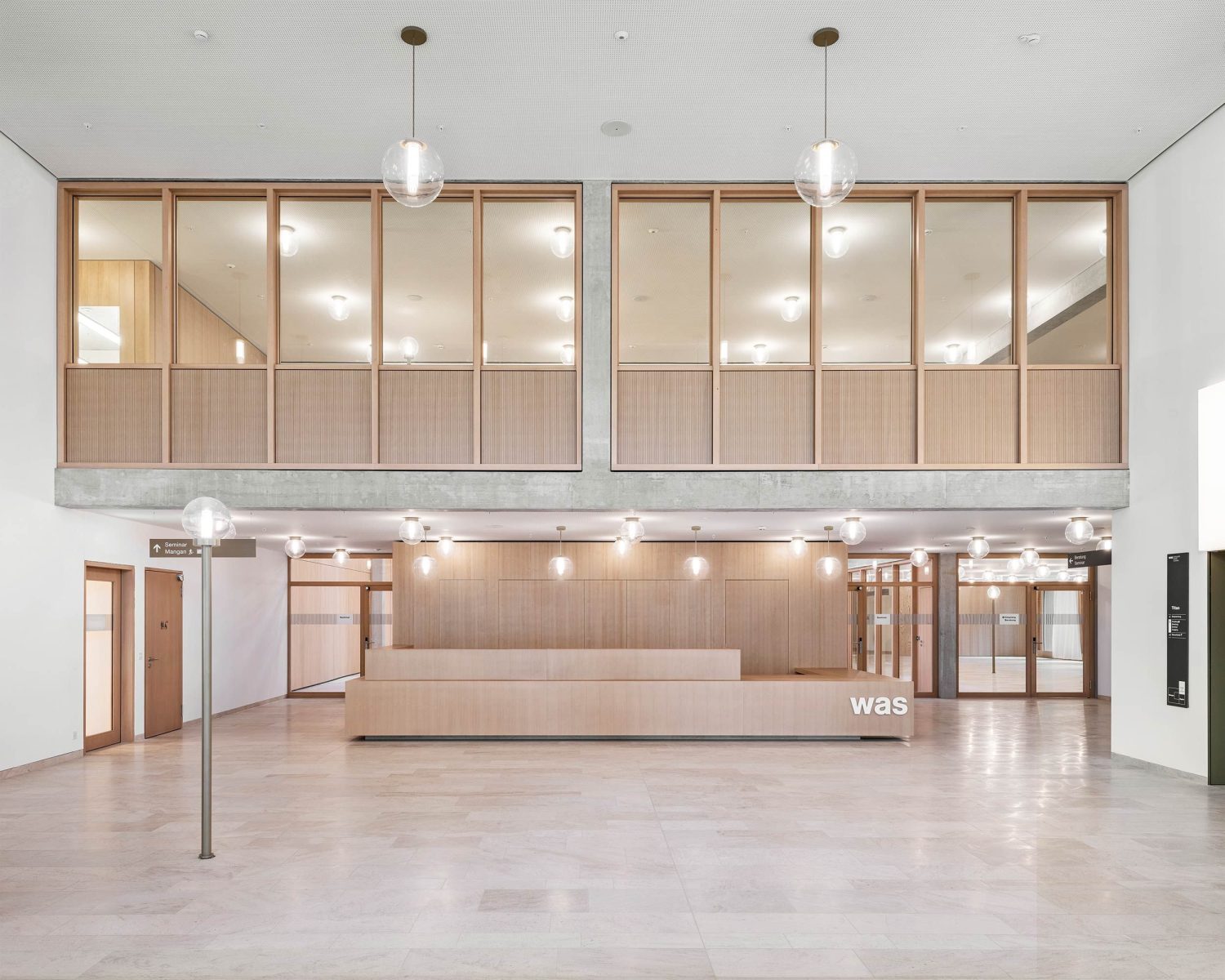
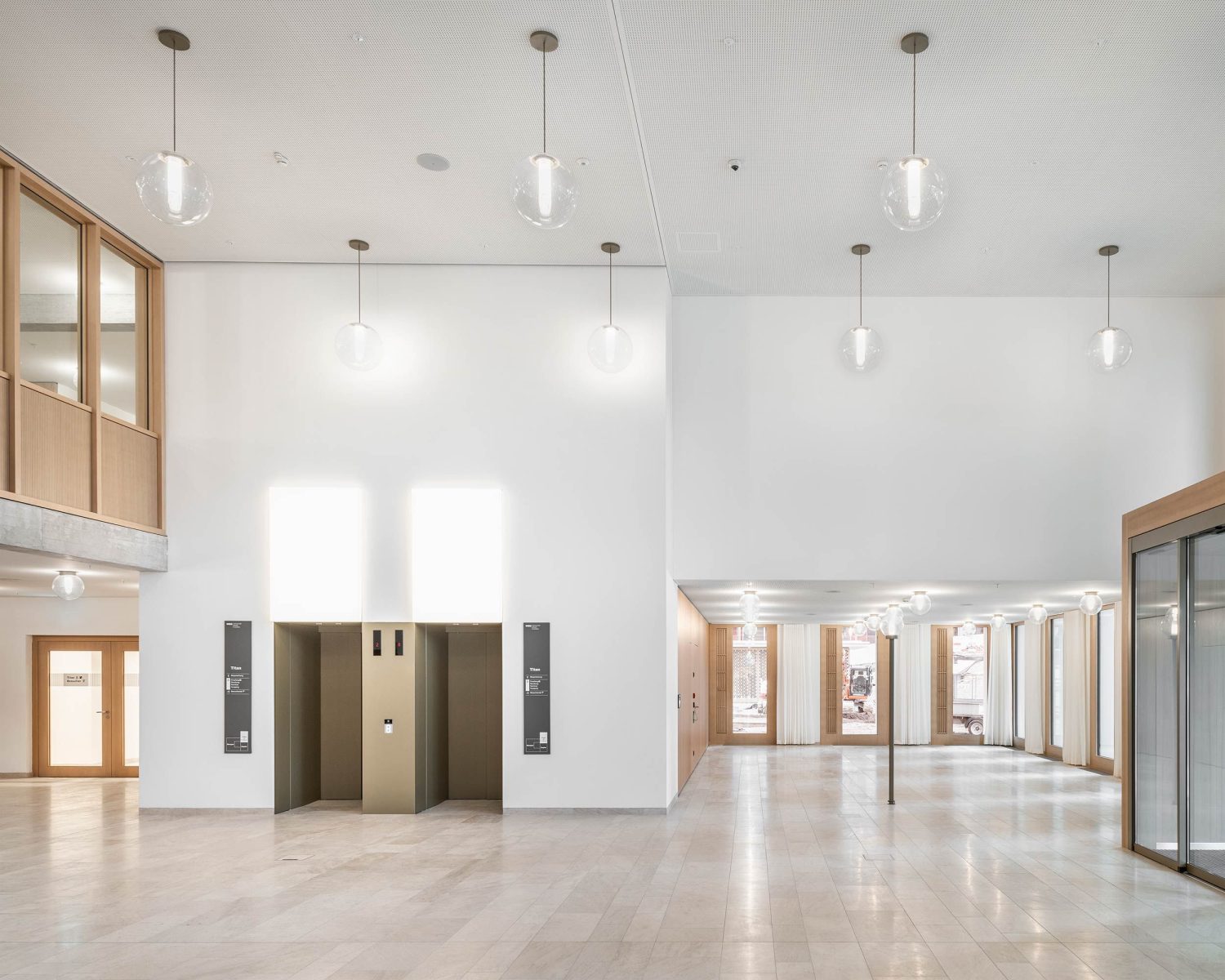
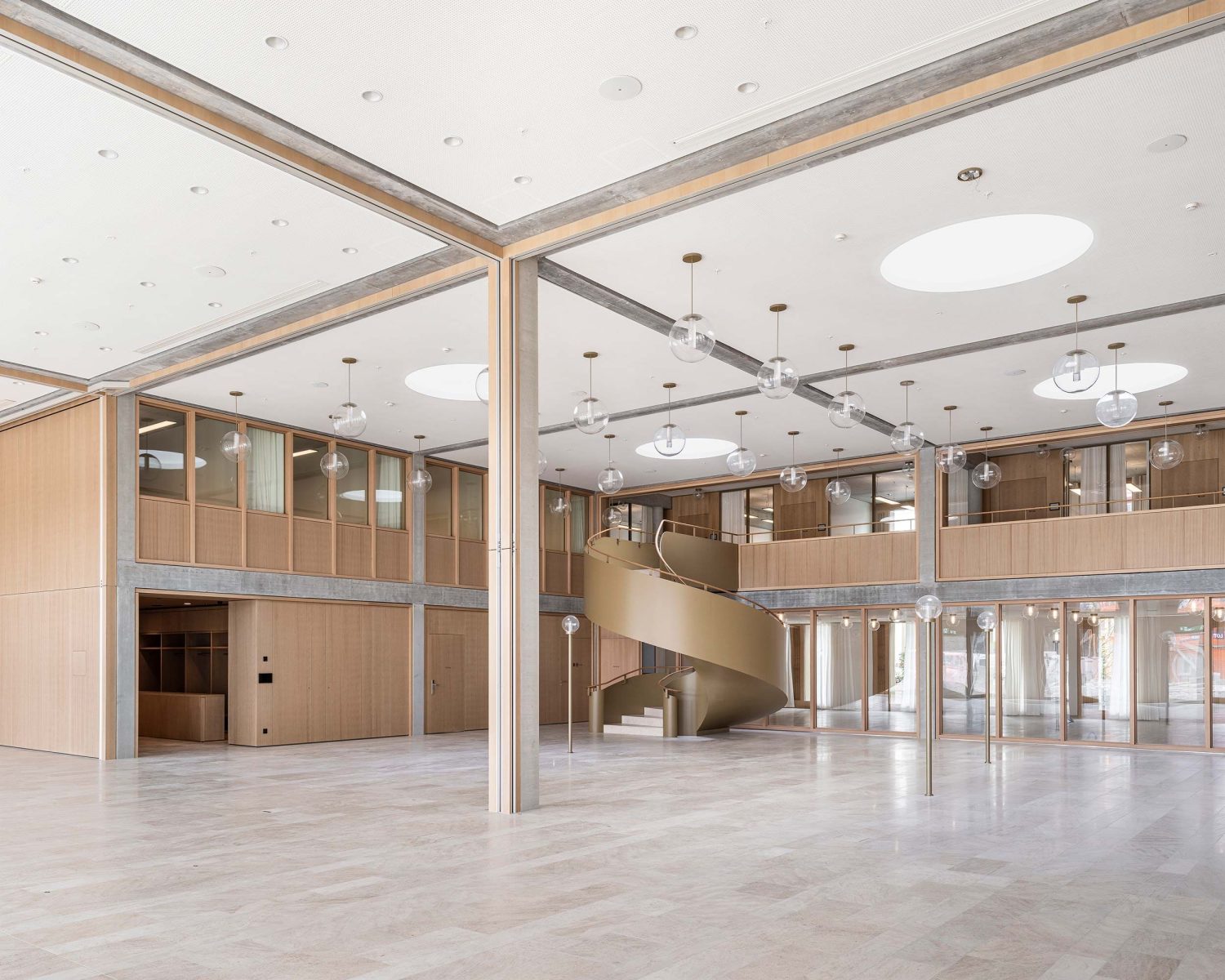
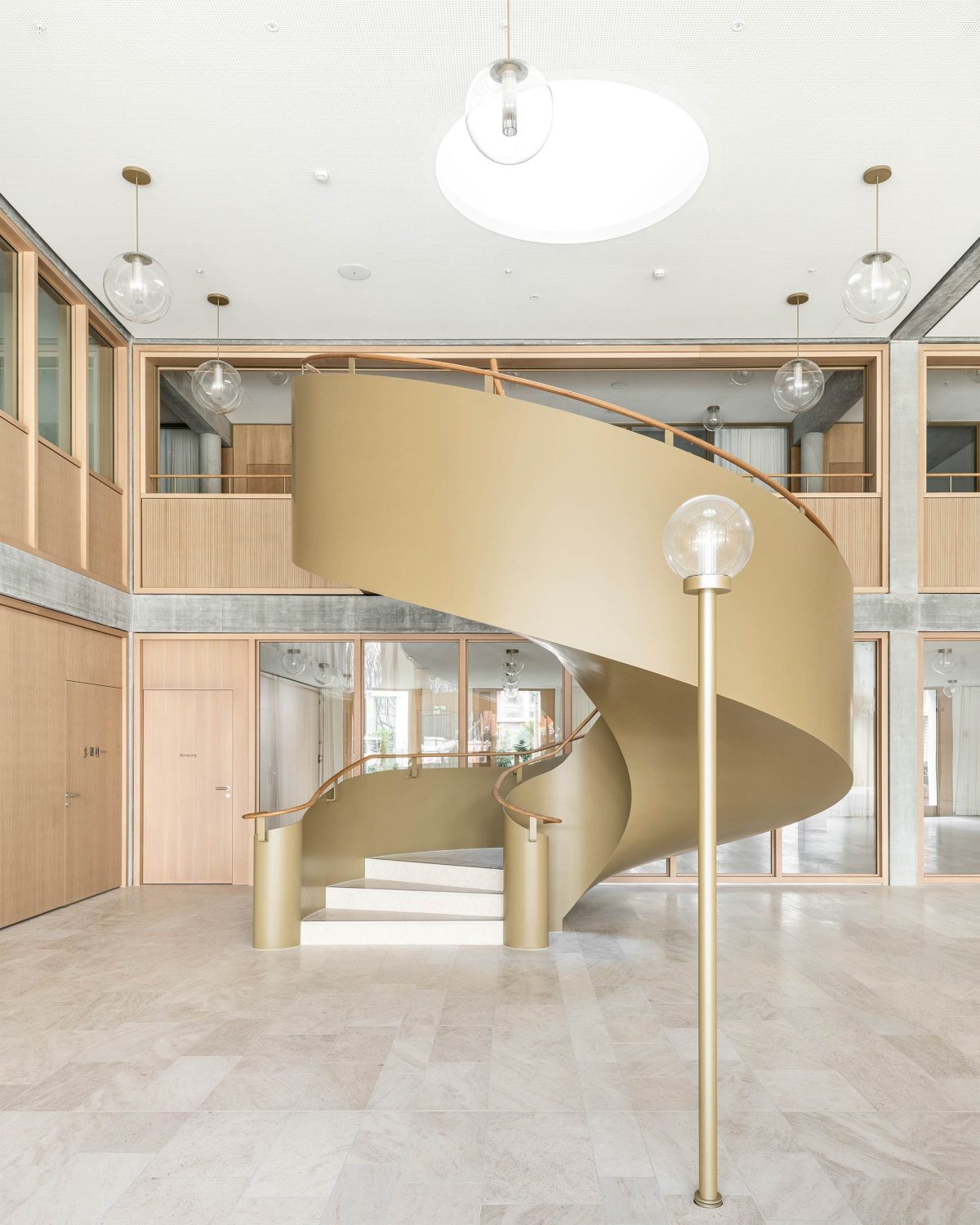
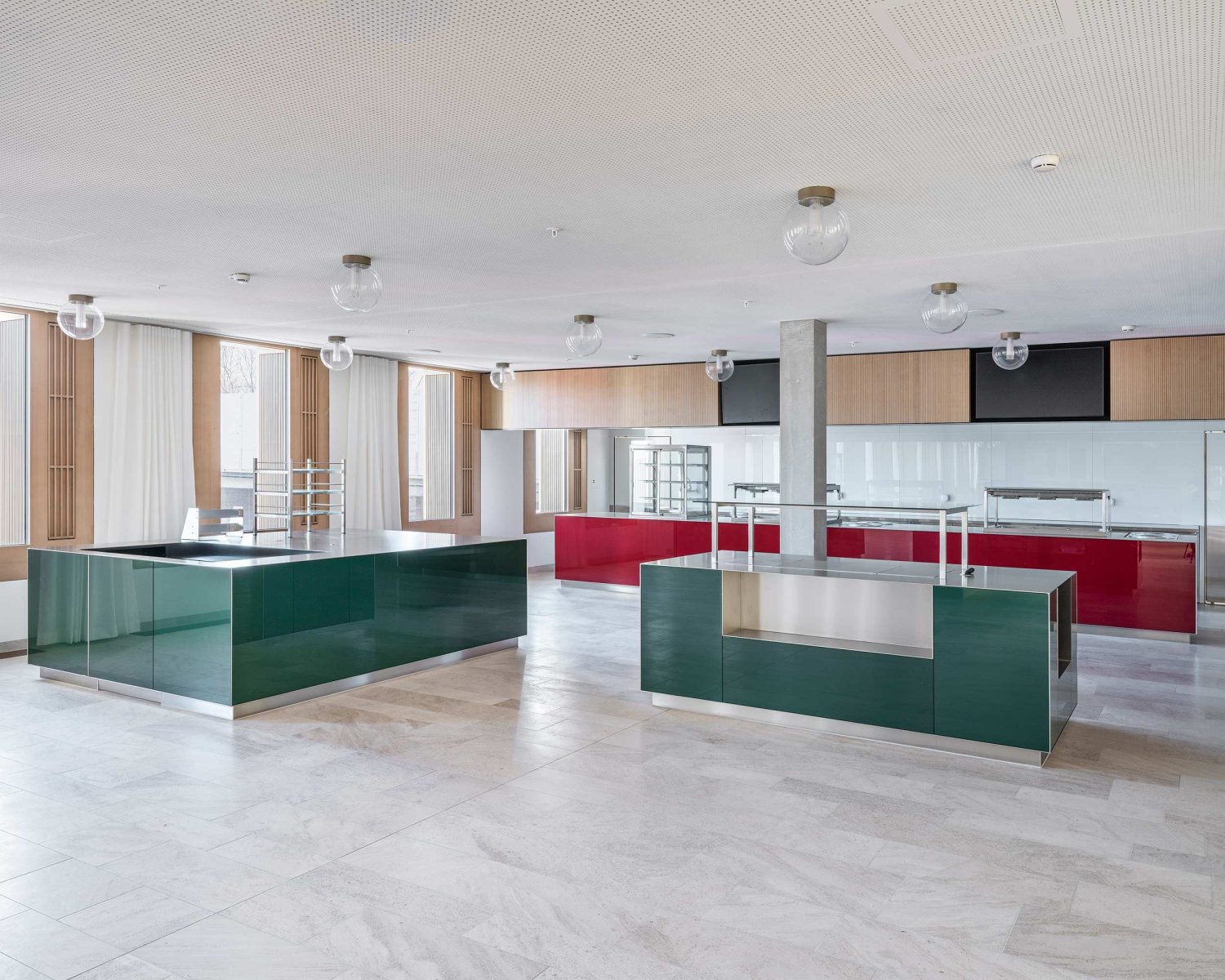
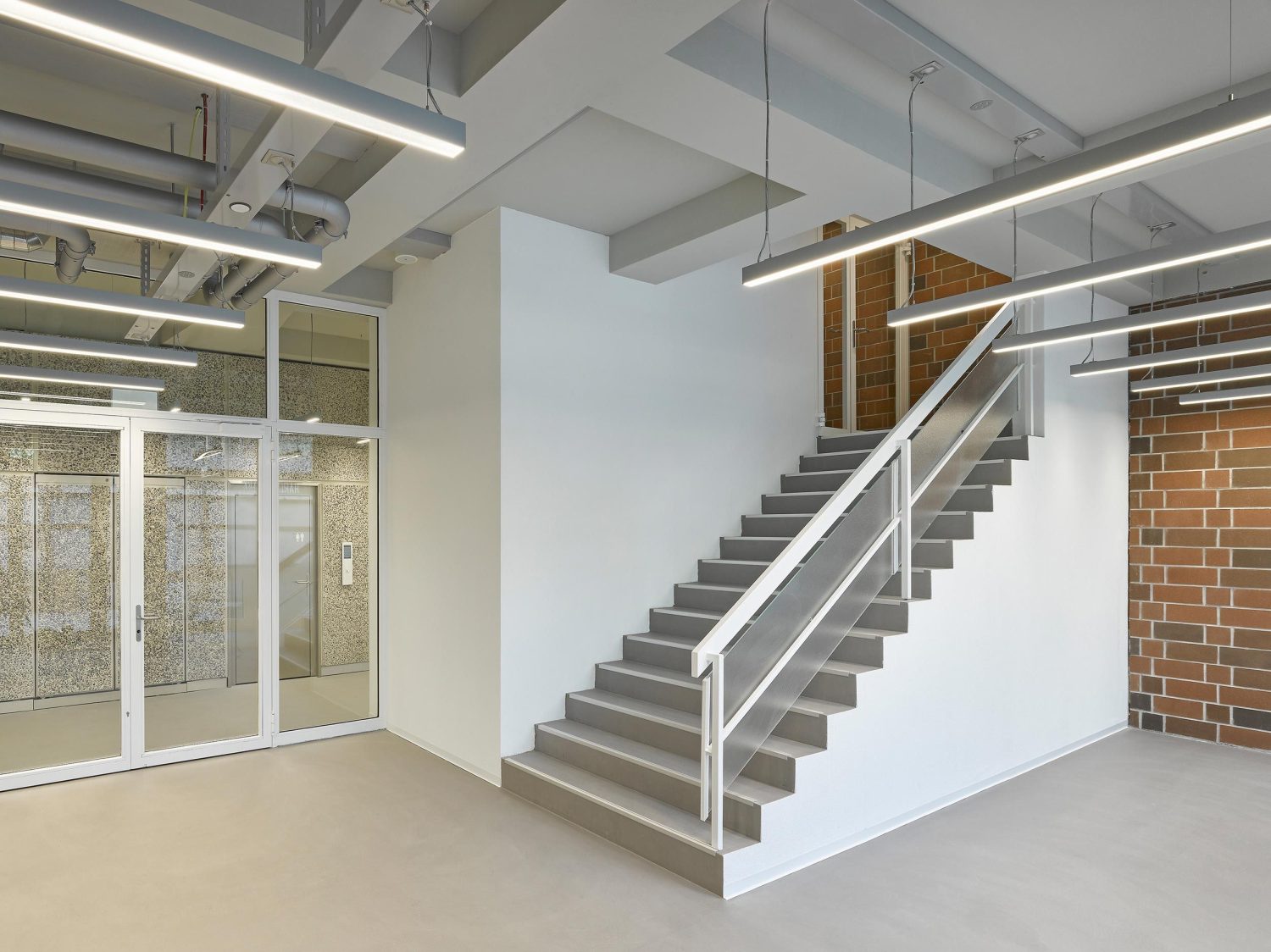
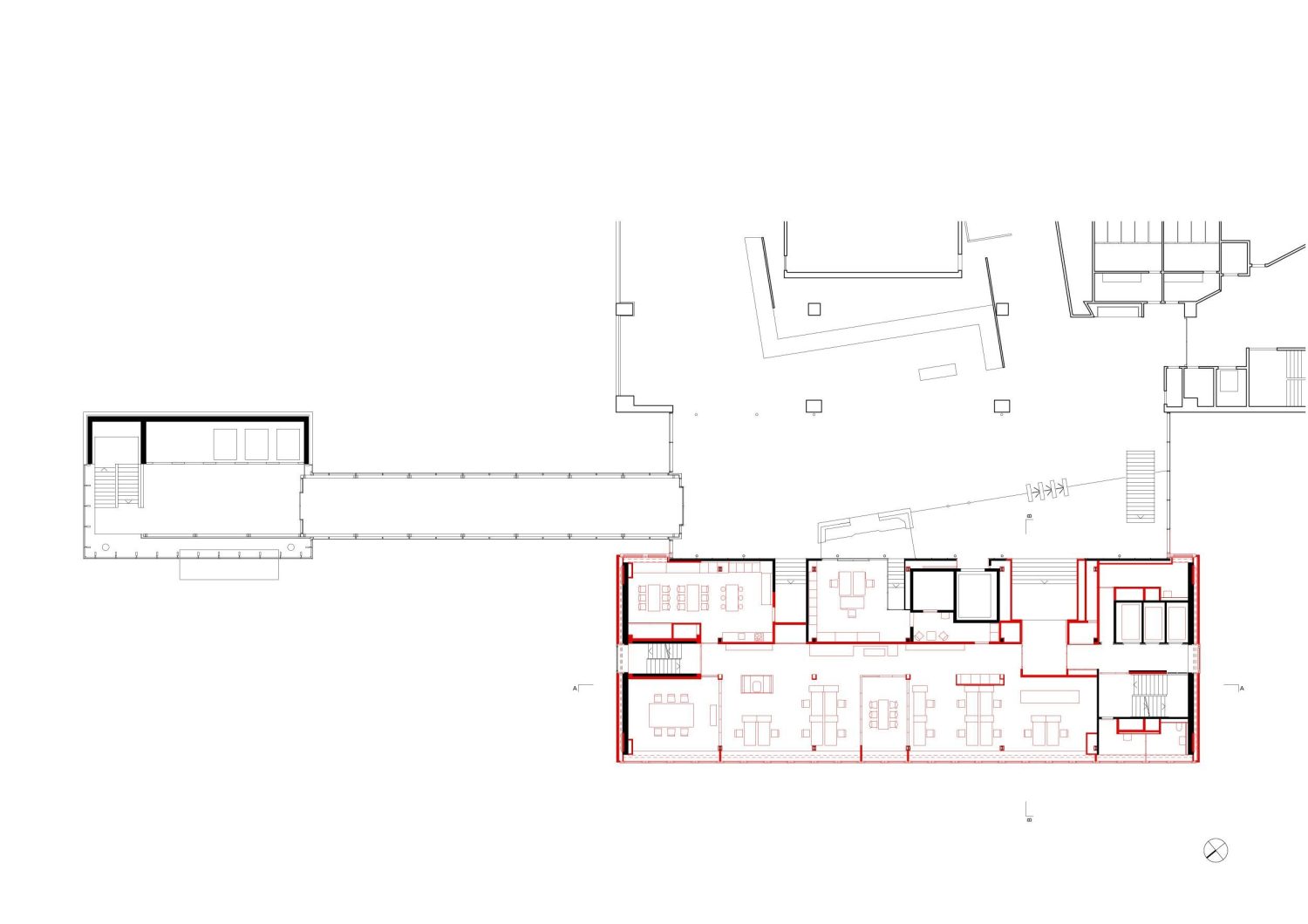
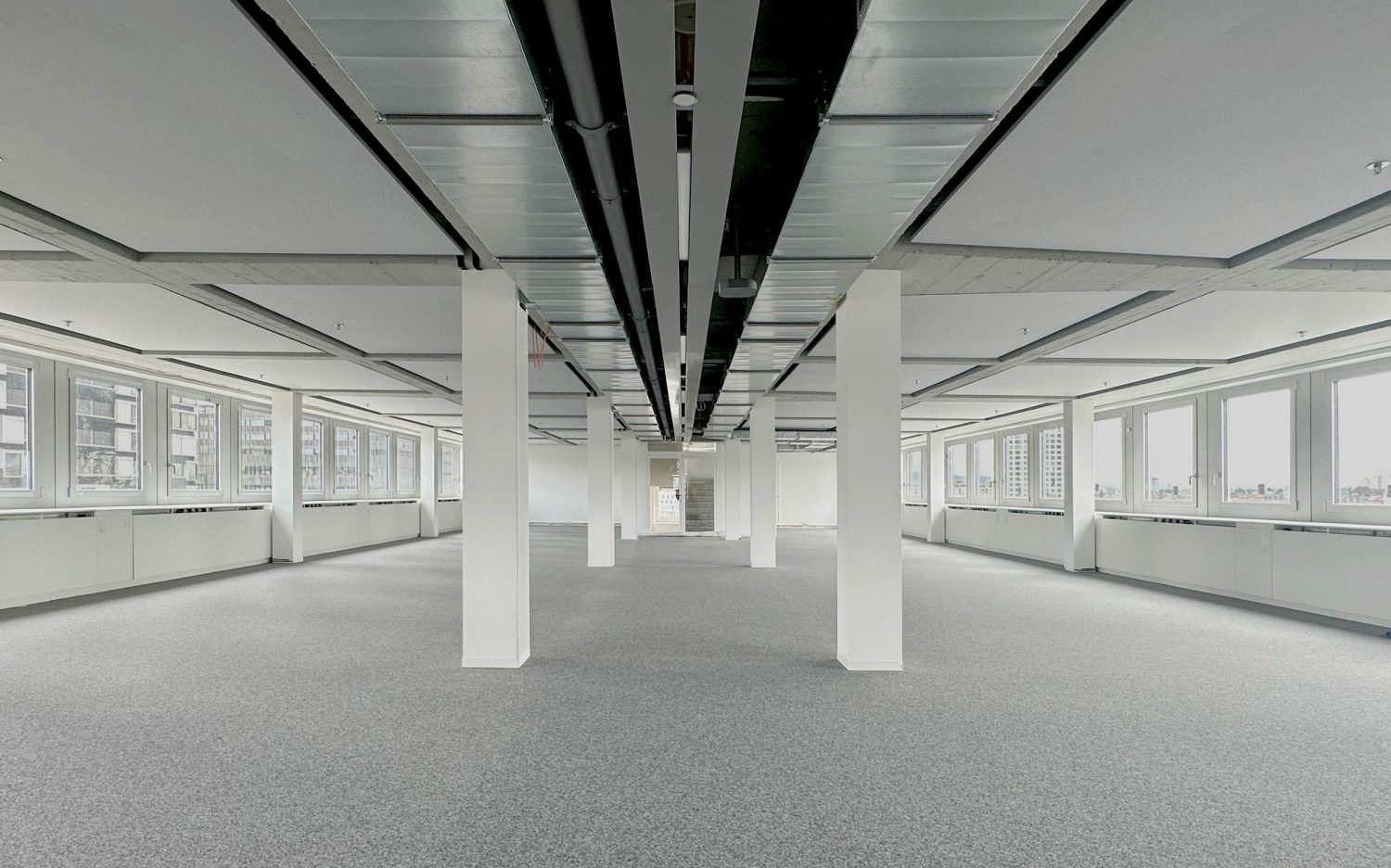
The new building is conceived as an urban block with clear, structurally ordered floor plans, which provide easy orientation for the employees and customers of the four operational divisions. The main entrance from the eastern forecourt leads into a generous vestibule with reception, waiting and consulting zones. The adjacent central foyer is naturally illuminated by four round roof lights and is visually connected by a gallery to the conference rooms on the first floor. The seminar rooms in the south can be separated with mobile partitions, or they can be opened towards the foyer for major events. Three interior cores access the upper storeys, which offer column-free structural spans of seven metres. The office spaces are varied in terms of space and orientation, allowing for multiple usage scenarios and flexible adaptation.

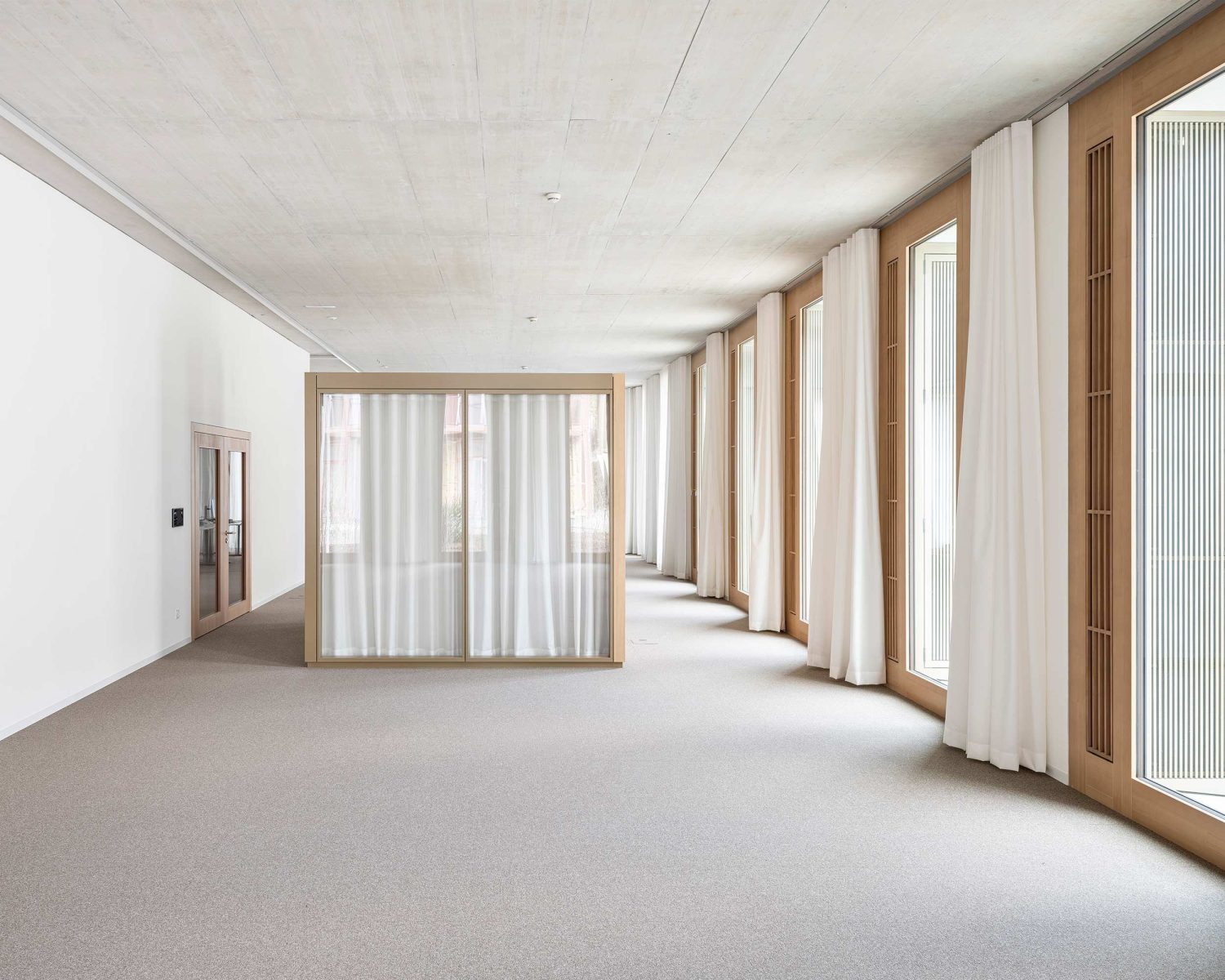
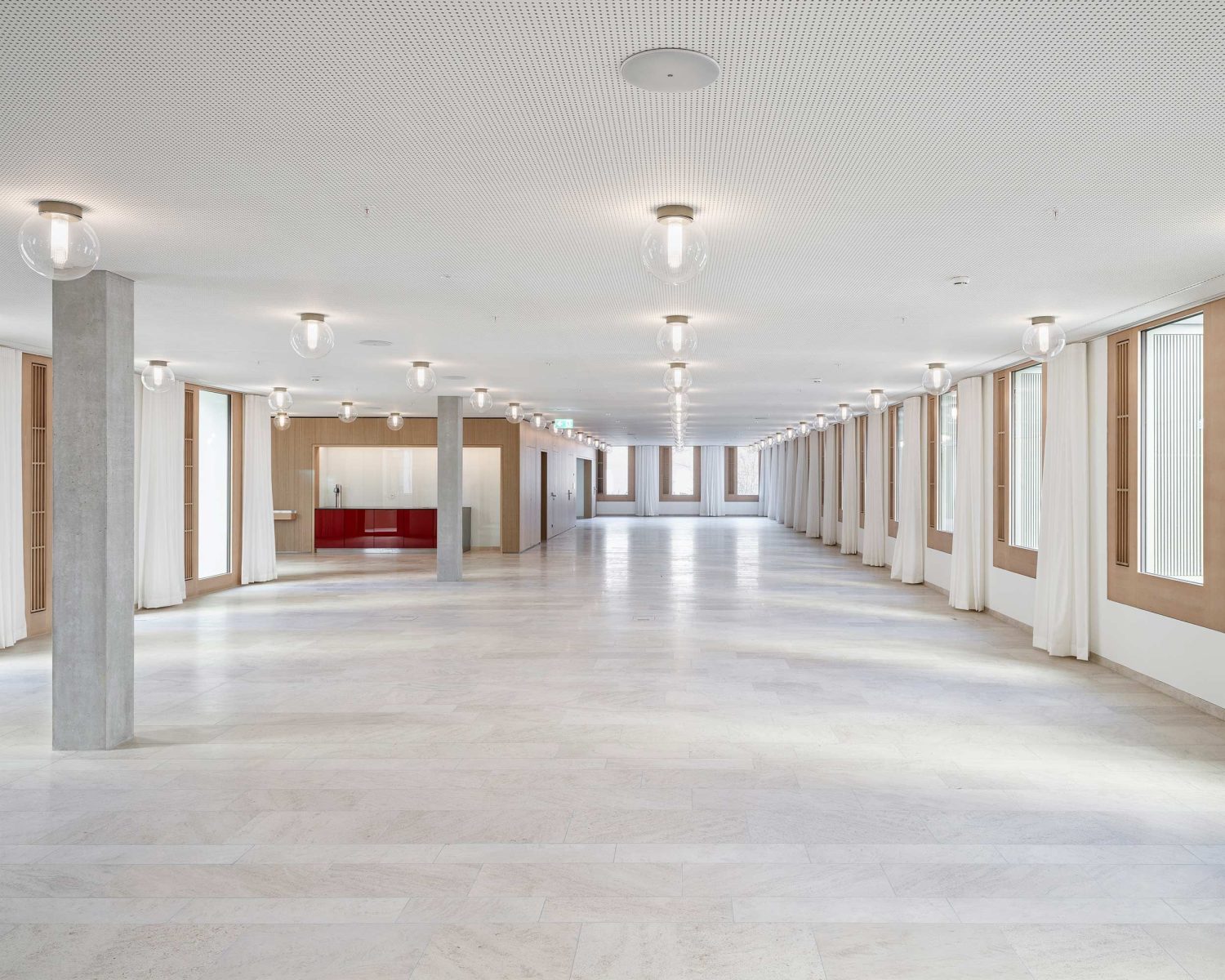
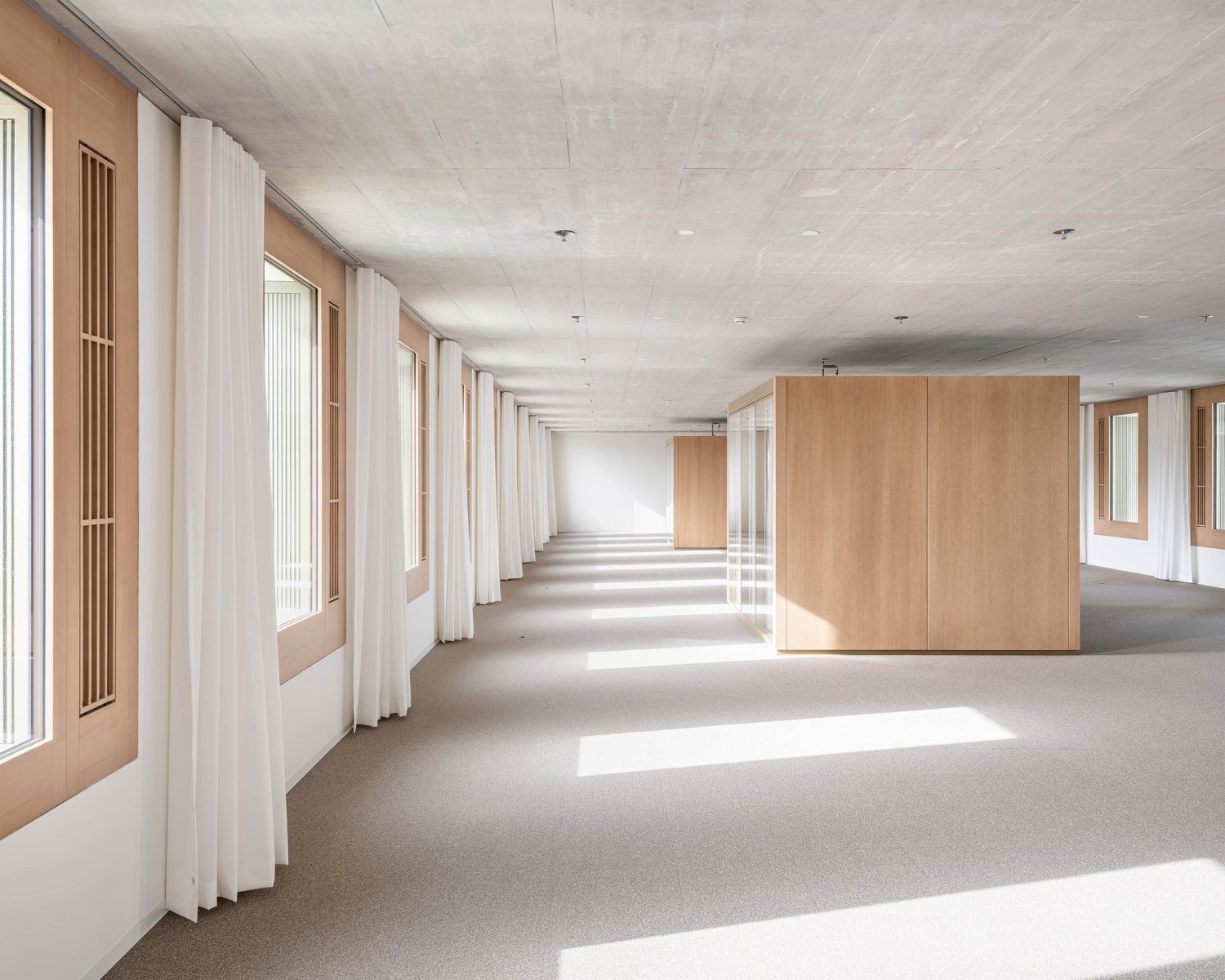
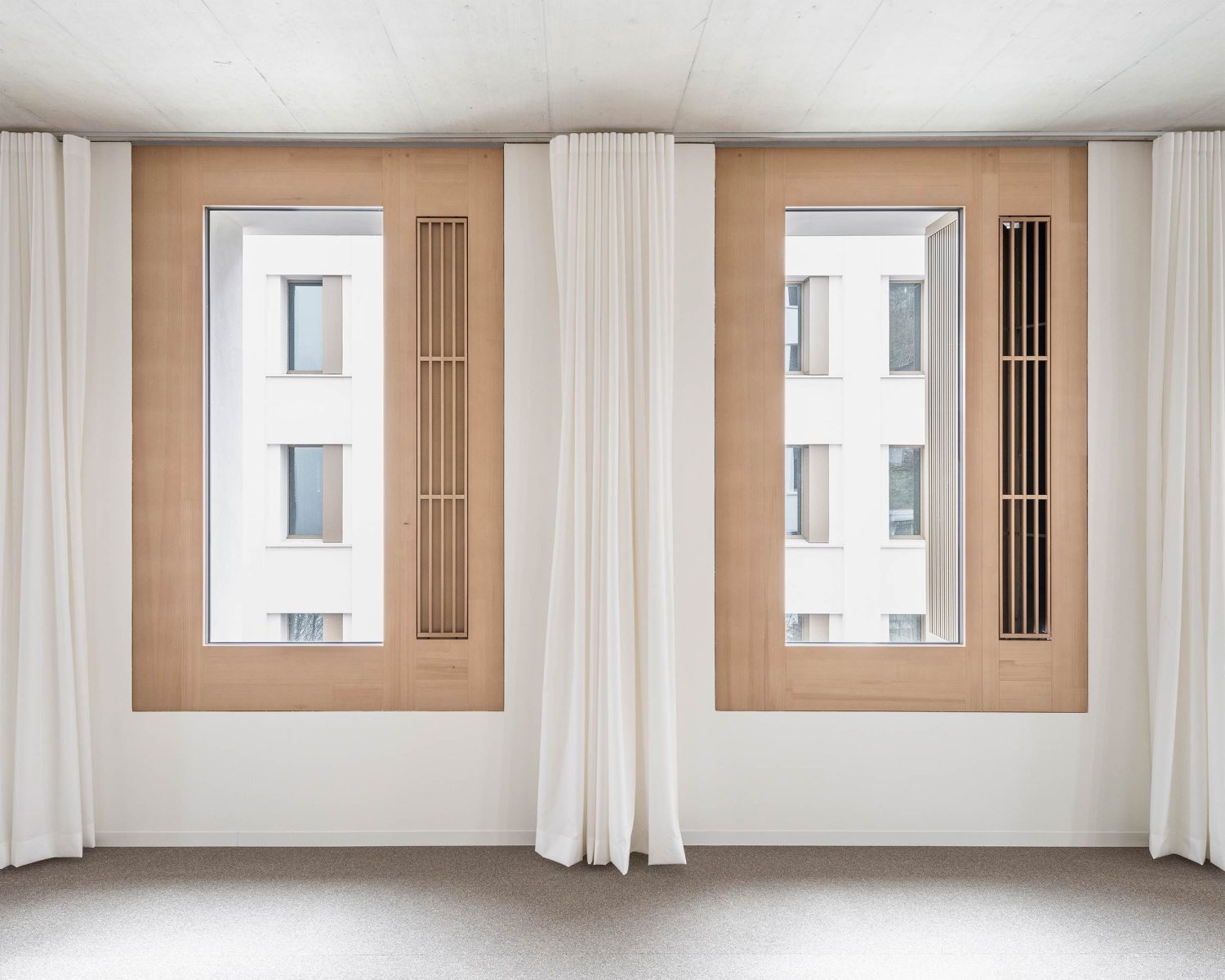
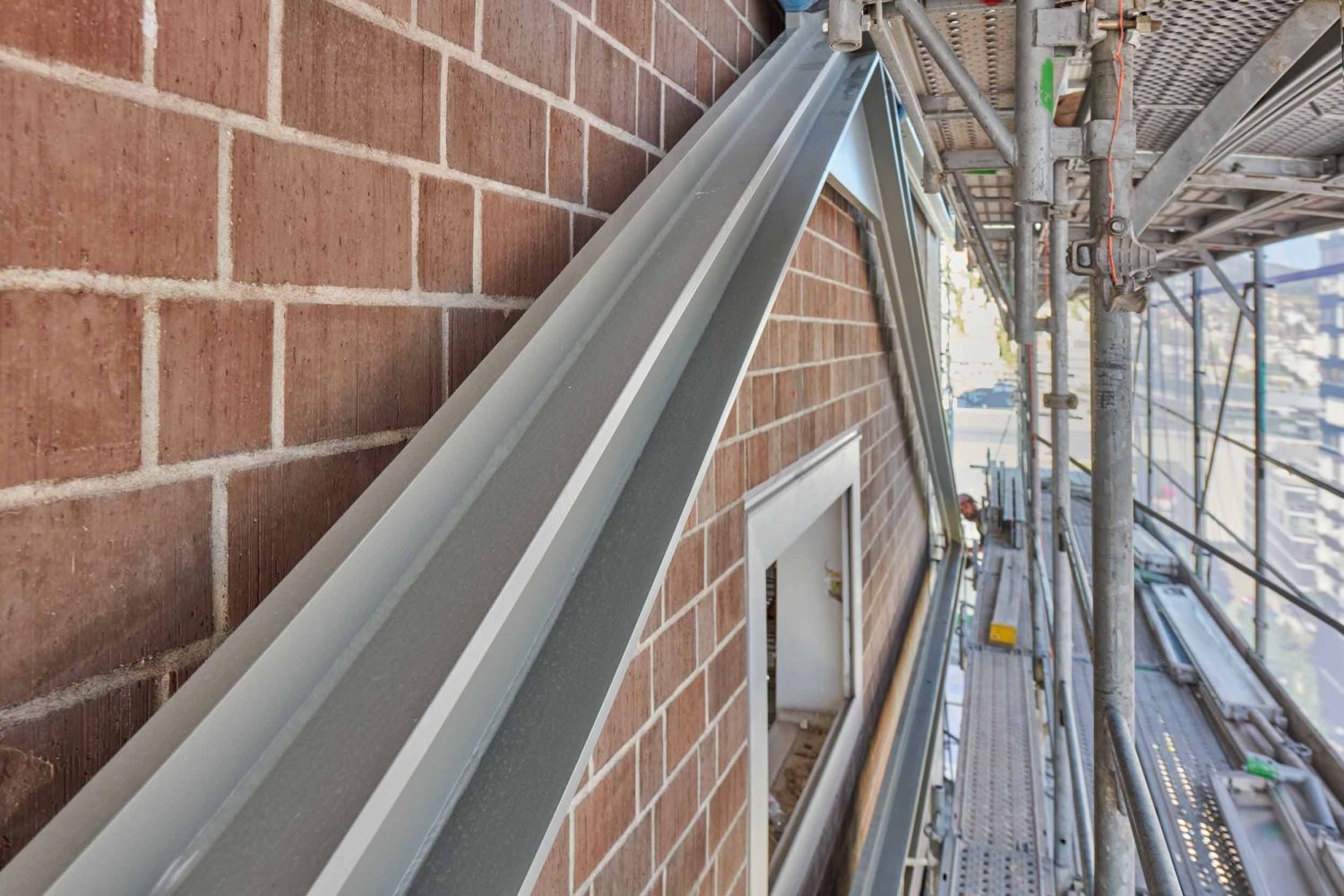
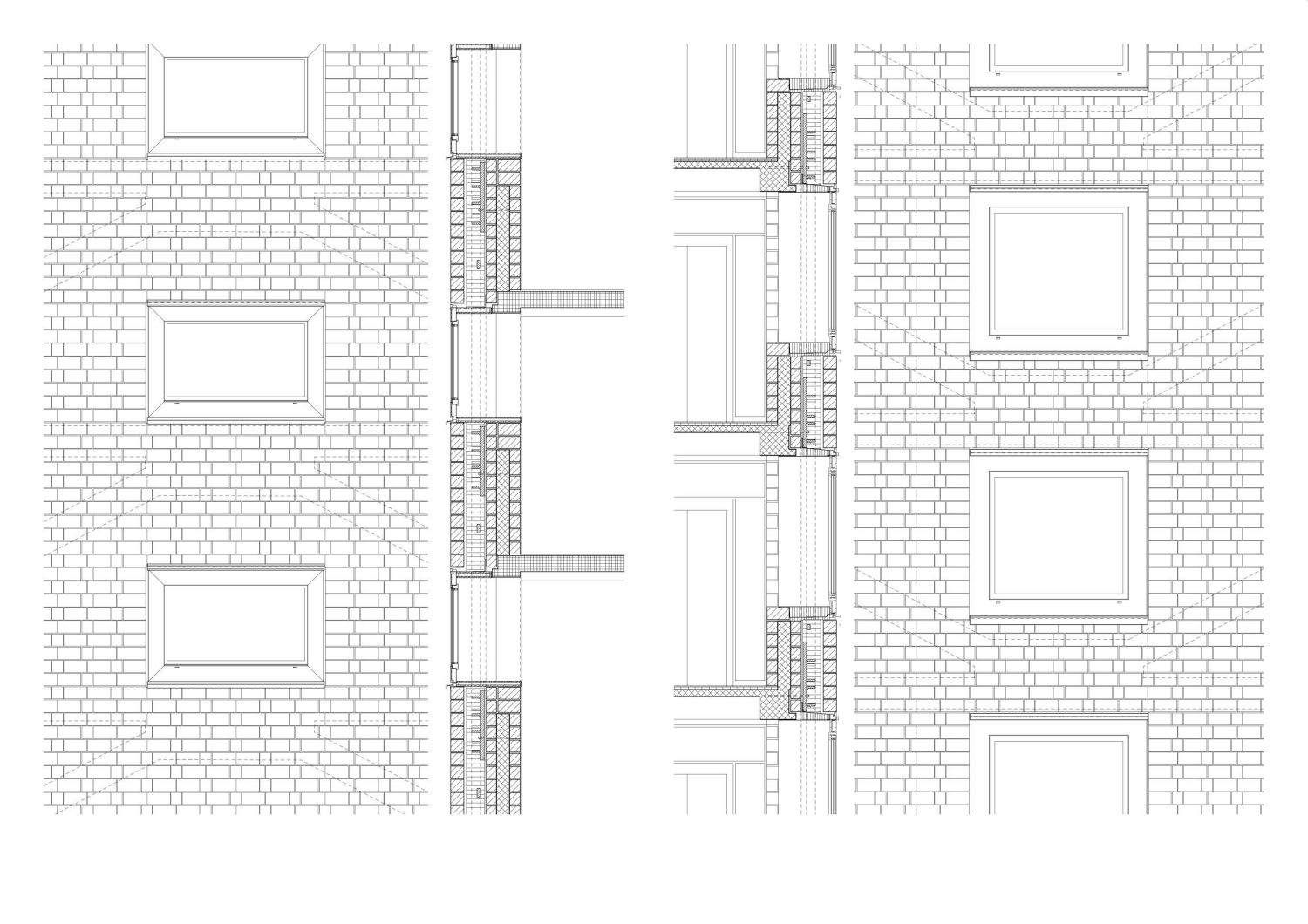
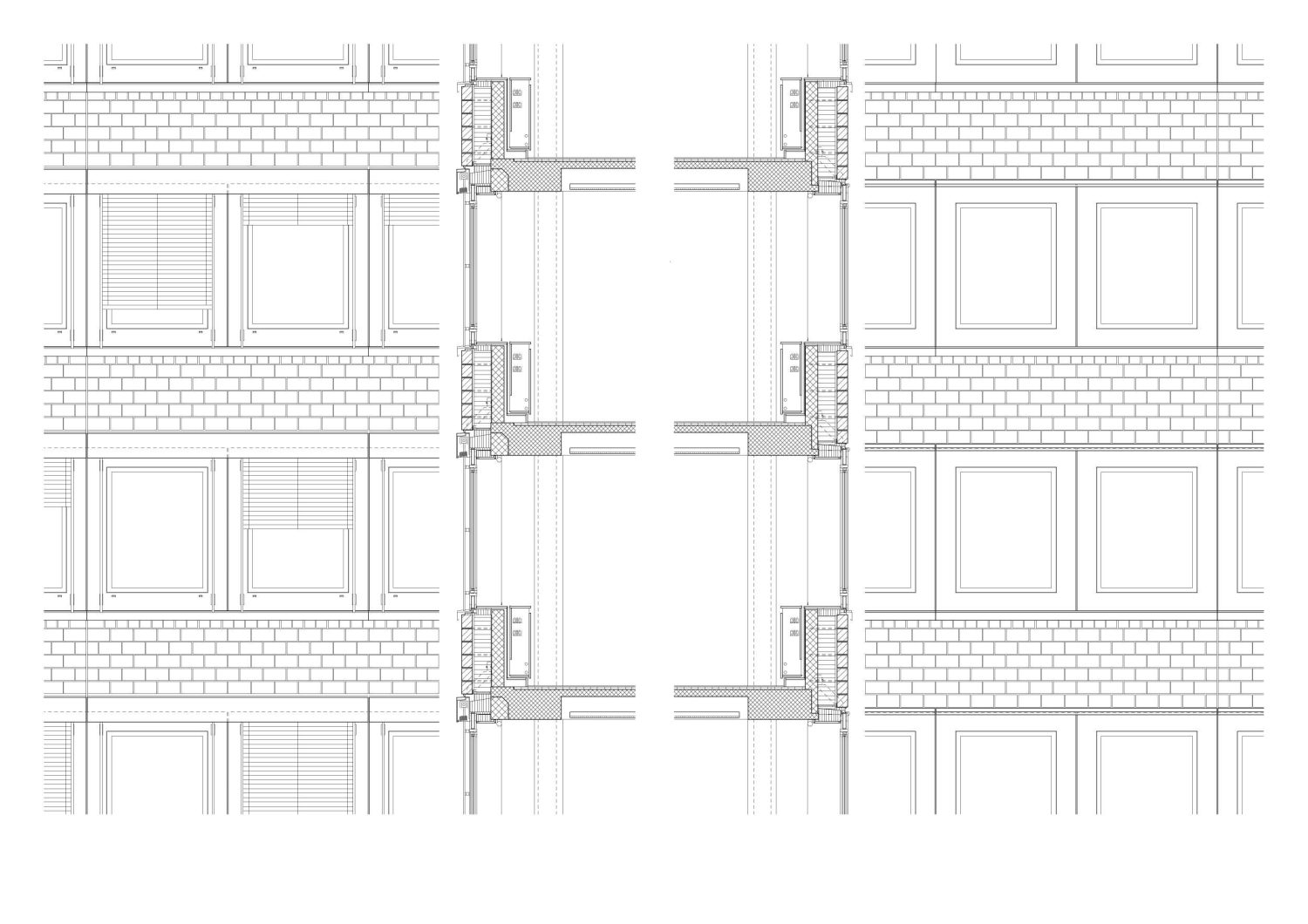
Both buildings are devised as massive constructions with solid masonry facades. Placed outside the inner load-bearing brick wall is an external layer of insulating bricks. The wood and metal windows are mounted above a low parapet and flush with the inside wall face. They have large, fixed glazed elements flanked by opaque ventilation flaps. Added outer sun shading is not necessary due to the low glazing proportion and the deep reveals. On the inside, curtains provide glare protection and function as sound absorbers.

The administrative buildings (main building 3rd to 9th storey and entire northern building) follow the concept “Vision 2226” with no heating, no cooling and no mechanical ventilation. The system is based on the thermal storage capacity and phase shift of heat absorption and release of building elements. The constructive conditions for this concept are met by the well-adjusted building envelope of 75–85 cm thick solid masonry, the low glazing proportion of 18 % and the ideal room layout with ceiling heights of three metres. Ventilation and climatisation are ensured by automated ventilation flaps next to the windows, which are regulated by a site-specific algorithm within the building control system. Low-tech hardware is operated efficiently by high-tech software. For power self-supply, a photovoltaic plant is installed on the roofs.

Location Kriens, Switzerland

Programme Two administrative buildings with office space for 700 workplaces, customer areas, foyer, seminar rooms, staff restaurant, underground parking.
The main building (3rd to 9th floors) and the entire northern building are designed according to the ‘Vision 2226’ concept without heating, cooling or mechanical ventilation.

Competition 2020, 1st Prize

Planning/Construction 2020 – 2026

Client WAS Immobilien AG, Lucerne

Label Confirmation for the SNBS Certificate (Sustainable Construction Standard Switzerland)

Gross Floor Area 24‘540 m2

Team GG Planning/Construction: Mike Guyer, Christian Maggioni (Team Manager), Matthias Clivio (Project Manager), Damien Andenmatten, Christoph Lay, Franzis Gericks, Roman Vetterli
Competition: Mike Guyer, Stefan Thommen, Lukas Kübli, Dario Caccialupi, Jan Zimmermann (I)

Total Contractor From total contractor tendering:
Anliker AG Generalunternehmung, Emmenbrücke

General Planning Preliminary design phase until total contractor tendering:
GP WAS GmbH, Lucerne:
GKS Architekten Generalplaner AG, Lucerne
with Gigon Guyer Partner Architekten AG

Landscape Architecture Patio and terraces: Lorenz Eugster, Zurich

Cost Planning/Scheduling Preliminary design phase until total contractor tendering:
TGS Bauökonomen AG, Lucerne

Structural Engineer Planning/Construction: CES Bauingenieur AG, Hergiswil
Competition: EBP Schweiz AG, Zurich

Electrical Engineer Jules Häfliger AG, Lucerne

Building Services Engineer Planning/Construction: 3-Plan Haustechnik AG, Winterthur
Competition: EBP Schweiz AG, Zurich

Building Physics Engineer 2226 AG, St. Gallen

Fire Safety Technik im Bau AG, Lucerne

Lighting Consultant Jules Häfliger AG, Lucerne

Facade Feroplan Engineering AG, Zurich

Door Consultant PZM Luzern AG, Horw

Restaurant Planning Creative Gastro Concept & Design AG, Hergiswil

Signage Designalltag Rinderer GmbH, Winterthur

BIM Preliminary design phase until total contractor tendering:
GKS Architekten Generalplaner AG, Lucerne

Visualization Gigon Guyer

Photos Roman Keller, Zurich

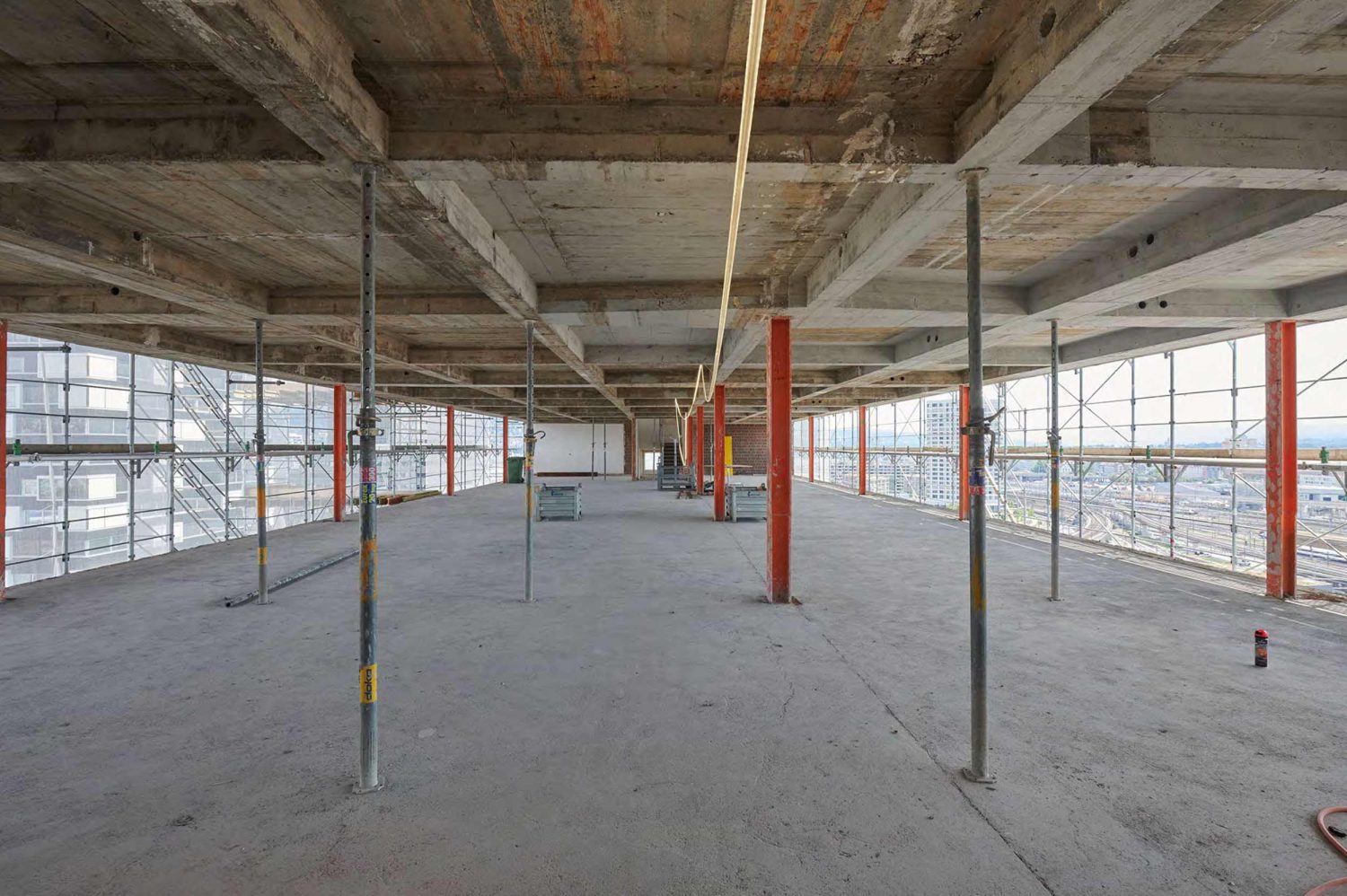
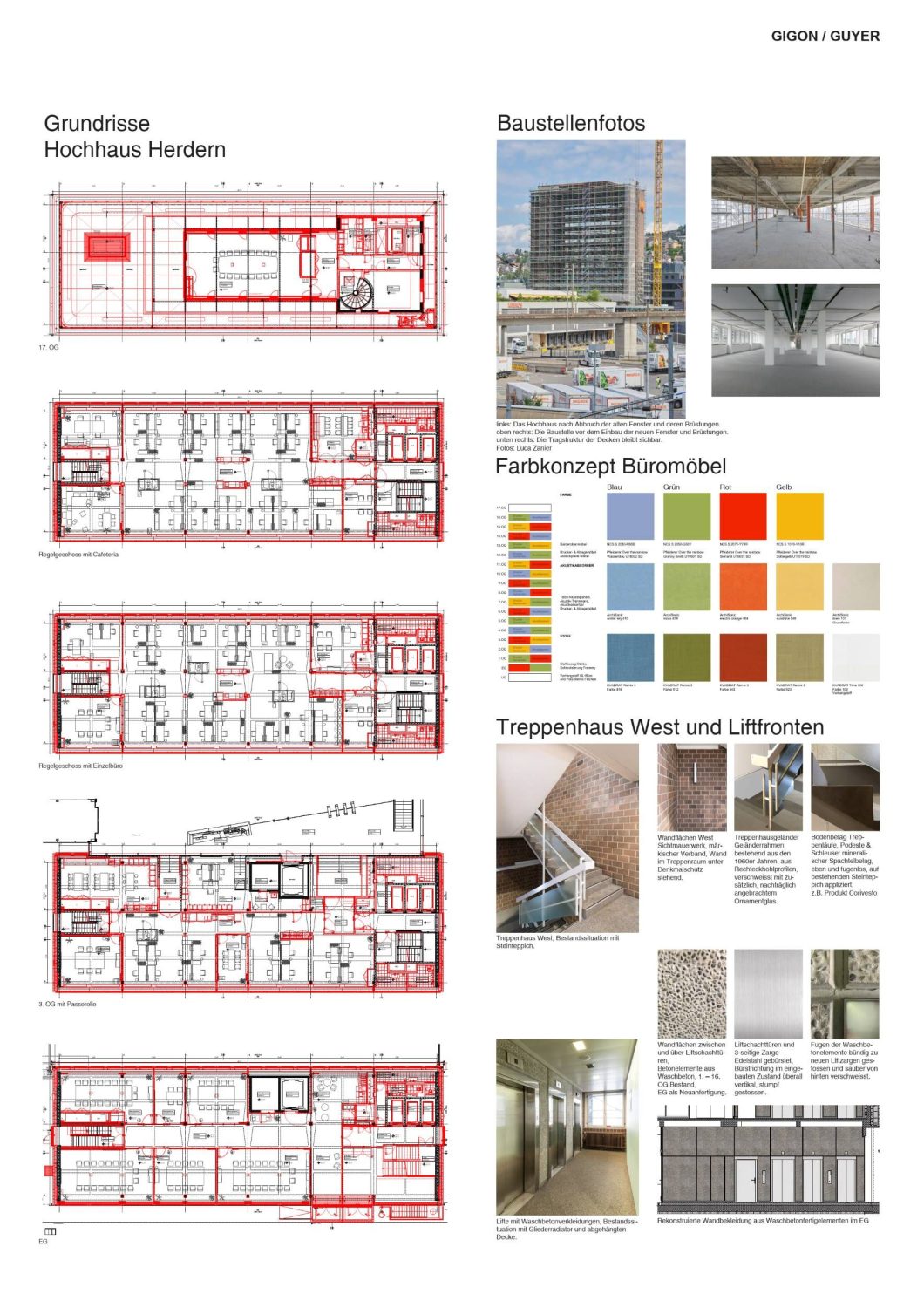
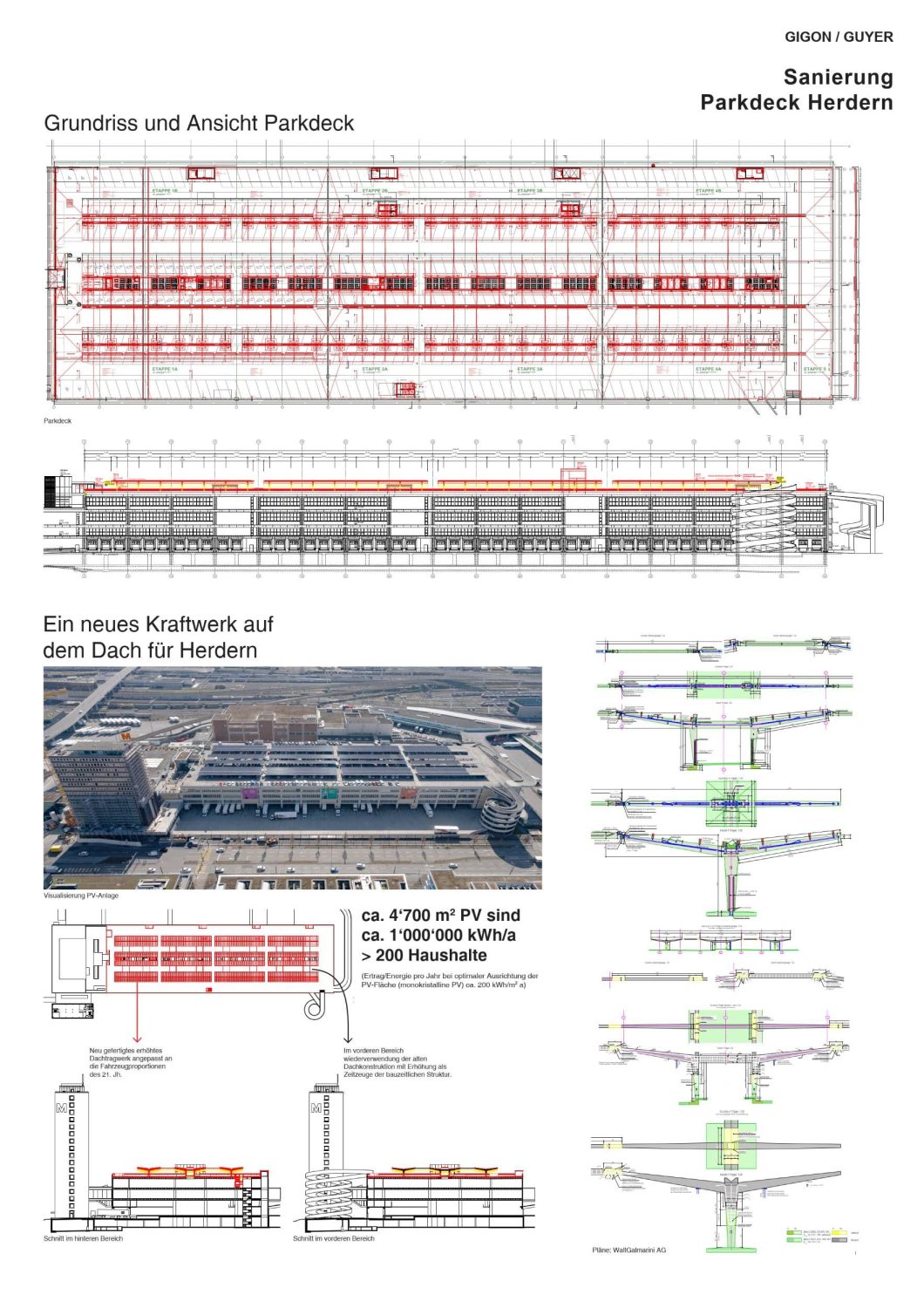
Refurbishment of the Herdern High-rise Building

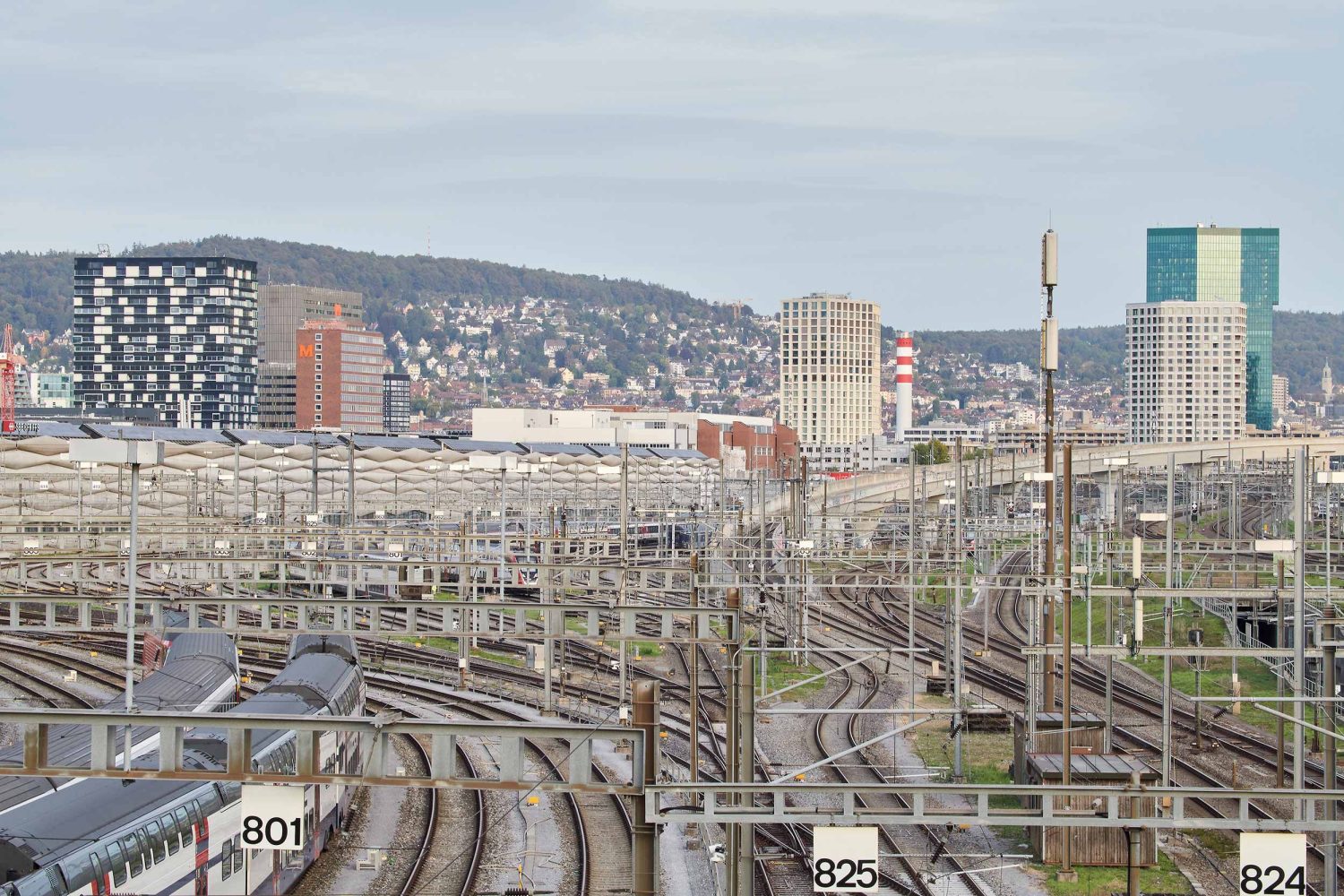
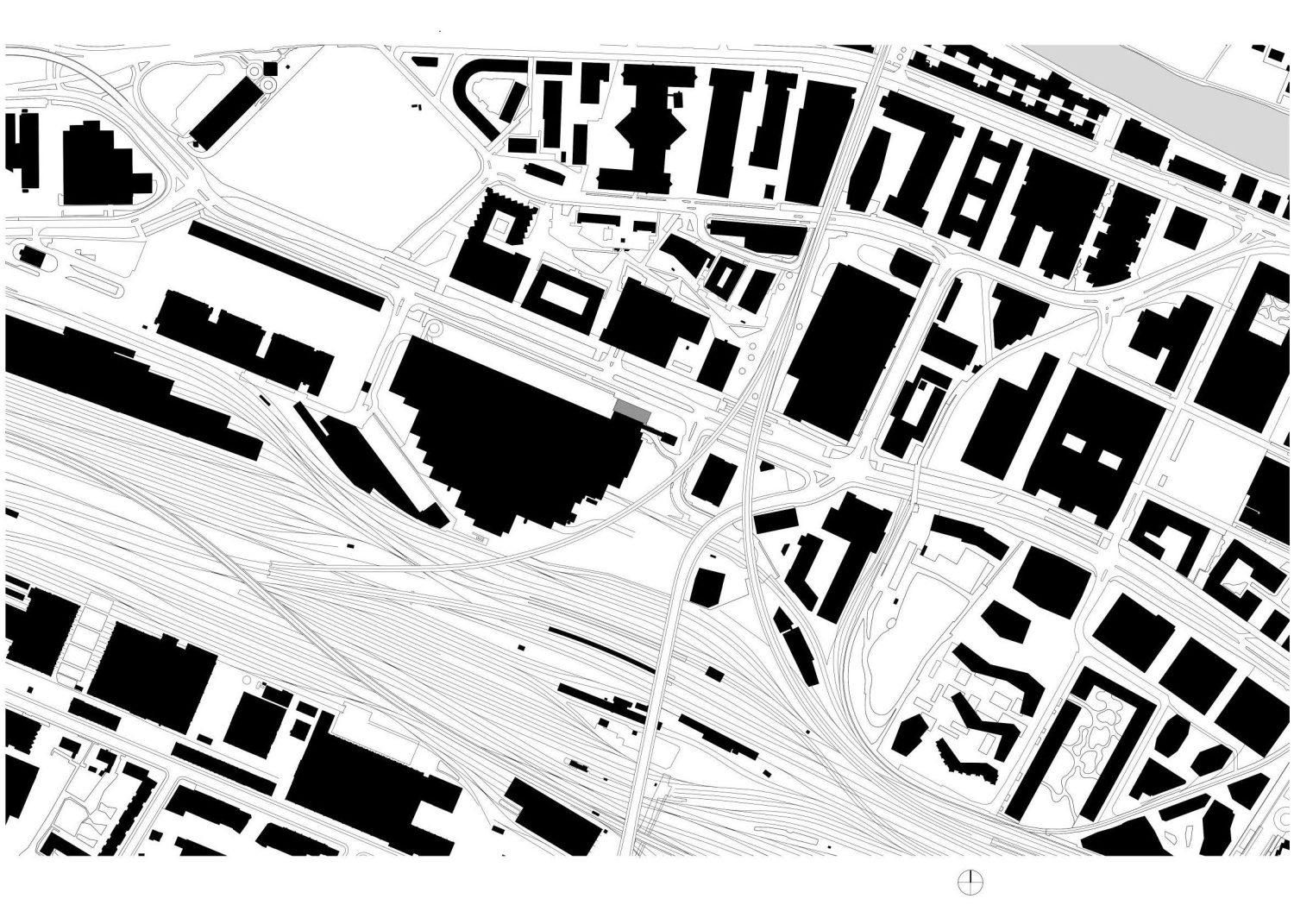
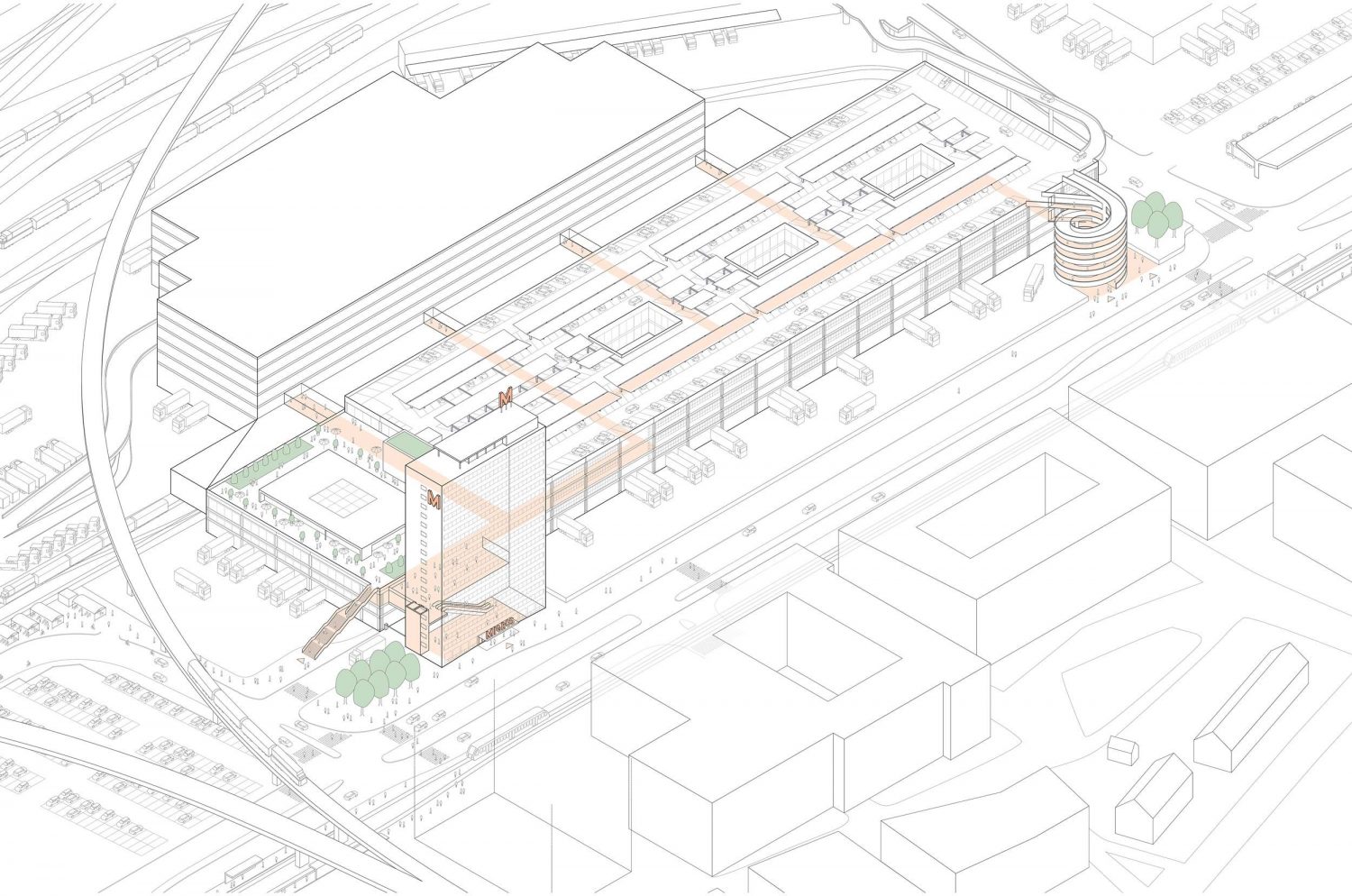
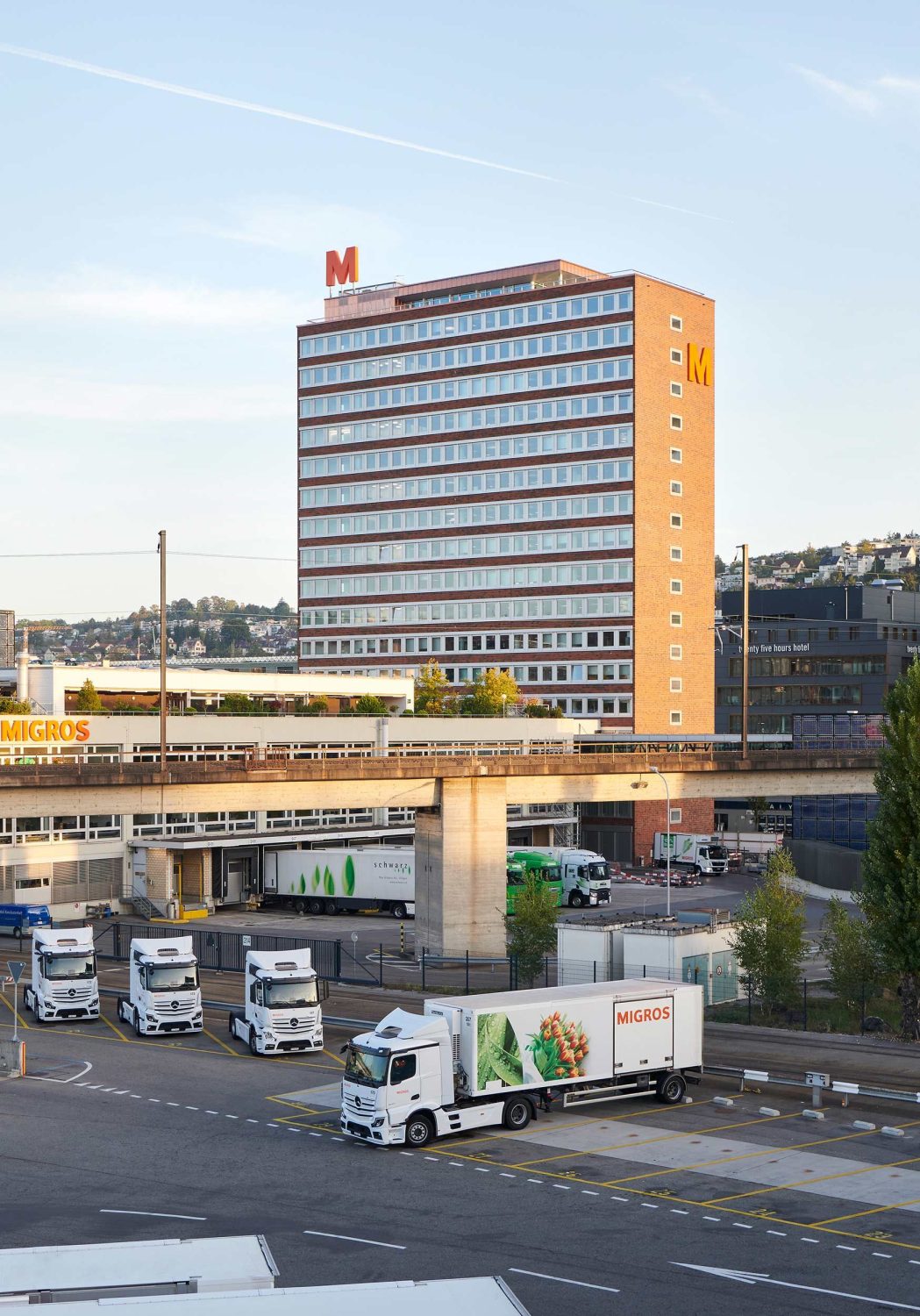
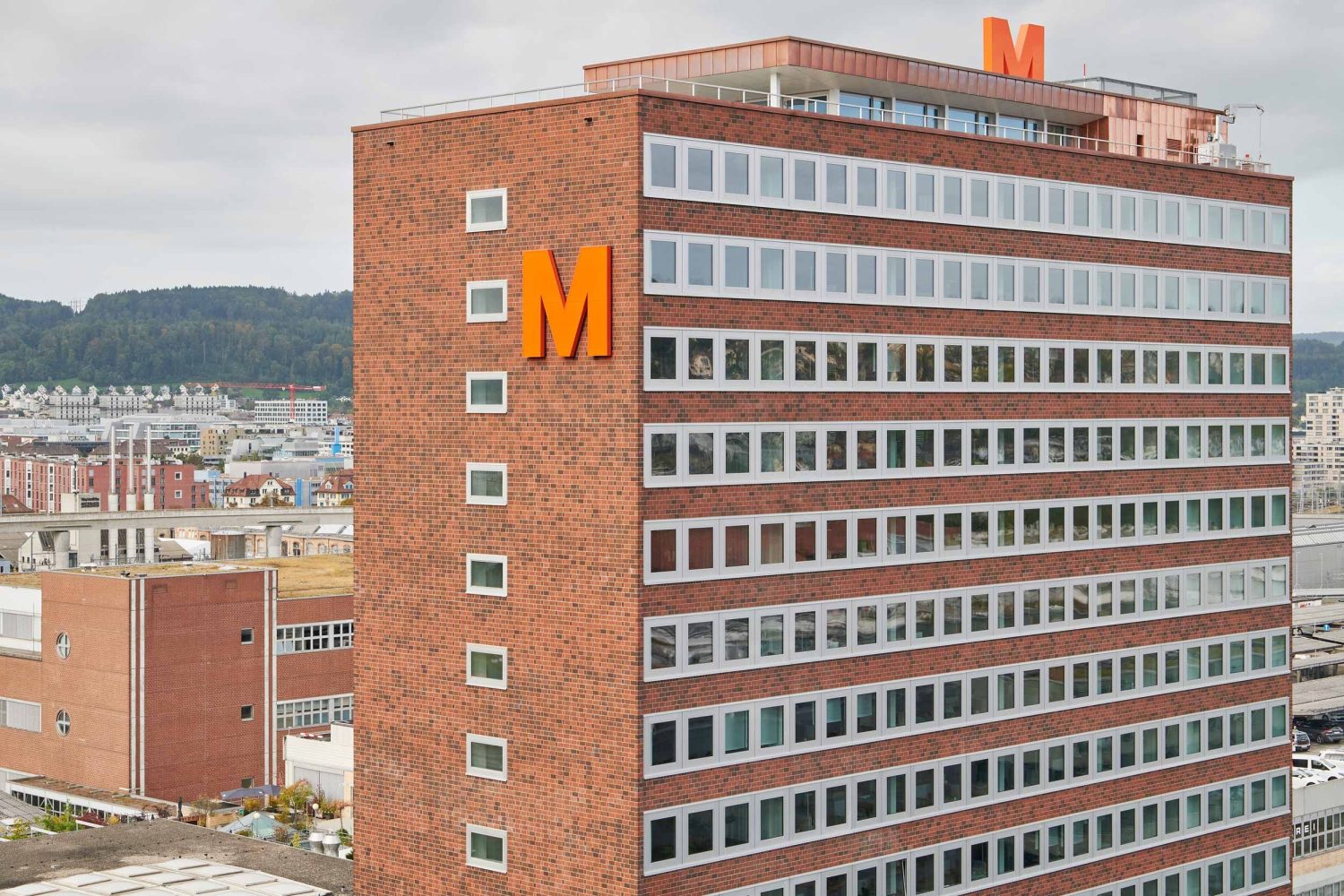
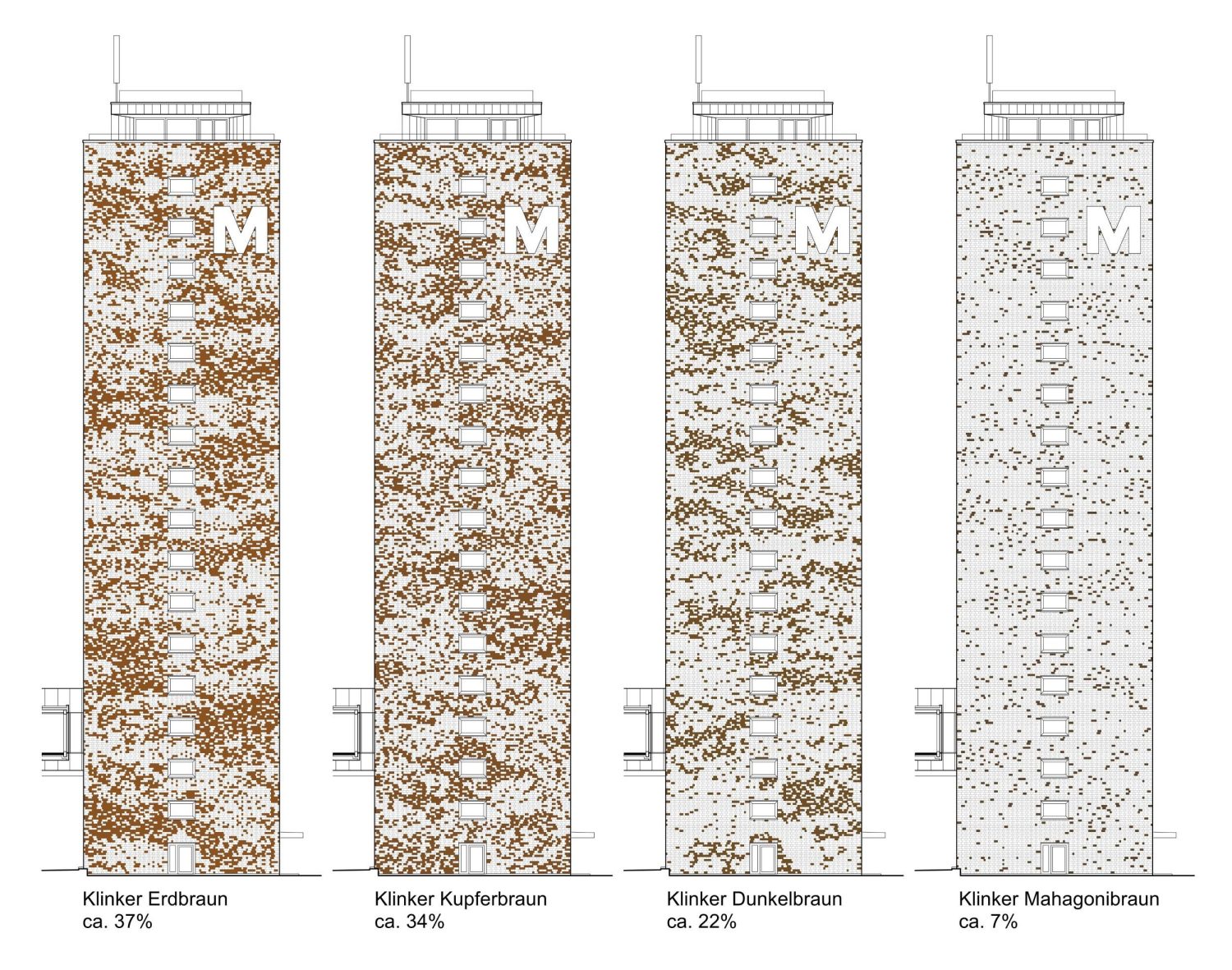
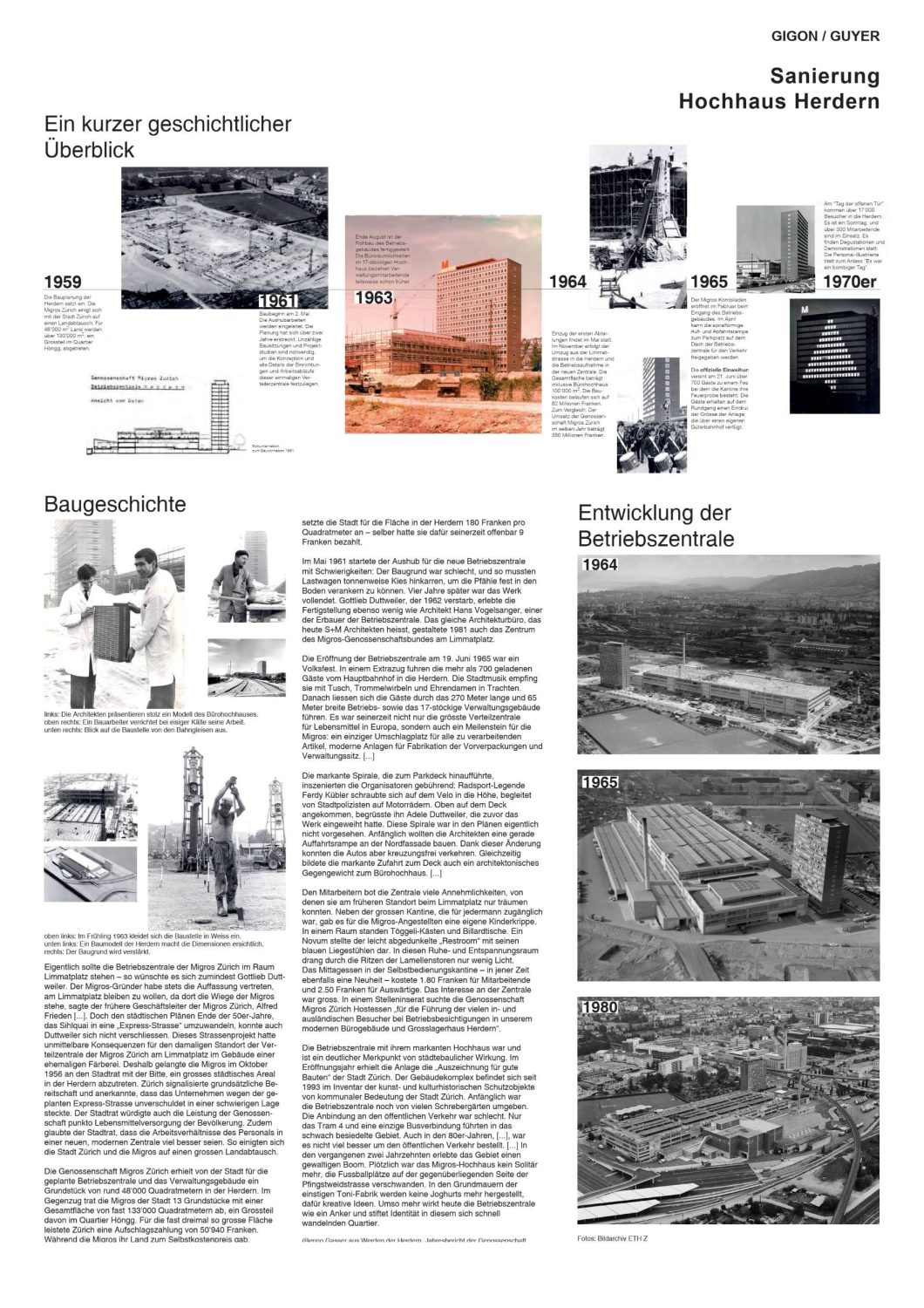
The slab-shaped high rise in western Zurich is part of the Herdern Migros headquarters, which opened in 1965 and is now listed as an industrial heritage site. Over the years, the brick facade of the 17-storey building has become weatherworn and is undergoing comprehensive refurbishment. The urban and preservation context as well as the building’s proportions are particularly significant in this respect.

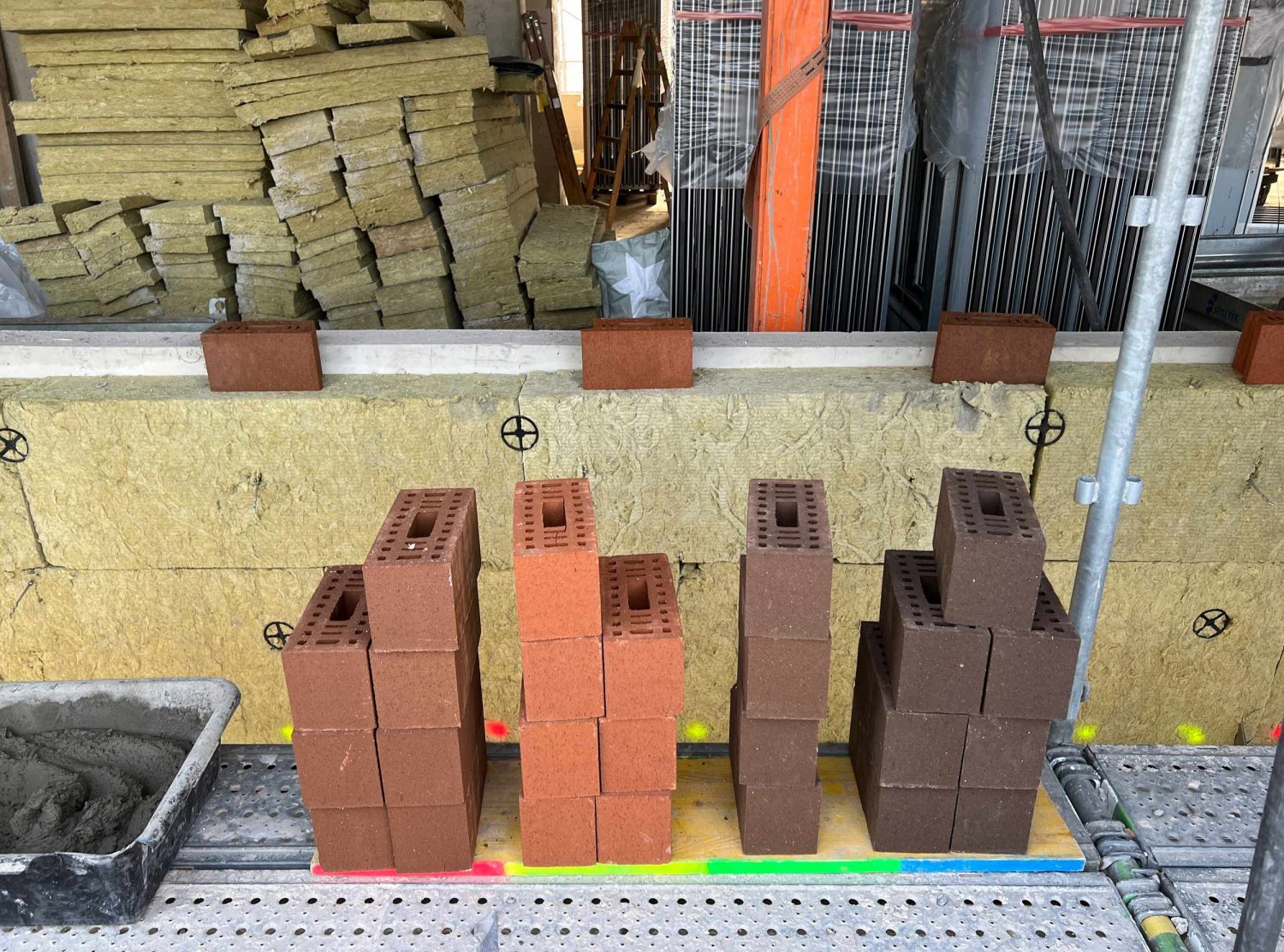
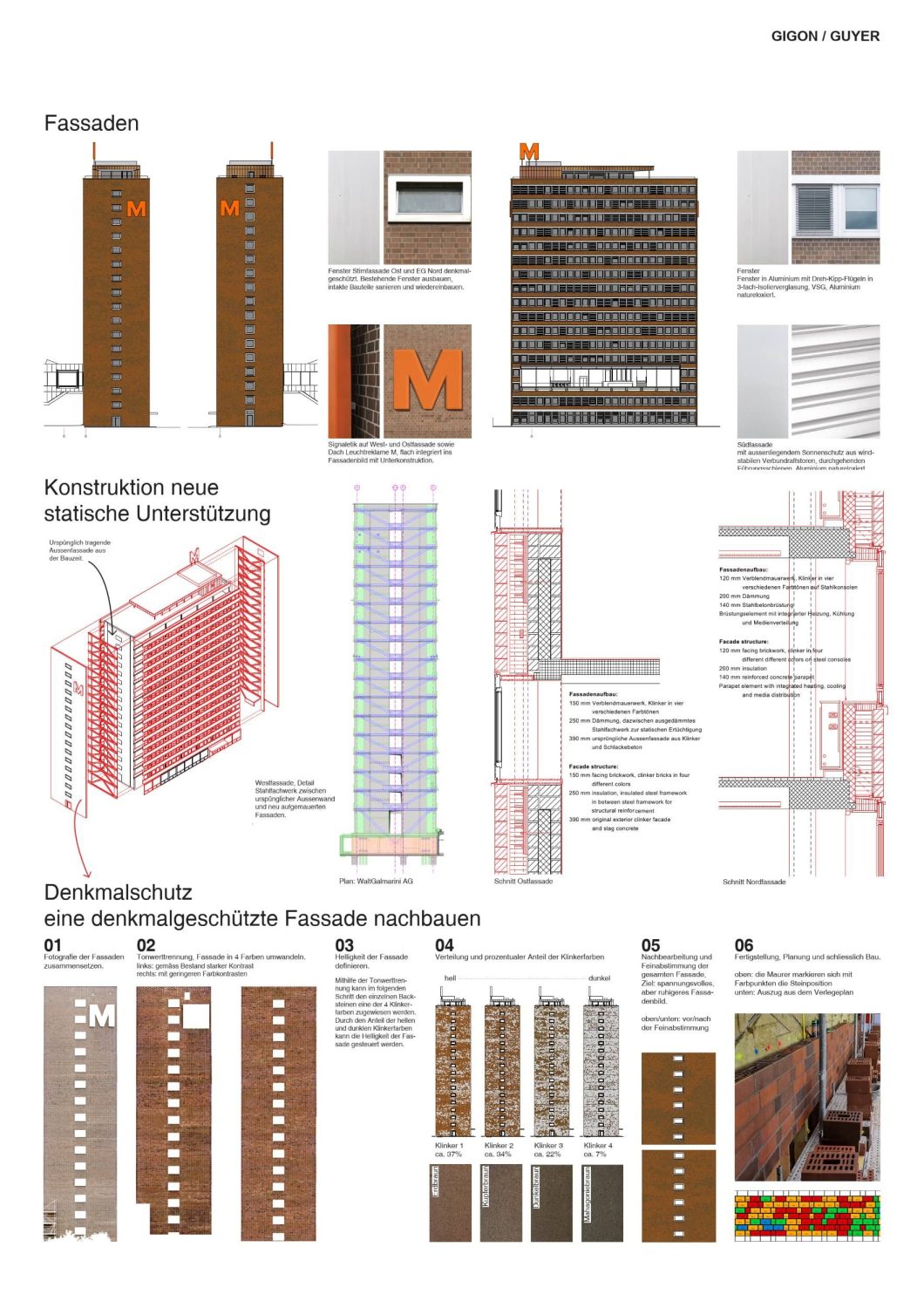
The work comprises the static and energetic renovation, including HVAC renewal. On the shorter sides, the load-bearing structure is being reinforced, while the existing brick facades and parapets will be replaced and thermally insulated all around. The new fair-faced masonry walls resemble the old ones in brick format, texture and colour. New aluminium windows with triple insulation glazing meet the thermal and acoustic specifications. Inside, the ribbed concrete ceilings of the office spaces will be uncovered and will serve as temperature buffer. They create a workshop-like atmosphere that matches the industrial history and aesthetic of the building.
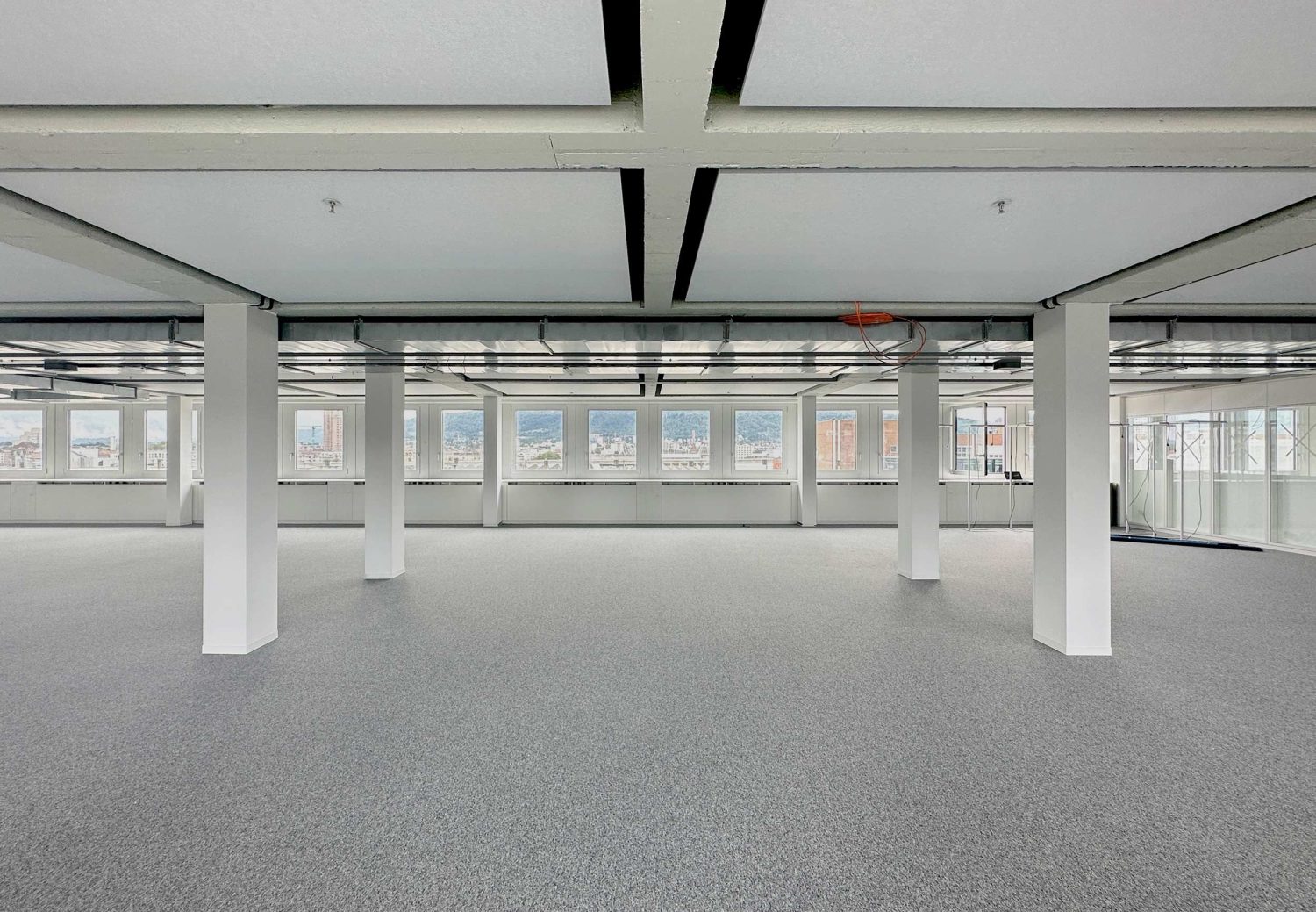
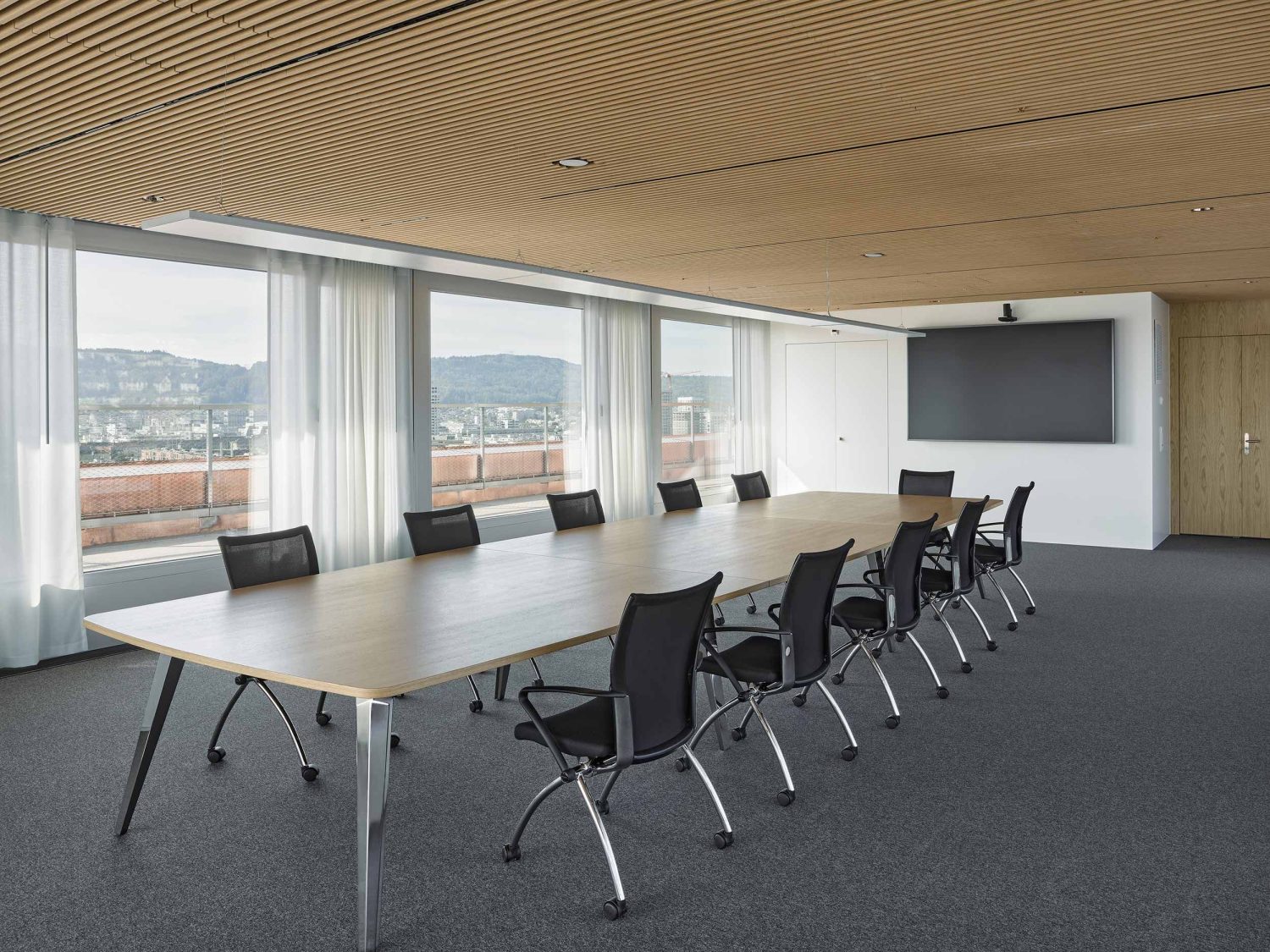
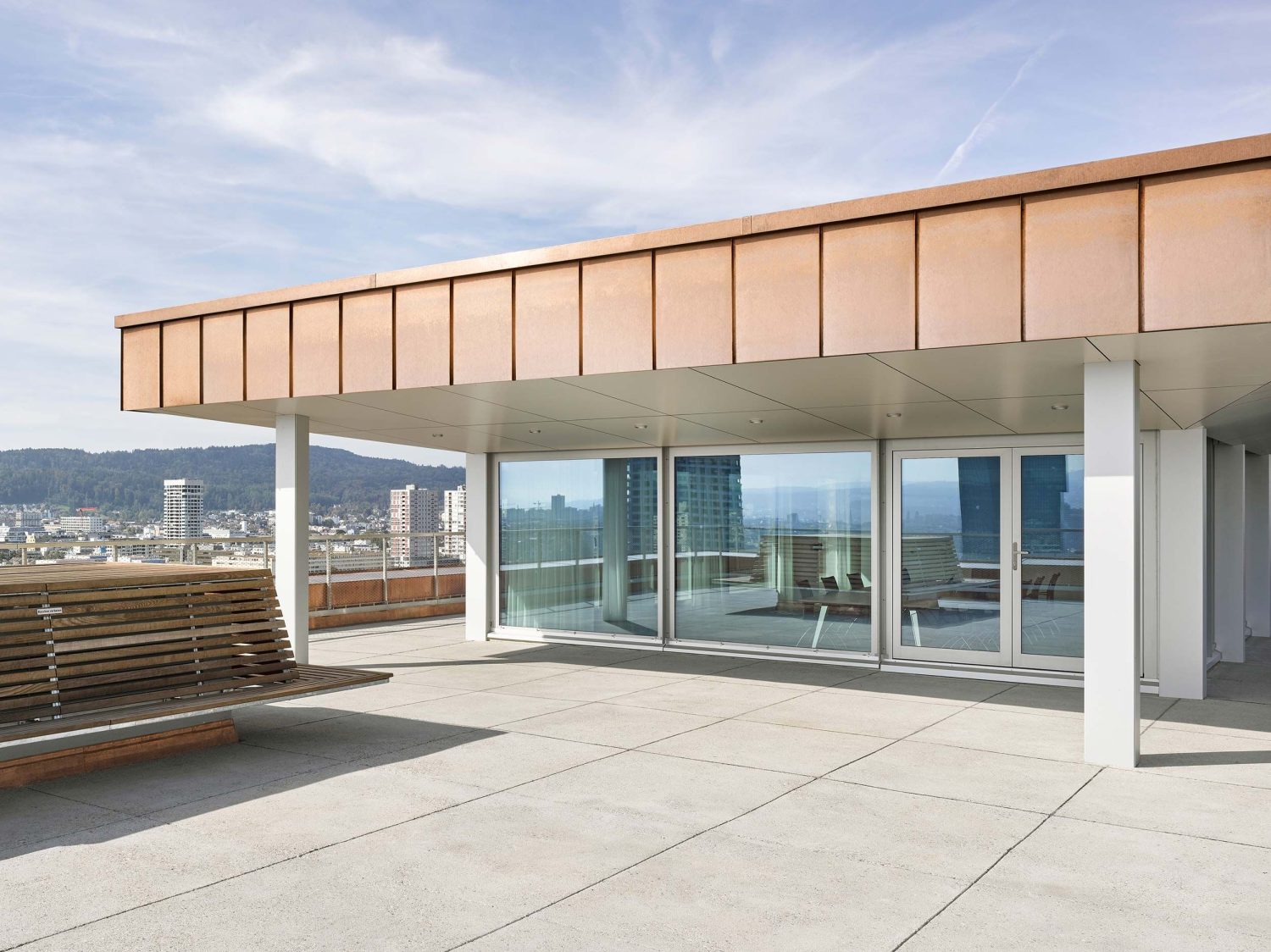
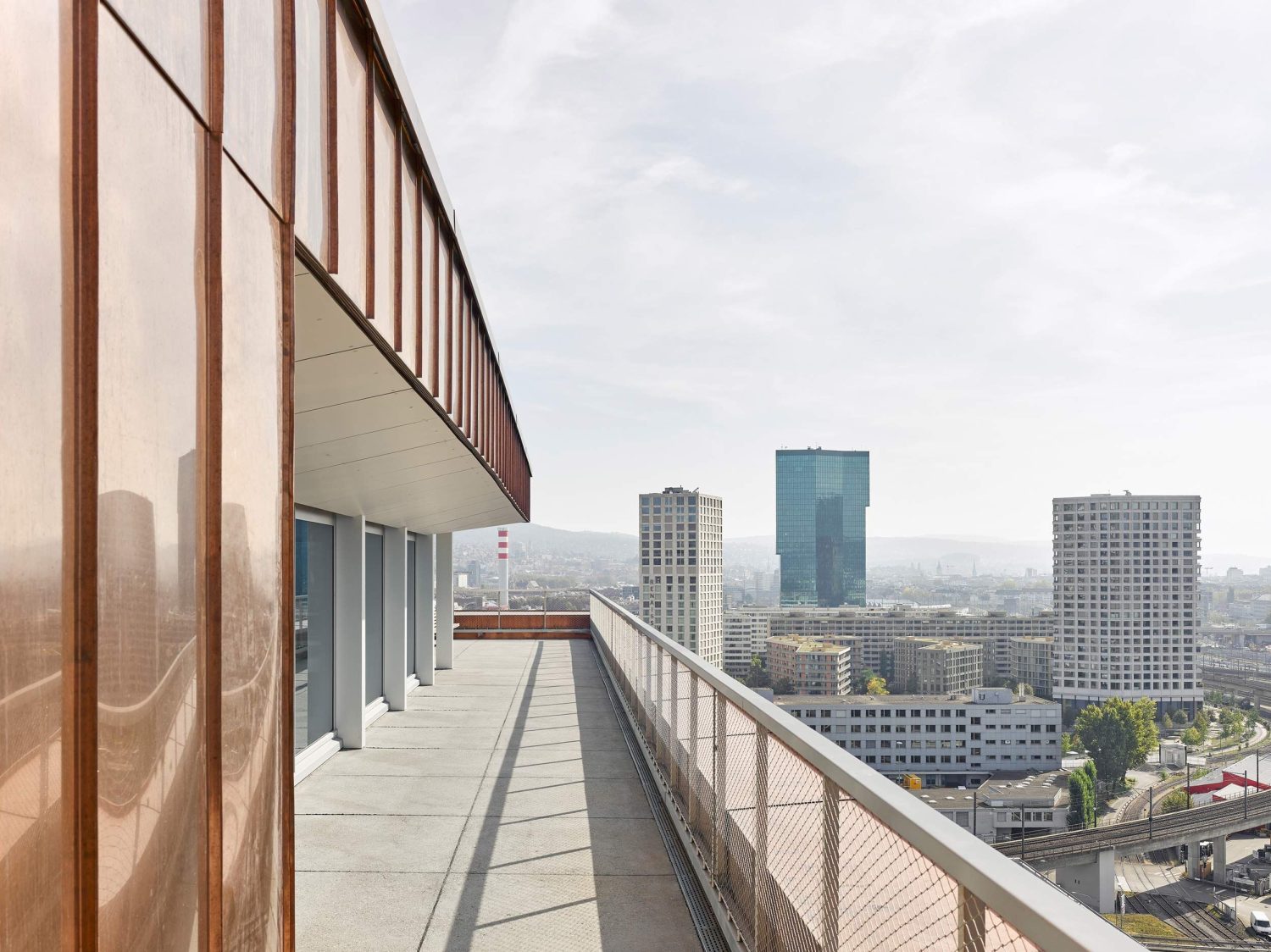
The setback top storey, surrounded by a roof terrace, houses an executive board room. The entire space, along with the small kitchen, will be refurbished and offers panoramic views of Zurich West and the Alps.
Location Zurich, Switzerland

Programme Refurbishment of the listed office high-rise building (built in 1963 by the architects Hans Vogelsanger, Ernst Scharzenbach, Albert Maurer),
19 floors (1 underground, 18 above ground), 500 workplaces, seminar rooms

Competition 2018, 1st Prize Gigon/Guyer Architekten and WaltGalmarini

Planning/Construction 2019–2023

Client Genossenschaft Migros Zurich

Gross Floor Area 9‘948 m2

Team GG Planning/Execution: Mike Guyer, Stefan Thommen (Team Manager), Urs Meyer (Project Manager), Milica Brockmann, Andy Gratwohl, Arend Kölsch, Pieter Rabijns, Urh Urbancic, Luisa Wittgen, Nathalie Reiz (I), Jannis Poncelet (I)
Competition: Mike Guyer, Stefan Thommen, Filippo Cattaneo, Vladimir Dianiska, Milica Brockmann, Mickael Minghetti (I), Michelle Feige (I)

Site Management Spiegel + Partner AG, Zurich

Landscape Architecture Lorenz Eugster Landschaftsarchitektur und Städtebau Gmbh, Zurich

Cost Planning/Scheduling Spiegel + Partner AG, Zurich

Structural Engineer WaltGalmarini AG, Zurich

Electrical Engineer Eplan AG, Reinach

Building Physics Engineer WaltGalmarini AG, Zurich

Fire Safety Migros Engineering Solutions, MGB, Zurich

Heating/Cooling Concept-G AG, Winterthur

Ventilation Engineer Concept-G AG, Winterthur

Acoustical Engineer WaltGalmarini AG, Zurich

Plumbing Concept-G AG, Winterthur

Sprinkler Consultant Banzer Beratung & Planung AG, Wil

Facade Reba Fassadentechnik AG, Chur

Door Consultant Batishield AG, Rüti

Other RDA: Enfors AG, Sempach

Photos Seraina Wirz, Zurich
Luca Zanier (Baustelle)
Tom Licht (Drohnenaufnahme)
Gigon/Guyer

Awards «Auszeichnung für gute Bauten der Stadt Zürich 2021–2024» Recognition


Office High-rise Andreasturm

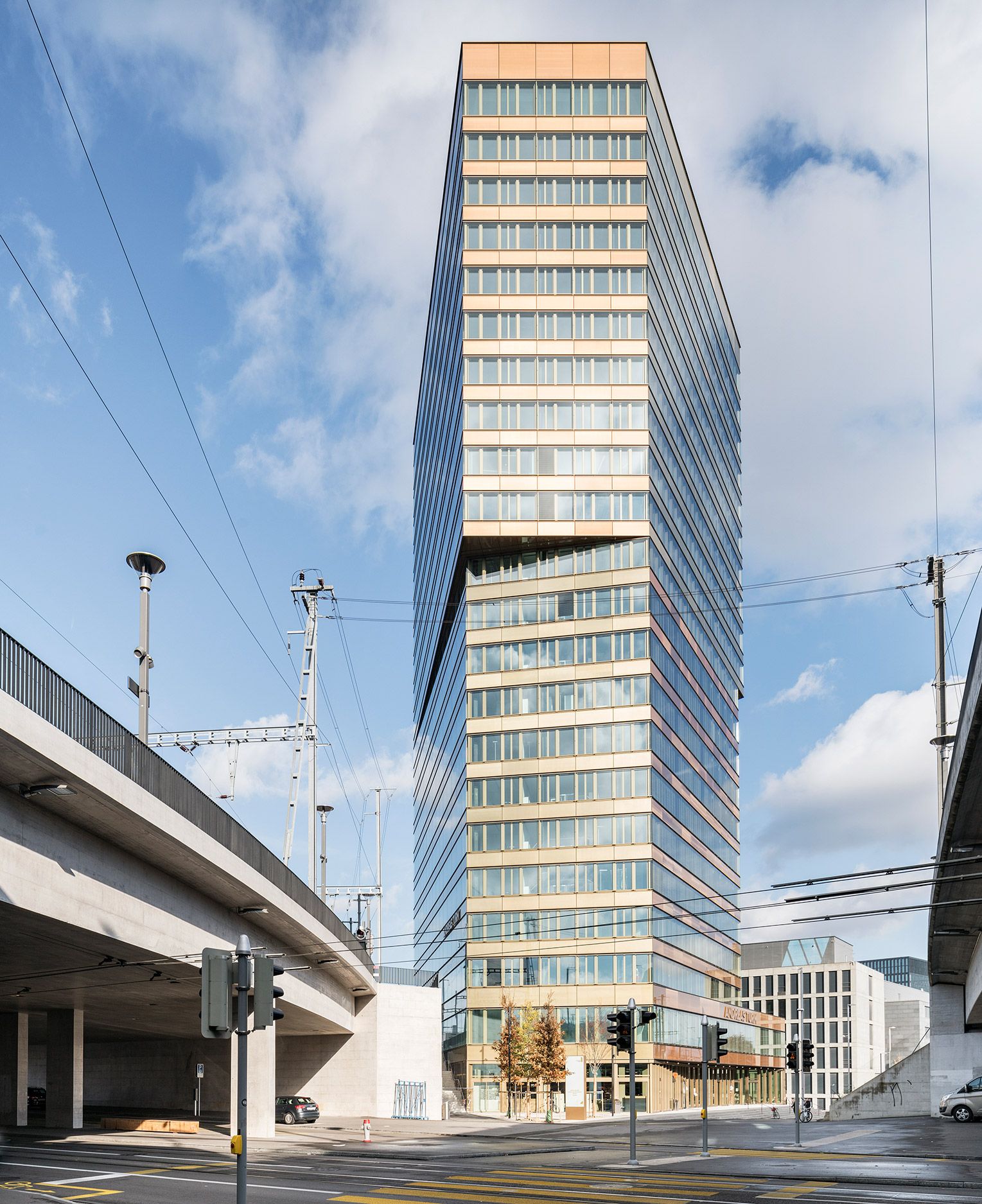
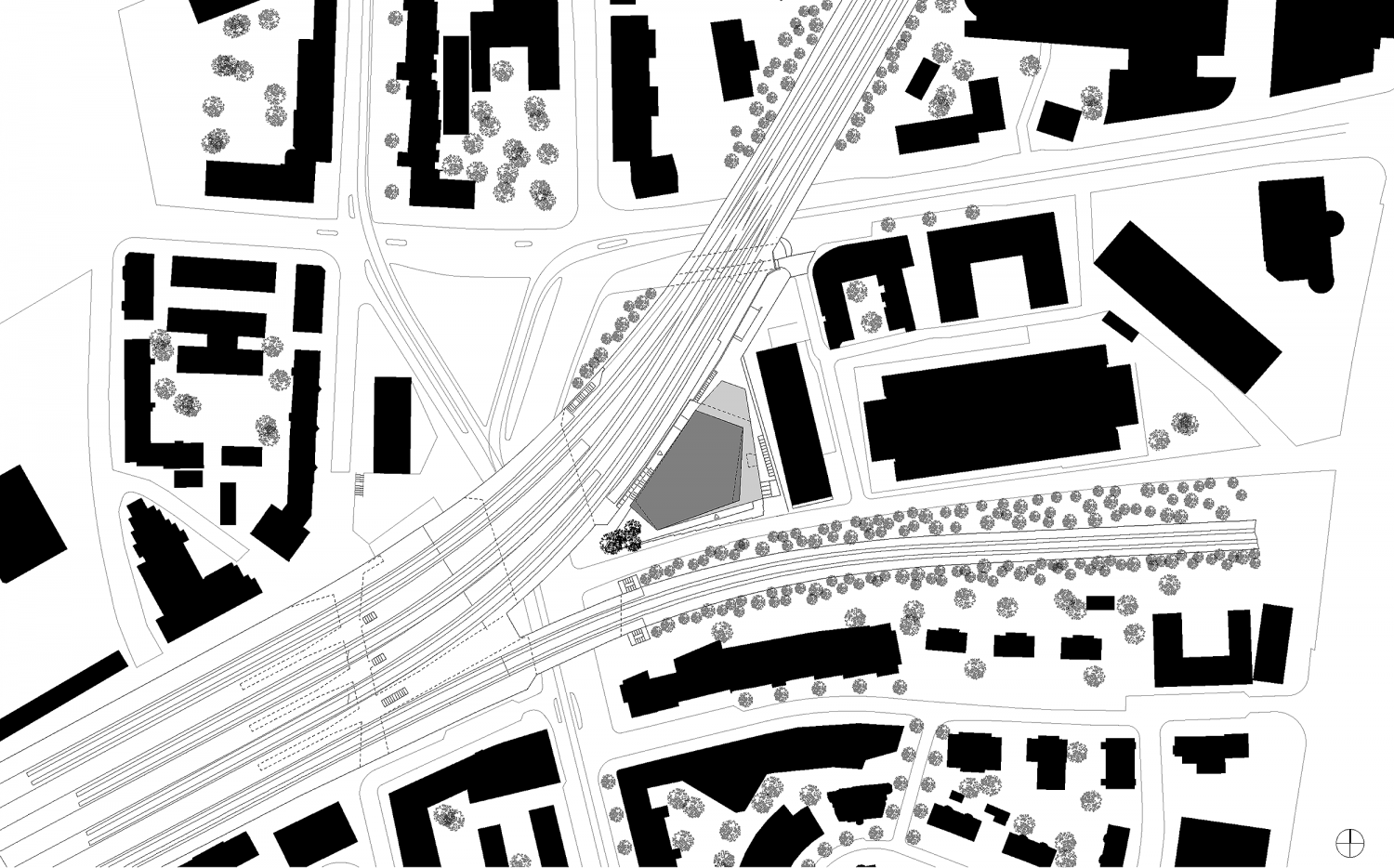
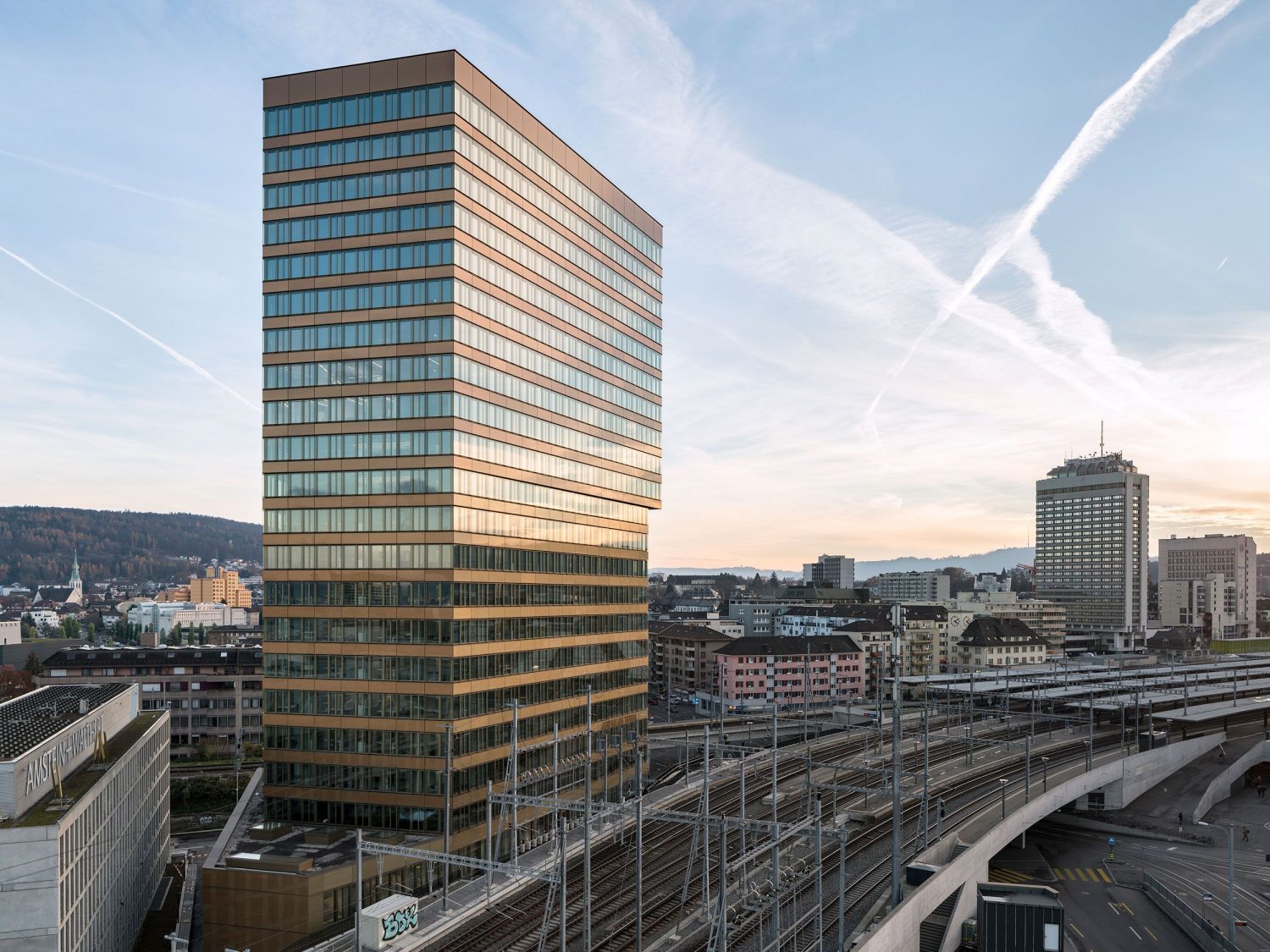
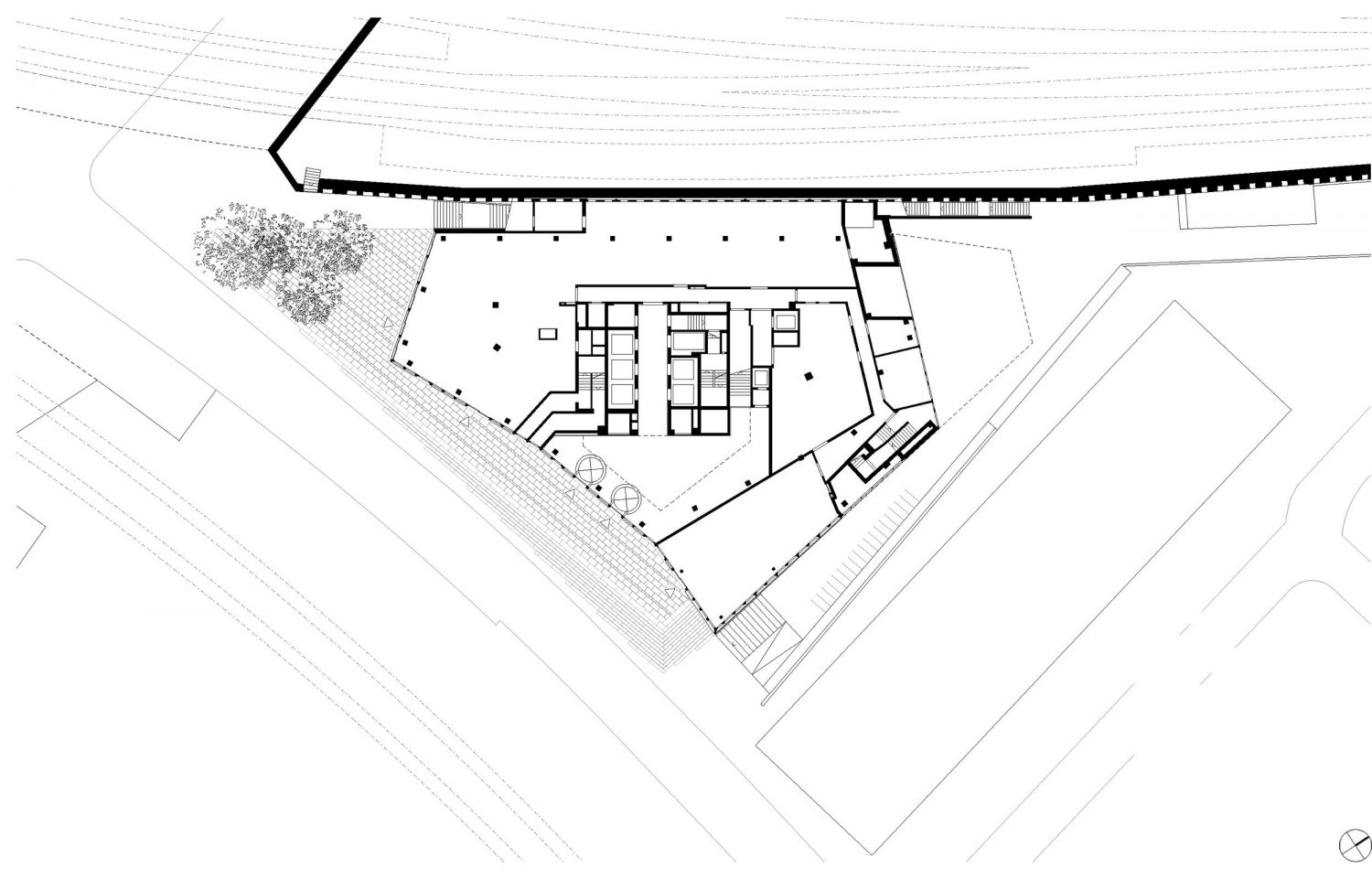
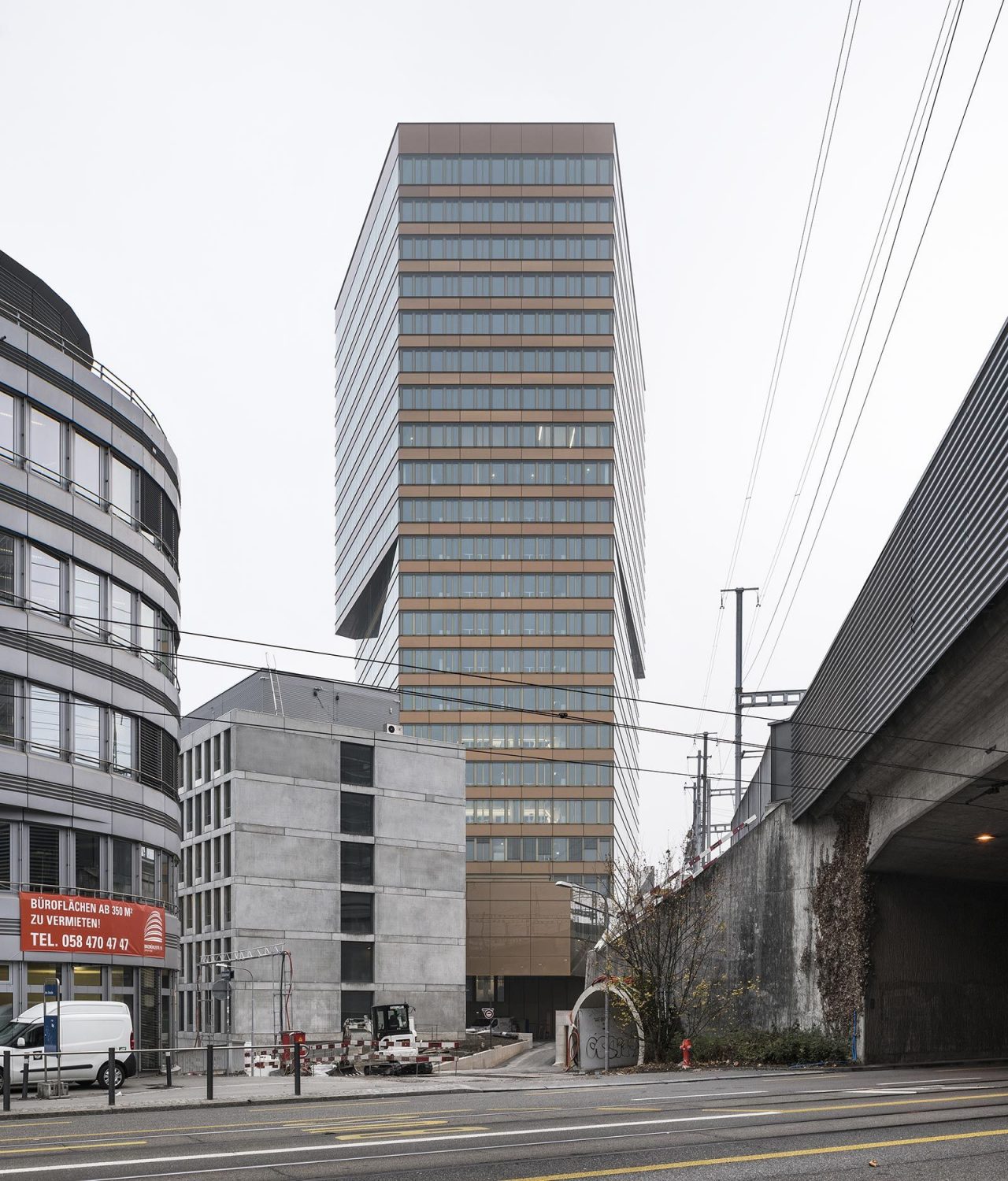
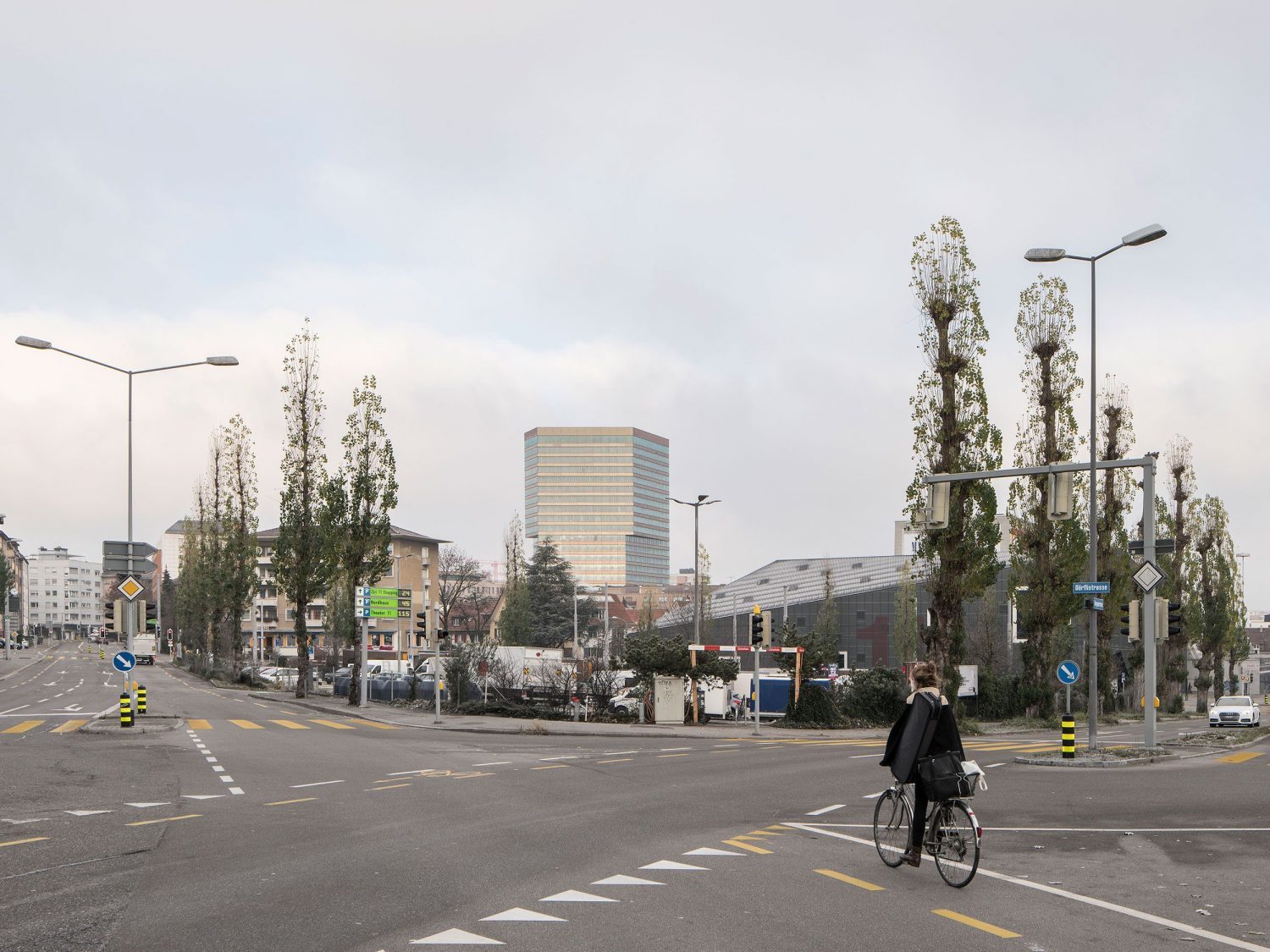
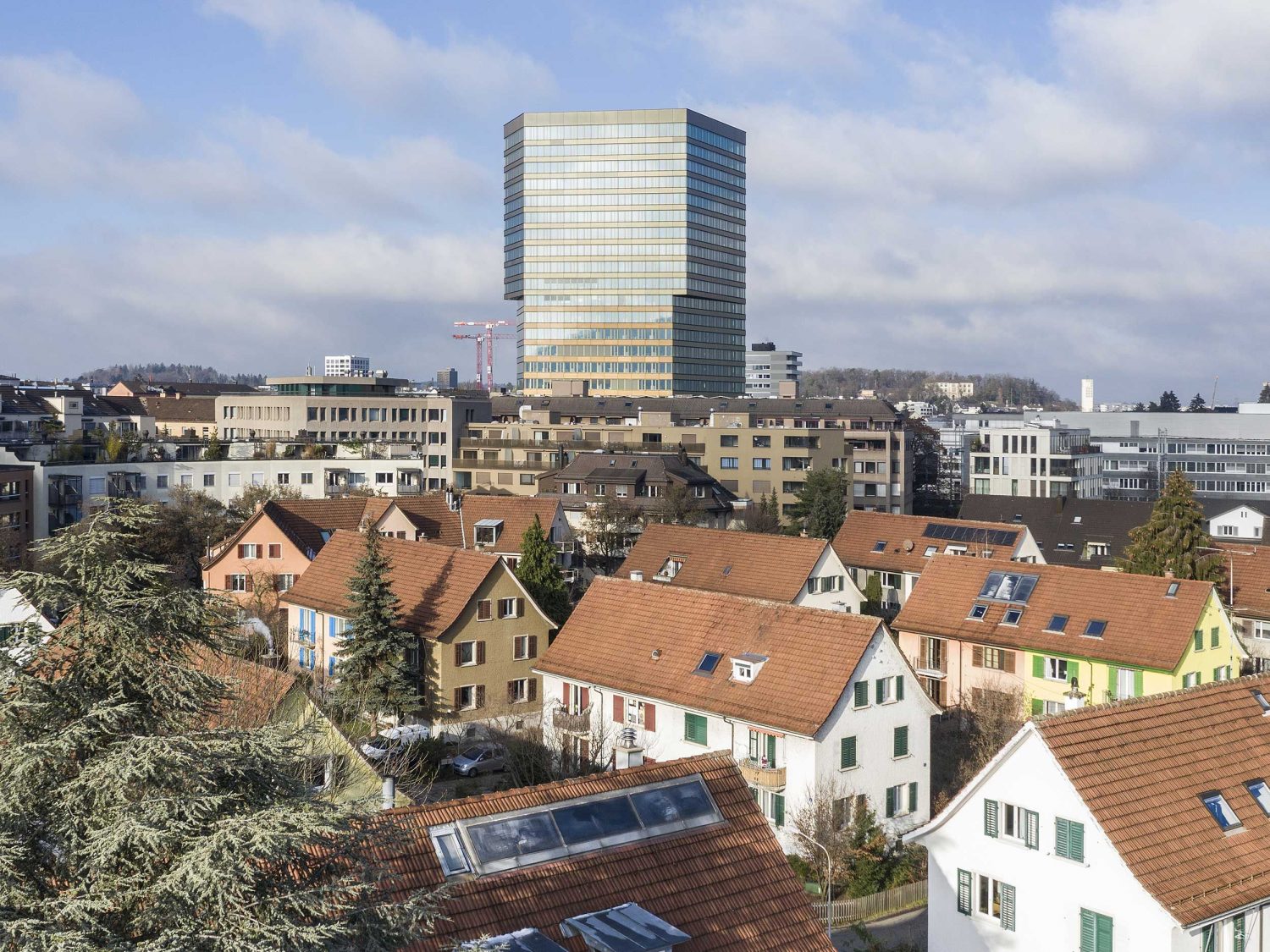
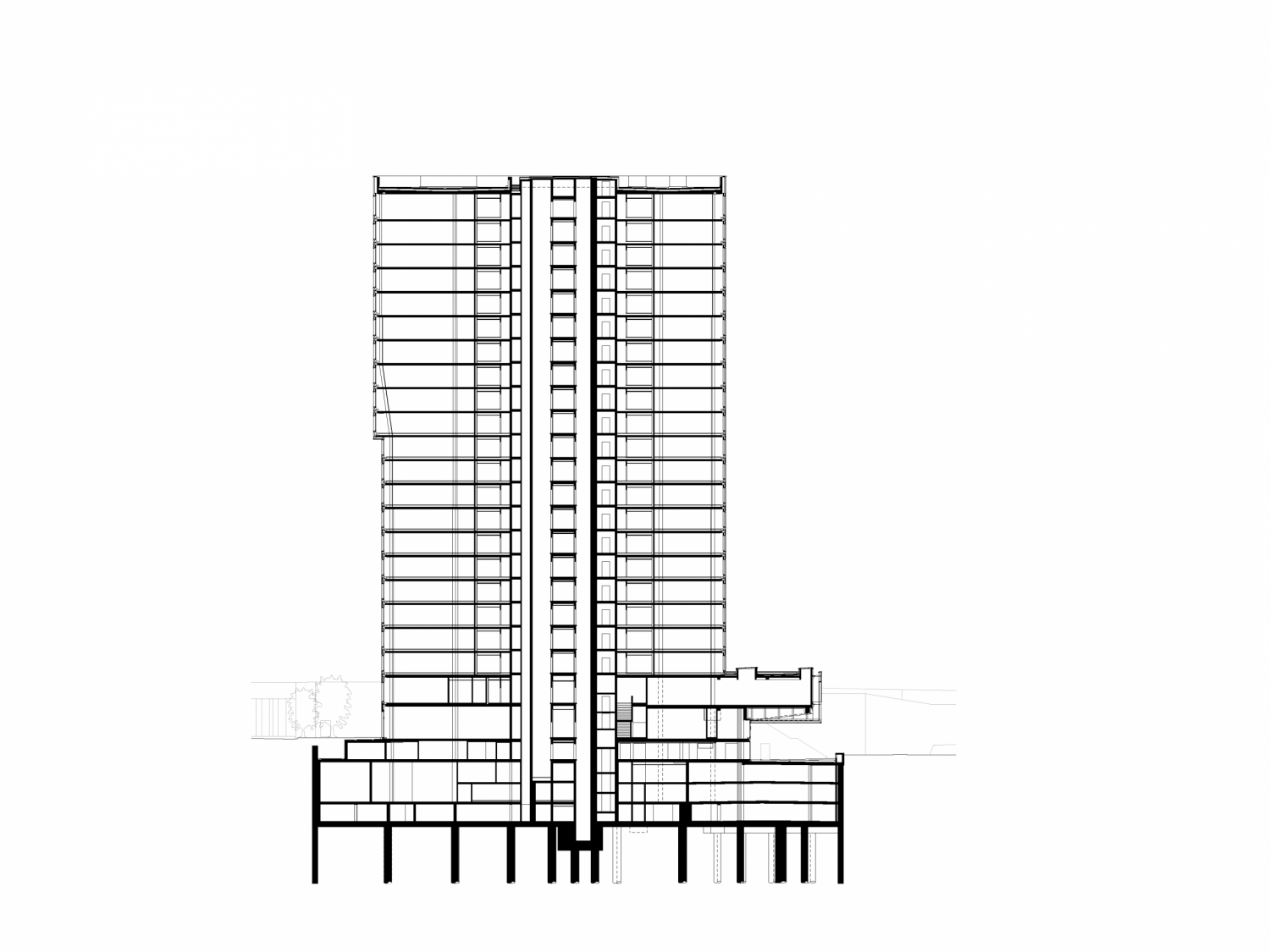
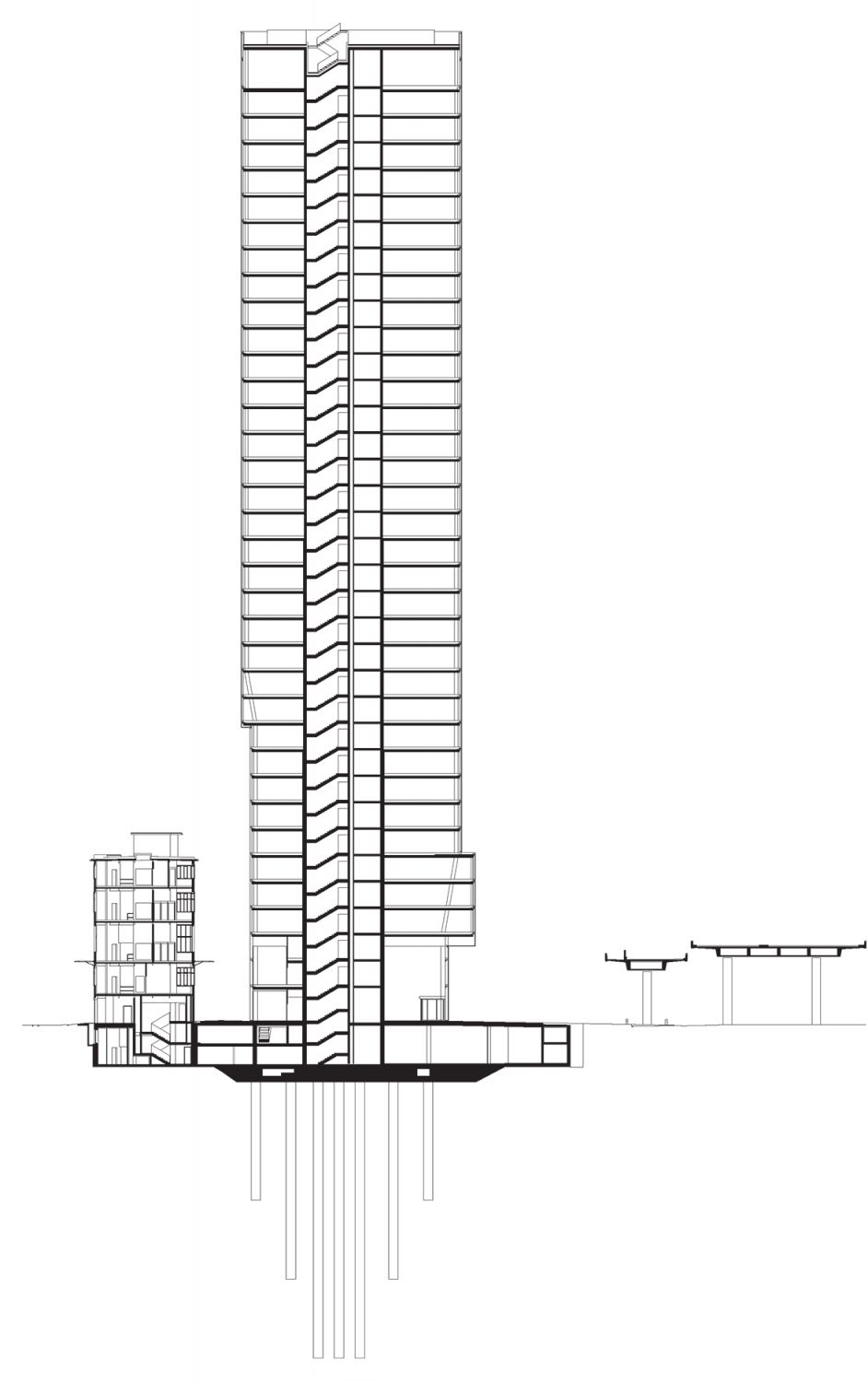
The office high-rise Andreasturm is situated on a triangular plot of land that has become available between the spread of railway tracks at Oerlikon station. The pentagonal tower, the property of the Swiss Federal Railways, is 80 m high, with 22 above-ground and four below-ground storeys.
Precisely placed cantilevers on the 12th floor divide the building into a middle and a head section, making it look slender or flat from a distance, depending on one’s vantage point.

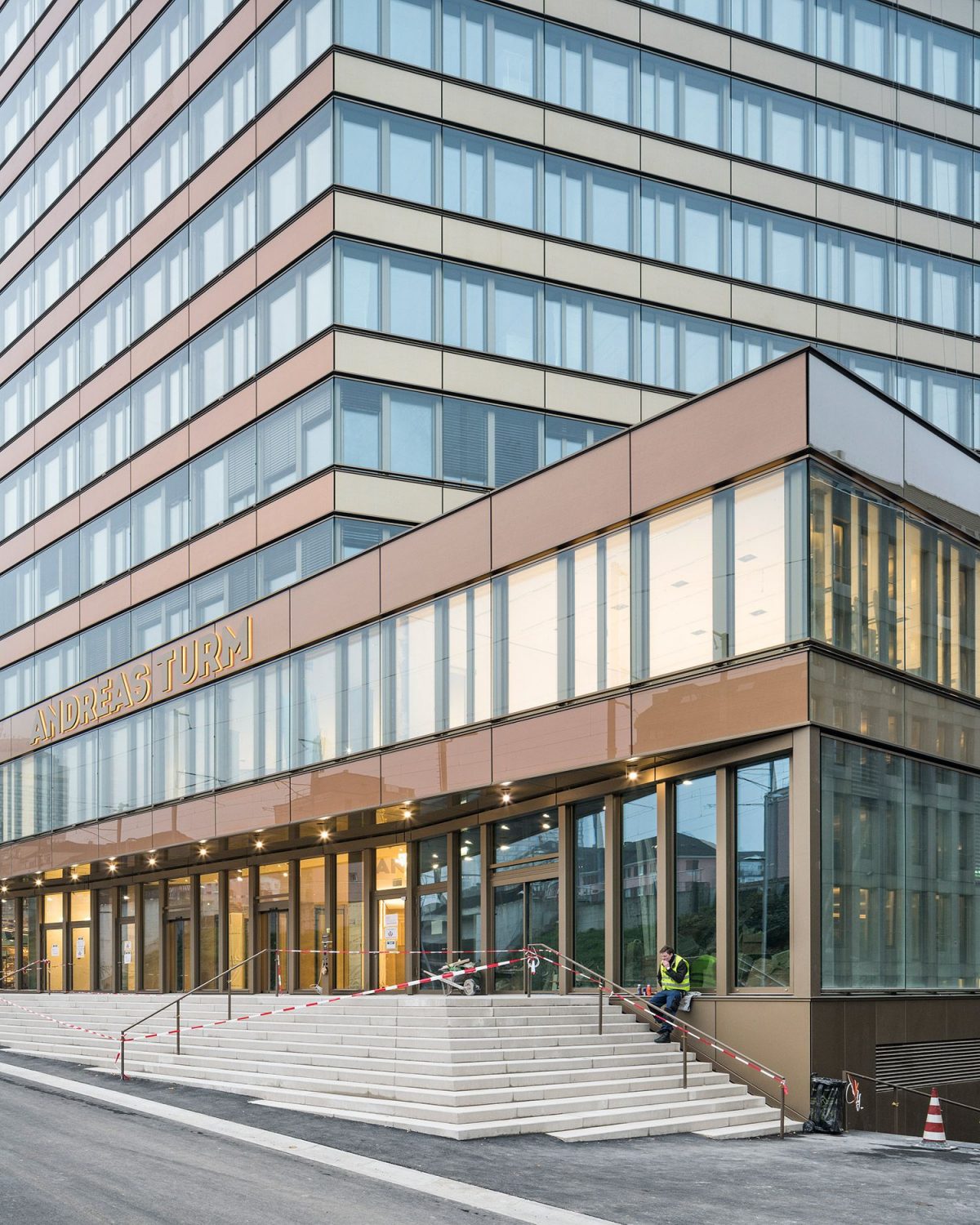
An expansive base anchors the structure in its surroundings and opens it up on three levels. The main entrance with public facilities and a small, new plaza face the traffic-calmed Andreasstrasse. The premises of anchor tenant Amstein + Walthert are accessed directly from the higher railroad platform while the delivery entrance is on the lower street to the rear.

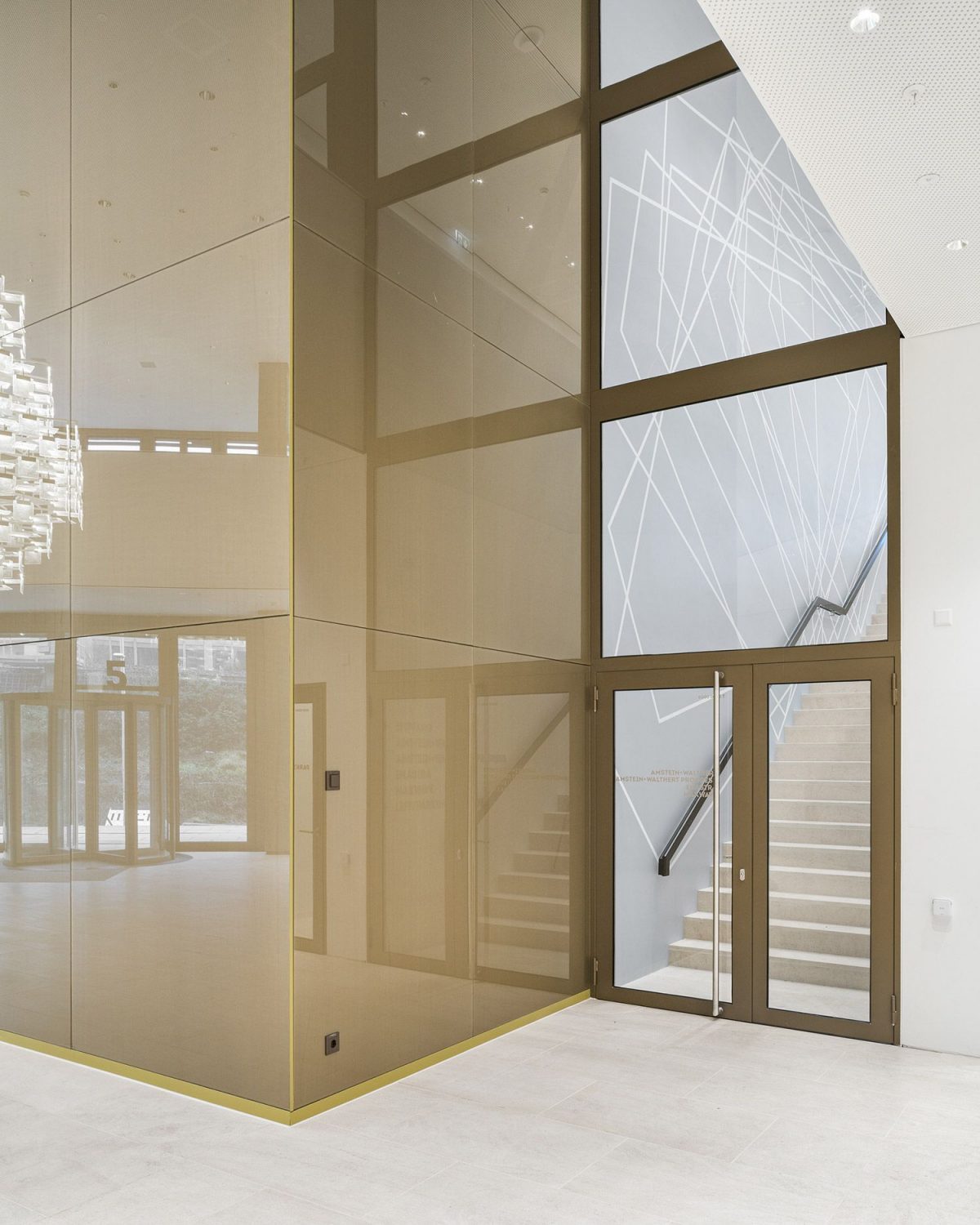
A well-appointed, double-height lobby welcomes tenants and visitors, who reach the upper stories via the lift lobby. An open staircase leads up to the first floor and the main tenant‘s reception desk. The tenant’s public spaces are arranged around a central core: a “piano nobile” with conference rooms, a gallery and a staff restaurant in the protruding portion of the base.

The skeleton of the high-rise is reinforced concrete with a double-shell element façade. Flat slabs span up to 9.30 meters between the core and the prefabricated concrete supports along the façade. The column-free spaces allow for flexible layouts and workplaces with natural daylight. The double-shell façade consists of an inner layer with slender windows that can be individually opened, and exterior glazing with horizontal parapet bands, into which copper and gold coloured inlays have been laminated, their tone varying to match the angled surfaces of the façade. The appearance of the building changes depending on the weather and lighting: at times, the tower may look like a flat, reflecting surface; at others, one can see the filigree vertical structure of the interior.

Location Zurich-Oerlikon, Switzerland

Programme 26-storey office building (4 underground, 22 above ground), 1,200 workplaces, offices, conference area, restaurant, retail, underground parking
Tenants: engineering office, medical centre, start-ups, university institutes

Competition 2-phase, 2013, 1st Prize

Planning/Construction 2013–2018

Client SBB AG, Zurich
Client’s Representative: EBP Schweiz AG, Zurich

Label DGNB Platin - Certificate by the 'Schweizer Gesellschaft für Nachhaltige Immobilienwirtschaft'

Gross Floor Area 35‘517 m2

Team GG Planning/ Construction: Mike Guyer, Stefan Thommen (Team Manager), Matthias Clivio (Project Manager basic construction), Luisa Wittgen (Project Manager tenant fitout), Christoph Lay, Nicolas Hunkeler, Christian Gammeter
Competition: Annette Gigon, Mike Guyer, Stefan Thommen, Mathias Rösner, Rodrigo Jorge, Thomas Möckel, Leyla Ilman

Site Management Ghisleni Planen und Bauen GmbH, Zurich (until Submission)

Total Contractor Implenia (from Submission)

General Contractor GGG Gigon Guyer Ghisleni Generalplaner Andreasturm AG (until Submission/ SIA Subphase 5)

Landscape Architecture Studio Vulkan, Zurich

Structural Engineer WaltGalmarini AG, Zurich

Electrical Engineer Amstein + Walthert AG, Zurich

Building Services Engineer Amstein + Walthert AG, Zurich

Building Physics Engineer BAKUS Bauphysik & Akustik, Zurich

MSRL Amstein + Walthert AG, Zurich

Heating/Cooling Amstein + Walthert AG, Zurich

Ventilation Engineer Amstein + Walthert AG, Zurich

Acoustical Engineer BAKUS Bauphysik & Akustik, Zurich

Lighting Consultant Ernst Basler + Partner AG, Zurich
tenant fitout: A+W: Reflexion AG, Zurich

Facade Reba Fassadentechnik AG, Chur

Interior Design tenant fitout A+W: Annette Gigon / Mike Guyer Architekten, Zurich
Trix Wetter, Zurich

Signage Integral Ruedi Baur, Zurich

Photos © Roman Keller

Awards «Auszeichnung für gute Bauten der Stadt Zürich 2016–2020» Recognition

Würth Haus Rorschach

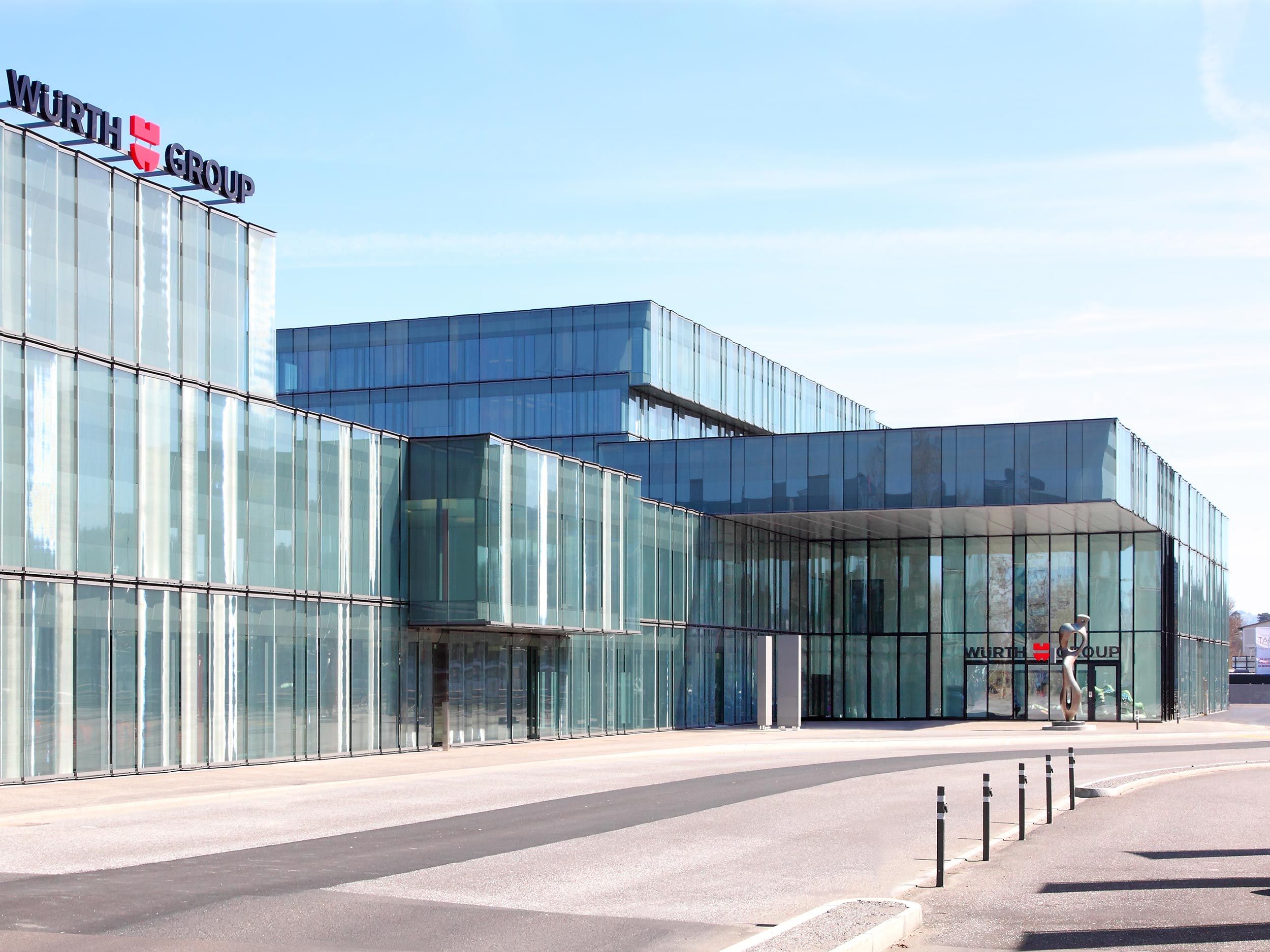
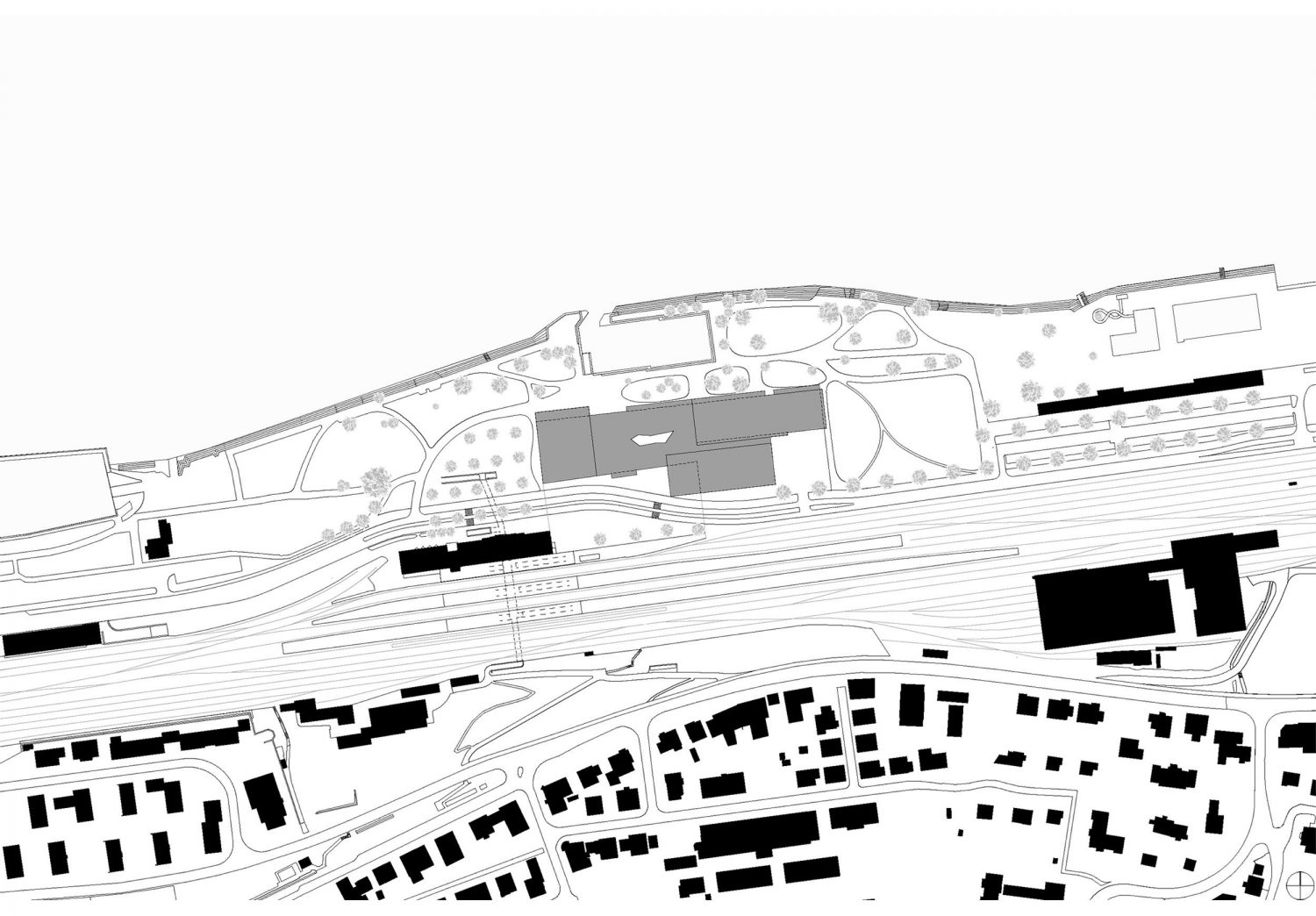
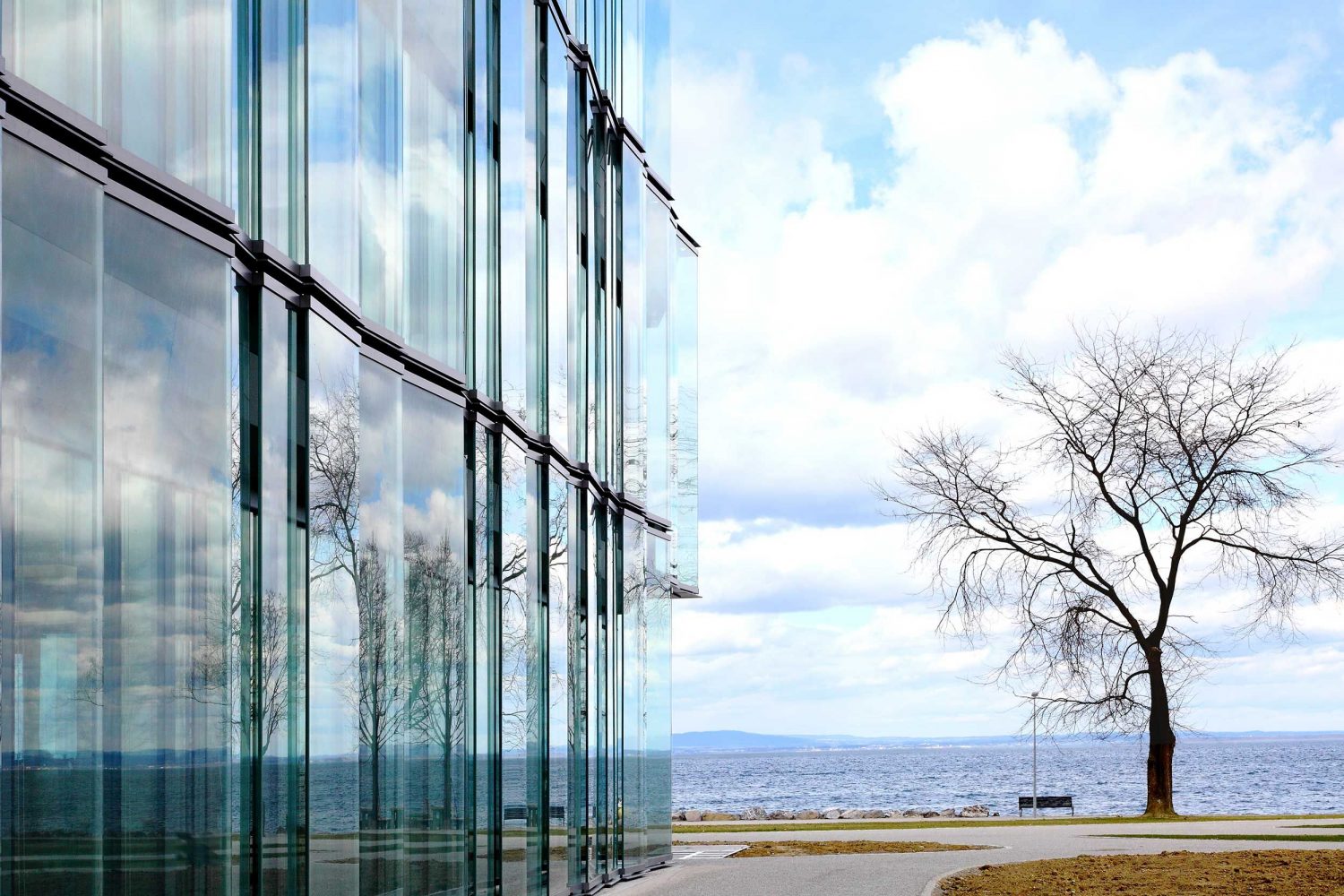
A greenish crystalline building responds to the unusual location of the site, set between the edge of Lake Constance and Churerstrasse. Walkers and passers-by experience a glass structure that oscillates between transparency and shiny reflective surfaces that multiply the natural beauty of the setting. The architecture affords views out to the surroundings, glimpses into the building, and sightlines through it to the park and lake.

The interior offers staff and visitors generously proportioned sequences of rooms - workspaces, communication areas, and leisure zones - as well as providing space for product presentations and art exhibitions. The structure responds to the train station building with lower volumes and reacts to the expanses of the park and lake with a higher segment. There are plans to add an extension on the eastern side in a future phase of construction. Toward the street, the volumes give shape to a range of external spaces through precisely defined projections and setbacks: in the middle is the entrance area, to the east the vehicle access and workshop zone, and to the west Bahnhofsplatz, the station square, which is expanded toward the lake. Maple trees set in a perpendicular configuration characterize this space, and also continue as rows along Churerstrasse.

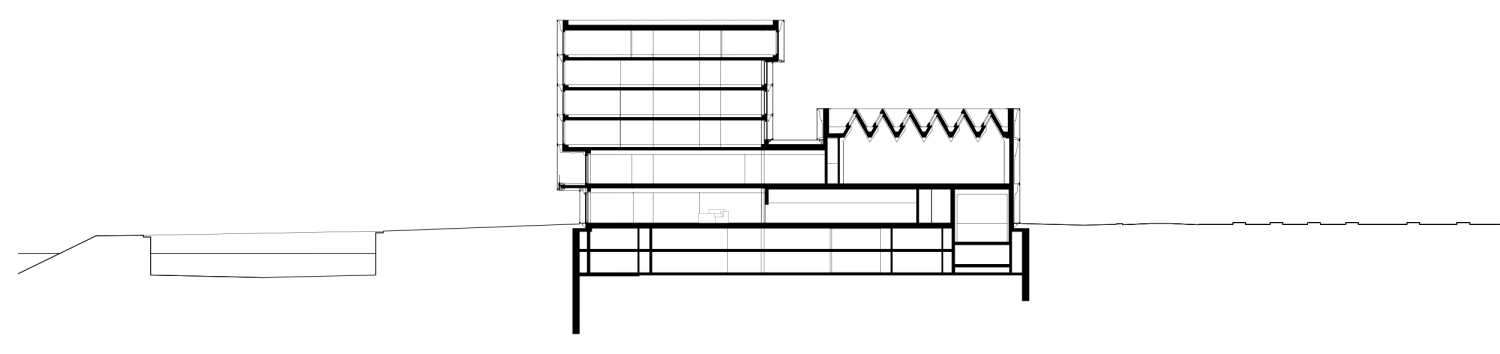
Approaching from the station, a broad canopy signals the main entrance. The various user groups - visitors, people attending courses, and company staff - enter the building through a large lobby and are guided from this point to the different parts of the building. On the ground floor and first floor, the public functions - training and conference rooms, as well as the restaurant - are grouped around a foyer with an open courtyard in the center and are linked by a sweeping stairway. Both the conference area and the separate exhibition spaces can be accessed directly from the exterior, allowing the option of using these areas independently from the rest of the building. The exhibition area guides visitors from the entrance to two different-sized exhibition rooms, which are located on the first floor of the southern part of the building and are naturally lit from above. The structure of the shed skylight over the exhibition spaces simultaneously supports the enormous projecting canopy over the entrance. Office space extends over four stories in the highest part of the building, which is not open to the general public. Informal meeting areas with balconies facing the lake, transparent or closed-off meeting rooms, and individual offices alternate here with open-plan office areas.

A double glass envelope encases the building. The inner layer is made up of triple glazing and metal-clad thermal insulation. The external, back-ventilated layer is composed of offset greenish glass panes equipped with a fine mesh insert with a metallic luster. This creates a rhythmically articulated glass curtain that provides protection against wind from the lake and noise from the street and also against excessive heat and cold. The predominance of glass in the building materials is continued on the roof in the form of CIS photovoltaic panels.

Location Rorschach, Switzerland

Programme Administration Building with Training and Conference Centre, 630-seat auditorium, museum, restaurant, cafeteria, hardware-shop, workshops

Competition 2009, 1st Prize

Planning/Construction 2009–2013

Client Würth International AG, Chur
Owner's representative: Walter Dietsche Baumanagement AG, Chur

Gross Floor Area 32'200 m2

Team GG Planning/Construction: Annette Gigon, Christian Maggioni (Team Manager), Matthias Clivio (Project Manager), Nicolai Rünzi, Christoph Lay, Katja Fröhlich, Rus Carnicero, Yvonne Grunwald, Martin Schneider, Michael Kloiber, Brigitte Rüdel, Franziska Bächer
Competition: Luisa Wittgen, Nicolai Rünzi, Bettina Gerhold, Thomas Möckel, Matthias Clivio

Site Management Walter Dietsche Baumanagement AG, Chur

Landscape Architecture Atelier Girot, Gockhausen

Structural Engineer Dr. Lüchinger Meyer Bauingenieure AG, Zurich

Electrical Engineer Bühler + Scherler AG, St.Gallen

Building Services Engineer Waldhauser Haustechnik AG, Basel

Building Physics Engineer Kopitsis Bauphysik AG, Wohlen

Fire Safety Makiol + Wiederkehr, Beinwil am See

MSRL Boxler MSRL Engineering, Jona

Ventilation Engineer Waldhauser Haustechnik AG, Basel

Acoustical Engineer Müller-BBM GmbH, Planegg, Germany

Daylighting Consultant Institut für Tageslichttechnik Stuttgart, Germany

Lighting Consultant Licht Zentrale, Nürnberg, Germany

Plumbing Tomaschett + Cioce AG, Rorschach

Facade Reba Fassadentechnik AG, Chur

Signage Trix Wetter, Zurich

Colours (partial) Harald F. Müller, Oehningen, Germany

Photos © Thies Wachter
© Shinkenchiku-sha, Tokyo

Address Churerstrasse 10, CH – 9400 Rorschach

«Platform» Office Building

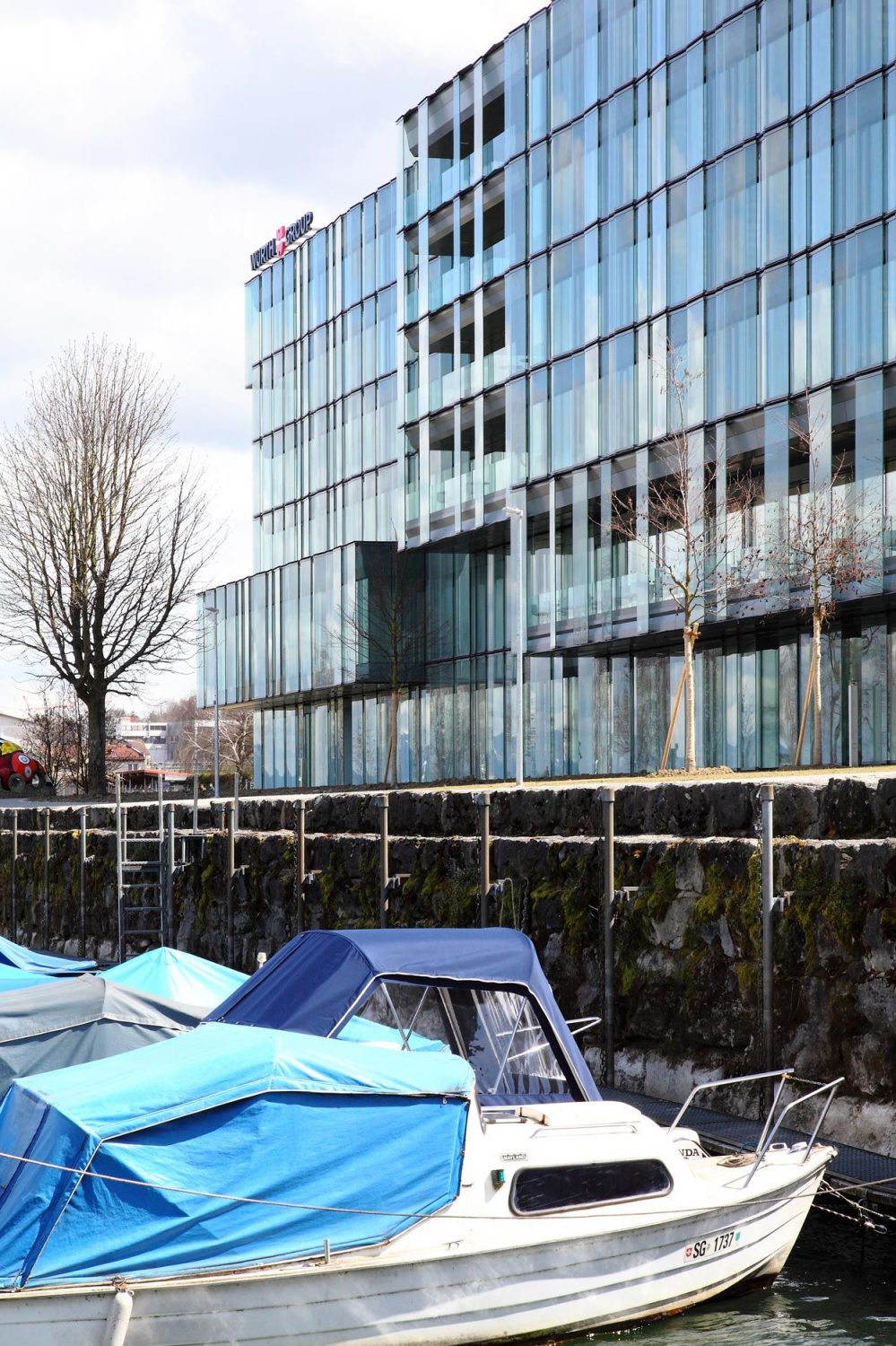
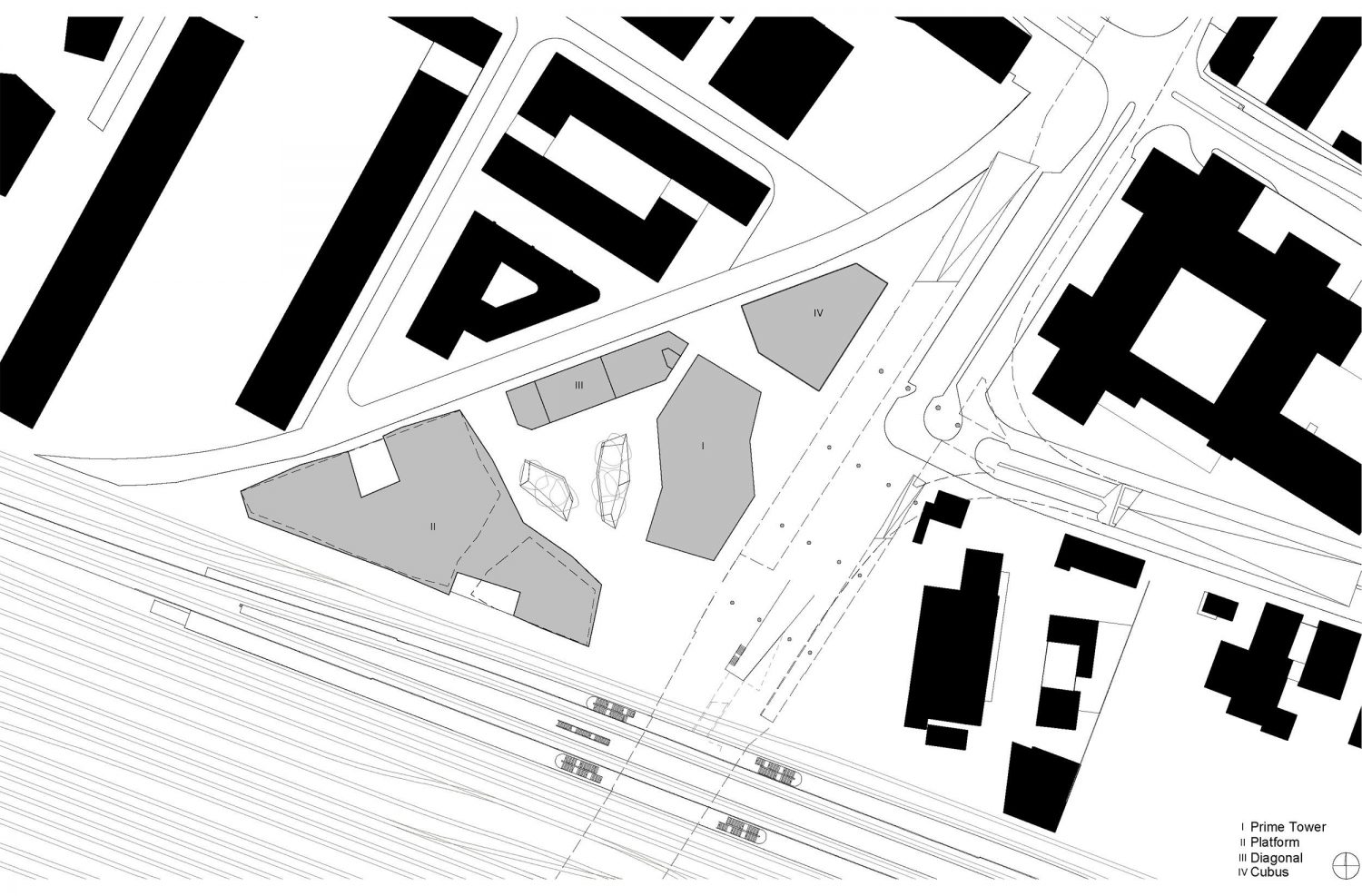
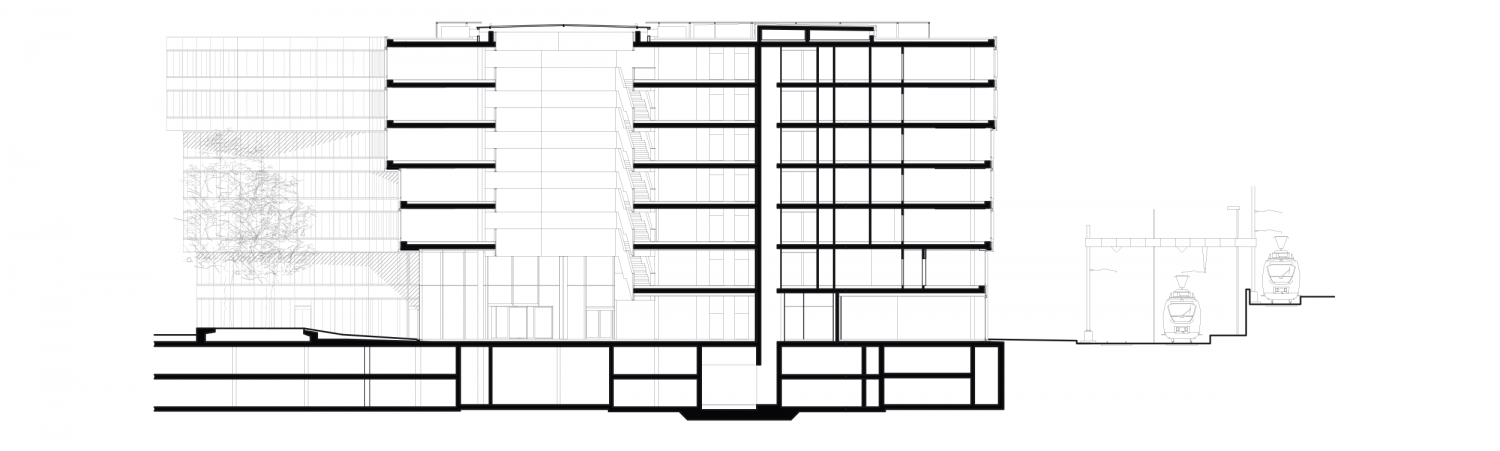
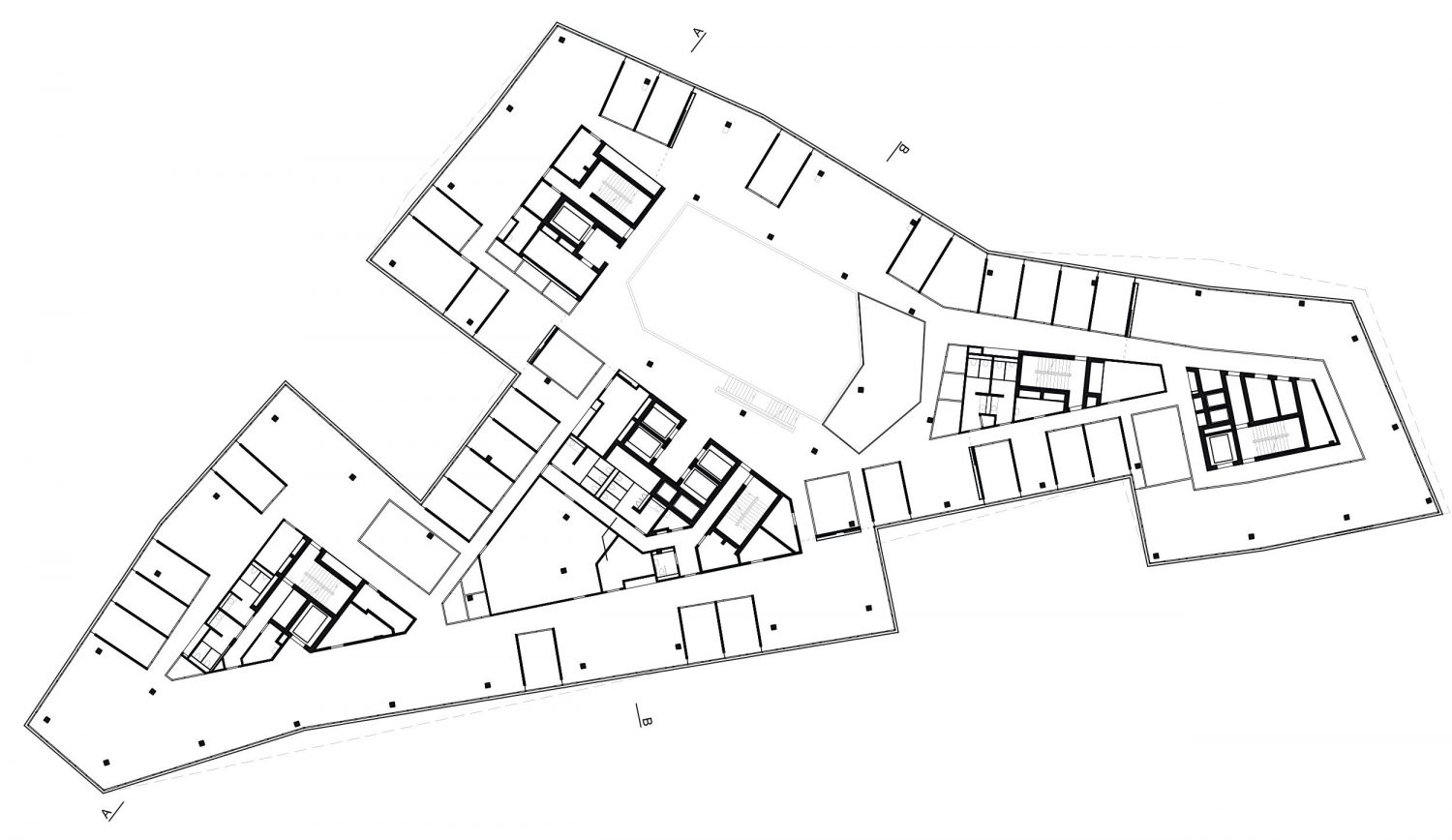
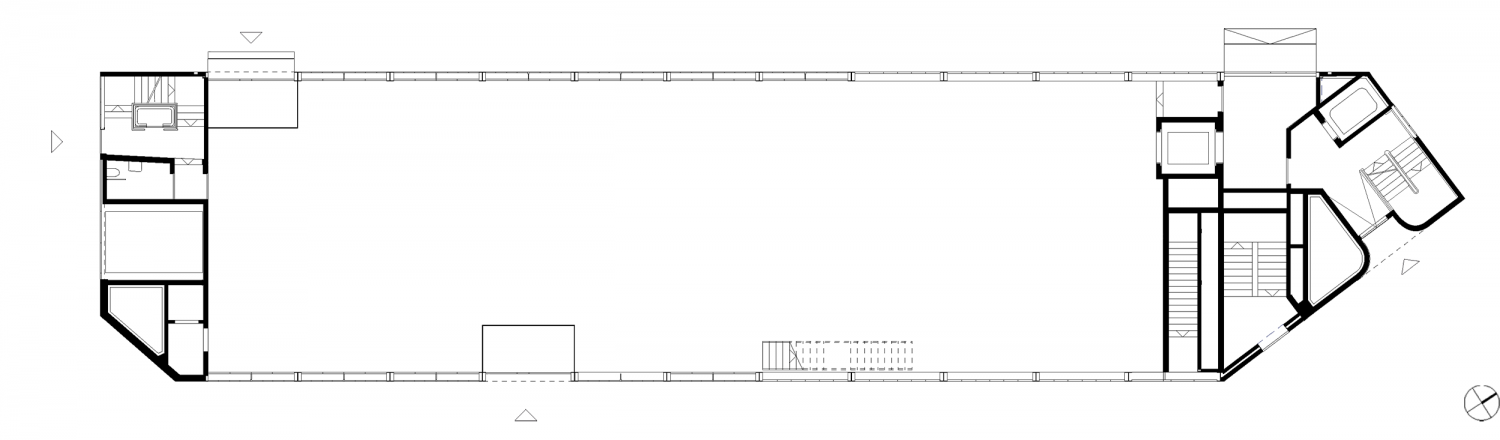
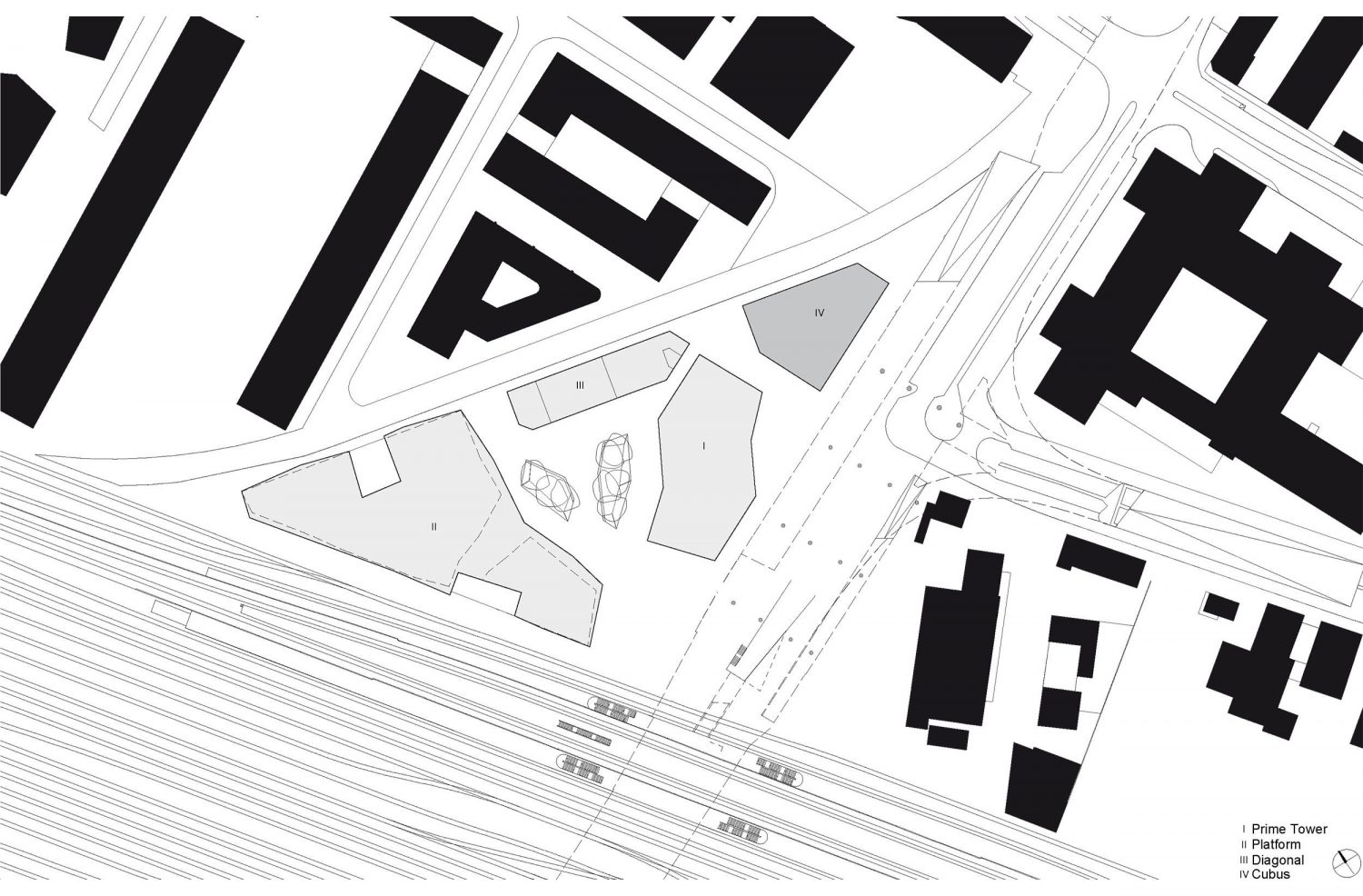
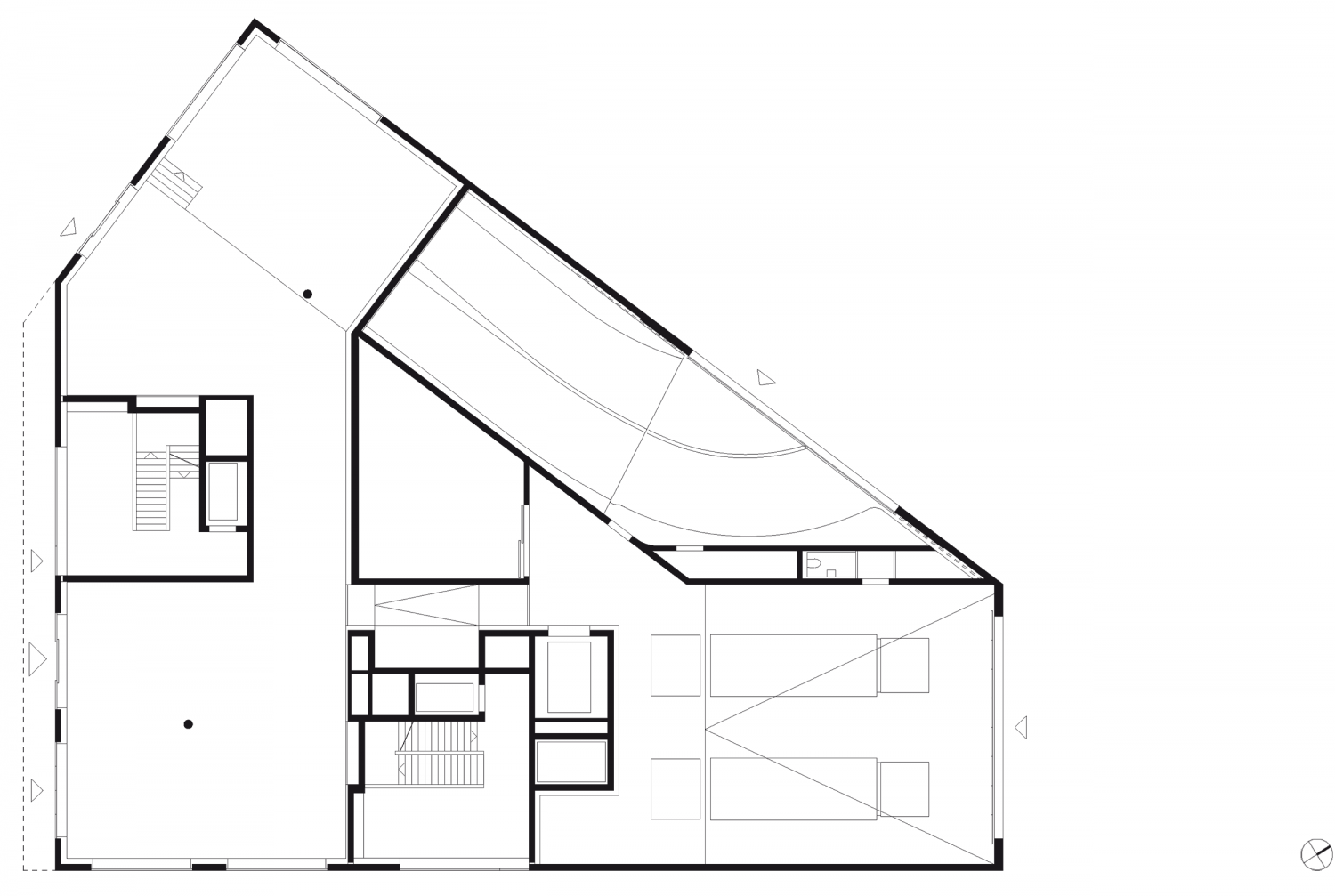
In the immediate vicinity of Hardbrücke railway station, the seven-story office building called Platform completes the ensemble comprising the high-rise Prime Tower and its annexes Cubus and Diagonal. The building’s volume, with various angles, reacts to the urban situation, providing a coherent link between the station and the new central square. A two-story-high passage through the building connects the square with the public pedestrian and bicycle path along the side of the tracks as well as with the new pedestrian underpass to Hardbrücke Station. In addition, the passage acts as a generous covered area outside the entrance foyer.

With its pronounced horizontal and layered design, the building contrasts with the Prime Tower nearby, effectively forming its reclining counterpart. As in the tower, the stories increase their floor area as the building rises, made possible by various projections. the volume of the building is also subdivided by courtyards that cut into the west and south sides and ensure well-lit office spaces within, as well as by the angular projections in the façade.

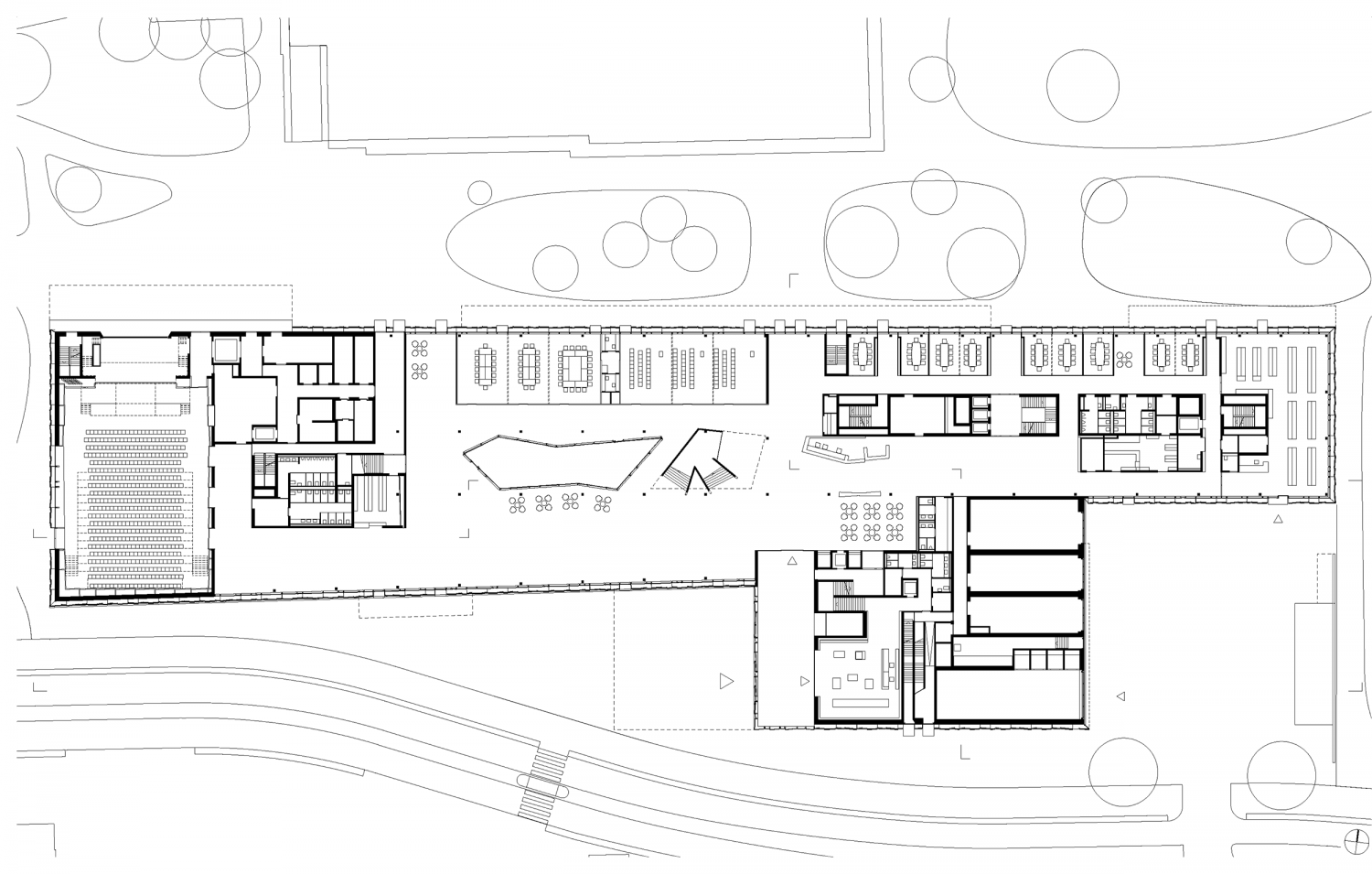
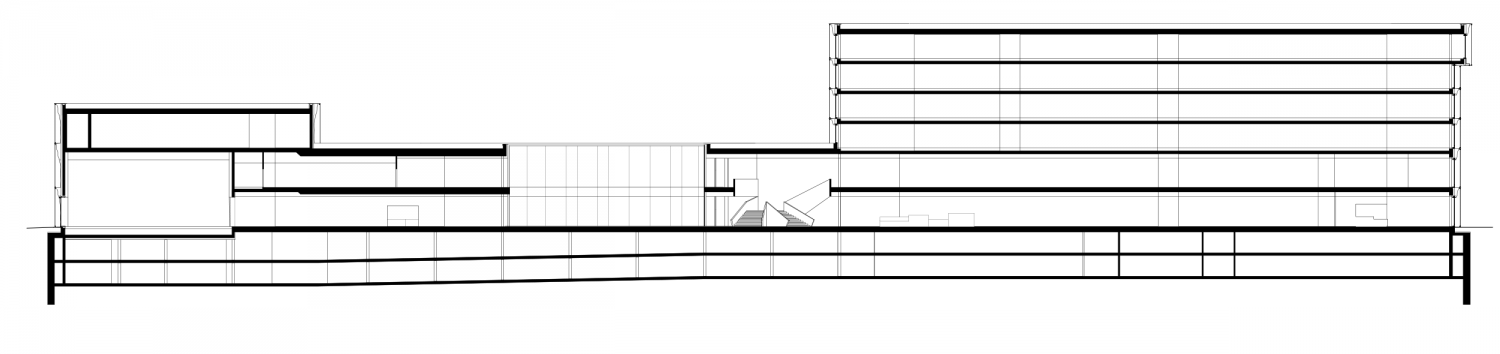
The central, prestigious entrance foyer forms an additional internal open area. A tall atrium flooded with natural light links the entrance level with the office floors above. Its function as a hub that lends the building its identity is additionally underlined by the open staircases and adjoining seating areas on the office floors. Dark glass balustrades mirror the space and the light in multifaceted reflections, creating a kaleidoscope effect.

Next to the entrance foyer on the ground floor are a restaurant, a cafeteria, and an auditorium. A wide, inviting staircase leads from the entrance level to the customer lobby on the first floor, from which the various conference rooms can be accessed. the levels above provide office space for around 1,000 staff. Although the building has been conceived as a corporate headquarters, the positioning of core facility areas permits a variety of office typologies if required in the future, including the division of each floor into a maximum of four separate rental units. Wall and ceiling paintings by Nic Hess, wallpaper and drapes by Lachmayer/Nobis and a textile sculpture by Ernesto Neto complete the interior.

To be able to meet changing spatial needs or different uses without radical structural alterations, the building has been designed as a load-bearing skeleton structure with reinforced cores.

The glazed façade is articulated by horizontally layered bands of parapets and windows. The double windows hold sunblinds in between and help reduce noise from outside. The inner windows can be opened for ventilation purposes toward the interim space of the double-skin façade. The slightly reflective outer glazing shell and parapets accentuate the building’s folded structure.

Location Zurich, Switzerland

Programme Seven storeys office building, 1'000 workplaces, atrium as central entrance hall, restaurants, shops, auditorium

Commission 2007

Planning/Construction 2007–2011

Client Swiss Prime Site AG, Olten

Gross Floor Area 28‘853 m2

Team GG Christian Maggioni (Team Manager), Franziska Bächer (Project Manager from 11/ 2007), Stefan Thommen (Project Manager until 06/ 2007), Christoph Rothenhöfer (Project Manager until 05/ 2007), Markus von Dellingshausen, Philippe Volpe, Karla Pilz, Armin Baumann, Pieter Rabijns

Total Contractor HRS Real Estate AG, Zurich

Landscape Architecture Schweingruber Zulauf Landschaftsarchitekten, Zurich

Structural Engineer Planning: ARGE Dr. Schwartz Consulting AG, Zug and Dr. Lüchinger + Meyer Bauingenieure AG, Zurich and Freihofer & Partner AG, Zurich
Construction: Ribi + Blum AG, Romanshorn

Electrical Engineer Planning: IBG B. Graf Engineering AG, St.Gallen
Construction: Herzog Kull Group Zürich, Schlieren

Building Physics Engineer BAKUS GmbH, Zurich

Heating/Cooling Planning: PB Peter Berchtold, Ingenieurbüro für Energie und Haustechnik, Sarnen
Construction: Lippuner Energie- und Metallbautechnik AG, Grabs

Ventilation Engineer Waldhauser AG, Münchenstein

Lighting Consultant Planning: Ernst Basler + Partner, Zurich
Construction: Regent, Zurich

Plumbing Planning: PB Peter Berchtold, Ingenieurbüro für Energie und Haustechnik, Sarnen
Construction: Huustechnik Rechberger AG, Zurich

Facade Planning: gkp fassadentechnik ag, Aadorf
Construction: Fahrni Fassadensysteme AG, Lyss

Furnishings Gigon / Guyer Architekten, Zurich
workspaces intern: Off Consult, Zurich

Art within Architecture Nic Hess, Zurich
Herbert Lachmayer and Margit Nobis, Vienna, Austria
Ernesto Neto, Brazil

Photos © René Dürr
© Walter Mair
© Shinkenchiku-sha, Tokyo
© Thies Wachter
© USM Möbelbausysteme / Dani Suter

Refurbishment of Former Diagonal Industrial Building, Maag-Areal

The Diagonal building, the former Maag cogwheel factory, has been preserved as a fascinating architectural testament to the site’s industrial past. The load-bearing structure and the façades have been carefully revitalized. the surviving slender glazing bars were restored and are complemented by insulating glazing on the interior. The Diagonal building contains a restaurant on the ground floor and gallery spaces on the upper floors.

Location Zurich, Switzerland

Programme Listed industrial building, with restaurant in the ground floor, art galleries, offices

Competition 2004, 1st Prize

Client Swiss Prime Site AG, Olten
Client’s Representative: Perolini Baumanagement AG, Zurich

Gross Floor Area 2‘759 m2

Team GG Planning/Construction: Stefan Thommen (Team- and Project Manager) Pieter Rabijns (Project Manager), Alex Zeller, Urs Meyer, Raffaella Bisceglia
Competition: Stefan Thommen

Total Contractor ARGE Prime Tower
Losinger Construction AG and Karl Steiner, Zurich

Landscape Architecture Schweingruber Zulauf Landschaftsarchitekten, Zurich

Cost Planning/Scheduling Building Project/General Contractor Submission: b+p baurealisation ag, Zurich

Structural Engineer Competition (C): Dr. Schwartz Consulting AG, Zug
Submission (S): Dr. Schwartz Consulting AG, Zug and Dr. Lüchinger + Meyer AG, Zurich and Freihofer & Partner AG, Zurich
Execution (E): Walt + Galmarini AG, Zurich with Dr. Schwartz Consulting AG, Zug, Dr. Lüchinger + Meyer AG, Zurich, Bänzinger Partner AG, Richterswil, Freihofer & Partner AG, Zurich

Electrical Engineer S: IBG Graf AG, St.Gallen
E: Hefti Hess Martingnoni, Zurich

Fire Safety S: Makiol + Wiederkehr, Beinwil am See
E: Gruner AG, Basel with Makiol + Wiederkehr, Beinwil am See

Heating/Cooling S/E: PB P. Berchtold, Sarnen

Ventilation Engineer C/S: Waldhauser AG, Münchenstein
A: Hans Abicht AG, Zurich

Plumbing S: PB P. Berchtold, Sarnen
E: GRP Ingenieure, Rotkreuz

Sprinkler Consultant S: PB P. Berchtold, Sarnen
E: GRP Ingenieure, Rotkreuz

Photos © Valentin Jeck
© Walter Mair
© Thies Wachter

Awards Auszeichnung für gute Bauten der Stadt Zürich 2011–2015

Cubus Office Building, Maag-Areal

The Cubus annex building, a seven-story structure with a pentagonal ground plan, houses offices on the upper floors and at ground level retail outlets, access to the parking garage, and deliveries for the entire complex. Of note here is that, due to the excellent public transport connections to this site, relatively few parking spaces are required. The load-bearing structure is executed in white-pigmented exposed concrete. Externally fixed glazing panels give the façade its character and help to reduce noise from the elevated road nearby.

Location Zürich, Switzerland

Programme Office building with 7 floors, ground floor with delivery and parking access for the Prime Tower and its annex buildings, retail, offices, upper floors concerning the load capacity are constructed for archive use

Competition 2004, 1st Prize

Client Swiss Prime Site AG, Olten
Client’s Representative: Perolini Baumanagement AG, Zurich

Gross Floor Area 6‘206 m2

Team GG Stefan Thommen (Team and Project Manager), Pieter Rabijns (Project Manager), Alex Zeller, Urs Meyer, Raffaella Bisceglia
Competition: Stefan Thommen

Total Contractor ARGE Prime Tower
Losinger Construction AG and Karl Steiner, Zurich

Landscape Architecture Schweingruber Zulauf Landschaftsarchitekten, Zurich

Cost Planning/Scheduling Building Project/General Contractor Submission: b+p baurealisation ag, Zurich

Structural Engineer Competition (C): Dr. Schwartz Consulting AG, Zug
Submission (S): Dr. Schwartz Consulting AG, Zug and Dr. Lüchinger + Meyer AG, Zurich and Freihofer & Partner AG, Zurich
Execution (E): Walt + Galmarini AG, Zurich with Dr. Schwartz Consulting AG, Zug, Dr. Lüchinger + Meyer AG, Zurich, Bänzinger Partner AG, Richterswil, Freihofer & Partner AG, Zurich

Electrical Engineer S: IBG Graf AG, St.Gallen
E: Hefti Hess Martingnoni, Zurich

Heating/Cooling S/E: PB P. Berchtold, Sarnen

Ventilation Engineer C/S: Waldhauser AG, Münchenstein
E: Hans Abicht AG, Zurich

Plumbing S: PB P. Berchtold, Sarnen
E: GRP Ingenieure, Rotkreuz

Sprinkler Consultant S: PB P. Berchtold, Sarnen
E: GRP Ingenieure, Rotkreuz

Facade C/S: gkp fassadentechnik ag, Aadorf
E: Reba Fassadentechnik AG, Chur

Photos © Walter Mair
© Thies Wachter

Prime Tower Office High-rise
with Annex Buildings Cubus and Diagonal, Maag-Areal

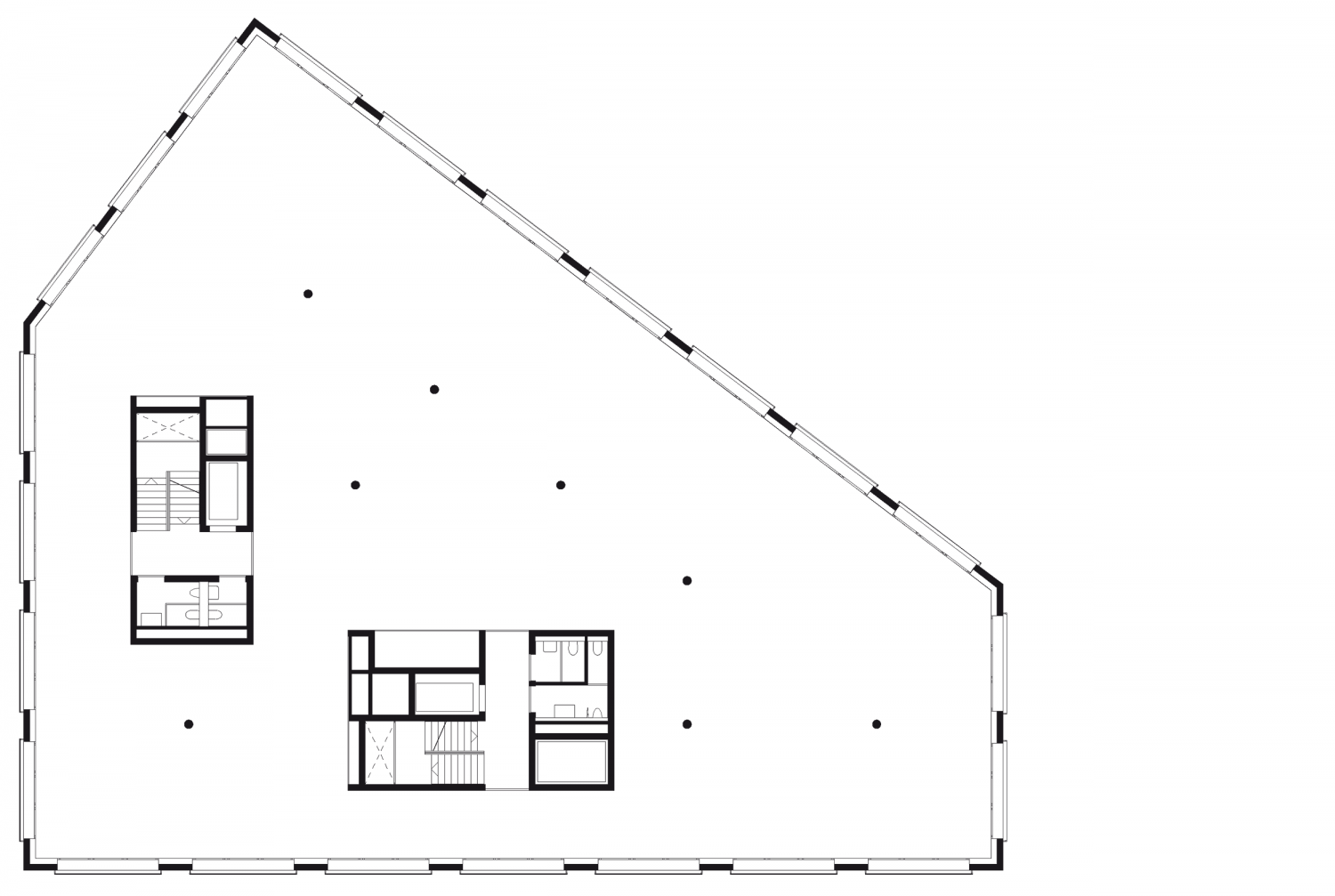
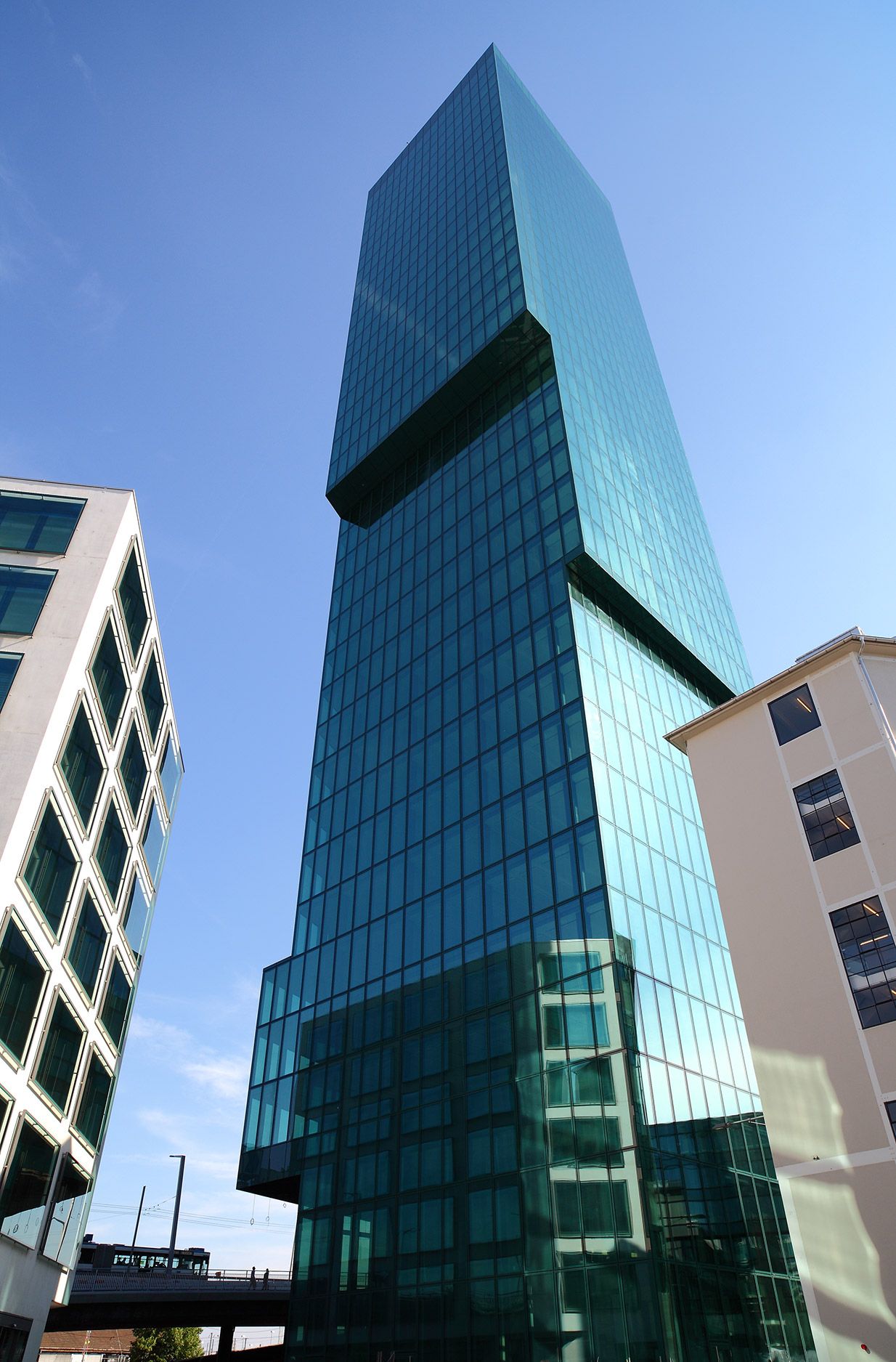
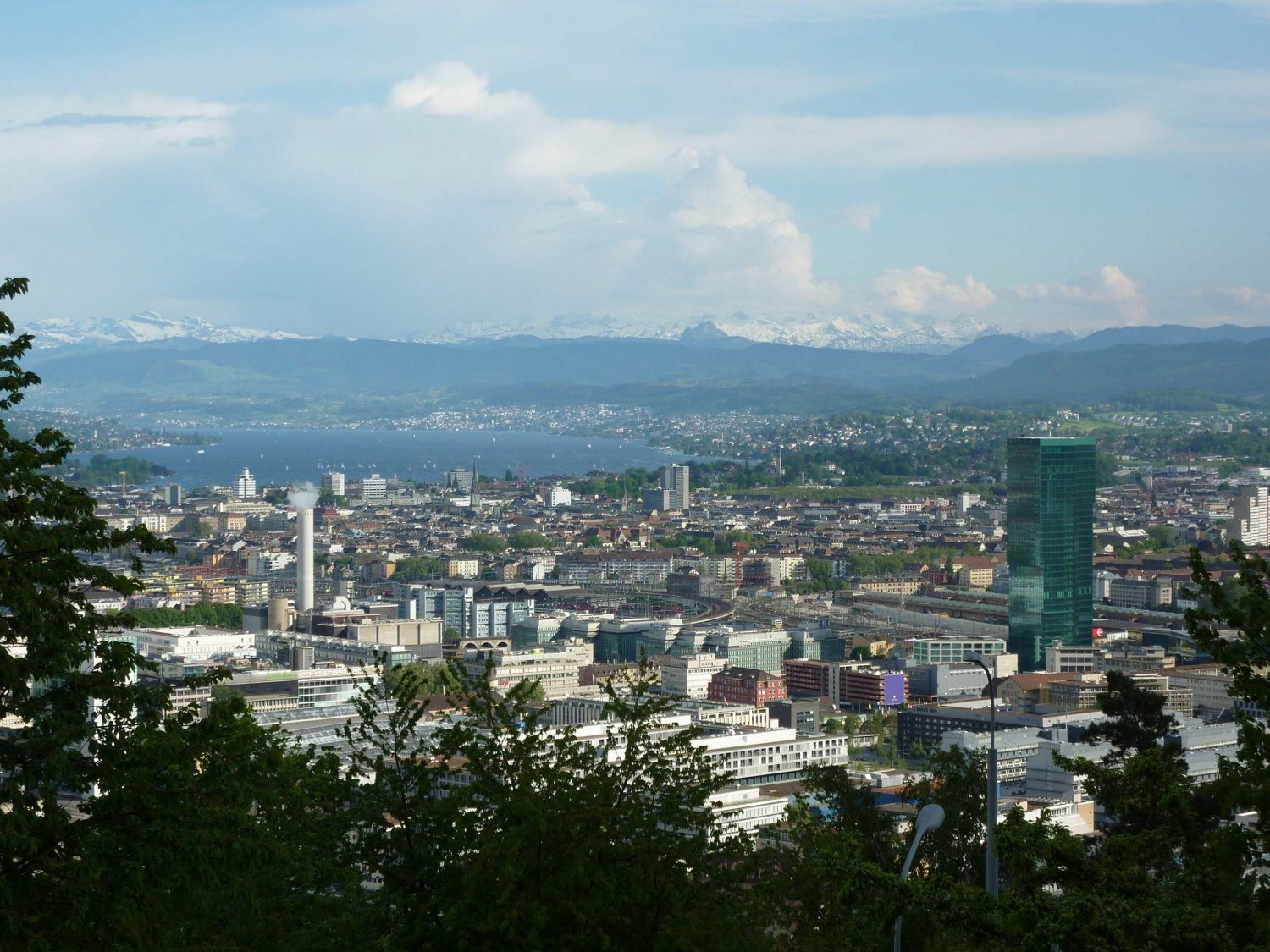
The location of the Prime Tower and its two annexes, the Cubus and Diagonal buildings, is part of a formerly almost inaccessible industrial site that is gradually being converted into a business and residential district with associated services. Situated in the immediate vicinity of Hardbrücke railway station and 126 meters in height, the high-rise is the tallest in Switzerland for the time being. It is not only a distinctive feature of the neighborhood, but also a landmark for the up-andcoming district of Zurich West.

The concept underpinning the Prime Tower is of a building that might be said to assume many guises, although its fundamental structure and the means deployed are relatively straightforward. The design aimed to find a floor plan arrangement that would maximize the number of well-lit workplaces, while also seeking to create a striking architectural form evoking differing impressions depending on the position from which it is viewed. The outcome of these efforts is a building on an irregular octagonal ground plan that confounds conventional expectations by broadening toward the top.

In terms of urban planning, the building’s significance is twofold in relation to its impact when seen from nearby or from a distance. From afar, it appears as an abstract, elegant volume formed from greenish glass that changes depending on whether it is seen from the side (from the north or south) or head-on (from the east or west). The planes of the façade, oriented in various directions, reflect the light and the surroundings in different ways, articulating and subdividing the volume into what might be called gigantic “pixel surfaces”. The impression the building makes when seen close-up also changes with the spectator’s standpoint. These close-up views reveal that the projecting portions of the tower exert an integrating effect on the surrounding buildings.

At Geroldstrasse, an inviting outdoor area between the high-rise and the new neighboring Cubus office building leads to the entrance of the Prime Tower and toward the planned Lichtstrasse. In the southwest, a plaza is created in conjunction with the existing listed Diagonal building and the new Platform office building beside the railway.

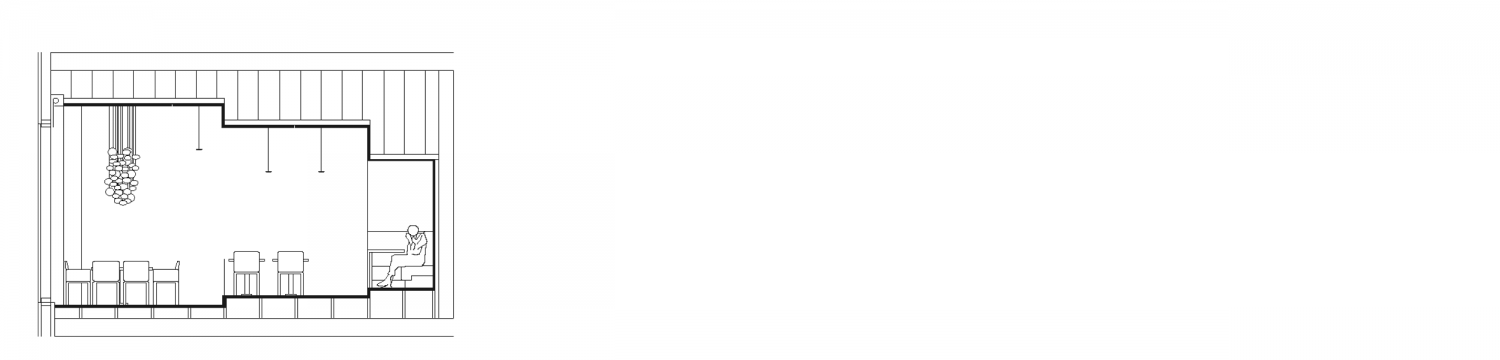
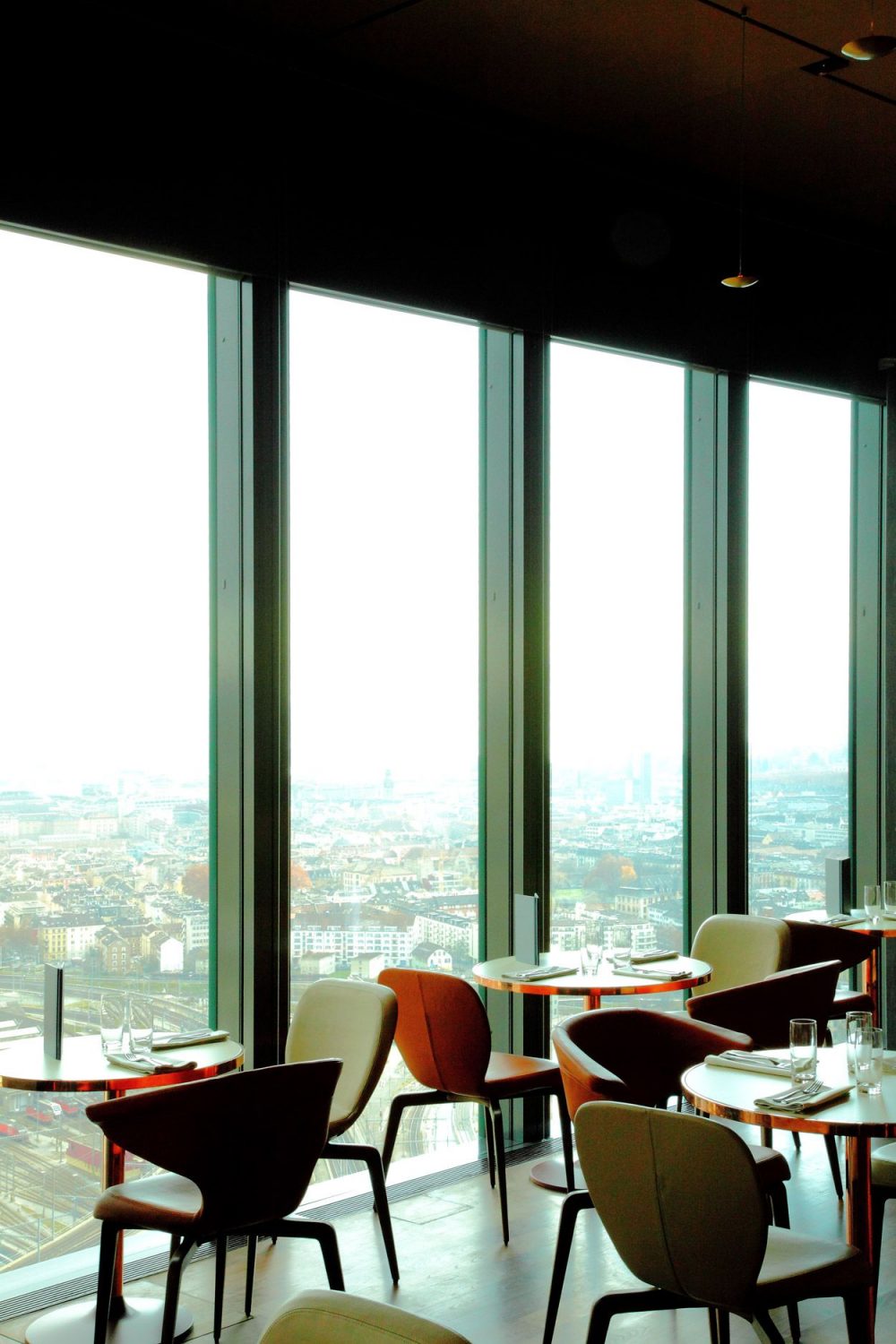
The ground floor of the Prime Tower houses retail spaces and a coffee bar for use by both office employees and passers-by. Special features on the top floor include a public restaurant, bistro with a bar, and a lounge, while a private conference area is available on the floor below.

The cores and emergency stairs are arranged so that up to four tenants can occupy offices on the same floor or, conversely, one business can occupy several floors with internal atriums and staircases. The projecting portions of the building create additional office space on the higher and therefore more soughtafter floors, as well as providing greater variety when using the space for different types of offices.

The load-bearing skeleton structure of the tower is made of concrete with reinforcing cores. The variously sized cantilevered projections are supported by slanting the supporting columns over two or three stories. The façade is constructed from insulated triple glazing with a greenish tint. To enhance workspace conditions, and to meet fire regulations, which require smoke ventilation, alternating windows can be opened parallel to the building. The prefabricated windows are frameless on the exterior. They grant the polygonal building the multifaceted appearance of a greenish crystal.

Location Zurich, Switzerland

Programme High-rise office building, 36 floors, 126 m hight, entrance hall, bank branch, varying office types, gastronomy, restaurant and conference area on the top floors

Competition 2004, 1st Prize

Planning/Construction 2004–2011

Client Swiss Prime Site AG, Olten
Client’s Representative: Perolini Baumanagement AG, Zurich

Label LEED Gold
Minergie Standard
GreenProperty

Gross Floor Area Total Prime Tower with Annex buildings: 73‘830 m2
Prime Tower: 53‘461 m2

Team GG Planning/Construction: Annette Gigon, Mike Guyer, Stefan Thommen (Team Manager), Christian Maggioni (Deputy Team Manager), Christoph Rothenhöfer (Project Manager until 2007), Pieter Rabijns (Project Manager from 2007), Alex Zeller, Urs Meyer, Franziska Bächer, Raffaella Bisceglia, Armin Baumann, Karin Winklmann, Roberto Outumuro, Rafael Schmid, Martin Bischofberger, Leander Morf
Competition: Annette Gigon, Mike Guyer, Stefan Thommen

Total Contractor ARGE Prime Tower
Losinger Construction AG and Karl Steiner, Zurich

Landscape Architecture Schweingruber Zulauf Landschaftsarchitekten, Zurich

Cost Planning/Scheduling Building Project/General Contractor Submission: b+p baurealisation ag, Zurich

Structural Engineer Competition (C): Dr. Schwartz Consulting AG, Zug
Submission (S): Dr. Schwartz Consulting AG, Zug and Dr. Lüchinger + Meyer AG, Zurich and Freihofer & Partner AG, Zurich
Execution (E): Walt + Galmarini AG, Zurich with Dr. Schwartz Consulting AG, Zug, Dr. Lüchinger + Meyer AG, Zurich, Bänzinger Partner AG, Richterswil, Freihofer & Partner AG, Zurich

Electrical Engineer S: IBG Graf AG, St.Gallen
A: Hefti Hess Martingnoni, Zürich

Heating/Cooling S/E: PB P. Berchtold, Sarnen

Ventilation Engineer C/S: Waldhauser AG, Münchenstein
E: Hans Abicht AG, Zurich

Plumbing S: PB P. Berchtold, Sarnen
E: GRP Ingenieure, Rotkreuz

Sprinkler Consultant S: PB P. Berchtold, Sarnen
E: GRP Ingenieure, Rotkreuz

Facade C/S: gkp fassadentechnik ag, Aadorf
E: Reba Fassadentechnik AG, Chur

Furnishings Gigon / Guyer Architects with C/S: Studio Hannes Wettstein, Zurich

Signage Integral Ruedi Baur Zürich GmbH

Art within Architecture Adrian Schiess, Zurich and Mouans-Sartoux, France
Harald F. Müller, Öhningen, Germany

Photos © Walter Mair
© Thies Wachter
Maagplatz: © Roman Keller

Awards Auszeichnung für gute Bauten der Stadt Zürich 2011–2015

Rosau Office Building

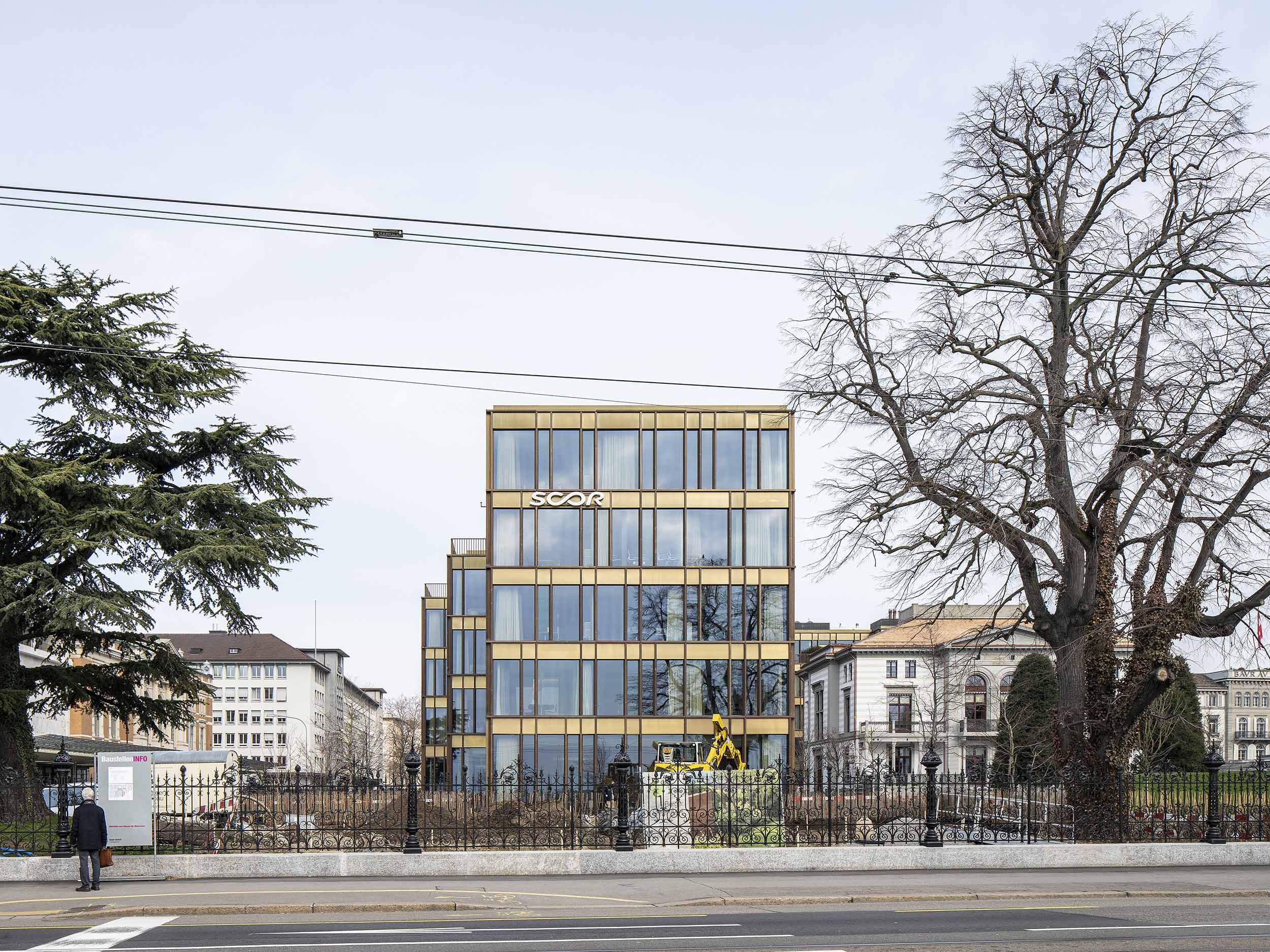
The new L-shaped office building opposite the Tonhalle on the corner of Gotthardstrasse and Claridenstrasse is integrated into the perimeter block structure along Claridenstrasse and tapers in width towards the lake. Villa Rosau and its surrounding gardens remain true to their historical conception. The green area forms a twin garden with the park of the Hotel Baur au Lac on the opposite side of the Schanzengraben canal. The newbuild marks the westerly end of the two gardens, whose beautiful trees border the public square Bürkliplatz.

The parks of Villa Rosau and Hotel Baur au Lac on Lake Zurich bear important witness to the history of the city’s expansion. The gardens flow around the villa and the new building so that the perimeter block development and the freestanding villa in the park form a coherent ensemble. The convergence of architectural and organic garden design also reinforces the organization of the green space into different zones.

New Rosau Office Building

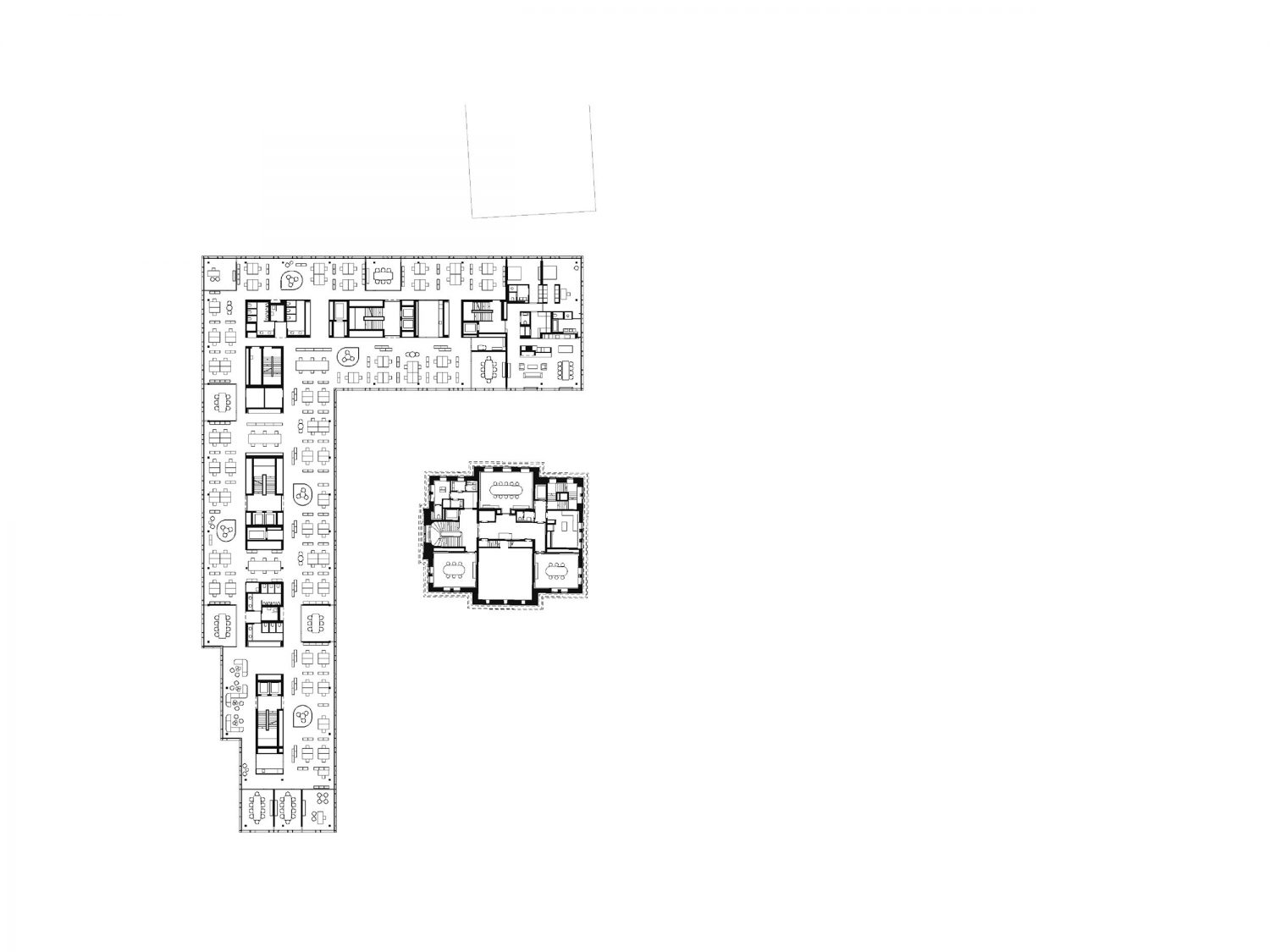
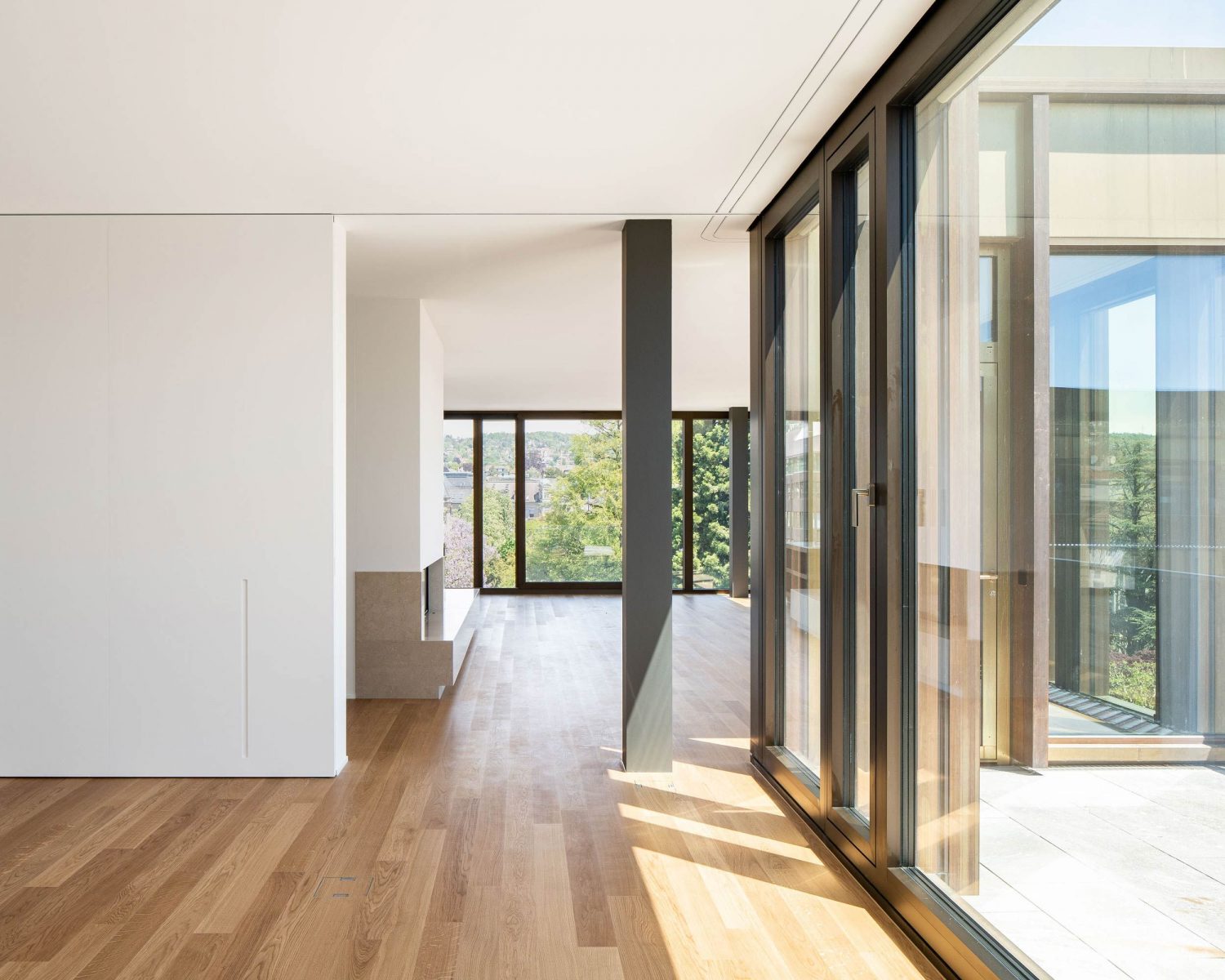
The new five-storey building provides a prestigious location for an international reinsurance company. Main access is from Claridenstrasse, with a spacious entrance hall and staff restaurant, as well as conference rooms on the ground floor. The four floors above house open plan offices, which are connected by three major staircases. The top floor is set back, creating ample terraces on both sides. At the southern end, the boardroom offers vistas across the lake.

The vehicle access divides the ground floor into two separate areas and grants a view from the street to the garden. A public bar and grill are situated at the street corner. The underground parking is accessed from Gotthardstrasse, as are further offices that can be sublet on the upper floors. The upper floors of the wing facing Schanzengraben accommodate two apartments.

The structure is a skeleton frame with recessed columns, braced by centrally located concrete circulation cores. Vertical and horizontal profiles of architectural bronze arranged in varying rhythms articulate the façade. They take up, on a larger scale and with greater geometric regularity, the existing ornamental wrought-iron fences surrounding the gardens.

Location Zurich, Switzerland

Programme Office building with 470 workingplaces, staff restaurant, meeting rooms, gastronomie, two apartments, underground parking

Commission 2008

Planning/Construction 2008–2020

Client Client basic fitout: Villa Rosau AG, Zurich
Client’s representative: Conarenco AG, Zurich
Client tenant fitout: SCOR Services Switzerland AG, Zurich

Label Minergie Standard

Gross Floor Area 17‘810 m2

Team GG Planning/Construction Office Building 2010–2020:
Mike Guyer, Christian Maggioni (Team Manager from 11/2012), Mathias Rösner (Project Manager from 2011), Michael Winklmann (Team Manager until 10/2012), Martin Bischofberger (Project Manager until 2010), Marco Cristuzzi, Franzis Gericks, Lilla Kis, Lisa Menje, Roman Vetterli, Rodrigo Jorge, Christoph Lay, Milica Brockmann, Christoph Dober, Brigitte Rüdel, Griet Aesaert
Planning Residential/Office Buiding 2008–2009:
Michael Winklmann (Team Manager), Christoph Justies (Project Manager), Mark Zjörjen, Christoph Dober, Cornelia Schmidt, Karin Schultze

Site Management b+p baurealisation ag, Zurich

Landscape Architecture Vogt Landschaftsarchitekten, Zurich

Structural Engineer Locher Bauingenieure AG, Zurich

Electrical Engineer IGB B. Graf AG, St.Gallen

Building Services Engineer Gruenberg + Partner AG, Zurich

Building Physics Engineer Kopitsis Bauphysik AG, Wohlen

Fire Safety Makiol+Wiederkehr, Beinwil am See

Facade gkp fassadentechnik ag, Aadorf

Interior Design Tenant fit-out Scor and Apartments: Gigon/Guyer Architekten, Zurich
Scor Furnishing: Ina Rinderknecht Interior Architecture AG, Erlenbach
Grill/Bar: Gigon/Guyer Architekten with Atelier Zürich

Signage Trix Wetter, Zurich (Gate, Villa Rosau)

Photos © Roman Keller

Address Glärnischstrasse / Claridenstrasse, CH – 8002 Zurich

Hotel and Office Building – Greencity

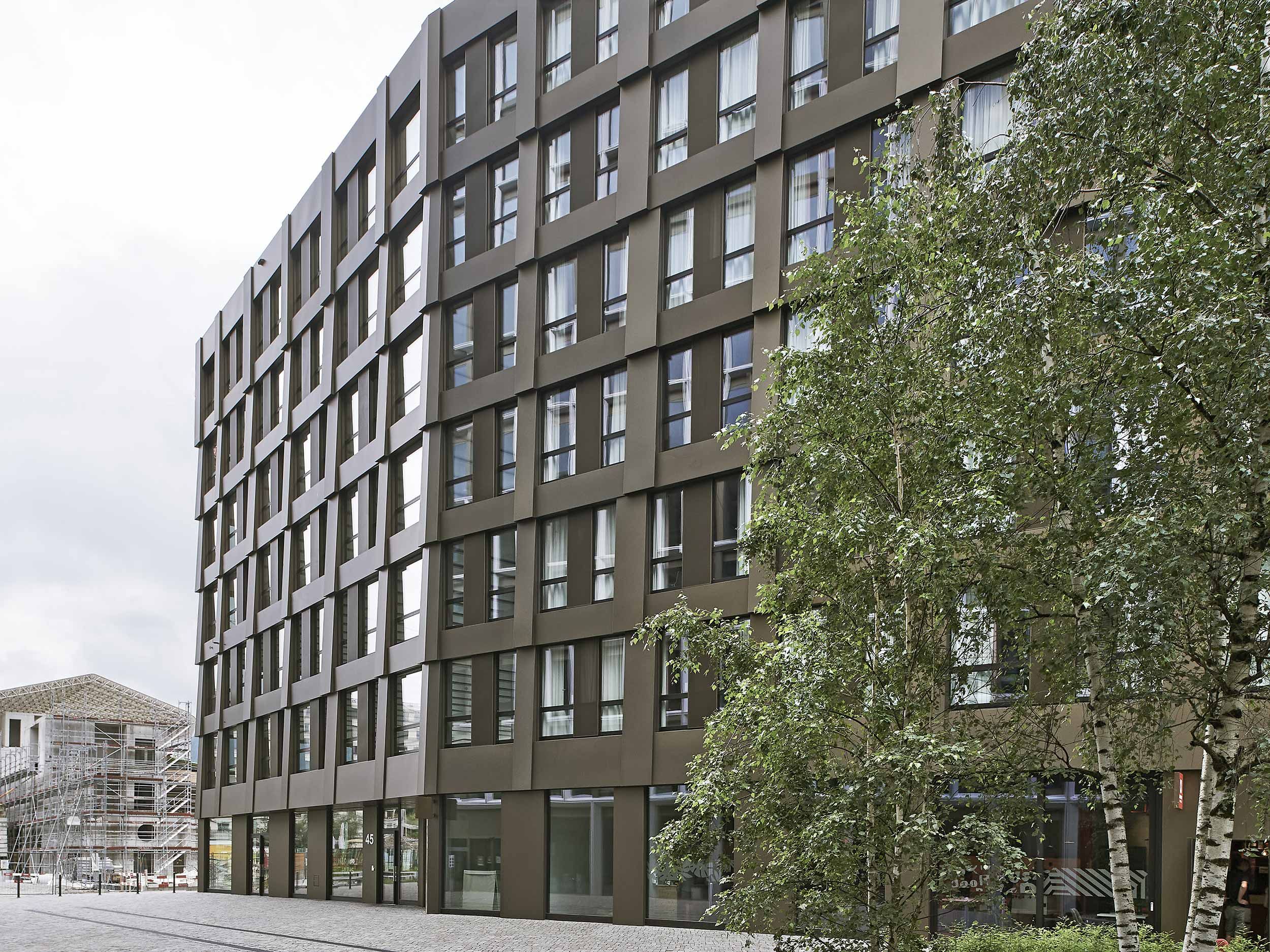
The mixed-use district Greencity, based on the principles of the 2000-watt society*, is under development on the former industrial site Sihlpapier Manegg in southern Zürich. Situated between the railroad tracks and the motorway, the seven-storey hotel and office building together with its eleven-storey neighbours forms the head of the new district facing the city centre. This ensemble frames a public courtyard, adjoining the elongated Maneggplatz. The oblong, lower building faces the tracks and street to the west as well as the courtyard. The latter is widened to piazza-like proportions by a tapering of the volume towards the north. Three covered recesses lead to the entrance halls of the different occupants. On the façades, overlapping horizontal and vertical elements of brown anodized sheet aluminium alternate with wood/metal windows and slender ventilation flaps. Depending on the point of view, openings and cladding, structure and envelope interpenetrate.

The international design competition for the site was based on a preliminary plan that stipulated tall building volumes next to the motorway for offices and services. Gigon / Guyer’s urban design was awarded first prize and further development was split between two architecture firms.

The present project was initially planned exclusively as office space, and in a second phase, exclusively for hotel use. The uses are now combined: one-third office space, two-thirds hotel. The office space occupies the southern part of the upper floors and includes a lobby, staircase and lift core. The ground floor here houses a day-care centre with a separate entrance. The hotel reception welcomes guests on the street side, whereas the breakfast room and bar face the courtyard.

A load-bearing skeleton of concrete columns, floor slabs and cores allows for various uses. The façade reflects the flexible partition grid of the floors as well as the construction, but at the same time this is overridden by the subtle offsets of the cladding, window frames and ventilation flaps between storeys. The tilting of the metal profiles contributes to multiple readings of the façade – creating impressions that are suitable both for the offices and the hotel.

In accordance with the core-and-shell model, hotel and office tenants fit out their own spaces. However, lobbies, staircases and lift cores, connecting outside and inside, lower and upper floors, are coherent in appearance: polished concrete flooring echoes the load-bearing structure, while dark brown metal surfaces refer to the building envelope.

* Up to 2000 people will live in Greencity, 3000 will work or study there. Among the goals are a commitment to mostly renewable energy sources, eco-friendly mobility thanks to the central suburban railway station, numerous bicycle parking spaces and open, car-free spaces in the district.

The ambitious energy specifications are met by the building through the use of geothermal heating, insulation layers of 20–24 cm, as well as photovoltaic panels on the roof. In the office spaces, heating and cooling ceiling elements, which also include ventilation inlets, provide efficient distribution. Exhaust air is centrally extracted at the cores. The hotel rooms are heated and cooled with pipes embedded in the ceiling rendering; the air ducts are installed above the prefabricated bathrooms. These and other measures ensure that the building can be LEED Platinum certified.

Location Zurich, Switzerland

Programme 7-storey hotel and office building, day-care centre, hotel with 174 rooms, 594 beds (Core and Shell: Gigon/Guyer, Interior fit-out: tenants), underground parking

Competition 2012, 1st Prize

Planning/Construction 2016–2021

Client Client: Losinger Marazzi AG, Zurich
Owner: Credit Suisse Anlagestiftung, Zurich

Label 2000-Watt-Areal, LEED Platinum Core & Shell Certification

Gross Floor Area 16‘505 m2

Team GG Planning/Construction: Annette Gigon, Christian Maggioni (Team Manager 01/2015–), Barbara Schlauri (Team Manager –12/2014), Damien Andenmatten (Project Manager), Chiara Giovanola
Competition: Annette Gigon, Michael Winklmann (Team Manager 08/2012), Stefan Thommen (Team Manager –07/2012), Karla Pilz, Thomas Möckel, Lena Ehringhaus, Natalie Koerner

Site Management Losinger Marazzi AG, Zurich

Total Contractor Losinger Marazzi AG, Zurich

Landscape Architecture Vogt Landschaftsarchitekten, Zurich

Structural Engineer Wismer + Partner AG, Rotkreuz

Electrical Engineer IBG B. Graf AG Engineering, Baar

Building Services Engineer Balzer Ingenieure AG, Winterthur

Building Physics Engineer Gartenmann Engineering AG, Zurich

Fire Safety Gruner AG, Zurich

Photos © Seraina Wirz

FILM